
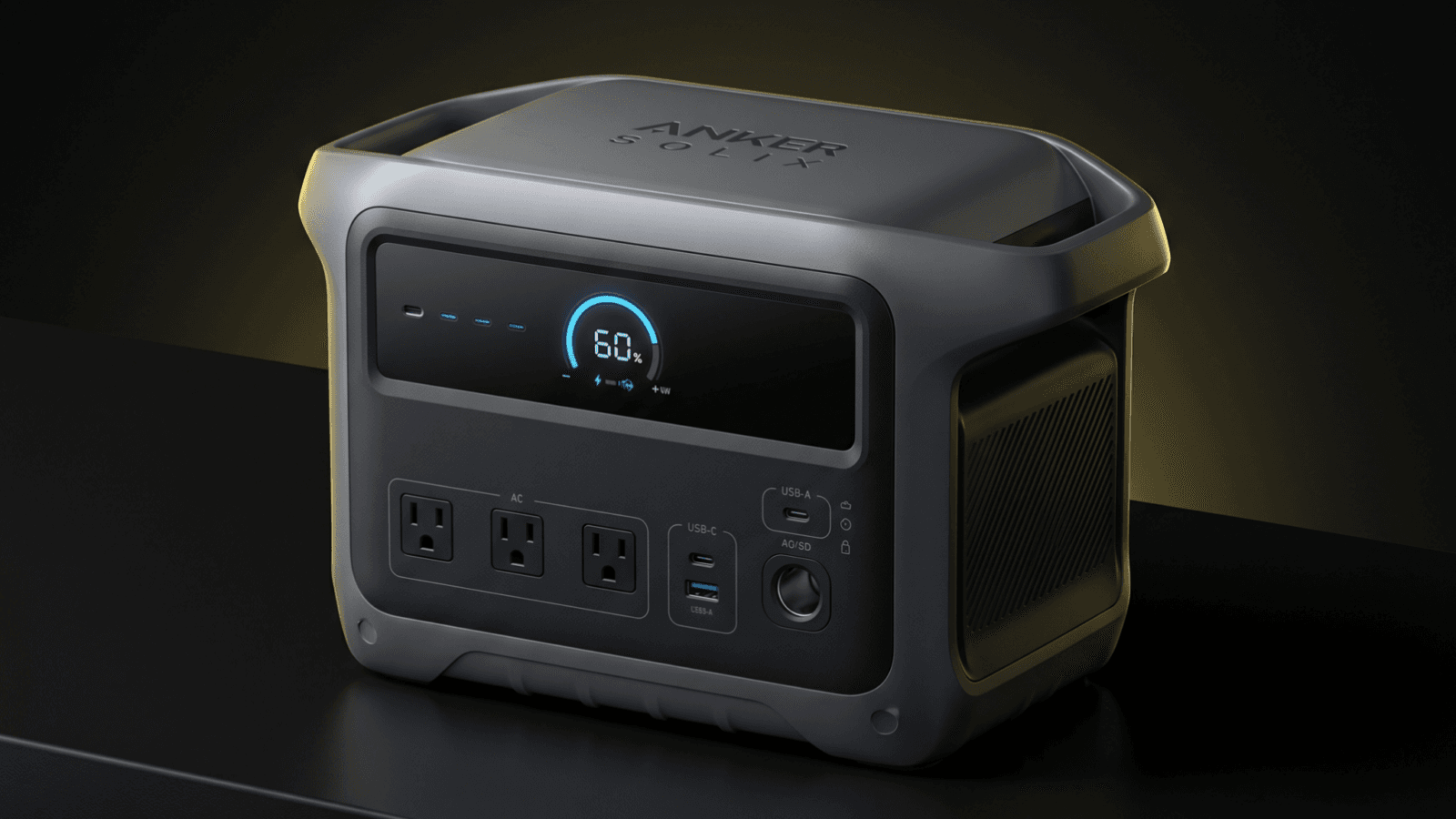
Product Intelligence
Fast Recharge PickAnker SOLIX C1000 Gen 2: Fast 1kWh Backup
Compact 1,024Wh portable power station with 2,000W output, 3,000W peak, 49-minute fast AC recharge, 600W solar input, and 10 ms UPS support for home backup, camping, and RV use.
Specifications
Key specs
Buyer Fit
Fit signals
Best for
Pros
- Fast app-enabled recharge.
- 2,000W continuous output.
- 600W solar ceiling.
- 10 ms UPS feature; 24.9 lb portability.
Cons
- No battery expansion; 1,024Wh limits sustained high-draw runtime; three AC outlets; sensitive and motor loads require verification.
Spec table
| Capacity | 1024 Wh |
|---|---|
| AC Output | 2000 W |
| Surge Output | 3000 W |
| Solar Input | 600 W |
| Weight | 24.9 lb |
| Battery | LiFePO4 |
| Warranty | 5 years |
| Expandability | No - not expandable |
| UPS / EPS | Yes - 10 ms UPS |
| Recharge Time | Up to 49 minutes with app-enabled 1,600W UltraFast Charging at suitable battery-cell temperature; up to 600W solar, with 1.8 hours claimed under stated conditions. |
This article may contain affiliate links. If you buy through these links, PowerLabPro may earn a commission at no extra cost to you. As an Amazon Associate I earn from qualifying purchases.
Anker SOLIX C1000 Gen 2 bottom line: this is a compact 1,024Wh portable power station for buyers who value rapid recharge, 2,000W AC output, 600W solar input, and short essential-load backup. It is a sensible fit for an apartment outage kit, remote-work backup, travel, camping, and selected home devices, but it is not a long-runtime home battery or an expandable platform.
The Anker SOLIX C1000 Gen 2 is strongest when the load plan is specific. A router, laptop, phones, LED lighting, a small fan, and some carefully managed appliance use require a different battery than a refrigerator-heavy, pump-heavy, or multi-day outage plan. Its 2,000W output offers more inverter headroom than many compact stations, while its 1,024Wh stored-energy limit still controls how long higher-draw loads can run.
This Product page is a structured reference, not a hands-on test report. The connected Review covers deeper buyer trade-offs. Confirm the current bundle, manual, app setting, panel configuration, and exact device requirements before purchase, especially when a device has a high startup load or must remain powered without interruption.
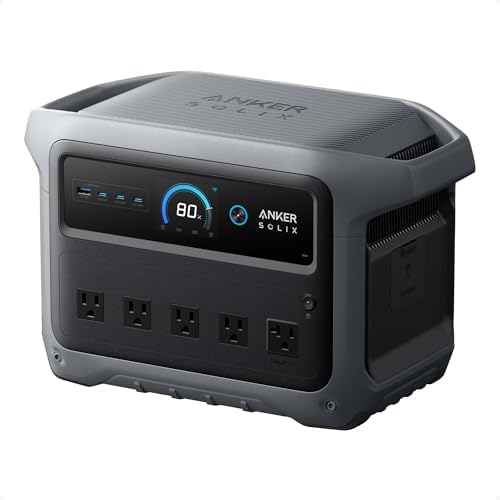
- 49 Min UltraFast Recharging: With upgraded HyperFlash tech, fully recharge at 1,600W—for outage prepping, camping trips,…
- 2,000W Output via 10 Ports: Delivers 2,000W (3,000W peak) and 1,024Wh capacity. Power up to 10 devices—ideal for emergen…
- Compact and Portable: Easily carry, store, and move from room to room, your RV, or even on beach and park outings. C1000…
Table of Contents
Anker SOLIX C1000 Gen 2: Quick Product Reference
The Anker SOLIX C1000 Gen 2 occupies the upper end of the compact 1kWh category. Anker lists 1,024Wh of LiFePO4 capacity, 2,000W of continuous output, 3,000W peak output, up to 600W solar input, and a 10 ms UPS feature. That combination is useful for buyers who need a portable station with meaningful output and fast recovery, without moving to a heavier 2kWh or 3kWh product.
The practical trade-off is clear. The same design choices that keep this unit at 24.9 lb also mean it has no add-on battery-expansion path. A buyer who prioritizes easier handling and fast recharge may see that as a benefit. A buyer who expects their runtime needs to grow should compare an expandable system before purchase.
- Best for: apartment outages, home-office continuity, CPAP planning after device verification, camping, car travel, and short essential-load backup.
- Not ideal for: long refrigerator runtime, sump-pump planning, sustained heating or cooling, multi-day home backup, or buyers who need extra battery modules later.
- Main strength: strong 2,000W output and app-enabled 49-minute UltraFast charging in a 24.9 lb form factor.
- Main limitation: 1,024Wh is still a compact battery reserve, and Anker states that this Gen 2 model is not expandable.
Anker SOLIX C1000 Gen 2 Specifications and Buyer Meaning
| Specification | Current source-backed information | Buyer meaning |
|---|---|---|
| Model identity | A1763 | Use this model identity with the Amazon ASIN and manual when checking listings or support documents. |
| Battery capacity | 1,024Wh | Stored energy for a defined load plan, not a fixed runtime promise. |
| Battery chemistry | LiFePO4 | Anker states 4,000 cycles with at least 80% remaining capacity. |
| Continuous AC output | 2,000W | Sets the total steady load that can run at one time. |
| Peak output | 3,000W | A temporary margin, not extra continuous wattage or additional stored energy. |
| AC outlets | 3 | Enough for a focused plan; outlet count can be limiting for a multi-device setup. |
| Solar input | Up to 600W, 60V maximum | Useful recovery potential with compatible panels; not a guaranteed daily charge rate. |
| UltraFast AC charging | 49 minutes to full, app-enabled | Anker says the result depends on suitable battery-cell temperature and the selected charging mode. |
| UPS feature | 10 ms listed switchover | For selected compatible devices, not a universal zero-transfer guarantee. |
| Dimensions | 15.12 × 8.19 × 9.61 in | Compact enough for closet, vehicle, or protected shelf storage when used safely. |
| Weight | 24.9 lb | More manageable than large rolling stations, though still worth lifting with care. |
| Expansion | No add-on battery expansion | Choose another platform if future capacity growth is a requirement. |
| Amazon ASIN | B0FN7MSY4L | Confirm the current standalone configuration or bundle before purchase. |
Source note: The official Anker SOLIX C1000 Gen 2 product page is the controlling source for the product identity, capacity, output, solar ceiling, UPS description, dimensions, weight, and stated lack of expansion. The Amazon listing is used to confirm the current standalone ASIN and listing identity.
The Anker SOLIX C1000 Gen 2 should be selected for the backup problem it actually solves. The 2,000W inverter can run a wider range of moderate loads than a lower-output compact station. The 1,024Wh battery reserve is still finite, so a high-watt appliance can consume stored energy quickly. Buyers should always separate the question of whether a device can start from the separate question of how long it can remain powered.
Who the Anker SOLIX C1000 Gen 2 Fits
The strongest buyer for the Anker SOLIX C1000 Gen 2 wants a portable, indoor-ready battery system for controlled essentials. It can fit a renter, condo owner, remote worker, camper, or vehicle traveler who wants more practical output than a small power bank offers but does not need a heavy modular backup platform.
- Apartment and condo buyers: a quiet battery option for a router, phone charging, LED lights, laptop work, and a modest short-outage plan.
- Home-office users: buyers who need a laptop, monitor, modem, router, and phone charging managed around a finite battery reserve.
- CPAP planners: users who have checked their exact machine, humidifier, heated-hose setting, and manufacturer backup guidance before relying on the unit.
- Camping and road-trip users: people powering lights, camera batteries, phones, laptops, small fans, and compatible low-to-moderate loads.
- Fast-recharge buyers: people who value the app-enabled 49-minute UltraFast mode and the ability to recover battery capacity quickly before a planned outage or trip.
For these uses, the Anker SOLIX C1000 Gen 2 can be more practical than a larger unit that is costly, harder to store, or unnecessarily heavy. The correct purchase is the smallest verified station that covers the essential list and has an achievable recovery plan.
Start with the PowerLabPro power-station sizing guide. It helps distinguish running watts, brief startup demand, total watt-hours, and charging recovery. Those are the inputs that determine whether a 1,024Wh station is sufficient.
Who Should Skip the Anker SOLIX C1000 Gen 2
A buyer should skip the Anker SOLIX C1000 Gen 2 when the requirement is more stored energy rather than faster recharge. Its 1,024Wh battery can be very useful for communications and limited essentials, but it is not the best starting point for long-duration refrigerator coverage, major appliance use, or several heavy loads in the same outage window.
- Expansion-first buyers: Anker states that this Gen 2 version does not include an expansion feature.
- Long-outage planners: a larger base battery is usually a better foundation when refrigeration or essential loads must run for much longer.
- Pump and compressor buyers: verify actual startup behavior. Anker warns that some inductive or compressor-based devices can exceed the station’s maximum output during startup.
- Heating and cooling users: space heaters, portable air conditioners, electric cooking appliances, and other sustained high-watt loads can consume capacity quickly.
- Whole-home expectations: this is not an automatic house-circuit, HVAC, or installed-backup replacement.
A smaller battery may also be the better choice when the real need is only phones, a router, lamps, and a laptop. More output and stored energy do not improve the plan when they add cost, weight, and complexity without covering a meaningful additional priority.
Capacity, Output, and Runtime Reality
The Anker SOLIX C1000 Gen 2 combines a 1,024Wh battery with a 2,000W continuous inverter. Those numbers answer two different questions. Output tells you whether the combination of connected devices stays within the inverter limit. Capacity tells you how long the loads may run after accounting for conversion losses, duty cycles, temperature, settings, and the battery reserve that the owner chooses to keep.
A router, modem, phone charger, LED lamp, and laptop are generally modest loads. A refrigerator may cycle on and off and have a higher compressor-start demand than its ordinary running draw suggests. A coffee maker, kettle, microwave, hair dryer, induction appliance, space heater, or portable air conditioner can use a substantial portion of a 1kWh-class battery in a short period. The buyer should not equate a 2,000W output rating with long runtime at 2,000W.
Anker’s 3,000W peak rating is also not a second continuous-output rating. It is a temporary peak specification. Device compatibility, particularly for motors and compressors, needs a separate check. The relevant question is whether the real device’s startup behavior and operating draw both stay within the documented limits, not whether a headline peak number appears larger than the device’s normal wattage.
The most practical plan for the Anker SOLIX C1000 Gen 2 is a priority sequence. Keep food, communication, lighting, work, or sleep-related needs in the plan first. Delay or avoid convenience loads that use high wattage. Recharge whenever an appropriate AC or solar opportunity exists. That approach produces more useful backup time than attempting to keep every available device running.
Fast Recharge, Solar Recovery, and App Control
Fast recharge is the defining feature of the Anker SOLIX C1000 Gen 2. Anker lists a full recharge in 49 minutes with its 1,600W UltraFast charging mode, which is enabled in the Anker app. That claim is conditional: Anker states that the battery-cell temperature must be above 68°F for the fastest mode, and charging at lower temperatures will reduce speed. Treat the 49-minute figure as a best-case, manufacturer-stated charging mode rather than a promise for every room, season, or electrical setup.
For solar, Anker lists up to 600W with a 60V maximum. The official page lists a 1.8-hour solar recharge figure under its stated 600W condition, but real solar production is shaped by panel selection, voltage compatibility, sunlight, shade, panel angle, cable condition, temperature, and battery state. Solar is useful for recovery and outdoor use, not an unlimited substitute for grid power.
The Anker app provides monitoring and control, including Standard and Time-of-Use modes. App access is helpful for checking input, output, and settings, but it does not change the battery capacity or make an unsuitable load safe. Enable high-speed charging deliberately, understand the temperature caveat, and test the operating routine before an outage rather than learning it under pressure.
The Anker SOLIX C1000 Gen 2 can accept AC and solar charging at the same time, with solar prioritized according to the manufacturer. That may improve recovery planning when compatible inputs are available, but the owner should still confirm all wiring, panel limits, and manual instructions before combining charging sources.
UPS Use and Sensitive-Device Boundaries
Anker lists a 10 ms UPS switchover for the Anker SOLIX C1000 Gen 2. This can be useful for selected compatible home-office, networking, or communications loads. It is not the same as a universal zero-millisecond transfer promise, and it does not prove that every device will tolerate the transition.
Before relying on the UPS feature, connect the actual modem, router, desktop, monitor, CPAP machine, or other device in a controlled setting. Some equipment has a sensitive power adapter, a specific backup requirement, or a startup sequence that needs different protection. Medical, life-safety, fire, security, or data-critical equipment should follow its own manufacturer’s backup guidance rather than relying on a generic portable-power claim.
The Anker SOLIX C1000 Gen 2 can reduce disruption for compatible tested devices, but the buyer remains responsible for confirming the complete setup. A tested, conservative essential-load plan is more reliable than an assumption based solely on a stated transfer-time figure.
Ports, Portability, and Practical Setup
Anker markets the unit as supporting 2,000W output through 10 ports and lists three AC output ports. The product also includes USB outputs and a 12V car socket, allowing lower-power devices to stay off the AC side when appropriate. In a small backup setup, that can preserve the AC outlets for a modem, refrigerator, or another priority device.
At 24.9 lb and 15.12 × 8.19 × 9.61 inches, the Anker SOLIX C1000 Gen 2 is easier to move and store than larger rolling power stations. That does not eliminate safe-handling planning. Choose a dry, stable location with clear cable routing, ventilation consistent with the manual, and no obstruction of exits. Do not place it where moisture, crush hazards, damaged cables, or improvised extension-cord runs create a risk.
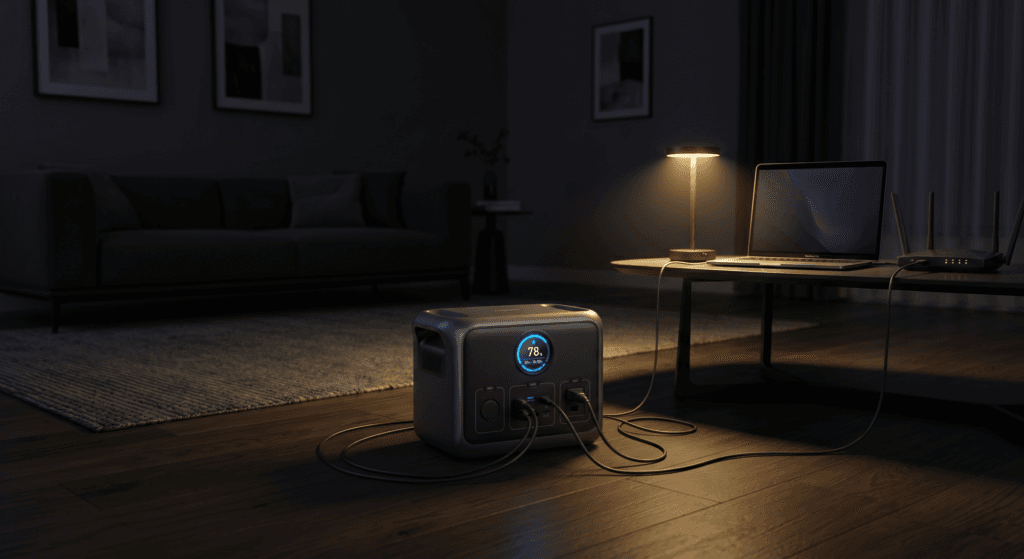
A compact station is most valuable when it is ready before an outage. Keep the battery charged according to the manufacturer’s guidance, check the power level periodically, verify that the intended cables still work, and run a controlled test of the priority devices. An emergency setup should be familiar before it becomes necessary.
What to Verify Before Buying the Anker SOLIX C1000 Gen 2
| Verify | Why it matters |
|---|---|
| Priority-load watts and required hours | They determine whether a 1,024Wh battery reserve is adequate. |
| Motor or compressor startup demand | Some pumps, saws, and compressor-based devices may exceed the available output at startup. |
| UltraFast charging conditions | The 49-minute mode is app-enabled and temperature dependent. |
| Solar panel voltage and configuration | The maximum solar input is 600W and 60V; compatibility and conditions affect real results. |
| UPS compatibility with each device | A 10 ms claim is not a guarantee for every sensitive, medical, security, or data device. |
| Need for future capacity | This Gen 2 model is not expandable, so later runtime growth means a different solution. |
| Outlet and cable plan | Three AC outlets require deliberate prioritization and correctly rated accessories. |
| Current Amazon configuration | Confirm ASIN B0FN7MSY4L, bundle contents, seller, and included accessories before purchase. |
For general preparation guidance, see Ready.gov’s power-outage guidance. Never backfeed a home electrical panel, use damaged cables, or treat a portable power station as a substitute for required transfer equipment, code-compliant installation, or dedicated life-safety backup.
Related Decision Paths
Read the connected Anker SOLIX C1000 Gen 2 review for buyer trade-offs and alternatives. This Product record remains the central source for model identity, core specifications, ASIN, and the affiliate-card destination.
For a related 1kWh-class alternative, see the Jackery Explorer 1000 v2 review. For a faster-charging EcoFlow decision path, see the EcoFlow DELTA 3 Plus review. A buyer who needs refrigerator-plus-essentials coverage for longer outages should use the sizing guide before moving to a larger battery category.
FAQ
Is the Anker SOLIX C1000 Gen 2 good for apartment backup?
The Anker SOLIX C1000 Gen 2 can be a strong apartment-backup option for a conservative priority list such as communications, phones, laptop work, LED lighting, and selected short-duration appliances. It is not a whole-home solution, and battery runtime depends on the actual load.
Can the Anker SOLIX C1000 Gen 2 run a refrigerator?
It may support many refrigerators within its output limits, but no universal runtime applies. Compressor startup behavior, cycling, room temperature, door openings, battery reserve, and other devices affect the result. Measure or estimate the specific refrigerator before depending on the system.
How fast does the Anker SOLIX C1000 Gen 2 recharge?
Anker lists a full charge in 49 minutes with the app-enabled 1,600W UltraFast mode. The manufacturer states that battery-cell temperature affects this result, so the figure should not be treated as a guaranteed recharge time in every condition.
Is the Anker SOLIX C1000 Gen 2 expandable?
No. Anker states that this Gen 2 model does not include an expansion feature. Buyers who know they will need more battery capacity later should compare an expandable platform before purchase.
Does the Anker SOLIX C1000 Gen 2 work as a UPS?
Anker lists a 10 ms UPS switchover. Test the actual device before relying on it, especially for sensitive electronics, medical devices, security equipment, servers, or other critical loads.
Final Product Decision
The Anker SOLIX C1000 Gen 2 is a practical choice for a buyer who needs a compact 1kWh station with rapid AC recovery, 2,000W output, useful solar headroom, and a manageable 24.9 lb body. It works best as a deliberate essential-load station for apartment outages, home-office continuity, travel, camping, and similar moderate-demand scenarios.
Skip the Anker SOLIX C1000 Gen 2 when the real requirement is long heavy-load runtime, a high-startup pump or compressor load that has not been verified, whole-home coverage, or future battery expansion. Begin with the load list, desired runtime, safe placement, and recharge plan. Then choose the smallest verified system that can meet those needs without overstating what a 1,024Wh portable battery can do.