
Product Intelligence
Best Heavy-Duty Home BackupAnker SOLIX F3800 Plus: Powerful 3.8kWh Backup
Heavy-duty 3,840Wh LFP portable power station with 6,000W AC output, 120V/240V support, up to 3,200W solar input, and expandable backup capacity for home, RV, and outage planning.
Specifications
Key specs
Buyer Fit
Fit signals
Best for
Pros
- 6,000W total AC output through the L14-30R path
- 3,840Wh LFP base capacity
- Up to 3,200W direct solar input
- Built-in 120V/240V L14-30R output
- Expansion support with up to six BP3800 batteries
- Six standard NEMA 5-20R outlets
- 5-year warranty
Cons
- 136.7 lb base unit requires planned placement
- Standard 120V outlets have a lower 2,400W stated limit
- Solar and generator performance depend on configuration
- Expansion adds cost, weight, and floor space
- Not a whole-home system without proper equipment and installation
- UPS behavior varies by input condition
Spec table
| Capacity | 3840 Wh |
|---|---|
| AC Output | 6000 W |
| Solar Input | 3200 W |
| Weight | 136.7 lb |
| Battery | LiFePO4 |
| Warranty | 5-year warranty |
| Expandability | Up to six 3,840Wh BP3800 Expansion Batteries; manufacturer lists up to 53.8kWh in supported configurations. |
| UPS / EPS | Yes. UPS support on three 120V outlets; switching time varies by setup |
| Recharge Time | AC: 1,800W maximum and under three hours under manufacturer-stated conditions. Solar: up to 3,200W total and under two hours in optimal sunlight. Generator and Home Power Panel paths depend on supported configuration. |
This article may contain affiliate links. If you buy through these links, PowerLabPro may earn a commission at no extra cost to you. As an Amazon Associate I earn from qualifying purchases.
Anker SOLIX F3800 Plus bottom line: this is a large 3,840Wh backup platform for a buyer who needs a verified 120V/240V output path, serious solar-recovery potential, and an expansion plan that can grow beyond one battery. It is built for selected home circuits, RV use, long-outage preparation, and controlled high-demand loads. It is not a casual carry battery or a substitute for a professionally designed whole-home system.
The Anker SOLIX F3800 Plus is most useful when the load list is already clear. A refrigerator, freezer, router, lighting, work equipment, an RV inlet, and selected circuits create a different backup problem than phones, a laptop, and a small fan. Its 6,000W total AC-output rating adds meaningful headroom, but its 3,840Wh base battery still sets the energy budget. High-watt appliances can use that reserve quickly.
This Product page is a structured model reference, not a hands-on test report. The connected Review offers deeper buyer analysis. Check the current manual, outlet mode, generator or home-panel accessory requirements, expansion compatibility, panel voltage, and your actual appliance demand before purchase.

- 𝗘𝗻𝗹𝗮𝗿𝗴𝗲𝗱 𝗖𝗮𝗽𝗮𝗰𝗶𝘁𝘆 𝗳𝗿𝗼𝗺 𝟯.𝟴𝟰𝗸𝗪𝗵: F3800 Plus starts with 3.84kWh, enough power for your family for one day. If that’s not …
- 𝗣𝗼𝘄𝗲𝗿 𝗠𝗼𝗿𝗲 𝗔𝗽𝗽𝗹𝗶𝗮𝗻𝗰𝗲𝘀 𝗦𝗶𝗺𝘂𝗹𝘁𝗮𝗻𝗲𝗼𝘂𝘀𝗹𝘆: F3800 Plus offers a massive 6,000W output, 58% more than other portable power stat…
- 𝗗𝘂𝗮𝗹-𝗩𝗼𝗹𝘁𝗮𝗴𝗲 𝗳𝗼𝗿 𝗔𝗻𝘆 𝗔𝗽𝗽𝗹𝗶𝗮𝗻𝗰𝗲: With 120V / 240V dual-voltage support, you can run everything at home without limitation…
Table of Contents
Anker SOLIX F3800 Plus: Quick Product Reference
The Anker SOLIX F3800 Plus belongs in the large rolling backup category. Anker lists a 3,840Wh LFP battery, 6,000W total AC output, dual-voltage 120V/240V capability through its L14-30R output, up to 3,200W total solar input, and up to six 3,840Wh BP3800 expansion batteries. The product can be relevant when a buyer needs more than a compact extension-cord backup plan.
The most important detail is configuration. Anker publishes a 6,000W total rating, but individual outlet paths have their own limits. The L14-30R is listed at 120V/240V and 6,000W maximum. Standard 120V NEMA 5-20R outputs are listed at up to 2,400W. The TT-30R RV outlet is also a separate 120V path. Build a plan around the outlet and connection method that the actual appliance uses.
- Best for: selected home-circuit planning, large RV setups, high-solar recovery, long outages, and buyers with a defined expansion path.
- Not ideal for: light apartment backup, frequent lifting, basic communications-only kits, or anyone who does not want to plan loads and connections.
- Main strength: 6,000W output headroom, built-in 120V/240V L14-30R capability, and up to 3,200W solar input in one large platform.
- Main limitation: the 136.7 lb base unit and system complexity make this a planned-placement product, not a grab-and-go solution.
Anker SOLIX F3800 Plus Specifications and Buyer Meaning
| Specification | Officially listed information | Buyer meaning |
|---|---|---|
| Battery capacity | 3,840Wh | Large base energy reserve, but not a fixed runtime promise. |
| Battery chemistry | LFP, 3,000+ cycles | Designed for repeated backup use; real aging varies with storage and operating conditions. |
| Total AC output | 6,000W maximum | Use the outlet-specific limit and the combined-load plan, not only the headline rating. |
| L14-30R output | 120V/240V, 25A maximum, 6,000W maximum | Supports a documented dual-voltage path for compatible equipment and properly planned connections. |
| Standard 120V AC outputs | 120V, 20A maximum, 2,400W maximum | Normal household-style outlet use has a lower stated limit than the L14-30R path. |
| Solar input | Two 11–165V inputs, 17A maximum, 1,600W maximum each | Up to 3,200W total with compatible direct solar, not guaranteed daily harvest. |
| AC charging | 1,800W maximum | Anker lists under three hours on its product page under stated conditions. |
| Generator or Home Power Panel port | Up to 6,000W AC input and output | Accessory and configuration requirements are material; do not assume universal generator compatibility. |
| Expansion | Up to six BP3800 batteries, 3,840Wh each | Anker lists a larger-system capacity up to 53.8kWh in supported configurations. |
| Standard AC outlets | Six NEMA 5-20R outlets | Useful for a managed essentials plan, while total-output and bypass conditions still apply. |
| Weight | 136.7 lb | Wheels help placement; stairs and frequent loading are meaningful constraints. |
| Dimensions | 27.6 × 15.3 × 15.6 in, including wheels | Confirm storage clearance, vehicle access, and safe placement before purchase. |
| Warranty | 5 years | Confirm current eligibility, registration, and seller conditions before purchase. |
| Amazon ASIN | B0DTSSCHG6 | Verify the current standalone configuration and included accessories before buying. |
Source note: The official Anker SOLIX F3800 Plus product page is the controlling source for capacity, output paths, solar limits, dimensions, expansion, warranty, and stated accessory conditions. The Amazon listing is used only to confirm the current U.S. ASIN and listing identity.
The Anker SOLIX F3800 Plus should be chosen because a buyer has a specific higher-demand plan, not because 6,000W and 3,840Wh look impressive in isolation. Capacity determines stored energy. Output determines what can run together. Solar input determines potential recovery speed. Expansion changes future capability, cost, floor space, and handling. These are separate decisions.
Who the Anker SOLIX F3800 Plus Fits
The strongest buyer for the Anker SOLIX F3800 Plus has moved beyond a modest device-backup list and needs a large, wheeled platform. This can include a homeowner planning selected circuits through a documented connection path, an RV owner with high-demand loads, a buyer who can deploy a large compatible solar array, or someone who expects a real expansion need after measuring their current runtime.
- Selected home-backup planners: buyers who have identified priority circuits and understand that transfer equipment, inlet boxes, and panel work require an appropriate installation path.
- Large RV users: owners with a compatible 120V or 120V/240V plan, a stable transport location, and realistic expectations about battery runtime.
- Solar-first outage planners: users who can safely match panels to two 11–165V solar inputs and have adequate sun exposure.
- Expansion-minded buyers: people who want to begin at 3,840Wh and have a verified reason to add BP3800 batteries later.
- High-output essential-load users: buyers whose properly verified load plan needs more than a 1kWh or 2kWh portable station can reasonably supply.
For these buyers, the Anker SOLIX F3800 Plus can provide a more deliberate backup foundation than several smaller units scattered across a house. The correct approach is still to size the battery around the must-run list, then decide whether output, stored energy, and recovery speed are enough for the planned outage duration.
Use the PowerLabPro power-station sizing guide before buying a system this large. It separates running watts, compressor or motor startup demand, stored watt-hours, and recharge planning. Those calculations matter more than a general claim that a large power station can power “a home.”
Who Should Skip the Anker SOLIX F3800 Plus
Buyers should skip the Anker SOLIX F3800 Plus when the need is simply communications, lighting, phone charging, laptop work, and short emergency runtime. That job is often handled more efficiently by a smaller, lighter battery. More capacity and output do not create better value when they add moving difficulty, space requirements, accessory questions, and a larger budget without solving a real load problem.
- Light-backup users: a router, phones, lights, a laptop, and a small fan are usually a poor reason to own a 136.7 lb platform.
- Upstairs or frequent-movement buyers: wheels do not eliminate stairs, loading ramps, storage thresholds, or the need to secure a heavy unit.
- Whole-home expectation buyers: one portable station is not a substitute for a designed electrical system, local code compliance, or a qualified installer.
- Unverified pump, HVAC, or compressor users: check running watts, startup behavior, plug type, circuit requirements, and outlet mode before relying on any output claim.
- Buyers without a recovery plan: a large battery remains finite if there is no realistic AC, solar, or generator-compatible recharge method.
Output Paths, Capacity, and Runtime Reality
The Anker SOLIX F3800 Plus combines a 3,840Wh battery with a 6,000W total output rating, but buyers should not treat either figure as universal. A high-output inverter may allow a device to operate while the stored battery capacity determines how long it can run. A refrigerator may cycle. A pump can have a high startup demand. A microwave, kettle, space heater, induction appliance, or portable air conditioner can consume a large amount of stored energy in a short period.
The outlet path matters as much as the appliance label. Anker lists the L14-30R at 120V/240V and 6,000W maximum, while standard 120V NEMA 5-20R output is listed at 2,400W maximum. The TT-30R is a distinct 120V RV option. Do not connect a load based on the biggest number on the product page without first checking the plug, outlet, combined load, and applicable manual guidance.
For a controlled outage plan, keep essential loads first. Communications, lights, food protection, medical-device planning after device-specific verification, and work equipment often matter more than high-watt comfort or convenience appliances. A disciplined plan will usually outlast a larger but unmanaged battery.
The Anker SOLIX F3800 Plus should be treated as a planned system: determine the devices, determine the running and starting demand, decide what needs to operate at the same time, and reserve energy for priority loads. A large portable power station becomes more useful when it is used selectively, not when it is expected to imitate every utility circuit in a home.
Solar Recovery, AC Charging, and Generator Bypass Boundaries
Solar recovery is one of the strongest reasons to consider the Anker SOLIX F3800 Plus. Anker lists two solar inputs, each supporting 11–165V and up to 1,600W, for a total maximum of 3,200W. Its product page describes a full recharge in under two hours in optimal sunlight. That is a manufacturer-stated best-case condition, not a promised result in everyday weather or with every panel arrangement.
Actual solar harvest depends on compatible panel voltage, current, wiring, shade, panel angle, temperature, cable condition, and battery state. The 165V ceiling is a safety boundary, not a target to exceed. Confirm the individual panel specifications and the complete series or parallel configuration before connection. A portable station should never be connected to a panel arrangement that exceeds the published input limits.
For AC charging, Anker lists 1,800W maximum and an under-three-hour charge time under its stated conditions. The product has additional generator and Home Power Panel pathways, including a listed 6,000W port for supported configurations. Those features are not a blanket permission to connect any generator or panel setup. The relevant output, input, bypass limits, accessory requirements, and pure-sine-wave conditions must be verified in current official documentation.
The Anker SOLIX F3800 Plus can be part of a layered outage plan, but an owner should test the intended charging routine before an emergency. A realistic plan identifies the panel layout, AC supply, compatible generator path if applicable, cable storage, and the safe placement of a heavy unit. Recovery capability is valuable only when it can be used reliably.
Expansion, 120V/240V Planning, and Connection Safety
Anker lists support for up to six BP3800 expansion batteries with the Anker SOLIX F3800 Plus. Each BP3800 is listed at 3,840Wh. The broader system can reach the manufacturer’s stated 53.8kWh capacity in supported configurations. Expansion should solve a measured runtime need, not become a default purchase because the maximum system size is large.
Additional batteries increase stored energy, but they also add cost, weight, floor space, transport constraints, and more components that must stay charged and functional. Buyers should start with the base station when it covers the current load plan, then expand after a controlled test shows that more runtime is genuinely required.
For 120V/240V use, the F3800 Plus has a built-in L14-30R path listed at up to 6,000W. That can be relevant for a correctly planned transfer switch, inlet box, RV, or compatible equipment. It does not mean any home panel or appliance can be connected without evaluating the circuit, plug, transfer equipment, load behavior, and local requirements. Use a qualified electrician whenever the plan involves a home electrical system or permanent wiring.
Never backfeed a home electrical panel through a wall outlet. Do not bypass required transfer equipment. Do not use damaged cables or improvised adapters. The Anker SOLIX F3800 Plus can offer serious output capacity, but safe use still depends on the complete connection path, not only the power station itself.
UPS Context, Ports, and Practical Placement
Anker describes different switching behavior in different input conditions. Its product-page FAQ lists a 20 ms switching time for the relevant 120V wall-input condition and lists other conditions separately. Treat the station as a useful continuity option for selected tested equipment, not as a universal zero-transfer solution for every router, computer, security system, CPAP device, medical device, or data-sensitive load.
Test the exact device in a controlled setting before relying on a backup feature. Device adapters, battery chargers, network equipment, and medical or life-safety products may have their own required backup specifications. Critical equipment should follow the manufacturer’s dedicated power guidance rather than a general portable-power claim.
The Anker SOLIX F3800 Plus has six NEMA 5-20R outlets, a TT-30R outlet, L14-30R output, USB-C ports listed up to 100W each, USB-A ports, and a 12V car socket. Port variety is helpful, but total output and outlet-specific limitations still apply. Direct USB-C charging can reduce the need for AC adapters when the connected laptop or device supports it.
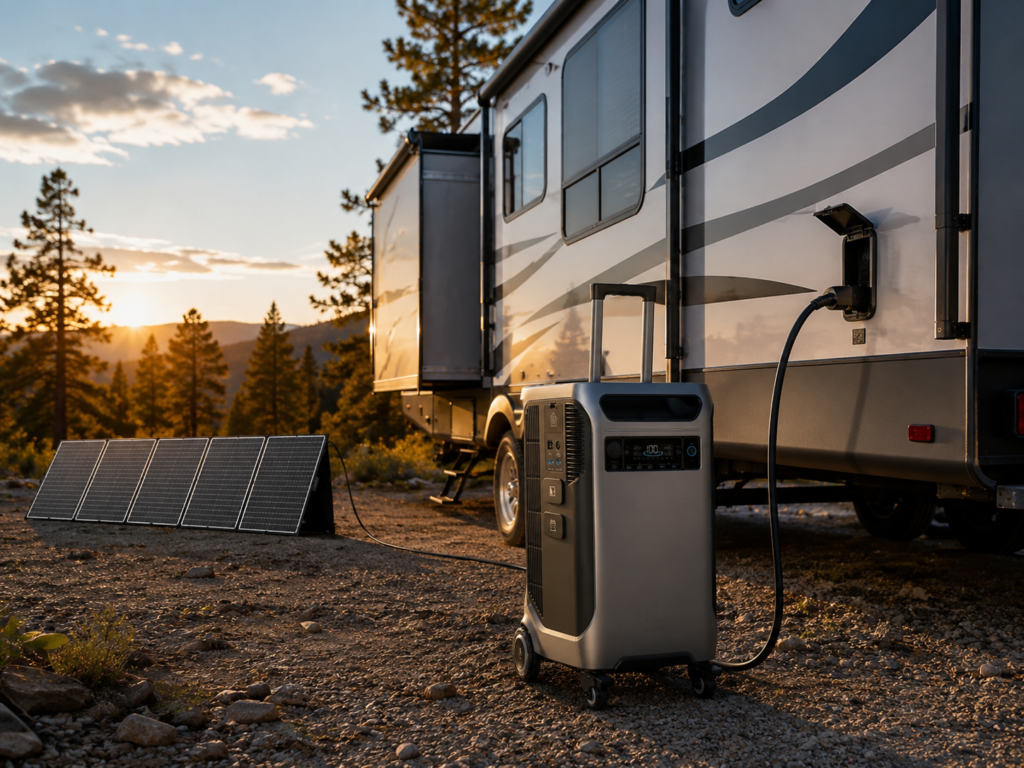
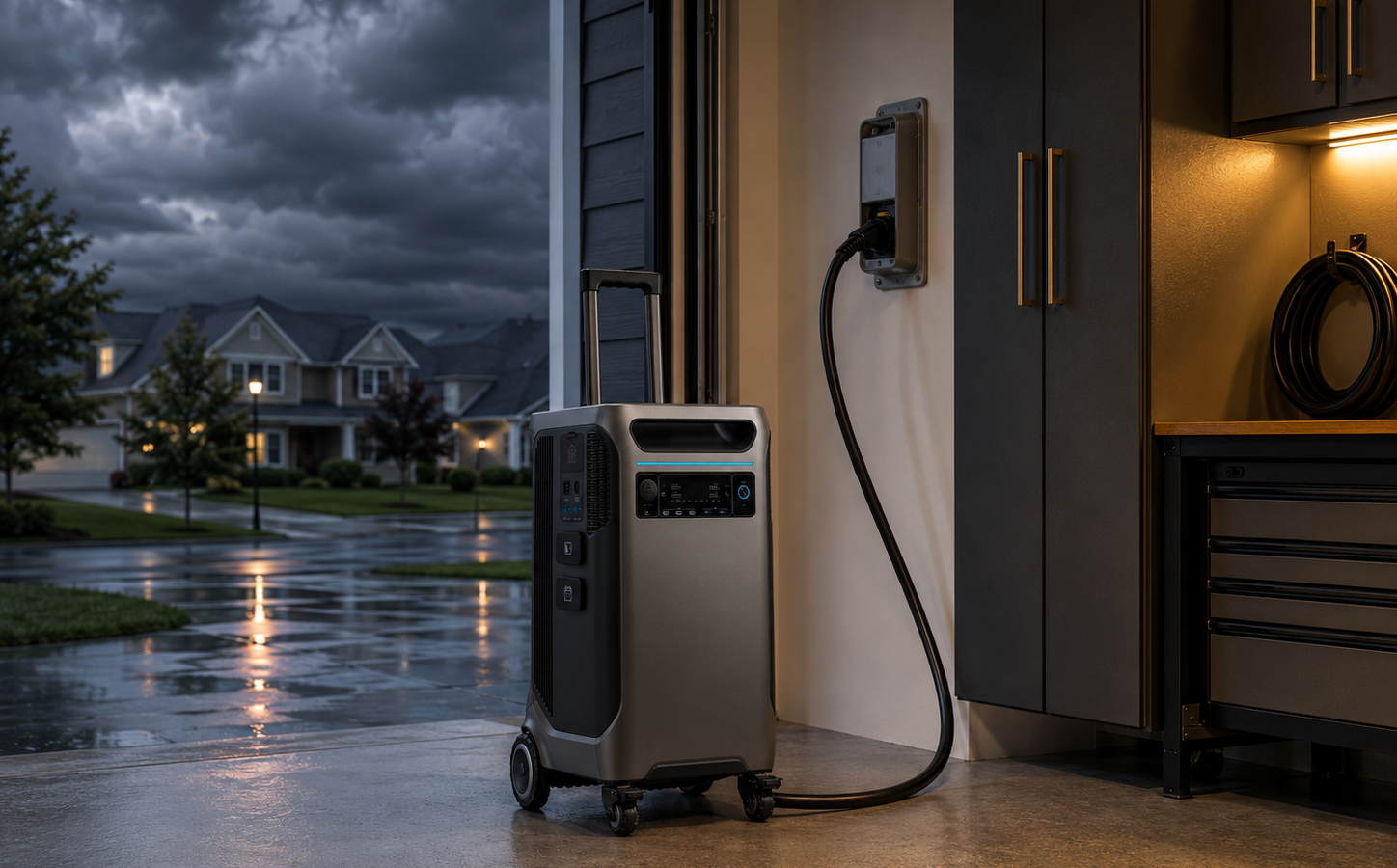
At 136.7 lb, placement is a decision, not an afterthought. Plan a dry, stable, ventilated location with clear cable routing and no blocked path of travel. Confirm that the floor, ramp, vehicle compartment, garage location, or RV bay can support the unit and any expansion batteries. Do not depend on a difficult moving route when the system is needed during an outage.
What to Verify Before Buying the Anker SOLIX F3800 Plus
| Verify | Why it matters |
|---|---|
| Priority-load watts and required hours | They determine whether 3,840Wh is sufficient before expansion. |
| Outlet and plug type for each high-demand load | The standard outlets, TT-30R, and L14-30R have different stated paths and limits. |
| Motor, compressor, pump, or HVAC startup behavior | Running watts do not always show the startup demand. |
| Solar panel voltage, current, and wiring plan | Each solar input is limited to 11–165V, 17A, and 1,600W maximum. |
| AC, generator, or Home Power Panel configuration | Fast charging and bypass claims depend on the documented accessory and operating condition. |
| Expansion-battery need and storage location | Extra capacity is valuable only when it solves a defined runtime shortfall. |
| UPS behavior for the exact connected equipment | Switching time and usable ports vary by input condition. |
| Physical placement and moving route | 136.7 lb requires deliberate storage, transport, and safe cable routing. |
| Current Amazon configuration | Confirm ASIN B0DTSSCHG6, seller, included accessories, and bundle contents before purchase. |
For general preparation, see Ready.gov’s power-outage guidance. Never treat a portable power station as a substitute for code-compliant transfer equipment, an installed life-safety system, or a manufacturer-approved medical-device backup plan.
Related Decision Paths
Read the connected Anker SOLIX F3800 Plus review for deeper editorial trade-offs and alternatives. This Product page remains the central reference for model identity, specifications, ASIN, and the affiliate-card destination.
For the closest EcoFlow decision, see the EcoFlow DELTA Pro 3 vs Anker SOLIX F3800 Plus comparison. Buyers who want a larger initial battery and higher stated single-unit output should also compare the Jackery Explorer 5000 Plus Product reference. The right system depends on the real load list, outlet path, recovery plan, storage space, and installation scope.
FAQ
Is the Anker SOLIX F3800 Plus good for home backup?
The Anker SOLIX F3800 Plus can be a strong fit for a planned selected-load backup system because it has 3,840Wh capacity, a 6,000W output path, 120V/240V capability, and expansion potential. It is not a universal whole-home solution. The home connection, required transfer equipment, and actual load plan must be verified first.
Can the Anker SOLIX F3800 Plus support 240V loads?
Anker lists the L14-30R at 120V/240V, 25A maximum, and 6,000W maximum. Verify the load, plug type, transfer or inlet setup, cable, and installation requirements before relying on the unit for any 240V application.
How much solar input does the Anker SOLIX F3800 Plus support?
The Anker SOLIX F3800 Plus supports up to 3,200W total solar input through two inputs, each listed at up to 1,600W. Real charging depends on compatible panel voltage, panel layout, sunlight, shading, and the rest of the setup.
Is the Anker SOLIX F3800 Plus expandable?
Yes. Anker lists support for up to six 3,840Wh BP3800 expansion batteries and describes a larger supported system reaching up to 53.8kWh. Confirm the current battery, hub, home-panel, and connection requirements before building an expanded system.
How heavy is the Anker SOLIX F3800 Plus?
Anker lists the unit at 136.7 lb. It is wheeled and movable on a planned route, but it is not a one-person carry product or a good fit for repeated stair movement.
Final Product Decision
The Anker SOLIX F3800 Plus is a powerful choice for buyers whose plan genuinely needs a large battery, high-output 120V/240V capability, serious solar input, and a long-term expansion path. It is strongest for selected home circuits, RV power, and extended outage planning where the owner can manage placement, loads, and recovery before the emergency begins.
Skip the Anker SOLIX F3800 Plus when the real requirement is a small device kit, easy portability, short emergency runtime, or a simple no-planning purchase. Start with the load list, intended outlet path, desired runtime, recovery method, and safe placement. Then choose the smallest verified system that meets the need without overstating what a portable 3,840Wh battery can do.