
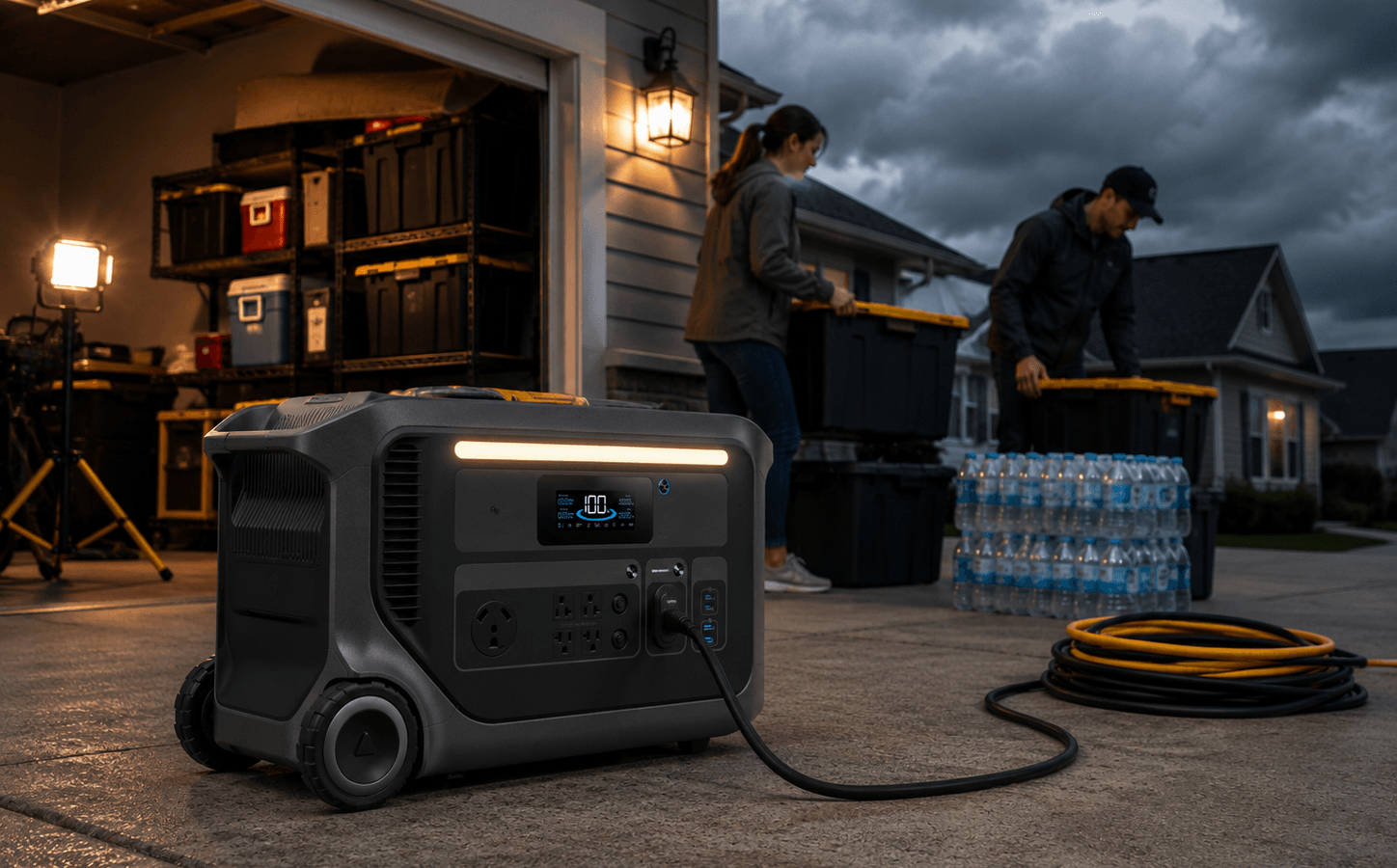
Product Intelligence
High-output 3kWh backupAnker SOLIX F3000: Powerful 3kWh Backup
A 3,072Wh LFP rolling portable power station for essential home backup, RV power, solar charging, and expandable outage planning.
Specifications
Key specs
Buyer Fit
Fit signals
Best for
Pros
- 3,072Wh LFP base capacity
- 3,600W TT-30R output path
- Up to 2,400W solar input
- Expandable BP3000 battery system
- 20 ms UPS function
- Two USB-C ports up to 100W each
- 5-year warranty
Cons
- 91.5 lb rolling unit is not easy to carry
- Standard NEMA 5-20R output is limited to 2,400W
- Single unit provides 120V only
- 240V requires two units and the Double Voltage Hub
- Solar and generator performance depend on compatible setup
- Expansion adds cost, weight, and storage needs
Spec table
| Capacity | 3072 Wh |
|---|---|
| AC Output | 3600 W |
| Surge Output | 7200 W |
| Solar Input | 2400 W |
| Weight | 91.5 lb |
| Battery | LiFePO4 |
| Warranty | 5 years |
| Expandability | Expandable through BP3000 batteries; Anker markets up to 24kWh F3000 system capacity. Verify current battery and paired-unit configuration. |
| UPS / EPS | 20 ms manufacturer-listed UPS. |
| Recharge Time | AC charging cable: up to 1,800W and under three hours under manufacturer-stated conditions. Supported TT-30 or J1772 paths can reach up to 3,600W input. Solar: up to 2,400W total under manufacturer-stated conditions. |
This article may contain affiliate links. If you buy through these links, PowerLabPro may earn a commission at no extra cost to you. As an Amazon Associate I earn from qualifying purchases.
Anker SOLIX F3000 bottom line: this is a 3,072Wh rolling power station for buyers who need more energy and output than a small device-backup battery can provide. A single unit supplies 120V power, supports up to 3,600W through the TT-30R output path, accepts up to 2,400W of solar input, and can expand through Anker’s BP3000 battery system. It is useful for a measured home-essential, RV, or solar-recovery plan. It is not a single-unit 240V or automatic whole-home solution.
The Anker SOLIX F3000 is most useful when the buyer starts with the actual load list. A refrigerator, freezer, router, lights, laptop work, RV appliances, and selected tools require a different plan than phones, a modem, and a small fan. Stored watt-hours determine the energy reserve. Outlet-specific output determines what can run together. Solar and generator charging determine whether the reserve can be recovered during a longer outage.
This Product page is a source-backed reference, not a hands-on test report. The connected Review provides the deeper editorial decision. Confirm the current manual, exact outlet, solar configuration, accessory requirements, generator compatibility, expansion battery, and appliance demand before purchase.

- 𝗠𝗮𝘀𝘀𝗶𝘃𝗲 𝟯,𝟲𝟬𝟬𝗪 𝗣𝗮𝘀𝘀-𝗧𝗵𝗿𝗼𝘂𝗴𝗵 𝗖𝗵𝗮𝗿𝗴𝗶𝗻𝗴: No more interruptions during outages. Recharge with a 120V generator and run appli…
- 𝗟𝗲𝘀𝘀 𝗣𝗼𝘄𝗲𝗿 𝗪𝗮𝘀𝘁𝗲, 𝗟𝗼𝗻𝗴𝗲𝗿 𝗕𝗮𝗰𝗸𝘂𝗽 𝗧𝗶𝗺𝗲: With ultra-low idle power consumption, F3000 achieves 125 hours of AC idle standby…
- 𝗨𝗹𝘁𝗿𝗮 𝟮,𝟰𝟬𝟬𝗪 𝗦𝗼𝗹𝗮𝗿 𝗥𝗲𝗰𝗵𝗮𝗿𝗴𝗶𝗻𝗴: Charge fast outdoors with portable and rigid solar panel compatibility. Just plug into th…
Table of Contents
Anker SOLIX F3000: Quick Product Reference
The Anker SOLIX F3000 is a large 3kWh-class station with a wheeled suitcase-style body, LFP battery chemistry, a TT-30R RV outlet, Anderson DC output, two solar-input paths, and an expansion route. Anker lists 3,072Wh of base capacity, 3,600W output on the TT-30R path, 2,400W maximum output from the NEMA 5-20R path, 7,200W AC surge, and 20 ms UPS switching.
The main buying distinction is that the Anker SOLIX F3000 is not a single-box 240V platform. Anker states that one F3000 delivers 120V output; 240V requires two F3000 units connected through the optional Double Voltage Hub. A buyer who needs 240V in one unit should consider a different product class rather than treating a future two-unit system as an included feature.
- Best for: planned refrigerator-plus-essentials backup, RV use with a compatible TT-30 setup, solar-supported outages, and buyers who expect to expand later.
- Not ideal for: small apartment kits, frequent stair carrying, simple phone-and-router backup, or a buyer who needs native single-unit 240V.
- Main advantage: a 3,072Wh base battery with strong 120V, RV, solar, generator-pass-through, and expansion options in one rolling form factor.
- Main limitation: output depends on the outlet and configuration, while 91.5 lb weight limits casual movement.
Anker SOLIX F3000 Specifications and Buyer Meaning
| Specification | Officially listed information | Buyer meaning |
|---|---|---|
| Battery capacity | 3,072Wh | A substantial essential-load reserve, not a fixed runtime promise. |
| Battery chemistry | LFP / LiFePO4 | Anker lists 4,000 cycles; battery aging still depends on storage and use. |
| Standard AC output | NEMA 5-20R: 120V, 20A maximum, 2,400W maximum | Use this limit for normal household-style AC outlets. |
| RV output | TT-30R: 120V, 30A maximum, 3,600W maximum | Useful for a compatible RV plan; plug type and total load still matter. |
| Single-unit voltage | 120V | A standalone F3000 does not supply 240V output. |
| 240V path | Two F3000 units plus Double Voltage Hub | Requires a larger, separate system purchase and documented connection path. |
| AC surge | 7,200W listed | Temporary startup margin, not a continuous-output or runtime increase. |
| Solar input | High PV: up to 1,600W; Low PV: up to 800W; 2,400W total | Strong recovery potential with compatible panels and real sun conditions. |
| AC charging | 1,800W maximum through the AC charging cable | Anker lists under three hours under its stated conditions. |
| TT-30 / EV charging path | Up to 3,600W input through supported documented accessories | Check the exact cable, generator, EV adapter, and setup before relying on it. |
| UPS | 20 ms listed | Test the actual connected device; do not assume universal sensitive-device compatibility. |
| Expansion | BP3000 expansion-battery system; Anker markets up to 24kWh system capacity | Expansion can add runtime, cost, weight, cables, and storage requirements. |
| Weight and dimensions | 91.5 lb; 25.6 × 11.8 × 14.8 in | Wheels help on flat ground, but placement and vehicle loading need planning. |
| Warranty | 5 years | Confirm current seller eligibility and registration conditions before purchase. |
| Amazon ASIN | B0F8BC2LFS | Confirm the current standalone bundle, seller, and included accessories before purchase. |
Source note: The official Anker SOLIX F3000 product page is the controlling reference for electrical limits, charging paths, solar input, dimensions, weight, battery chemistry, and system conditions. The Amazon listing is used to confirm the current U.S. identity, model A1782, warranty listing, and ASIN.
Who the Anker SOLIX F3000 Fits
The Anker SOLIX F3000 fits buyers whose plan has outgrown a compact 1kWh station but does not yet require a larger 4kWh or 5kWh heavy-backup platform. It can fit a homeowner who has a specific essential-load list, an RV owner who can use the TT-30R connection, an off-grid user with compatible solar panels, or a preparedness buyer who expects to add capacity after testing base-unit runtime.
- Home-essential planners: buyers with a defined list such as refrigeration, communications, lighting, laptops, fans, and selected low-to-moderate draw appliances.
- RV users: people who need a verified 120V TT-30R path, a controlled appliance plan, and a safe location for a rolling 91.5 lb unit.
- Solar-recovery users: buyers who can design a compatible high-PV and low-PV panel setup without exceeding published voltage or current limits.
- Expansion planners: users who need more reserve than one battery can provide but want to build capacity after confirming an actual runtime gap.
- Generator-supported outage planners: buyers who can follow Anker’s documented pass-through and input requirements rather than improvising a generator connection.
The Anker SOLIX F3000 is not automatically the better choice than a smaller station. It earns its space and cost when the owner will use the larger battery, TT-30R output, solar-input headroom, or expansion system. For a router, laptop, phones, lights, and a small fan, a lighter product may be easier to own and may deliver better value.
Start with the PowerLabPro power-station sizing guide. It separates running watts, startup demand, stored watt-hours, and recharge planning. A load list should decide the product size, not a desire to buy the largest battery that fits the budget.
Who Should Skip the Anker SOLIX F3000
Buyers should skip the Anker SOLIX F3000 when portability is the first requirement or when their emergency plan is limited to small electronics. A 91.5 lb rolling unit is not easy to carry up stairs, place in an apartment closet, move through narrow doors, or load repeatedly into a vehicle. More capacity is not automatically better when it creates a storage or handling problem.
- Light-backup buyers: a phone, router, laptop, LED lights, and a fan rarely require a 3kWh platform.
- Single-unit 240V buyers: the F3000 needs two units and the Double Voltage Hub for 240V output.
- Whole-home expectation buyers: one portable unit cannot replace a code-compliant electrical design, transfer equipment, or professional installation.
- Unverified motor-load buyers: refrigerators, pumps, compressors, and RV air-conditioning equipment need individual startup and connection checks.
- No-recovery-plan buyers: a large battery still becomes finite during a long outage without a realistic AC, solar, or generator-compatible charging path.
Anker SOLIX F3000 Output, Capacity, and Runtime Reality
The Anker SOLIX F3000 makes the watts-versus-watt-hours distinction especially important. Its 3,072Wh battery provides the stored energy. Its output changes by connection path. Standard NEMA 5-20R output is listed at up to 2,400W, while the TT-30R output is listed at up to 3,600W. A buyer who treats every outlet as though it has the same limit can build an unsafe or disappointing plan.
Capacity does not create guaranteed runtime. A refrigerator cycles. A motor can require more power to start than to run. A microwave, kettle, space heater, induction appliance, coffee maker, or portable air conditioner can use a large amount of stored energy quickly. The station may support a particular device without making it a smart choice for a long-duration backup plan.
Use the Anker SOLIX F3000 for a priority sequence. Keep food protection, lighting, communications, work, and essential device charging ahead of high-watt convenience loads. Measure or estimate the specific appliance demand, confirm plug compatibility, and decide which devices really need to operate at the same time. A managed plan normally provides more useful outage time than an unmanaged one.
Anker lists 7,200W AC surge and 4,860W SurgePad power. Those are temporary or load-management figures, not replacements for the 2,400W standard-outlet and 3,600W TT-30R continuous limits. Do not treat them as unlimited inverter capacity, added battery energy, or a guarantee for every motor-driven appliance.
Solar Recovery, AC Charging, and Generator Use
The Anker SOLIX F3000 has two distinct solar inputs. The high-PV input is listed at 11–165V, 17A maximum, and up to 1,600W. The low-PV input is listed at 11–60V, 17A maximum, and up to 800W. Together they support up to 2,400W of solar input. Anker markets a full solar recharge in under two hours with optimal sunlight, but that is a stated best-case condition rather than an everyday outcome.
Solar recovery depends on panel voltage, panel configuration, shade, weather, cable condition, panel angle, temperature, and battery state. The 165V and 60V input limits are hard setup boundaries, not targets to exceed. Verify the full series or parallel plan before connecting panels, and do not assume a rooftop or portable array is compatible without the required equipment.
With the included AC charging cable, Anker lists up to 1,800W input and an under-three-hour charge time under its stated conditions. The F3000 also has documented TT-30 and J1772 accessory paths that can reach 3,600W input, plus manufacturer marketing for higher combined generator-and-solar recharge with a supported expansion configuration. These are not interchangeable claims. The cable, accessory, generator rating, battery configuration, and operating mode all matter.
The Anker SOLIX F3000 can support pass-through charging, which can be useful when a compatible generator charges the station while connected loads receive power. It does not remove the need to confirm generator waveform, connection method, rated input, ventilation, fuel safety, and the manufacturer’s current instructions. Test the intended charging sequence before an emergency rather than learning it during an outage.
Expansion, RV Use, and 240V Limits
Expansion is a major reason to consider the Anker SOLIX F3000. Anker markets F3000 systems up to 24kWh with BP3000 expansion batteries. The feature is valuable when the buyer has a defined runtime requirement that a 3,072Wh base unit cannot meet. It is less valuable when bought only because the system maximum looks impressive.
Extra batteries add reserve, but they also add purchase cost, storage space, transport effort, cable management, and more hardware to keep ready. Start with the smallest configuration that covers the real load plan. Expand after a controlled test shows that the current system falls short of the needed runtime.
For RV use, the 120V TT-30R outlet can be a practical advantage when the RV connection, cable, transfer switch, and appliance plan are compatible. The F3000 is still not a substitute for checking RV electrical requirements. Do not assume it can run every air conditioner, heater, induction cooktop, or charger at the same time simply because a 3,600W output path is available.
A single Anker SOLIX F3000 provides 120V output. Anker states that 240V requires two F3000 units and a Double Voltage Hub. This is a material system decision, not a small accessory detail. Buyers who truly need 240V should price, place, wire, and validate the complete paired system before deciding that the F3000 is the right platform.
UPS Context, Ports, and Practical Placement
Anker lists a 20 ms UPS function for the Anker SOLIX F3000. That can be useful for selected tested equipment such as a router, modem, desktop, or monitor. It is not a universal zero-transfer guarantee for every device. Test the exact equipment before relying on it, especially for servers, medical devices, security equipment, CPAP devices, or other equipment with its own power-backup instructions.
The front and rear connection set includes NEMA 5-20R AC output, TT-30R output, Anderson DC output, two USB-C ports listed at up to 100W each, USB-A ports, a 12V car socket, high-PV input, low-PV input, and expansion-battery connectivity. Direct USB-C charging can help preserve AC-outlet capacity for another priority device when the connected laptop or accessory supports it.
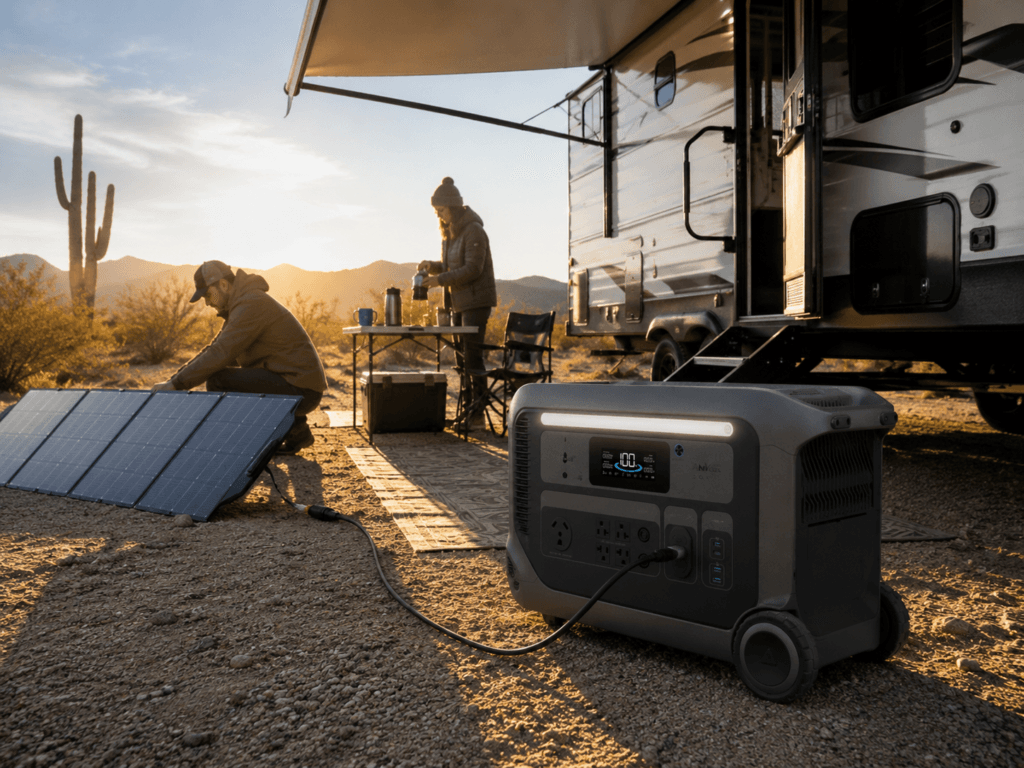
At 91.5 lb, the Anker SOLIX F3000 needs deliberate placement. Use a dry, stable, ventilated position with a safe cable route and a realistic path between storage and use. Wheels and a pull handle help on flat ground but do not solve stairs, tight thresholds, ramps, or vehicle lifting. Keep solar cables, charging accessories, and the priority load list together so the system is ready before an outage.
What to Verify Before Buying the Anker SOLIX F3000
| Verify | Why it matters |
|---|---|
| Priority-load watts and required hours | They determine whether 3,072Wh is enough before any expansion batteries are added. |
| Outlet and plug type for high-demand loads | NEMA 5-20R and TT-30R have different listed output limits. |
| Motor, compressor, pump, or RV appliance startup behavior | Running watts may not reflect startup demand or connection compatibility. |
| Solar panel voltage, current, and wiring plan | High PV is limited to 11–165V and 1,600W; low PV to 11–60V and 800W. |
| Generator and pass-through setup | Use only the supported input path, cable, rating, and documented operating conditions. |
| Expansion need and physical placement | More capacity adds cost, weight, space, and system complexity. |
| UPS behavior for each priority device | 20 ms switching does not guarantee compatibility with every sensitive load. |
| 240V requirement | Two F3000 units and the Double Voltage Hub are required for Anker’s 240V configuration. |
| Current Amazon configuration | Confirm ASIN B0F8BC2LFS, model A1782, seller, included accessories, and bundle contents. |
For general preparation, see Ready.gov’s power-outage guidance. Never backfeed a home electrical panel through a wall outlet, use an improvised adapter for a high-current connection, or treat a portable power station as a substitute for code-compliant transfer equipment or a manufacturer-approved medical-device backup plan.
Related Decision Paths
Read the connected Anker SOLIX F3000 review for the deeper buyer decision and alternatives. This Product reference remains the central record for the verified model identity, specifications, ASIN, and affiliate-card destination.
Buyers who need a larger single-unit backup platform with native 120V/240V capability should compare the Anker SOLIX F3800 Plus Product reference. Buyers whose needs are only a router, laptop, phones, and lighting should use the sizing guide before moving into a 3kWh category. The better choice depends on the load list, recovery path, placement plan, and whether a paired 240V system is really necessary.
FAQ
Is the Anker SOLIX F3000 good for home backup?
The Anker SOLIX F3000 can be a strong fit for a planned essential-load backup system because of its 3,072Wh battery, 120V output, 3,600W TT-30R path, solar-input options, and expansion route. It is not an automatic whole-home replacement. A home-circuit plan requires the correct transfer equipment, connection method, and load verification.
Can a single Anker SOLIX F3000 provide 240V power?
No. Anker states that a single F3000 provides 120V output. Its 240V configuration requires two F3000 units connected with the Double Voltage Hub.
How much solar input does the Anker SOLIX F3000 support?
The Anker SOLIX F3000 supports up to 2,400W total solar input: up to 1,600W through the high-PV input and up to 800W through the low-PV input. Real output depends on compatible panels, sunlight, wiring, shade, and temperature.
Is the Anker SOLIX F3000 expandable?
Yes. Anker markets expandable F3000 systems up to 24kWh through BP3000 expansion batteries. Verify the current battery and paired-unit configuration before purchasing extra capacity.
How heavy is the Anker SOLIX F3000?
Anker lists the unit at 91.5 lb. Wheels and a pull handle make it movable on a planned flat route, but it is not a light carry unit or a good frequent-stair option.
Final Product Decision
The Anker SOLIX F3000 is a practical choice for a buyer who needs a rolling 3kWh backup platform with outlet-specific 120V options, TT-30R RV support, useful solar headroom, generator-compatible recovery planning, and a path to more capacity. It is strongest when the owner has a measured essential-load plan and a place to store and use a 91.5 lb station safely.
Skip the Anker SOLIX F3000 when the real need is compact electronics backup, one-person carry portability, or native single-unit 240V. Start with actual loads, required runtime, the planned outlet, solar and generator options, and safe placement. Then choose the smallest verified system that fits the real decision without overstating what one 3,072Wh portable battery can do.