
Review
BLUETTI Elite 200 V2 Review
The BLUETTI Elite 200 V2 is a strong fixed-capacity choice for buyers who need 2,073.6Wh capacity, 2,600W continuous output, fast recharge, app control, and UPS mode. Choose an expandable system instead if you expect your backup needs to grow.
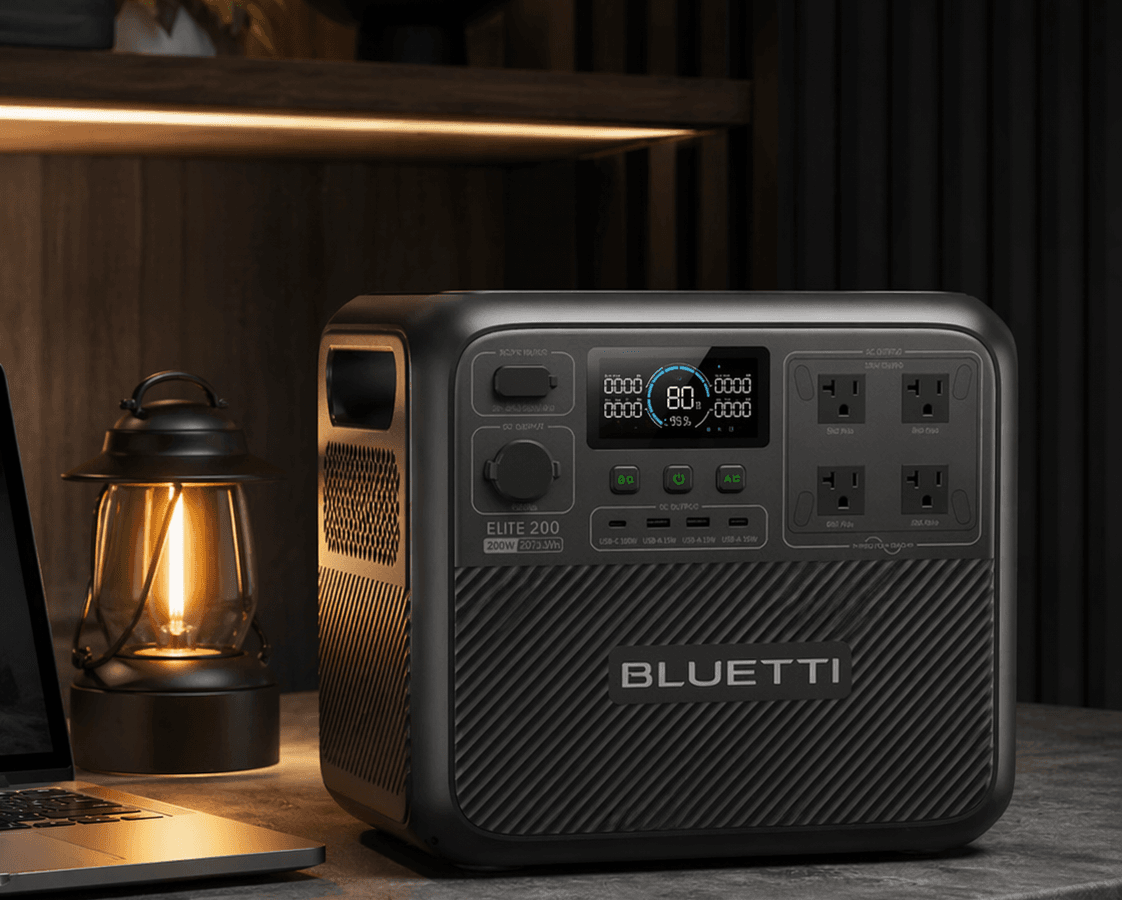
Linked Product Snapshot
Core specs
Buyer Fit
Pros and tradeoffs
Strengths
Pros
- 2,073.6Wh LiFePO4 capacity 2,600W continuous AC output UPS mode with ≤15 ms switchover for appropriate backup loads Wi-Fi and Bluetooth app control Up to 1,000W solar input 60-month manufacturer warranty
Tradeoffs
Cons
- No compatible expansion-battery option listed in current official documentation 53.35 lb weight is not ideal for casual carrying 3,900W Power Lifting is limited to pure resistive loads and is not continuous output UPS mode is not for data servers or workstations needing high-performance UPS Solar charging depends on compatible panel setup and conditions
This BLUETTI Elite 200 V2 review is based on current BLUETTI product documentation, the official user manual, and a current Amazon identity check for ASIN B0DCJV9LTB. PowerLabPro has not performed hands-on lab testing. Charging time, runtime, accessory compatibility, and connected-device behavior should be verified for the exact buyer setup before purchase.
The real question in this BLUETTI Elite 200 V2 review is not whether 2,073.6Wh sounds large. It is whether a fixed-capacity 2kWh-class station gives you the right balance of stored energy, 2,600W continuous output, fast recharge, solar input, UPS mode, and carrying weight for the loads you actually plan to protect.
The connected BLUETTI Elite 200 V2 product record holds the central verified specifications. This review focuses on the buyer decision: who benefits from this model, who should skip it, and where its no-expansion limitation changes the recommendation.
Quick verdict: This BLUETTI Elite 200 V2 review recommends the unit for buyers who want high output from a self-contained LiFePO4 power station and do not need to add battery capacity later. Its strongest points are 2,600W continuous output, UPS mode with a stated 15 ms or less switchover, Wi-Fi and Bluetooth app control, up to 1,000W solar input, and a 60-month warranty. Its core trade-off is fixed 2,073.6Wh capacity.
Best for: planned home essential-load backup, RV travel, camping, off-grid use, and mobile work where the load plan is known.
Not ideal for: buyers who expect to expand over time, need multi-day whole-home coverage, require a high-performance UPS for servers or workstations, or want a lightweight station for frequent carrying.
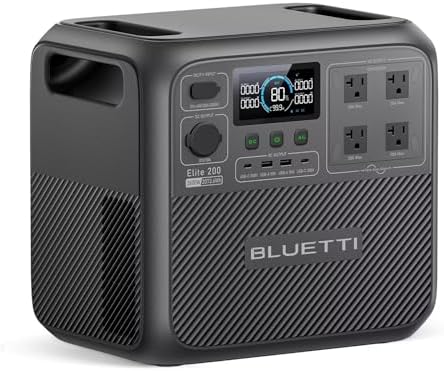
- [2600W Continuous & 3900W Power Lifting] – With BLUETTI’s HyperWatt tech, the Elite 200 V2 delivers a robust 2600W of co…
- [Less Waste, More Usable Power] – An advanced energy management system and high-efficiency components reduce standby pow…
- [Longest Lifespan of 17-Year] – Equiped with the industry’s first CNAS-certified true automotive-grade LiFePO4 battery, …
BLUETTI Elite 200 V2 Review: Quick Specifications
This BLUETTI Elite 200 V2 review uses the manufacturer’s continuous-output figure for normal load planning. BLUETTI lists Power Lifting up to 3,900W for supported pure resistive loads, but its manual is clear that actual output remains 2,600W. That distinction is important for buyers comparing a space heater or kettle with a motor-driven appliance.
| Battery capacity | 2,073.6Wh (54Ah) |
|---|---|
| Battery chemistry | LiFePO4 |
| Continuous AC output | 2,600W total, 120V, 21.6A |
| Power Lifting | Up to 3,900W for selected pure resistive loads. It is not a continuous or surge-output rating. |
| Solar input | Up to 1,000W, 12V to 60V, 20A maximum |
| AC recharge | 80% in about 1 hour and 100% in about 1.4 hours at 10–30°C / 50–86°F, per the manual |
| UPS mode | Manufacturer-listed switchover time of 15 ms or less |
| App support | BLUETTI app with Wi-Fi and Bluetooth |
| AC outlets | 4 |
| USB-C output | 2 × USB-C PD 3.0, 100W maximum per port |
| Car outlet | 12V / 10A |
| Weight | 53.35 lb (24.2 kg) |
| Warranty | 60 months / 5 years |
| Expansion | No compatible expansion-battery option listed in current official documentation |
Who Should Buy It
The clearest fit in this BLUETTI Elite 200 V2 review is a buyer who already knows the basic load plan. Think networking gear, phones, a laptop, LED lighting, fans, selected kitchen appliances, carefully planned refrigerator backup, or RV equipment that stays inside the continuous-output limit. The battery is large enough to be meaningful, while the inverter is stronger than many compact 1kWh stations.
For home backup, the Elite 200 V2 makes most sense as an essential-load station. It can help keep communication, lighting, charging, and selected appliances running during a short outage. It does not replace a professionally planned home battery or generator system, and it should not be connected to home circuits unless the installation and equipment are designed for that purpose.
For RV and camping buyers, this BLUETTI Elite 200 V2 review sees a good fit when the unit will travel in a vehicle, be staged at camp, or sit in an RV rather than move repeatedly by hand. At 53.35 lb, it is manageable for some people but it is not a casual grab-and-go battery. The 2,600W output, 12V/10A port, USB-C charging, and solar capability are more relevant when the trip includes real appliance and device loads rather than only phones and lights.
For off-grid or mobile-work use, the fixed battery can still work well when solar recovery is realistic and the daily energy budget is controlled. The important buyer question is not whether the product has 1,000W solar input on paper. It is whether the panel voltage, cable setup, weather, shade, angle, and available daylight can produce enough energy to recover what you use.
Who Should Skip It
This BLUETTI Elite 200 V2 review is not a universal recommendation because the product is intentionally fixed-capacity. Current official documentation does not list a compatible expansion-battery option. That is fine for a buyer who wants a simple one-box solution, but it is a real limitation for anyone who expects to add capacity after the first purchase.
Skip it when the intended use involves long refrigerator runtime, multi-day outages, a sump pump plan, a growing family load list, or a future solar-plus-battery system that needs modular growth. In those cases, an expandable platform can be the better long-term decision even if it costs more or is heavier at the start.
Also skip this model for data servers, high-performance workstations, or other critical equipment that needs a dedicated high-performance UPS. BLUETTI documents UPS mode and a stated switchover of 15 ms or less, but its own manual says the feature is not for data servers or workstations requiring that class of UPS protection.
Output, Capacity, and Power Lifting
The central performance point in this BLUETTI Elite 200 V2 review is the combination of 2,073.6Wh capacity and 2,600W continuous output. Capacity tells you the available energy reserve. Output tells you what the inverter can run at a given moment. A high capacity does not help if the inverter cannot start or sustain the device, while high output does not create more runtime once the battery is depleted.
BLUETTI’s Power Lifting setting can support certain pure resistive loads up to 3,900W. That is useful context for buyers considering devices like electric blankets, kettles, or hair dryers. It is not the same as a 3,900W continuous rating, and it should not be used as proof that the unit can run every motor, compressor, pump, or high-inrush appliance. For normal decision-making, use 2,600W as the continuous-output figure and check the appliance startup requirement separately.
Runtime depends on much more than a watt-hour number. Device draw, conversion loss, cycling, connected accessories, temperature, battery state, and power-station self-consumption all matter. The BLUETTI manual uses a runtime approach that includes usable depth of discharge, inverter efficiency, the connected load, and the unit’s own consumption. That is why no responsible BLUETTI Elite 200 V2 review should promise a fixed number of refrigerator hours or appliance cycles without the exact load assumptions.
Use the PowerLabPro sizing guide before choosing a fixed-capacity power station. It helps separate a workable essential-load plan from a battery that is simply too small for the loads you hope it will handle.
Recharge and Solar Planning
Fast recharge is a genuine strength in this BLUETTI Elite 200 V2 review, but the current manual provides the safer buyer numbers: about 80% in one hour and 100% in about 1.4 hours under stated temperature conditions with 1,800W AC charging. Charging behavior can slow down outside the stated temperature range or when the battery-management system reduces input to protect the cells.
The up-to-1,000W solar limit is also strong for this class, provided the panels fit the documented input range of 12V to 60V and 20A maximum. BLUETTI says the unit can reach full charge in about 2.4 hours with a continuous 1,000W solar input. Treat that as a controlled-input ceiling. Most real setups will see lower and less consistent harvest because sunlight and panel conditions change through the day.
Third-party panels can work when their voltage, connector, and current specifications are compatible. Do not mix unmatched panel types, and do not connect panels with open-circuit voltage above the 60V maximum. For buyers who expect solar to carry a multi-day outage plan, the panel configuration and daily energy budget are as important as the power station itself.
UPS Mode, App Control, and Ports
This BLUETTI Elite 200 V2 review gives meaningful credit to the UPS and app features because the current manual documents both. The unit can be set to UPS modes in the BLUETTI app and lists a switchover of 15 ms or less. For appropriate home-office and networking loads, that may be a valuable convenience during a brief outage.
The same documentation places clear boundaries around that feature. It should not be treated as a blanket replacement for a dedicated UPS designed for sensitive servers or high-performance workstations. Buyers with medical, safety-critical, server, or code-governed backup needs should follow the device manufacturer’s instructions and use equipment designed for that scenario.
Wi-Fi and Bluetooth app support enable settings, monitoring, firmware updates, charging-mode control, and UPS configuration. The port selection also supports a practical mix of devices: four AC outlets, two 100W USB-C ports, USB-A ports, and one 12V/10A cigarette-lighter output. The output limit is shared. Connecting more ports does not raise the 2,600W continuous AC limit.
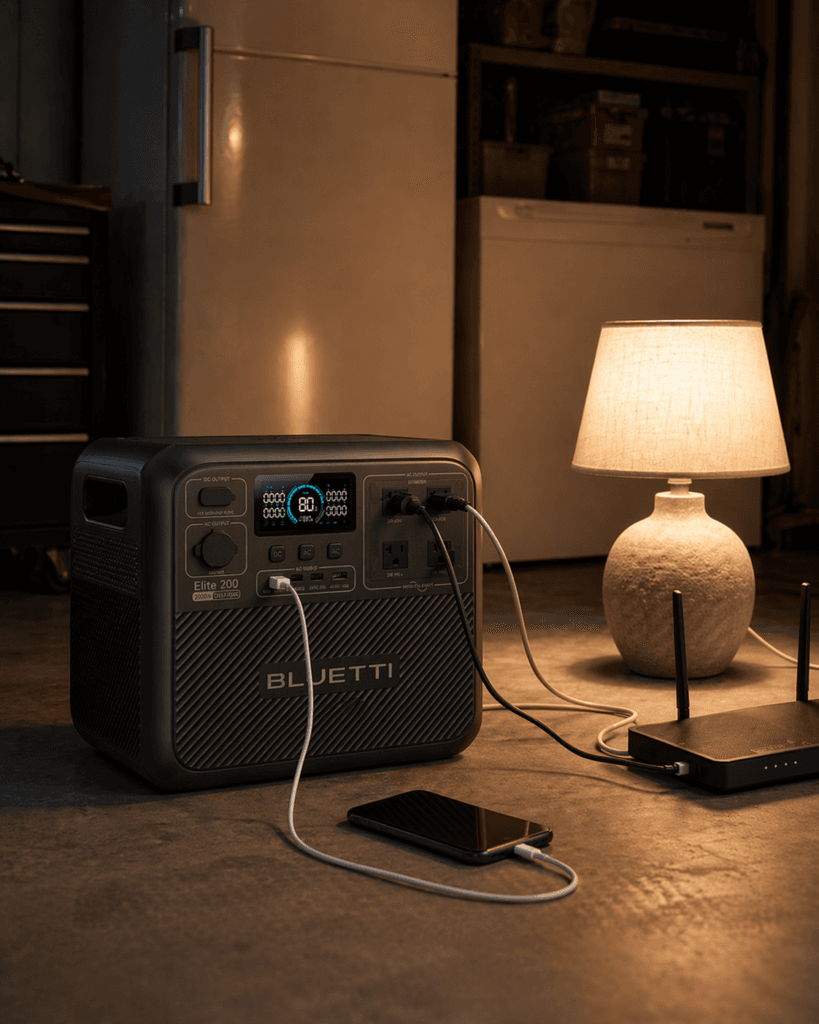
BLUETTI Elite 200 V2 Review: Main Trade-Offs
The advantages and limits in this BLUETTI Elite 200 V2 review are easy to state once the role is clear. It is powerful, well-equipped, and relatively compact for its capacity, but it is not modular.
- Strength: 2,600W continuous AC output gives more appliance flexibility than many smaller stations.
- Strength: 2,073.6Wh LiFePO4 capacity provides a useful reserve for planned essential loads.
- Strength: UPS mode, app control, and up to 1,000W solar input improve practical ownership value.
- Strength: The current 60-month warranty is stronger than short one-year coverage often seen on lower-cost units.
- Trade-off: 53.35 lb is portable in a vehicle or staged setup, but not easy for repeated casual carrying.
- Trade-off: no compatible expansion battery is listed, so the capacity you buy is the capacity you keep.
- Trade-off: Power Lifting has specific pure-resistive-load conditions and should not be mistaken for a general continuous-output upgrade.
Alternatives for Different Buyers
A useful BLUETTI Elite 200 V2 review should point buyers away when another design fits better.
- Need expansion: choose a verified expandable platform, such as the BLUETTI Apex 300, when the goal is to add capacity over time rather than accept a fixed 2kWh battery.
- Need easier carrying: a lighter 1kWh-class model such as the EcoFlow DELTA 3 Plus can make more sense for compact loads, shorter outages, and frequent transport.
- Need longer home-backup runtime: compare a larger modular 3kWh or 5kWh-class system after calculating the load plan, recharge path, and storage requirements.
- Need critical UPS behavior: use a dedicated UPS or professionally designed backup equipment where the connected device requires high-performance, safety-critical, or code-governed protection.
BLUETTI Elite 200 V2 Review FAQ
Can the BLUETTI Elite 200 V2 run a refrigerator?
Many refrigerators fall within the unit’s 2,600W continuous-output range, but the exact answer depends on compressor startup demand, running watts, temperature, cycling behavior, and what else is connected. Check the appliance label and calculate the load before purchase.
Is the BLUETTI Elite 200 V2 expandable?
No compatible expansion-battery option is listed in the current official product documentation. Buyers who want to add storage later should choose an expandable system from the start.
How fast does it recharge?
The current BLUETTI manual lists 80% in about one hour and 100% in about 1.4 hours at 10°C to 30°C with 1,800W AC charging. Actual timing can vary by temperature, battery state, and charging configuration.
Does it have UPS mode?
Yes. The manual lists UPS mode with a switchover of 15 ms or less and says UPS modes are set in the BLUETTI app. It is not intended for data servers or workstations requiring a high-performance UPS.
Is 3,900W Power Lifting the same as continuous output?
No. The 3,900W setting applies to selected pure resistive loads. The manufacturer states that actual output remains 2,600W, which is the number to use for normal load planning.
Final Verdict
This BLUETTI Elite 200 V2 review lands on a clear conclusion: it is a strong fit for buyers who want a powerful fixed-capacity portable power station and can make a realistic plan around its 2,073.6Wh battery. The 2,600W continuous inverter, up to 1,000W solar input, one-hour 80% charge claim under stated conditions, app control, UPS mode, and five-year warranty give it a compelling feature set.
The product should not be forced into every backup plan. The lack of an expansion-battery path is the defining limitation, not a minor detail. Choose it when the fixed capacity fits your actual loads. Choose an expandable alternative when future runtime growth is part of the plan.
Before purchase, confirm the current Amazon listing, accessory bundle, solar-panel compatibility, and the exact requirements of your connected appliances or devices.