
Review
EcoFlow DELTA 2 Max Review: Fast 2kWh Backup With Real Expansion
The EcoFlow DELTA 2 Max makes the most sense for buyers who need 2kWh capacity with fast charging and expansion options. The 43-minute fast charge and 1000W solar input are class-leading. It is not the right choice for buyers who need 3000W+ continuous output or who need a lightweight unit for frequent transport.
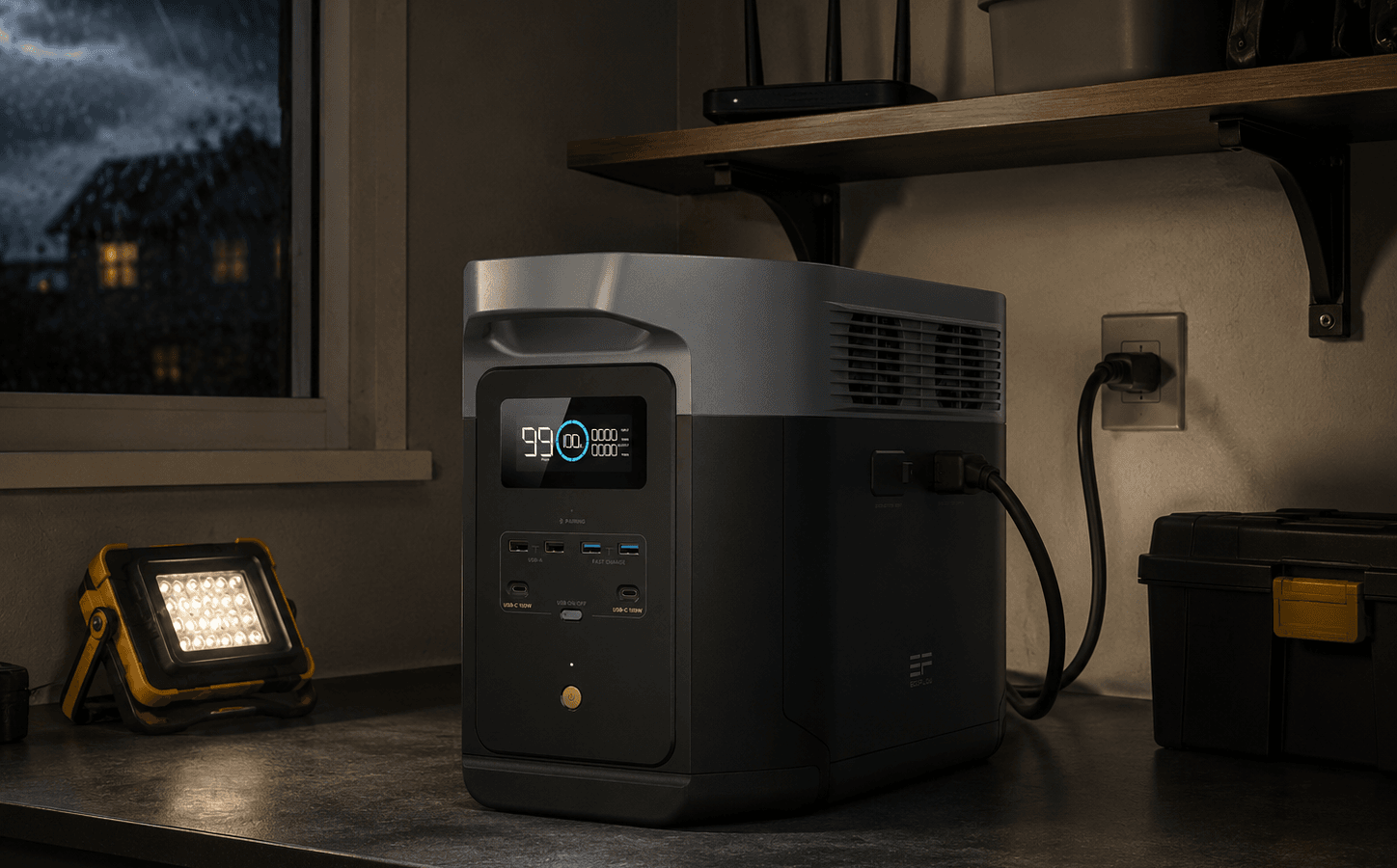
Linked Product Snapshot
Core specs
Buyer Fit
Pros and tradeoffs
Strengths
Pros
- 2048Wh LiFePO4 battery rated for 3000 cycles
- Fast 0-80% in about 43 minutes via combined AC and solar
- 1000W dual MPPT solar input for RV and off-grid use
- Expandable to 6144Wh with two Smart Extra Batteries
- 6 AC outlets plus 2x100W USB-C and 4 USB-A
- App control and scheduling via EcoFlow App
- 5-year warranty
Tradeoffs
Cons
- About 50 lbs makes solo relocation difficult
- X-Boost is load management not a 3400W continuous inverter
- UPS function not prominently confirmed — verify firmware before relying on it
- Expansion batteries sold separately at significant additional cost
- No native 240V output as a standalone unit
This article may contain affiliate links. If you buy through these links, PowerLabPro may earn a commission at no extra cost to you. As an Amazon Associate I earn from qualifying purchases.
The EcoFlow DELTA 2 Max review comes down to one real question: does a 2kWh station with fast charging and modular expansion actually earn its price premium over the lighter, cheaper 1kWh options? This EcoFlow DELTA 2 Max review covers verified specs, honest trade-offs, and clear buyer scenarios based on manufacturer-published specifications. No hands-on testing is claimed.
EcoFlow DELTA 2 Max Review: Quick Verdict
The EcoFlow DELTA 2 Max is a well-built 2kWh unit with three genuine strengths: fast recharge, strong solar input, and a modular expansion path to 6144Wh. The 43-minute 0-to-80% charge time using combined AC and solar input is among the fastest in this capacity class. At approximately 50 lbs, it trades portability for output and longevity. Buyers who need a lightweight unit or need more than 2400W continuous should look at different options.
In This Review

- Fuel up 80% in Only 43 Mins: With DELTA 2 Max’s upgraded tech, combine up to 1000W solar input with AC for world-leading…
- 10-Year Long-Lasting LFP Battery: LFP battery chemistry provides 3000 cycles till it lowers to 80% capacity. That’s 6 mo…
- Expandable Capacity from 2kWh to 6kWh: Triple the capacity of DELTA 2 Max with up to 2 extra solar powered batteries. Cu…
Who It Is Best For
- Home backup buyers who want 2kWh capacity with room to expand via extra batteries
- RV and van owners with solar panels who want 1000W dual MPPT input and app control
- Buyers with a transfer switch planning partial home backup that can scale later
- Off-grid setups where fast recharge from combined solar and AC is a priority
Who Should Skip It
- Buyers who need to move the unit frequently on their own (50 lbs is a two-hand carry)
- Anyone whose backup needs fit within 1kWh (the EcoFlow DELTA 3 Plus is lighter, cheaper, and has confirmed UPS)
- Buyers who need 3000W or more continuous AC output (the Jackery Explorer 2000 Plus outputs 3000W)
- Anyone who needs a confirmed fast-switchover UPS without verifying firmware support first
EcoFlow DELTA 2 Max Review: Key Specifications
| Spec | Value |
|---|---|
| Capacity | 2048Wh |
| Battery Chemistry | LiFePO4 (3000 cycles) |
| AC Output | 2400W continuous |
| X-Boost Mode | Manages loads up to 3400W (load management, not continuous inverter) |
| Solar Input | Up to 1000W (dual MPPT) |
| AC Input | Up to 1800W |
| 0-80% Recharge | ~43 min (AC + solar combined); ~1.1 hr AC only |
| AC Outlets | 6 x 120V |
| USB-C | 2 x 100W |
| USB-A | 4 ports |
| Car Socket | 1 x 12V DC |
| Weight | ~50 lbs / ~22.7 kg [VERIFY at us.ecoflow.com] |
| Expandable | Yes, up to 6144Wh with two Smart Extra Batteries |
| App | EcoFlow App (iOS/Android) |
| Warranty | 5 years |
What Fast Charging Actually Means Here
The 43-minute headline applies to a specific scenario: charging simultaneously from an 1800W AC source and up to 600W of solar input, hitting a combined rate of approximately 2400W. AC-only charging to 80% takes roughly 1.1 hours. Still fast for a 2kWh unit, but the number requires context.
Solar-only charging depends heavily on panel wattage and conditions. A single 400W panel in good sun gets you roughly 5 to 6 hours for a full charge. The dual MPPT system allows two independent solar strings to charge simultaneously, so a proper 800W to 1000W solar setup reduces that to approximately 2 hours. Buyers planning a solar-primary setup should verify panel wattage, connector compatibility, and MPPT ratings before expecting headline solar speeds.
X-Boost: Load Management, Not Extra Inverter Power
EcoFlow markets X-Boost as the ability to run appliances up to 3400W. The inverter is still 2400W continuous. X-Boost is software that limits what the connected appliance actually draws so it stays within inverter capacity. A 1500W portable heater in X-Boost mode runs at reduced heat output, not full rated power. For buyers planning to run high-draw appliances, understanding actual inverter output matters more than the X-Boost ceiling. The portable power station sizing guide covers wattage calculations and capacity selection without guesswork.
Home Backup Performance
For this EcoFlow DELTA 2 Max review, the most realistic home-backup use case is short-outage support for essentials rather than full-house backup.
At 2048Wh and 2400W continuous output, the EcoFlow DELTA 2 Max handles a typical short-outage essential load: refrigerator, router, phone and laptop charging, and lighting. A standard energy-efficient refrigerator drawing 150 to 200W should run for roughly 7 to 10 hours on a full charge, though actual runtime depends on cycling behavior and ambient temperature. Use your own appliance wattage data rather than manufacturer runtime estimates.
Transfer switch compatibility extends the practical use significantly. With two Smart Extra Batteries, total capacity reaches 6144Wh. At that level, a conservative essentials-only load could realistically stretch 24 to 36 hours before recharging. The expansion batteries are sold separately and represent a significant additional cost that should factor into the total system budget.
See the EcoFlow DELTA 2 Max product page for the full structured specs and affiliate link.
RV and Off-Grid Use
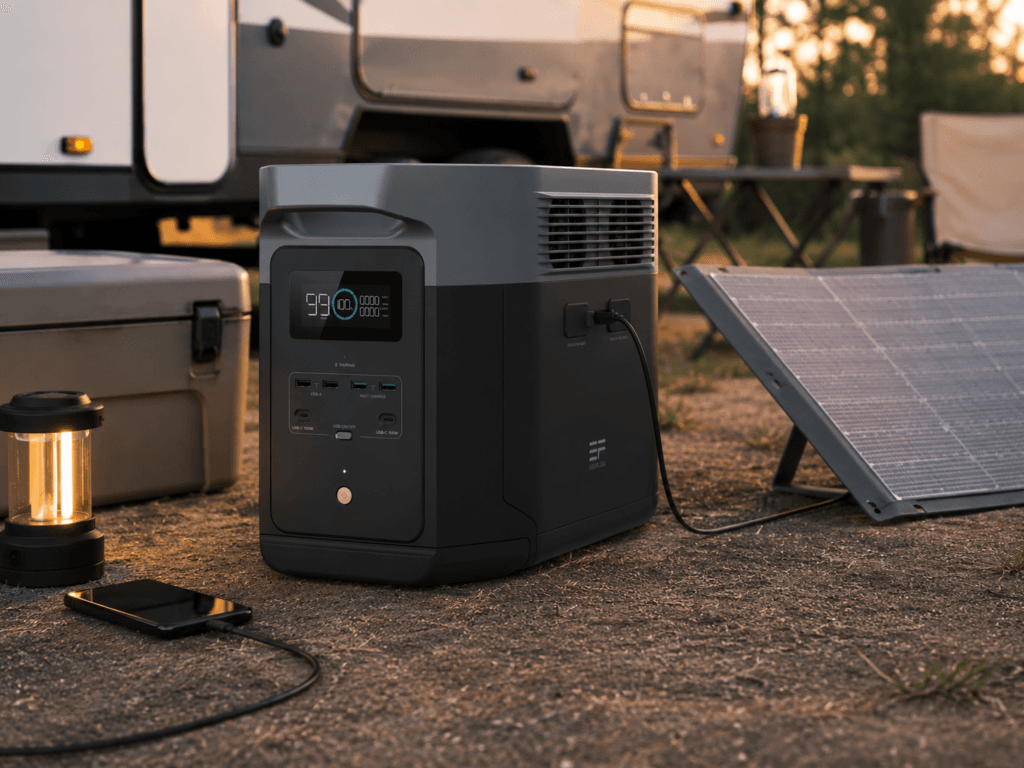
For RV buyers reading this EcoFlow DELTA 2 Max review, the 1000W dual MPPT solar input is the standout spec.. The EcoFlow App adds scheduling, reserve thresholds, and input source prioritization, which matters for buyers who split time between shore power hookups and off-grid camping.
Weight is the trade-off. At approximately 50 lbs, this unit stays mounted or stored in a fixed location. For van builds and larger RVs with a dedicated power bay, that is a non-issue. For smaller rigs or buyers who want flexibility, the weight limits practical portability.
Expandability: When It Makes Sense
The modular expansion path is the DELTA 2 Max’s clearest differentiator in the 2kWh class. Adding one Smart Extra Battery brings you to 4096Wh. Two batteries bring you to 6144Wh. Whether that math works depends on current pricing. Expansion batteries are not cheap, and the combined cost of base unit plus two batteries can approach or exceed the price of a purpose-built larger unit. Verify current pricing for both the base unit and Smart Extra Batteries before committing to expansion as the primary buying reason.
Pros and Cons
Pros
- 2048Wh LiFePO4 battery with 3000-cycle lifespan
- Fast 0-80% in approximately 43 minutes using combined AC and solar input
- 1000W dual MPPT solar input, strong for off-grid and RV setups
- Expandable to 6144Wh with two Smart Extra Batteries
- 6 AC outlets with 2400W continuous output
- App monitoring, scheduling, and input prioritization
- 5-year warranty
Cons
- Approximately 50 lbs makes solo relocation difficult
- X-Boost is load management, not a true 3400W continuous inverter
- UPS fast-switchover not confirmed — verify firmware before relying on it
- Expansion batteries sold separately at significant additional cost
- No native 240V output as a standalone unit
How It Compares
EcoFlow DELTA 2 Max Review Comparison: DELTA 2 Max vs DELTA 3 Plus
The DELTA 3 Plus is lighter, costs less, and includes a confirmed fast-switchover UPS. If your backup load fits within 1kWh and you need something you can carry easily, the DELTA 3 Plus is the smarter buy. The EcoFlow DELTA 2 Max earns its premium when you need more than 1kWh, want the expansion option, or plan to run a refrigerator through a full day outage.
EcoFlow DELTA 2 Max vs Jackery Explorer 2000 Plus
Both are 2kWh LiFePO4 stations with strong build quality. The Jackery Explorer 2000 Plus outputs 3000W continuous versus the EcoFlow DELTA 2 Max’s 2400W. The EcoFlow DELTA 2 Max charges faster as a standalone unit and accepts more solar input. For raw appliance output, the Jackery 2000 Plus has the edge. For fastest charging and solar-priority use, the EcoFlow DELTA 2 Max wins.
What to Verify Before Buying
Before acting on this EcoFlow DELTA 2 Max review, verify the current product page, battery compatibility, and warranty terms.
- Confirm current unit weight against the manufacturer spec page before purchase
- Verify UPS/EPS fast-switchover support if needed for medical equipment or sensitive electronics
- Check current Smart Extra Battery pricing and compatibility with your specific unit version
- Confirm solar panel connector type before pairing with third-party panels
- Review current warranty terms directly at us.ecoflow.com before purchase
Frequently Asked Questions
Is this EcoFlow DELTA 2 Max review based on hands-on testing?
No. This EcoFlow DELTA 2 Max review is based on manufacturer-published specifications, product data, and buyer-fit analysis. No hands-on testing is claimed.
Does the EcoFlow DELTA 2 Max have a UPS function?
EcoFlow has not prominently featured a fast-switchover UPS on the DELTA 2 Max in the same way as the DELTA 3 Plus. Verify current firmware support before relying on it for sensitive medical or network equipment.
How long does it take to charge the EcoFlow DELTA 2 Max?
Using combined AC and solar input at maximum rates, the EcoFlow DELTA 2 Max reaches 80% charge in approximately 43 minutes. AC-only charging to 80% takes roughly 1.1 hours. Solar-only charging depends on panel wattage and conditions.
Can the EcoFlow DELTA 2 Max run a refrigerator?
Yes. A typical energy-efficient refrigerator drawing 150 to 200W should run for roughly 7 to 10 hours on a full 2048Wh charge. Actual runtime depends on your fridge model, ambient temperature, and cycling frequency.
How many extra batteries can the EcoFlow DELTA 2 Max support?
The EcoFlow DELTA 2 Max supports up to two Smart Extra Batteries, expanding total capacity from 2048Wh to a maximum of 6144Wh. The extra batteries are sold separately.
What is the difference between the EcoFlow DELTA 2 Max and the DELTA 2?
The DELTA 2 has 1024Wh capacity and 1800W output. The EcoFlow DELTA 2 Max has 2048Wh, 2400W output, 1000W solar input, and supports expansion batteries for up to 6kWh total capacity.
Final Verdict
This EcoFlow DELTA 2 Max review finds the unit strongest for buyers who want fast charging, long battery lifespan, and the option to grow their backup capacity without replacing the base unit. The 43-minute fast charge and 1000W dual MPPT solar input are genuine strengths in this class. The weight limits portability, and buyers who need 3000W continuous output or a confirmed UPS function should look at alternatives. For its intended use as a home backup base unit or a fixed RV power hub, the EcoFlow DELTA 2 Max delivers what it promises.
Testing Notes
- No hands-on testing claimed by PowerLabPro
- Analysis based on verified manufacturer-listed specifications
- Amazon page used only for product identity ASIN and purchase path
- Runtime estimates should be calculated using actual appliance wattage
- Buyers should verify current warranty and availability before purchase