
Comparison
Jackery Explorer 2000 Plus vs EcoFlow DELTA 2 Max: Which 2kWh Backup Station Fits?
Jackery Explorer 2000 Plus vs EcoFlow DELTA 2 Max comparison for home backup, RV power, solar charging, and expandable capacity. Verified specs, buyer fit, and clear recommendations.
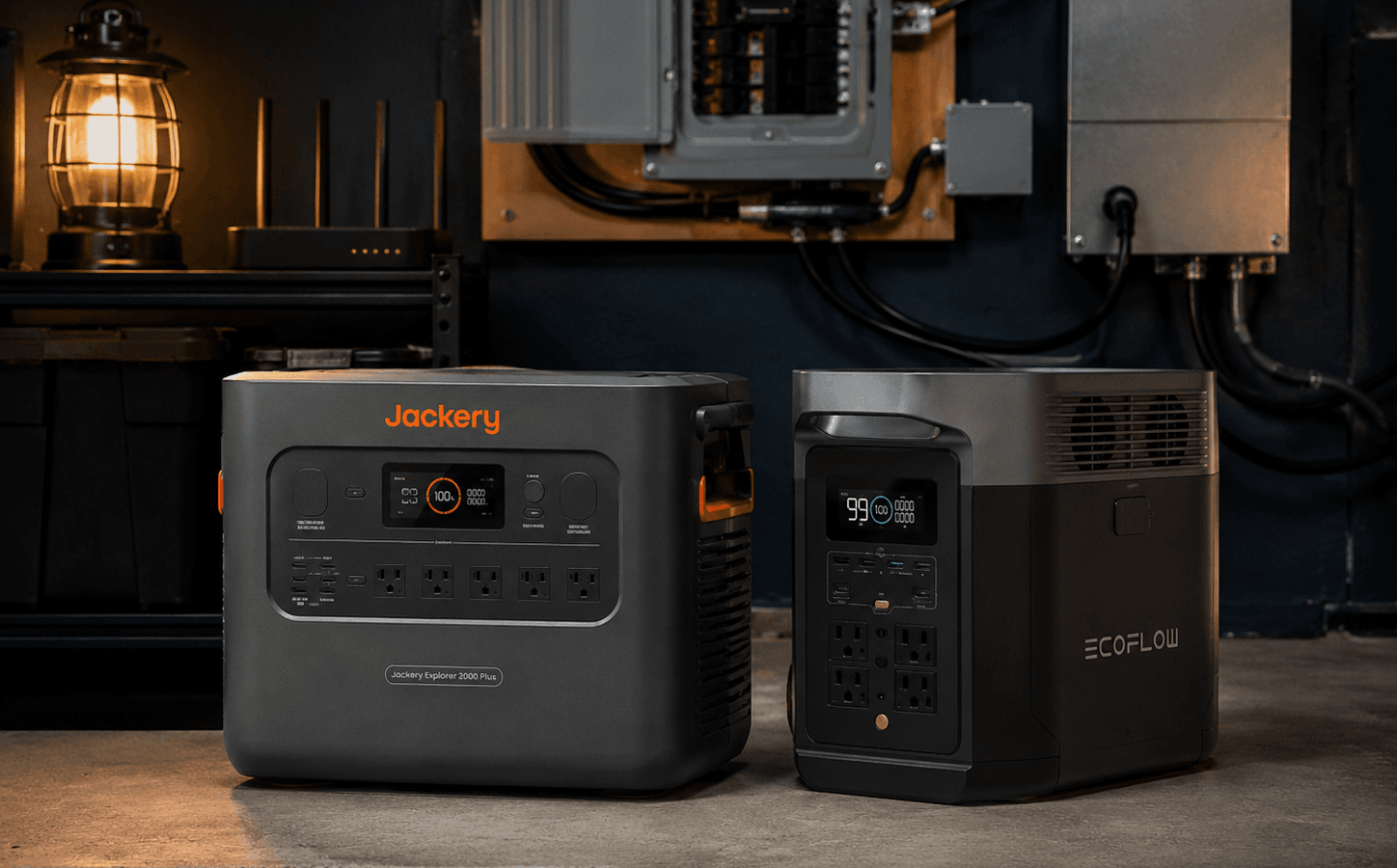
Product Matchup
Side-by-side summary
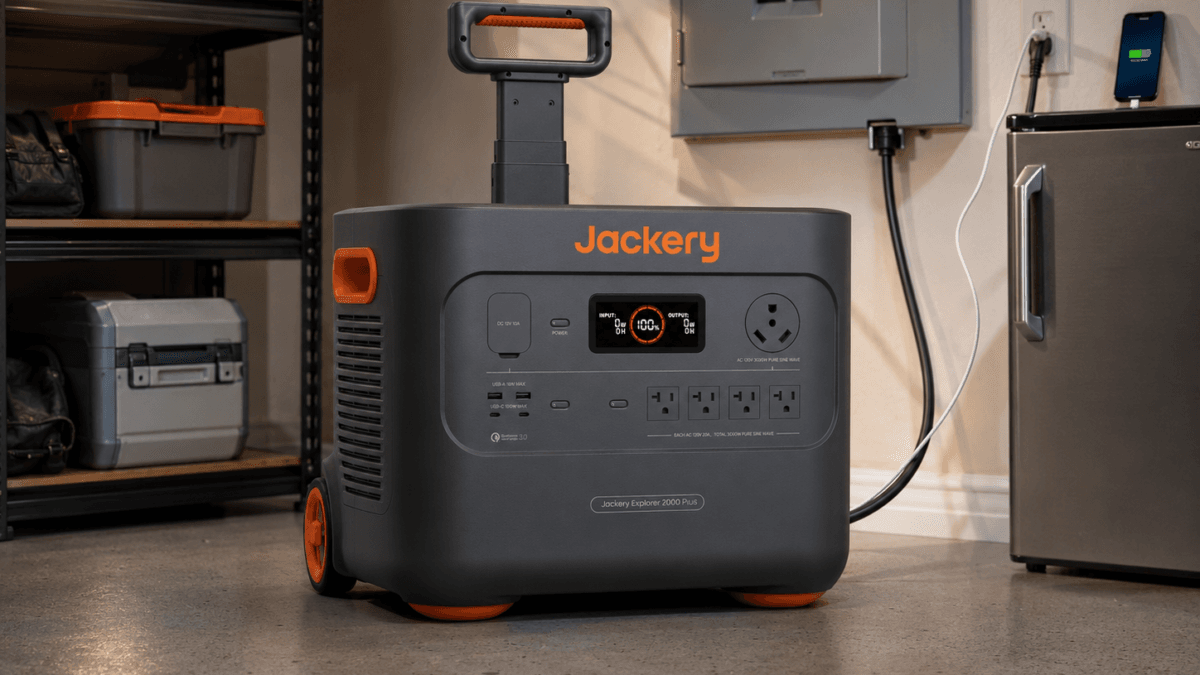
Product A
Jackery Explorer 2000 Plus Portable Power Station
The Jackery Explorer 2000 Plus is a 2042.8Wh LiFePO4 portable power station with 3000W AC output, 6000W surge power, 1400W max solar input, EPS support, and expandable capacity from 2kWh up to 24kWh for home backup, RV power, and off-grid use.
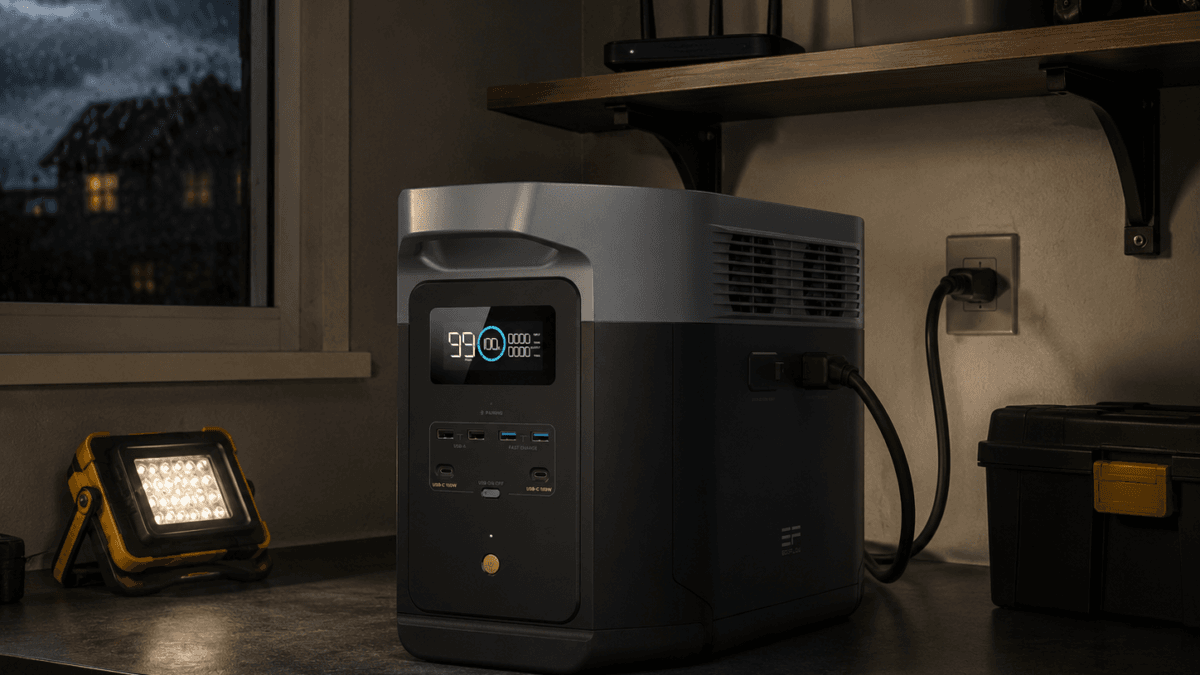
Product B
Overall Winner
EcoFlow DELTA 2 Max
The EcoFlow DELTA 2 Max portable power station delivers 2048Wh LiFePO4 capacity, 2400W output, and fast 43-minute charging. Built for expandable home backup, RV solar use, and buyers who need room to grow.
Spec Comparison
Core numbers
| Spec | Jackery Explorer 2000 Plus Portable Power Station | EcoFlow DELTA 2 Max |
|---|---|---|
| Capacity | 2042.8 Wh | 2048 Wh |
| AC Output | 3000 W | 2400 W |
| Solar Input | 1400 W | 1000 W |
This article may contain affiliate links. If you buy through these links, PowerLabPro may earn a commission at no extra cost to you. As an Amazon Associate I earn from qualifying purchases.
The Jackery Explorer 2000 Plus vs EcoFlow DELTA 2 Max comparison matters because both are 2kWh LiFePO4 power stations and both show up on nearly every “best backup” shortlist. On paper they look close. In practice, they solve different backup problems.
The Jackery Explorer 2000 Plus pushes harder on raw output: 3000W continuous, 6000W surge, and an expansion platform that reaches 24kWh. It is the stronger pick for high-draw appliances, 240V parallel setups, and buyers who want a system they can grow into over the next several years.
The EcoFlow DELTA 2 Max pushes harder on convenience: 43-minute fast charge to 80%, a stronger app with scheduling and remote monitoring, and a lighter frame at roughly 50 lbs versus the Jackery’s 61.5 lbs. Whether you are shopping for home backup, RV power, or both, this Jackery Explorer 2000 Plus vs EcoFlow DELTA 2 Max guide covers the specs, trade-offs, and buyer fit you need to decide.
Quick Verdict: Jackery Explorer 2000 Plus vs EcoFlow DELTA 2 Max
Choose the Jackery Explorer 2000 Plus if you need 3000W continuous AC output, 240V parallel capability, or an expansion path up to 24kWh. Best for high-draw home backup and RV owners with serious power needs.
Choose the EcoFlow DELTA 2 Max if you want the fastest recharge in this class, a better app experience, and a lighter unit you can move between rooms or vehicles without help. Best for convenience-first backup buyers.
Bottom line: the Jackery wins on output ceiling and expansion scale. The EcoFlow wins on charging speed, portability, and daily usability. For most buyers, the EcoFlow DELTA 2 Max is the better overall value in this Jackery Explorer 2000 Plus vs EcoFlow DELTA 2 Max matchup.

- Fuel up 80% in Only 43 Mins: With DELTA 2 Max’s upgraded tech, combine up to 1000W solar input with AC for world-leading…
- 10-Year Long-Lasting LFP Battery: LFP battery chemistry provides 3000 cycles till it lowers to 80% capacity. That’s 6 mo…
- Expandable Capacity from 2kWh to 6kWh: Triple the capacity of DELTA 2 Max with up to 2 extra solar powered batteries. Cu…

- Magnificent Performance: Featuring up to 2,042.8 Wh gigantic capacity, the Jackery 2000 Plus Power Station can power a r…
- Ultra Fast Charging: Charge directly from the sun or via wall outlet, conveniently, quickly and additionally worry free….
- 2kWh – 24kWh Flexible Expansion: The Jackery Explorer 2000 Plus supports up to 5 expandable battery packs, featuring pow…
Jackery Explorer 2000 Plus vs EcoFlow DELTA 2 Max: Quick Comparison
Specs sourced from the Jackery Explorer 2000 Plus product page and the EcoFlow DELTA 2 Max product page. These are informational links, not affiliate links.
| Feature | Jackery Explorer 2000 Plus | EcoFlow DELTA 2 Max | Winner |
|---|---|---|---|
| Best For | High-output backup, 240V parallel, max expansion | Fast recharge, app control, lighter carry | Depends on use case |
| Capacity | 2,042Wh | 2,048Wh | Tie |
| AC Output | 3,000W (6,000W surge) | 2,400W (X-Boost to 3,400W) | Jackery |
| Recharge (0-80%) | ~1.3 hours via AC | ~43 minutes (AC + solar) | EcoFlow |
| Solar Input | Up to 1,400W | Up to 1,000W (dual MPPT) | Jackery |
| Expansion | Up to 24kWh (parallel) | Up to 6,144Wh | Jackery |
| 240V Output | Yes (two-unit parallel) | No | Jackery |
| Weight | 61.5 lbs | ~50 lbs | EcoFlow |
| App Control | Yes (Jackery App) | Yes (EcoFlow App, more advanced) | EcoFlow |
| AC Outlets | 5 | 6 | EcoFlow |
| UPS/EPS | 20ms EPS | Not confirmed | Jackery |
| Warranty | 3+2 years (registration) | 5 years | EcoFlow |
| Battery Chemistry | LiFePO4 (~3,000 cycles) | LiFePO4 (3,000 cycles) | Tie |
The Jackery Explorer 2000 Plus vs EcoFlow DELTA 2 Max spec table shows a clear pattern: the Jackery wins on power and expansion categories, the EcoFlow wins on speed, weight, and ecosystem categories.
Key Differences That Actually Matter
At first glance, this Jackery Explorer 2000 Plus vs EcoFlow DELTA 2 Max comparison looks like a coin flip. Both use LiFePO4 chemistry. Both sit right around 2kWh. Both support solar. Both have apps. The headline number is almost identical.
The split shows up in how each unit earns its place in a backup plan. The Jackery is built to hit harder and grow bigger. Its 3000W continuous output handles window AC units, larger microwaves, and space heaters that would trip the EcoFlow’s 2400W inverter. Its expansion ceiling of 24kWh (two units in parallel with battery packs) is four times what the EcoFlow can reach.
The EcoFlow is built to recover faster and fit into daily life more easily. Charging from empty to 80% in 43 minutes is not a spec-sheet trick; it changes how you plan around an outage. The app gives you remote monitoring, charging schedules, and firmware updates that the Jackery app does not match yet. And at roughly 11 lbs lighter, you can actually carry the EcoFlow between a garage and a living room without dreading it.
PowerLabPro Note
Do not choose between these two based on capacity alone. The Jackery Explorer 2000 Plus vs EcoFlow DELTA 2 Max decision is really about output ceiling versus charging speed, and expansion scale versus daily convenience.
Output and Surge Power
The Jackery Explorer 2000 Plus vs EcoFlow DELTA 2 Max output gap is meaningful. The Jackery delivers 3000W continuous with a 6000W surge. That is 600W more than the EcoFlow’s rated 2400W, and it makes a real difference when you run appliances that pull close to or above 2400W during startup.
The EcoFlow DELTA 2 Max uses X-Boost to handle loads up to 3400W, but this is load management, not a true 3400W inverter. X-Boost reduces voltage to keep appliances running, which works well for resistive loads like space heaters. It does not work as reliably for motors, compressors, or appliances that need full voltage.
If your backup plan includes running a window AC unit, large microwave, or high-draw tools alongside other loads, the Jackery has more overhead. If your loads stay under 2400W and you just want more run time on essentials, the EcoFlow is fine. For the output category in this Jackery Explorer 2000 Plus vs EcoFlow DELTA 2 Max comparison, the Jackery wins clearly.
Battery Capacity and Expansion
Base capacity in the Jackery Explorer 2000 Plus vs EcoFlow DELTA 2 Max matchup is nearly identical: 2042Wh for the Jackery, 2048Wh for the EcoFlow. Neither has a meaningful advantage on a single charge.
The expansion story is where the Jackery pulls away. A single Explorer 2000 Plus can add up to five Battery Pack 2000 Plus units to reach approximately 12kWh. Two Explorer 2000 Plus units in parallel can reach 24kWh and unlock 240V/6000W output. That kind of ceiling is uncommon in consumer portable power stations.
The EcoFlow DELTA 2 Max expands to 6144Wh with two Smart Extra Batteries. That is roughly 3x the base unit and more than enough for most home backup scenarios, but it cannot match the Jackery’s scale for buyers who want to build a semi-permanent system.
Here is the honest trade-off: most buyers will never expand beyond one or two add-on batteries. If your realistic plan stops at 4 to 6kWh, the EcoFlow’s expansion ceiling is fine. If you genuinely need 10kWh or more, the Jackery is the only realistic choice in the Jackery Explorer 2000 Plus vs EcoFlow DELTA 2 Max expansion comparison.
Charging Speed
Charging speed is the EcoFlow’s strongest advantage in the Jackery Explorer 2000 Plus vs EcoFlow DELTA 2 Max comparison. The DELTA 2 Max reaches 80% in approximately 43 minutes using combined AC and solar input. A full charge takes roughly one hour. That speed matters when you get a storm warning, when the power just came back and you need to top off before the next outage, or when you’re loading up for a camping trip on short notice.
The Jackery Explorer 2000 Plus reaches 80% in about 1.3 hours via AC. That is still fast by most standards, but it is roughly double the EcoFlow’s time. In a repeated-outage scenario where the power cycles on and off, the EcoFlow recovers meaningfully faster each time. For the Jackery Explorer 2000 Plus vs EcoFlow DELTA 2 Max charging race, the EcoFlow wins by a wide margin.
For buyers who charge primarily through solar, the Jackery can accept up to 1400W of solar input compared to the EcoFlow’s 1000W. In strong sun with enough panel capacity, the Jackery’s higher solar ceiling can close the gap.
Solar Charging
Solar performance in the Jackery Explorer 2000 Plus vs EcoFlow DELTA 2 Max matchup splits by approach. The Jackery supports up to 1400W of solar input and is optimized for Jackery’s own SolarSaga panels. Third-party panel compatibility should be confirmed before purchase because the connector type (DC8MM/DC8020) may limit options.
The EcoFlow DELTA 2 Max accepts up to 1000W through dual MPPT controllers, which can handle two independent panel strings. This is more flexible for RV and off-grid setups where you might use different panels on different roof angles or orientations. EcoFlow supports a broader range of third-party MC4-connector panels out of the box.
If maximum solar wattage matters most, the Jackery wins on paper. If panel flexibility and dual-string optimization matter more, the EcoFlow has the edge. For practical RV setups with 400W to 800W of panels, both units in this Jackery Explorer 2000 Plus vs EcoFlow DELTA 2 Max solar comparison perform well.
Portability and Weight
Portability is a clear EcoFlow advantage in the Jackery Explorer 2000 Plus vs EcoFlow DELTA 2 Max comparison. The EcoFlow DELTA 2 Max weighs approximately 50 lbs, roughly 11 lbs lighter than the Jackery Explorer 2000 Plus at 61.5 lbs. Both units include handles. The Jackery adds wheels and a telescoping handle, which helps on flat surfaces but does not solve the problem of lifting it into an RV, up stairs, or over rough ground.
If you plan to keep the unit in one spot (utility closet, garage shelf, dedicated RV bay), weight matters less and the Jackery’s wheels are a useful bonus. If you move it between rooms during outages or load it into a vehicle for weekend trips, the EcoFlow’s 11-lb advantage adds up over time.
Neither unit is a one-hand carry. Both are two-person or dolly situations for anyone who does not want to risk a back injury.
App and Smart Features
App quality is another area where the Jackery Explorer 2000 Plus vs EcoFlow DELTA 2 Max gap favors the EcoFlow. The EcoFlow App gives you real-time input/output monitoring, charging mode control, scheduling, remote on/off, and firmware updates that can add features and fix bugs after purchase. For buyers who treat a power station as part of a home energy setup rather than a box that sits in a closet, the EcoFlow app adds genuine daily value.
The Jackery App provides basic monitoring and some control functions. It works, but it does not yet match the EcoFlow app for depth, responsiveness, or smart-home integration. Jackery has been improving its app over time, so this gap may narrow, but as of current firmware it is still noticeable.
For buyers who just want to plug in and go, the app difference will not change the Jackery Explorer 2000 Plus vs EcoFlow DELTA 2 Max purchase decision. For buyers who monitor energy usage, schedule off-peak charging, or want remote alerts during an outage, the EcoFlow has a measurable advantage.
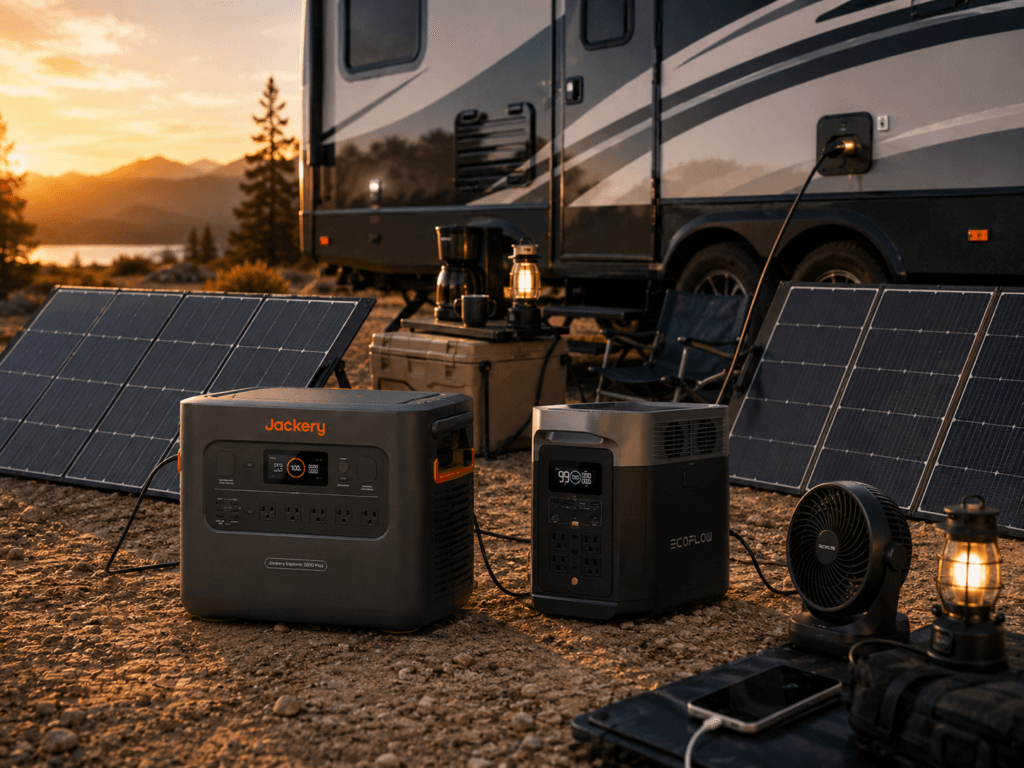
Home Backup Use
For home backup, the right choice in this Jackery Explorer 2000 Plus vs EcoFlow DELTA 2 Max comparison depends on what you plan to run and how long you plan to run it.
The Jackery is the better fit for home backup scenarios that include higher-draw appliances: window AC, electric heater, large microwave, or multiple circuits via a transfer switch. Its 3000W output and 240V parallel option give it more headroom than the EcoFlow for serious backup planning.
The EcoFlow is the better fit for essential-load backup where fridge, router, lights, devices, and occasional higher-draw use make up the load profile. The faster recharge means the unit recovers between outage cycles more quickly, and the app lets you monitor remotely instead of walking to the garage to check the display. For essential-load home backup, the Jackery Explorer 2000 Plus vs EcoFlow DELTA 2 Max verdict favors the EcoFlow.
If you are not sure how much backup capacity you need, start with the PowerLabPro sizing guide before choosing either unit.
RV and Off-Grid Use
Both units work well for RV use, but the Jackery Explorer 2000 Plus vs EcoFlow DELTA 2 Max split here follows the same theme: scale versus convenience.
The Jackery Explorer 2000 Plus is the better fit for full-time or extended RV use. Its 1400W solar ceiling, wheels, telescoping handle, and expansion path make it the more complete RV energy platform. Buyers who want to reduce or replace generator reliance during multi-day boondocking will find the Jackery’s scale more useful.
The EcoFlow DELTA 2 Max is the better fit for weekend RV trips, campsite-to-campsite travel, and setups where the unit plugs in at each stop and tops off quickly before the next leg. Its dual-MPPT solar input handles mismatched panel orientations more gracefully, which matters on RV roofs where panels cannot always face the same direction. For RV buyers weighing the Jackery Explorer 2000 Plus vs EcoFlow DELTA 2 Max choice, the answer depends on trip length and solar ambition.
For a deeper look at the Jackery’s RV fit, read the Jackery Explorer 2000 Plus review. For the EcoFlow’s buyer fit, see the EcoFlow DELTA 2 Max review.
Which One Should You Buy?
Here is the Jackery Explorer 2000 Plus vs EcoFlow DELTA 2 Max buyer decision in plain terms.
Choose the Jackery Explorer 2000 Plus if:
- You need 3000W continuous output for high-draw appliances.
- You want 240V output via a two-unit parallel connection.
- You plan to expand to 12kWh or beyond over time.
- You want a serious RV or off-grid platform with 1400W solar input.
- Your backup plan includes a transfer switch or whole-home circuit coverage.
- EPS (20ms switchover) matters for keeping devices running during an outage.
Choose the EcoFlow DELTA 2 Max if:
- You want the fastest recharge in the 2kWh class (43 minutes to 80%).
- You want a better app with remote monitoring and scheduling.
- You need a lighter unit you can move without a second person or dolly.
- Your loads stay under 2400W and the 6 AC outlets are more useful.
- You want a 5-year warranty without registration requirements.
- Dual-MPPT solar and MC4 panel compatibility matter for your setup.
If neither scenario fits perfectly, read both reviews and compare against your actual load list. The Jackery Explorer 2000 Plus vs EcoFlow DELTA 2 Max answer always comes back to what you plan to plug in and how fast you need it recharged.
Jackery Explorer 2000 Plus vs EcoFlow DELTA 2 Max FAQ
Which has more battery capacity?
They are nearly identical. The Jackery has 2042Wh and the EcoFlow has 2048Wh. The 6Wh difference will not affect real-world runtime in this Jackery Explorer 2000 Plus vs EcoFlow DELTA 2 Max comparison.
Which charges faster?
The EcoFlow DELTA 2 Max, by a significant margin. It reaches 80% in approximately 43 minutes versus the Jackery’s 1.3 hours.
Which has better solar charging?
The Jackery accepts more total solar wattage (up to 1400W vs 1000W). The EcoFlow has dual-MPPT controllers that optimize two panel strings independently, which is more flexible for uneven panel setups.
Can either produce 240V output?
Only the Jackery Explorer 2000 Plus, and only when two units are connected in parallel. The EcoFlow DELTA 2 Max does not support 240V output.
Which is better for CPAP backup?
Both are more than capable for CPAP backup. The Jackery’s confirmed 20ms EPS gives it a slight edge for uninterrupted power, though buyers should verify current firmware for the specific EPS behavior. For a dedicated CPAP guide, see best portable power station for CPAP.
Is one clearly better than the other overall?
For most buyers, the EcoFlow DELTA 2 Max is the better overall value because of faster charging, lighter weight, better app, and a 5-year warranty. The Jackery Explorer 2000 Plus is the better pick only when 3000W output, 240V, or large-scale expansion is genuinely needed.
Is this a hands-on comparison?
No. This Jackery Explorer 2000 Plus vs EcoFlow DELTA 2 Max comparison is based on manufacturer-listed specifications, verified product data, and PowerLabPro’s backup-power decision framework. No hands-on lab testing is claimed.
Final Verdict: Jackery Explorer 2000 Plus vs EcoFlow DELTA 2 Max
The Jackery Explorer 2000 Plus vs EcoFlow DELTA 2 Max comparison does not have a single winner because these two units serve different buyer priorities at the same capacity level.
The Jackery Explorer 2000 Plus is the stronger pick for buyers who need raw output, a 240V parallel option, and a modular platform that can grow to 24kWh. It handles higher-draw loads, offers more solar headroom, and is the better foundation for a serious long-term backup or RV energy system.
The EcoFlow DELTA 2 Max is the stronger pick for buyers who want speed, convenience, and a smarter daily experience. The 43-minute fast charge, better app, lighter weight, and longer no-registration warranty make it the easier unit to live with, especially for buyers whose loads stay under 2400W. For most 2kWh buyers who do not need 3000W output or 240V, the EcoFlow DELTA 2 Max is the better overall value.
Buy the Jackery if your backup plan is about power ceiling and expansion. Buy the EcoFlow if your backup plan is about speed, flexibility, and ease of use. Both are strong 2kWh choices, and the right Jackery Explorer 2000 Plus vs EcoFlow DELTA 2 Max answer depends on how you plan to use it.
For the full editorial analysis of each unit, read the Jackery Explorer 2000 Plus review and the EcoFlow DELTA 2 Max review. For help sizing your backup needs, see what size power station do I need.
Winners by Category
| Overall | EcoFlow DELTA 2 Max Portable Power Station |
|---|---|
| Value | EcoFlow DELTA 2 Max Portable Power Station |
| Portability | EcoFlow DELTA 2 Max Portable Power Station |
| Output | Jackery Explorer 2000 Plus: Expandable 2kWh Backup |
| Battery | Jackery Explorer 2000 Plus: Expandable 2kWh Backup |
Final Verdict
The Jackery Explorer 2000 Plus is the stronger pick for buyers who need 3000W continuous output, 240V parallel capability, or a modular expansion system that can scale to 24kWh. The EcoFlow DELTA 2 Max is the better choice for buyers who want the fastest recharge in this class, better app control, and a lighter unit that costs less at the base level. Choose the Jackery for raw output ceiling and expansion scale. Choose the EcoFlow for charging speed, portability, and smart features.