
Product Intelligence
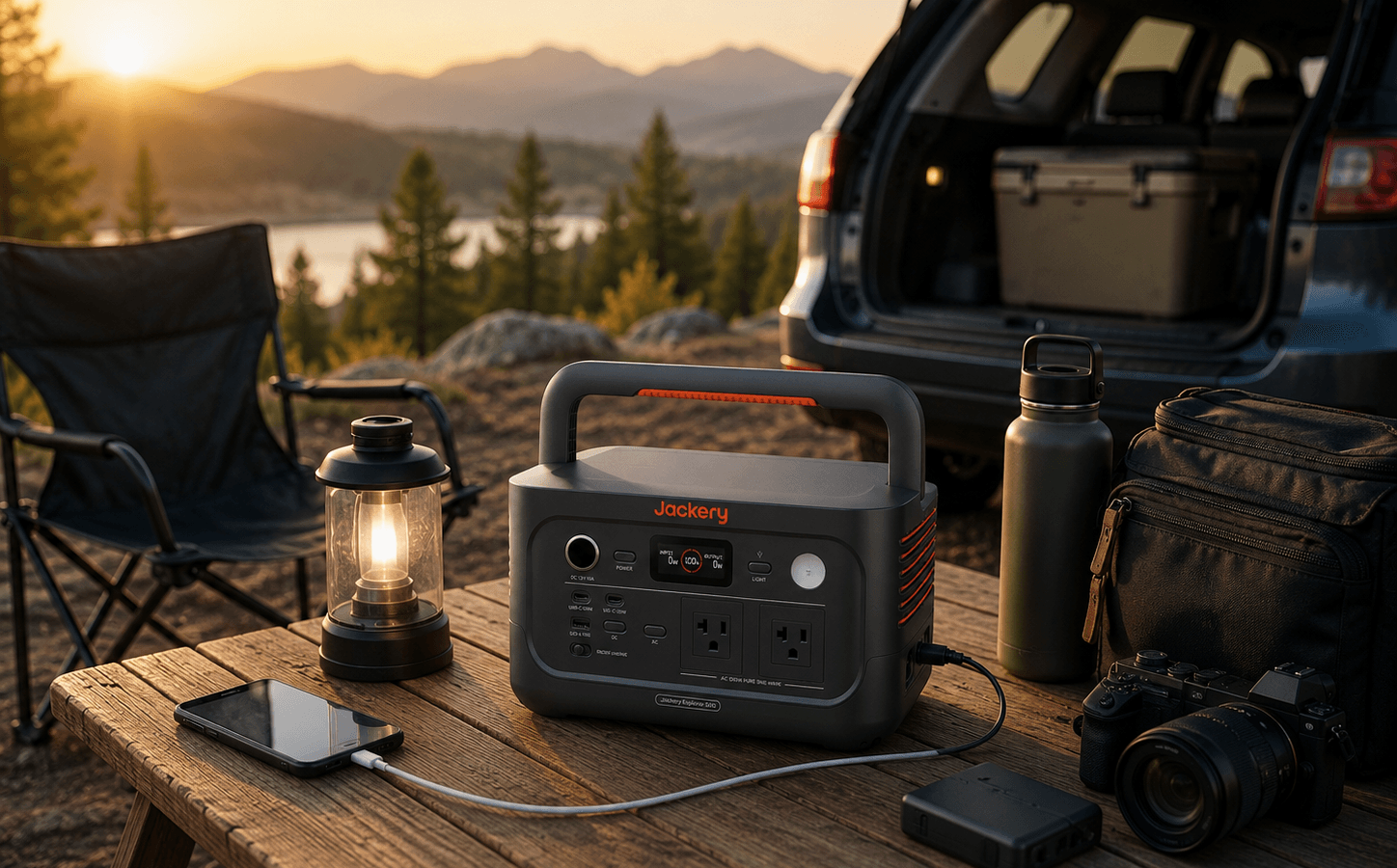
Best for light portable backupJackery Explorer 500 v2 Portable Power Station: 512Wh, 500W
A lightweight 640Wh LiFePO4 power station with 500W AC output and dual 100W USB-C ports for camping, travel, remote work, and controlled device backup.
Specifications
Key specs
Buyer Fit
Fit signals
Best for
Pros
- Light 12.6 lb carry weight for a 512Wh power station
- LiFePO4 battery with manufacturer-stated long cycle life
- Up to 200W solar input for compact recovery planning
- Useful mix of AC, USB-C, USB-A, and 12V outputs
- Fast wall charging for regular travel and backup routines
Cons
- 500W continuous output excludes many appliances and tools
- No expansion-battery path documented
- No Wi-Fi or Bluetooth app support documented
- Solar input is compact rather than system-scale
- UPS-style feature requires compatibility testing
Spec table
| Capacity | 512 Wh |
|---|---|
| AC Output | 500 W |
| Surge Output | 1000 W |
| Solar Input | 200 W |
| Weight | 12.6 lb |
| Battery | LiFePO4 |
| Warranty | 5 years stated in current regional product coverage; verify U.S. warranty terms and registration requirements before purchase. |
| Expandability | No expansion-battery path documented for the Explorer 500 v2 platform. |
| UPS / EPS | UPS-style switchover under 10 ms listed. Not 0 ms uninterrupted power. Test the exact device before relying on it. |
| Recharge Time | Wall charging: about 1.3 hours; solar at up to 200W: about 2.8 hours; 12V car charging: about 6 hours; actual time varies by conditions. |
This article may contain affiliate links. If you buy through these links, PowerLabPro may earn a commission at no extra cost to you. As an Amazon Associate I earn from qualifying purchases.
Based on manufacturer-listed specifications and a current U.S. retailer identity check, the Jackery Explorer 500 v2 is a compact LiFePO4 portable power station with a 512Wh battery and a 500W continuous AC inverter. It is built for a defined low-draw power plan rather than broad household backup. That distinction matters more than the battery number alone.
The Jackery Explorer 500 v2 is most useful for buyers who will carry it regularly: camping, vehicle travel, camera gear, laptop work, router backup, phones, lights, and other equipment that remains comfortably within the 500W output limit. At about 12.6 lb, it is light enough to move between a car, campsite, desk, and outage kit without turning every setup into a lifting task.
Its main trade-off is direct. The Jackery Explorer 500 v2 is not an appliance-first station. Buyers who need heating, cooking, large tools, pumps, or broad household backup should start with a higher-output inverter and a larger energy reserve. This page is a verified product reference, not a hands-on test.
Jackery Explorer 500 v2 quick verdict
The Jackery Explorer 500 v2 is a practical compact choice for buyers who value low weight, direct USB-C charging, simple controls, and a predictable device list. Its 512Wh capacity can support communications, charging, lighting, and selected travel or home-office equipment. The 500W inverter is the boundary. Choose it for a controlled essential-load plan, not for a kitchen, workshop, or whole-home substitute.

- Reliable Power On-the-Go: The Jackery Explorer 500 v2 offers 512Wh capacity, delivering 500W rated power and 1000W surge…
- Camping Essential: Weighing just 14 lbs, the Explorer 500 v2 is the lightest LiFePO4 power station of its size. Its comp…
- Built to Last 10+ Years: Featuring a LiFePO4 battery with 6000 charge cycles, the Explorer 500 v2 guarantees more than 1…
Table of Contents
Jackery Explorer 500 v2 verified specifications
| Specification | Verified figure | Buyer meaning |
|---|---|---|
| Battery capacity | 512Wh | A compact energy reserve for a planned device list. |
| Battery chemistry | LiFePO4 | Jackery lists long cycle life under its stated conditions. |
| Continuous AC output | 500W | The core limit for sustained AC loads. |
| Surge output | Up to 1,000W | Temporary startup margin, not additional continuous power. |
| Solar input | Up to 200W | A compact solar recovery path with compatible panels. |
| Weight | About 12.6 lb | A major advantage for travel and frequent carrying. |
| UPS-style switchover | Under 10 ms listed | Must be tested with the exact connected device. |
The Jackery Explorer 500 v2 combines a 512Wh battery, two AC outlets, USB-C, USB-A, a 12V car-style output, and an integrated light in current regional documentation. For the primary product details and regional specifications, consult Jackery’s Explorer 500 v2 product documentation. Check the exact U.S. listing before purchase because bundle contents, warranty terms, outlet layouts, and included cables can vary.
Who should choose the Jackery Explorer 500 v2
The Jackery Explorer 500 v2 is a good fit for campers, car travelers, photographers, and remote workers who want enough stored energy for important electronics without moving into the weight and bulk of a 1kWh station. It is also suitable for a short-outage plan that protects communications: a router, laptop, phone, selected lighting, and device charging.
It is less suitable for buyers who begin with a refrigerator, heater, kettle, air fryer, large coffee maker, high-watt tool, pump, or several rooms of equipment. The Jackery Explorer 500 v2 can power devices well when the load plan is intentional. It becomes a poor purchase when it is expected to replace a large inverter or fixed backup system.
Jackery Explorer 500 v2 500W output and surge planning
Plan the Jackery Explorer 500 v2 around its 500W continuous output. Continuous output tells you what the inverter can sustain, while surge output gives limited help during a brief startup event. A higher surge number does not make a 700W appliance suitable for a 500W station. It does not create a comfortable long-running margin for heaters, cooking devices, or tools.
A better way to plan is to list priority loads, add their running watts, leave a buffer, and then check startup behavior. A router, laptop, phone charger, LED lamp, camera battery charger, and modest fan can form a strong match for the Jackery Explorer 500 v2. A compressor or motor-driven appliance needs extra caution because startup draw may be higher than the running value shown on its label.
Do not use the Jackery Explorer 500 v2 as a substitute for medically necessary, life-safety, fire-alarm, or code-governed backup. For a product that must support a demanding appliance or a higher-risk load, choose equipment with verified system compatibility and professional guidance where appropriate.
What 512Wh means in a realistic device plan
The 512Wh rating on the Jackery Explorer 500 v2 describes stored energy before normal losses and operating conditions are considered. Runtime changes with the device draw, temperature, battery condition, cable choice, inverter losses, and whether a device is charged directly from USB-C or through an AC adapter. That is why a simple runtime promise is not responsible product guidance.
The strongest use of the Jackery Explorer 500 v2 is normally a priority plan. Keep communication, work, and charging devices available first, then decide whether there is enough energy left for comfort equipment. Direct USB-C charging can reduce unnecessary conversion steps for compatible laptops, tablets, and cameras. Use the PowerLabPro sizing guide to calculate capacity needs from the actual devices you expect to run.
A 512Wh station can feel generous on a short camping trip or during a brief outage when loads are modest. The same battery can be depleted quickly when it is asked to run high-watt comfort loads. The Jackery Explorer 500 v2 should be chosen because its capacity matches a disciplined plan, not because every possible device can connect to it.
Jackery Explorer 500 v2 charging and solar recovery
The Jackery Explorer 500 v2 supports wall, car, solar, and combined AC-plus-solar charging. Jackery lists wall charging around 1.3 hours, solar charging around 2.8 hours at a 200W input ceiling, and 12V vehicle charging around 6 hours. Treat these as manufacturer-condition targets, not guaranteed recovery times.
Solar harvest depends on the panel, angle, season, shade, cable losses, temperature, battery state, and available sunlight. The Jackery Explorer 500 v2 can accept up to 200W of compatible solar input, but a 200W panel does not produce 200W continuously in the field. Verify the connector and adapter requirements before combining panels from different brands or generations.

Ports and practical workflow
The Jackery Explorer 500 v2 is a device-first power station. Its port mix is useful for a laptop, phone, camera battery charger, tablet, router, and selected 12V accessories. Direct USB-C power can simplify a travel or home-office kit because it avoids running an AC brick when the device supports USB-C charging.
Before ordering, check the current U.S. listing for individual port ratings, socket configuration, and included cables. The Jackery Explorer 500 v2 may be more valuable to a buyer who needs high-power USB-C than to someone who mainly needs several AC sockets. The practical question is not which product has the most ports. It is which product supports the equipment you own without creating unnecessary adapters or inverter losses.
Jackery Explorer 500 v2 UPS-style use and compatibility
Jackery lists an under-10-ms switchover for the Jackery Explorer 500 v2. That can be useful for compatible routers, lights, and personal devices. It is not a 0 ms uninterrupted-power guarantee and should not be treated as a universal replacement for a dedicated UPS, server backup, medical device, or safety-critical system.
Test the actual device before an outage. Connect one priority load, simulate the transfer while present, and confirm that the device remains stable. Repeat that test after changing a cable, charger, router, or power supply. A published switchover figure is only part of the decision. The behavior of the connected equipment is what matters.
Jackery Explorer 500 v2 use-case fit
Camping and travel
For camping, the Jackery Explorer 500 v2 is well matched to lighting, phones, cameras, laptops, portable speakers, a compact fan, and other low-draw equipment. Its light carry weight means it is more likely to leave the car and be useful at the campsite. Keep high-watt cooking and heating separate from this use case unless you have verified their continuous and starting demands.
Home office and communications
For a small home-office plan, the Jackery Explorer 500 v2 can protect a router, laptop, phone charging, selected lighting, and a carefully chosen monitor. Decide which devices must stay online, total the load, and avoid plugging in every convenience device. It is an outage bridge for a controlled essential-load plan, not a broad household battery.
Creator gear and mobile work
The Jackery Explorer 500 v2 can also suit photographers, drone users, and field workers who need charging away from an outlet. Verify each charger’s input requirements, carry the correct cables, and keep the station dry and ventilated. Its portability is valuable only when the equipment and setup are compatible.
What to verify before buying
| Verify | Why it matters |
|---|---|
| Actual device watts and startup behavior | Protects against overloads and poor appliance fit. |
| Exact listing, bundle, and socket layout | Regional versions and accessory contents can differ. |
| Solar connector compatibility | A panel needs the right connection and input range. |
| UPS-style behavior with your device | Under-10-ms switchover does not guarantee every device will remain online. |
| Warranty and return conditions | Commercial terms should be confirmed at the point of purchase. |
The Jackery Explorer 500 v2 is easiest to recommend after this check is complete. Buyers should not rely on an assumed runtime or a peak-watt number. A quick device list and a confirmed load plan make the product decision clearer and reduce the chance of buying a compact unit for the wrong job.
Safety, storage, and outage planning
Use the Jackery Explorer 500 v2 on a dry, stable, ventilated surface with vents clear and cables routed safely. Do not use it near water, inside a sealed hot vehicle, or where it could block an exit. It is a portable energy source, not a replacement for fixed electrical work, a transfer switch, or professionally designed backup power.
For general emergency preparation, review Ready.gov’s power-outage guidance alongside your own device and communication plan. Store the Jackery Explorer 500 v2 according to the manual, inspect charging cables periodically, and test the exact priority loads before an outage. A prepared setup is more useful than a battery that is stored with unknown charge and missing accessories.
Jackery Explorer 500 v2 final product decision
The Jackery Explorer 500 v2 is a strong compact choice for buyers who prioritize portable, low-draw power over appliance flexibility. It is especially sensible for travel, camping, creator equipment, remote work, communication continuity, and short outages with a verified device list. Its carry-friendly size, 512Wh capacity, USB-C capability, and compact solar pathway are the main advantages.
Choose a larger alternative when you need more than 500W continuously, longer energy reserve, expansion batteries, stronger solar recovery, or a more feature-rich monitoring platform. For deeper buyer trade-offs and alternatives, read the Jackery Explorer 500 v2 review. For any decision that depends on runtime, start with the PowerLabPro sizing guide.