
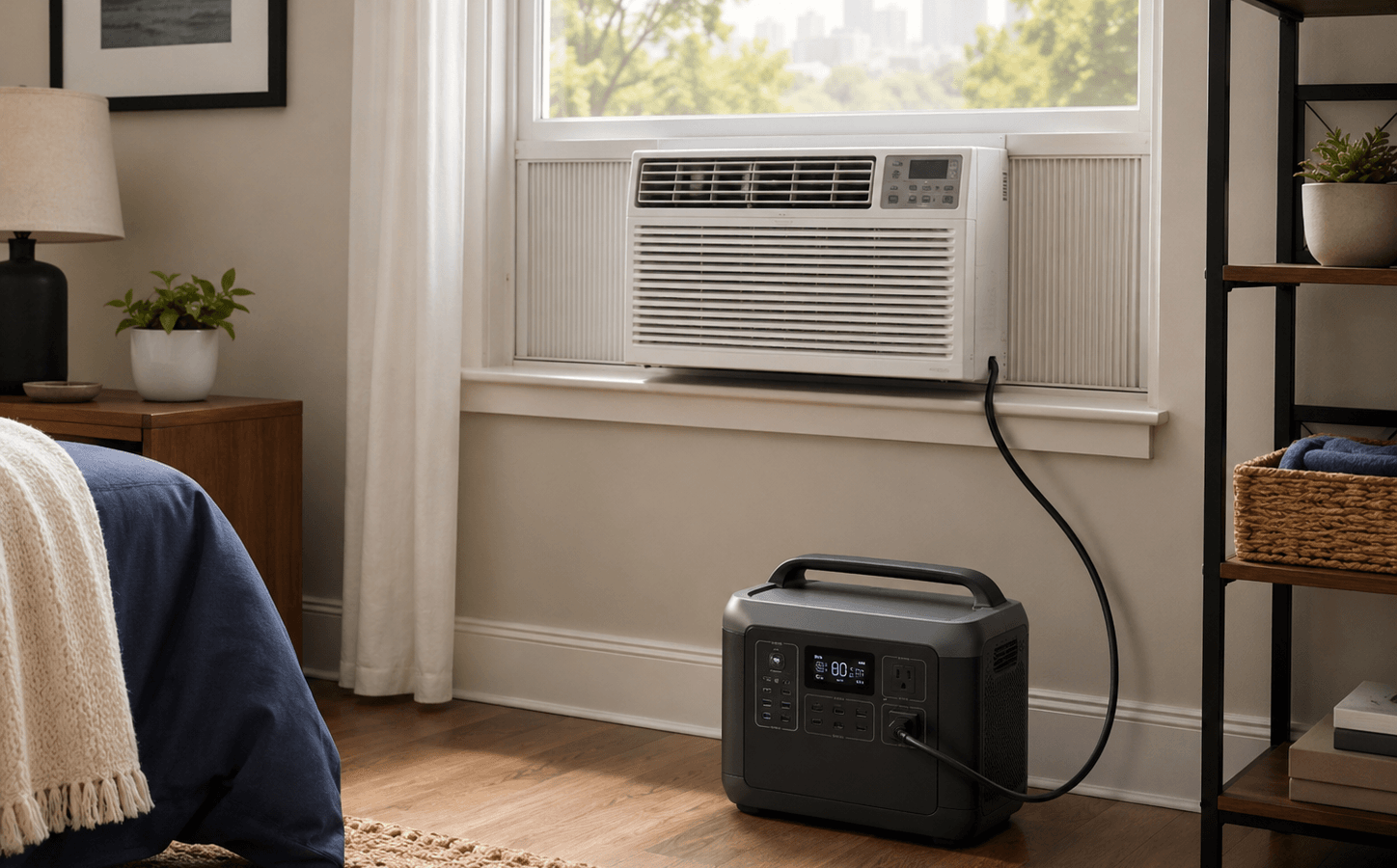
When the grid goes down on a hot afternoon, the first question is simple: can a window air conditioner run from a portable power station? Often, yes. But a successful five-minute test does not prove the setup will cool the room through repeated compressor cycles, preserve a battery reserve, or last through the hottest part of the day. The answer depends on voltage, running demand, startup behavior, measured energy use, room conditions, and the size of the battery.
This guide covers cord-connected US room units that use a compatible household outlet. It does not cover central air conditioning, mini-splits, heat pumps, hardwired equipment, backfeeding, or improvised connections to home wiring. The guidance is research-led and based on current US Department of Energy, ENERGY STAR, and CDC information. PowerLabPro has not tested your appliance or power station.
Quick answer
A portable power station can run a window air conditioner when the appliance uses compatible voltage, the inverter supports both normal operation and compressor startup, and the battery stores enough usable energy for the planned cooling period.
Good fit: a small or medium 120V room unit, one closed room, controlled additional loads, and a measured runtime plan.
Poor fit: a 230V or 240V unit without matching output, unknown electrical requirements, an undersized battery, or a plan that depends on uninterrupted cooling during dangerous heat.
Main decision: verify electrical compatibility first. Calculate runtime second. Keep a heat-safety fallback regardless of the result.
Table of Contents
Window Air Conditioner Backup: 7 Critical Checks
Most bad backup plans fail for one of two reasons. Either the station cannot start the compressor reliably, or the battery runs out far sooner than the owner expected. These seven checks show whether a window air conditioner backup plan is electrically compatible, useful for the required hours, and safe enough to depend on.
- Match the voltage and receptacle. The appliance and station must use compatible electrical output. A high watt rating cannot correct a voltage mismatch.
- Verify continuous demand. Use the exact window air conditioner label, manual, EnergyGuide information, or an approved measurement. Do not estimate electrical demand from BTU alone.
- Check compressor startup. The inverter must support the brief starting event without tripping, overheating, or forcing abnormal appliance behavior.
- Measure energy over time. A single display reading misses thermostat cycling, fan-only periods, and changing room conditions.
- Calculate usable runtime. Include conversion losses, battery reserve, other connected loads, battery temperature, and battery age.
- Reduce the cooling job. Close one room, block direct sun, seal gaps, and avoid heat-producing appliances.
- Prepare a fallback. Know when the battery plan is no longer enough and where reliable air conditioning is available.
A window air conditioner can pass the energy test and still fail the output test. The reverse is also possible: the station may start the compressor easily but lack enough battery capacity for meaningful cooling. Treat inverter compatibility and stored energy as two separate gates.
Start With Voltage, Not BTU
BTU per hour describes cooling capacity, not electrical input. Two room units with the same BTU rating can draw different power because of compressor design, efficiency, fan speed, humidity, installation quality, and the temperature difference between the room and outdoors.
The US Department of Energy room air conditioner guidance explains that smaller units can use ordinary 120V circuits, larger units may need a dedicated 115V circuit, and the largest models may require 240V. A 120V-only station cannot run a 240V window air conditioner simply because the inverter wattage looks large enough.
Read the window air conditioner label before shopping for a battery. Record voltage, rated amps or watts, plug shape, and any dedicated-circuit requirement. Then compare those facts with the station manual. Do not use the branch-circuit rating as the appliance load. A 15-amp circuit does not mean the unit continuously consumes 1,800 watts.
Correct room sizing matters too. DOE and ENERGY STAR room air conditioner guidance both emphasize matching cooling capacity to the room. An oversized unit may cool quickly without removing humidity well. An undersized unit may run continuously and turn a reasonable battery estimate into an unrealistic one.
| What to verify | Where to find it | Why it changes the decision |
|---|---|---|
| Voltage and plug | Appliance label and manual | Must match the station output and receptacle |
| Rated input | Label, manual, EnergyGuide, or approved measurement | Sets the continuous-output requirement |
| Startup behavior | Manufacturer documentation or controlled testing | Determines whether the compressor starts reliably |
| Cooling hours | Your outage plan | Sets the battery-energy target |
| Other loads | Your written load list | Reduces output headroom and runtime |
Running Watts and Compressor Startup
The station’s continuous AC rating must support the window air conditioner after startup. Its temporary surge capability must also handle the compressor-start event for long enough to let the motor accelerate. A large peak-output number on a product page does not prove compatibility with every compressor.
If the appliance label lists volts and amps, multiplying them gives a rough volt-amp screening figure. For example, 120 volts multiplied by 5 amps equals 600 volt-amps. That is not proof of exactly 600 watts, and it does not reveal startup demand or power factor. Use the number as an early screen, not a final answer.
Leave margin between the window air conditioner load and the station’s continuous rating. Margin helps when the fan changes speed, the compressor restarts, the battery is partly discharged, or another small load turns on. Do not run kettles, microwaves, space heaters, hair dryers, or other large appliances at the same time.
- Test several compressor starts, not only one start at full battery.
- Repeat a controlled test at a lower state of charge only when the station manual permits it.
- Stop if the station trips, the plug becomes hot, the appliance sounds abnormal, or either manual prohibits the setup.
- Do not rely on voltage-reduction or “power lifting” modes unless both manufacturers support compressor use.
A window air conditioner that starts in a cool room may behave differently on the hottest day of the year. Protection logic, ambient temperature, cord resistance, and battery condition can all change the result. A controlled test improves confidence, but it is not a guarantee.
Conventional and Variable-Speed Room Units
A conventional window air conditioner generally cycles the compressor fully on and off. Each restart can create a noticeable starting event. A variable-speed model can adjust compressor speed and may settle at a lower sustained draw after the room approaches the thermostat setting.
ENERGY STAR explains that conventional compressors behave more like an on-off switch, while variable-speed compressors can continuously adjust output. That can improve efficiency and temperature control. It does not automatically make a variable-speed window air conditioner compatible with a portable battery.
The word “inverter” on an air conditioner describes compressor-control technology. It does not mean the appliance will run from every power-station inverter. The exact model still needs compatible voltage, frequency, waveform, continuous output, startup support, and grounding behavior.
Measure a Complete Cooling Cycle
The most useful window air conditioner runtime input is energy consumed over a representative period, not the lowest watt number briefly shown on a display. Measure long enough to include startup, active cooling, fan-only operation, thermostat cycling, and the room conditions expected during an outage.
A correctly rated plug-in watt meter may be appropriate for a cord-connected 120V window air conditioner when the appliance manufacturer permits measurement. Do not use an underrated smart plug or meter. Never connect a 240V unit to equipment intended for ordinary 120V receptacles.
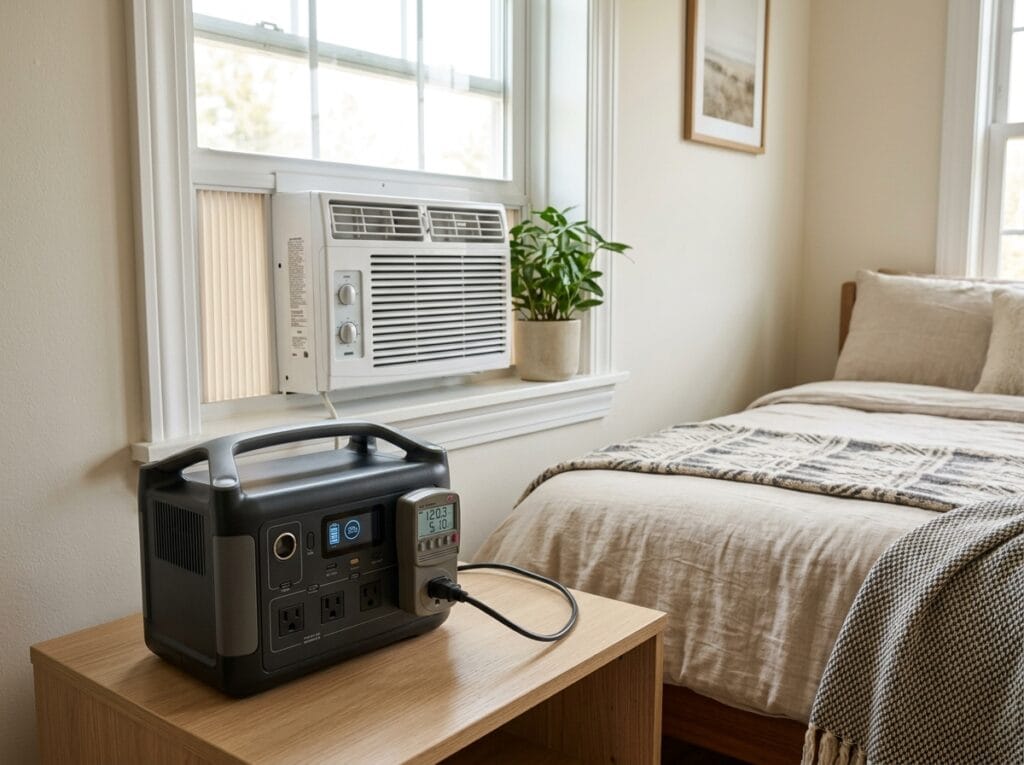
- Record indoor and outdoor temperature, thermostat setting, fan speed, sunlight, and whether doors are open.
- Begin with the room warm enough for the compressor to operate normally.
- Record startup behavior and any peak shown by properly rated equipment.
- Measure watt-hours through at least one complete compressor cycle. A longer test is better.
- Repeat the test under realistic conditions and use the higher representative result for planning.
- Add the energy used by every device that will share the power station.
- Keep a reserve rather than planning to reach the battery’s shutdown point.
A short test on a mild morning can understate energy use during severe heat. Direct sun, poor insulation, air leaks, high humidity, and an undersized appliance can keep the compressor running almost continuously. Test the room, not just the machine.
Calculate Realistic Backup Runtime
Battery capacity is measured in watt-hours. Start with measured window air conditioner watts multiplied by planned cooling hours. Then add other loads and account for conversion losses and reserve.
Planning formula
Required nominal battery capacity ≈ (measured average cooling watts + other average watts) × cooling hours ÷ usable-energy factor
A usable-energy factor below 1 represents conversion losses and reserve. Use manufacturer information when available. The result is a planning estimate, not guaranteed runtime.
Suppose the window air conditioner averages 600 watts over a representative hour and communication loads average 50 watts. Four hours require 2,600Wh before losses and reserve. With a planning factor of 0.85, the nominal battery target is about 3,059Wh. The station must still pass the voltage and startup checks.
| Measured average cooling load | Cooling target | Energy before losses and reserve | Planning meaning |
|---|---|---|---|
| 400W | 3 hours | 1,200Wh | A 1kWh battery is unlikely to cover the full target |
| 600W | 4 hours | 2,400Wh | A 2kWh battery is below the raw energy requirement |
| 800W | 5 hours | 4,000Wh | The plan moves toward a large or expandable system |
| 1,000W | 8 hours | 8,000Wh | The setup becomes heavy, costly, and difficult to recharge |
These examples are not appliance specifications. Your window air conditioner may average less after the room cools, or much more when the room starts hot. Battery age, ambient temperature, station protection limits, and inverter efficiency also change the outcome.
Window AC Backup Planning Worksheet
Write the window air conditioner plan down. A worksheet exposes missing information before it becomes an expensive purchase mistake.
| Planning input | Your value | How it is used |
|---|---|---|
| Voltage and plug | _____ V / _____ | Compatibility gate |
| Documented or measured running demand | _____ W | Continuous inverter requirement |
| Startup requirement or observed peak | _____ W or A | Compressor-start screening |
| Measured energy | _____ Wh over _____ hours | Average-load calculation |
| Cooling target | _____ hours | Base energy requirement |
| Other loads | _____ W / _____ Wh | Combined output and energy |
| Loss and reserve allowance | _____ % | Prevents optimistic runtime |
| Recharge method | AC, solar, vehicle, or none | Recovery between cooling periods |
| Fallback location | _____ | Heat-safety plan if cooling fails |
Use the PowerLabPro sizing guide to turn the worksheet into a full load, runtime, and reserve plan. Keep the assumptions so they can be updated after a real measurement.
What Different Battery Sizes Can Realistically Do
| Nominal battery class | Possible role after compatibility is verified | Main trade-off |
|---|---|---|
| About 1kWh | Short testing or limited cooling with a small, efficient 120V unit | Runtime may be brief during sustained heat |
| About 2kWh | More practical short-outage cooling for one verified room unit | May not cover an overnight or all-day target |
| About 3kWh | Longer cooling windows or cooling plus a few controlled essentials | Weight, cost, placement, and recharge time increase |
| Expandable system | Longer outages with a measured load and recovery plan | Requires more space, equipment, charging energy, and management |
These are window air conditioner planning roles, not promised runtimes. The same battery can behave very differently with a small variable-speed unit, a larger conventional compressor, or a room that never reaches the thermostat setting.
Capacity also changes portability. A large power station may be difficult to carry upstairs, move through a narrow apartment, or place safely near the appliance. Confirm weight, dimensions, ventilation clearances, floor stability, and cord reach before assuming the system is practical.
Protect Energy for Other Essential Loads
A window air conditioner should not silently consume the reserve needed for communication, refrigeration, lighting, or a safe relocation. Decide what stays connected before the outage.
| Priority | Examples | Planning rule |
|---|---|---|
| Communication | Phone, router, radio | Reserve enough energy to receive alerts and contact help |
| Health and temperature | One-room cooling, prescribed equipment | Use a separate fallback when failure can have serious consequences |
| Food protection | Refrigerator or freezer | Avoid simultaneous starts if combined demand exceeds the station |
| Convenience | Television, gaming, decorative lighting | Disconnect before sacrificing cooling or safety reserve |
Apartment residents also need to consider storage, carrying weight, secure window installation, lease rules, and a dry location for the battery. The apartment outage power-station guide covers that wider decision.
Make One Room Easier to Cool
Trying to recreate whole-home cooling from a portable battery is usually the wrong goal. A window air conditioner works best here as a one-room tool, not a whole-home substitute. A stronger plan cools one appropriately sized room, closes it off from the rest of the home, and reduces heat gain before the battery is needed.
- Choose a room that can be closed and occupied safely.
- Shade sun-facing windows before the room becomes hot.
- Seal the installation according to the appliance instructions.
- Keep the power station dry, stable, and outside the condensate path.
- Maintain the required ventilation around both devices.
- Limit cooking and other heat-producing activities in the cooled space.
- Keep doors closed and use a small circulation fan only when it fits the energy plan.
Test the window air conditioner in the same room, with the same thermostat setting and installation conditions expected during an outage. Moving the appliance to a larger, sunnier, or less insulated room can invalidate the runtime estimate.
Solar Charging Can Help, but It Does Not Erase the Load
A station’s solar-input rating is a ceiling, not a promise that solar will cover the window air conditioner every day. Panel rating, sun angle, shade, clouds, temperature, cable losses, and the station’s charge controller all affect recovery. Hot weather can increase cooling demand at the same time haze or clouds reduce solar production.
Compare energy, not just peak watts. A 600W solar-input limit does not mean the battery receives 600 watts all day. When the window air conditioner consumes more energy than the panels replace, the battery state of charge continues to fall.
- Calculate the cooling energy budget before adding solar assumptions.
- Use a conservative harvest estimate for the location and season.
- Keep solar panels outdoors and keep the power station within its environmental limits.
- Route cables without pinching them in doors or creating a trip hazard.
- Preserve enough battery for evening cooling after solar production ends.
Solar is most useful as a recovery source between cooling periods or as a way to extend a carefully managed plan. Do not buy a small battery on the assumption that one folding panel will keep a compressor running indefinitely.
Build a Heat-Emergency Fallback
A window air conditioner powered by a portable battery should never be the only response to dangerous heat. The CDC heat-health guidance recommends staying cool, staying hydrated, recognizing symptoms of overheating, and using air conditioning or finding a location that has it.
CDC also warns that fans should be used only when indoor temperatures are below 90°F because a fan can increase body temperature above that level. A fan is not a complete replacement when the window air conditioner stops and the room continues to heat.
- Identify a reliably air-conditioned location before the outage.
- Plan transportation if elevators, roads, or public transit are disrupted.
- Monitor indoor temperature rather than relying only on comfort.
- Keep drinking water available and check on people at higher risk.
- Know symptoms such as dizziness, weakness, nausea, headache, heavy sweating, or shortness of breath.
- Do not delay emergency help while waiting for a battery to recharge.
A household with a heat-sensitive medical need should not treat a consumer power station as a life-safety system. Use professional and healthcare guidance to build a more dependable plan.
When a Portable Power Station Is the Wrong Method
- The appliance requires 230V or 240V and the station does not provide compatible output.
- The label, manual, or compressor behavior cannot be verified.
- The station trips repeatedly or the room unit behaves abnormally.
- The required cooling time is far beyond the battery and realistic recharge plan.
- The battery cannot remain dry, stable, ventilated, and securely placed.
- The setup depends on an underrated extension cord, adapter, power strip, or improvised wiring.
- The household needs dependable climate control for a high-risk person and has no separate emergency plan.
In those situations, stop relying on the window air conditioner battery plan and use a reliably cooled location, a professionally planned backup system, or a relocation plan. A window air conditioner backup setup should reduce risk, not create false confidence.
Common Planning Mistakes
- Using BTU as watts: cooling capacity and electrical demand are different measurements.
- Ignoring voltage: a 240V appliance cannot run from a 120V-only station.
- Relying on peak output: surge capability does not replace adequate continuous output.
- Using one instant reading: a cycling appliance needs measurement over time.
- Using nominal battery capacity as deliverable AC energy: conversion losses and reserve reduce usable output.
- Cooling an open home: one closed room is usually more realistic.
- Skipping repeated testing: startup, cycling, cord routing, heat, and battery behavior can change.
- Assuming solar means continuous operation: recovery varies and may remain below the load.
- Draining the battery completely: preserve energy for communication and relocation.
- Ignoring heat-health limits: a runtime estimate is not a cooling-center plan.
Window Air Conditioner Backup FAQ
Can a 1,000Wh power station run a window AC?
It may run a compatible small window air conditioner if the inverter supports normal demand and compressor startup, but useful runtime can be short. Measure average energy use, account for losses and reserve, and do not assume the full 1,000Wh is available as AC output.
Can a power station run an 8,000 BTU room unit?
BTU alone cannot answer the question. Check the exact model’s voltage, rated input, startup behavior, and measured energy use. An efficient variable-speed model can behave differently from a conventional on-off unit with the same cooling capacity.
Does the power station need pure sine wave output?
Use the waveform and electrical specifications required by the appliance manufacturer. Many quality stations provide pure sine wave output, but both manuals still need to support the intended setup.
Can solar panels keep the room cool all day?
Not automatically. The panels, weather, station, and appliance must produce and manage enough energy. Portable solar often extends runtime or restores part of the battery rather than guaranteeing continuous cooling.
Should I use an extension cord?
Follow the appliance manual. Many room units require direct connection to a suitable receptacle and prohibit extension cords or power strips. Do not add a cord merely because the battery is easier to place farther away.
Can I rely on this setup during dangerous heat?
Do not rely on a consumer battery as the only heat-safety plan. Monitor indoor temperature, preserve energy for communication and relocation, know local cooling options, and move to reliable air conditioning when the setup cannot maintain safe conditions.
Final Decision
A portable power station can run a window air conditioner when voltage matches, continuous and startup demand fit the inverter, and measured energy use fits the battery with a reserve. The strongest plan is not built from a generic BTU chart. It is built from the exact appliance label, both manuals, a complete-cycle measurement, realistic room conditions, and a written fallback.
After verifying the load, compare suitable battery classes in the portable power stations for home backup guide. Product pages can help narrow the equipment, but they cannot replace the electrical requirements and measured behavior of your exact window air conditioner.