
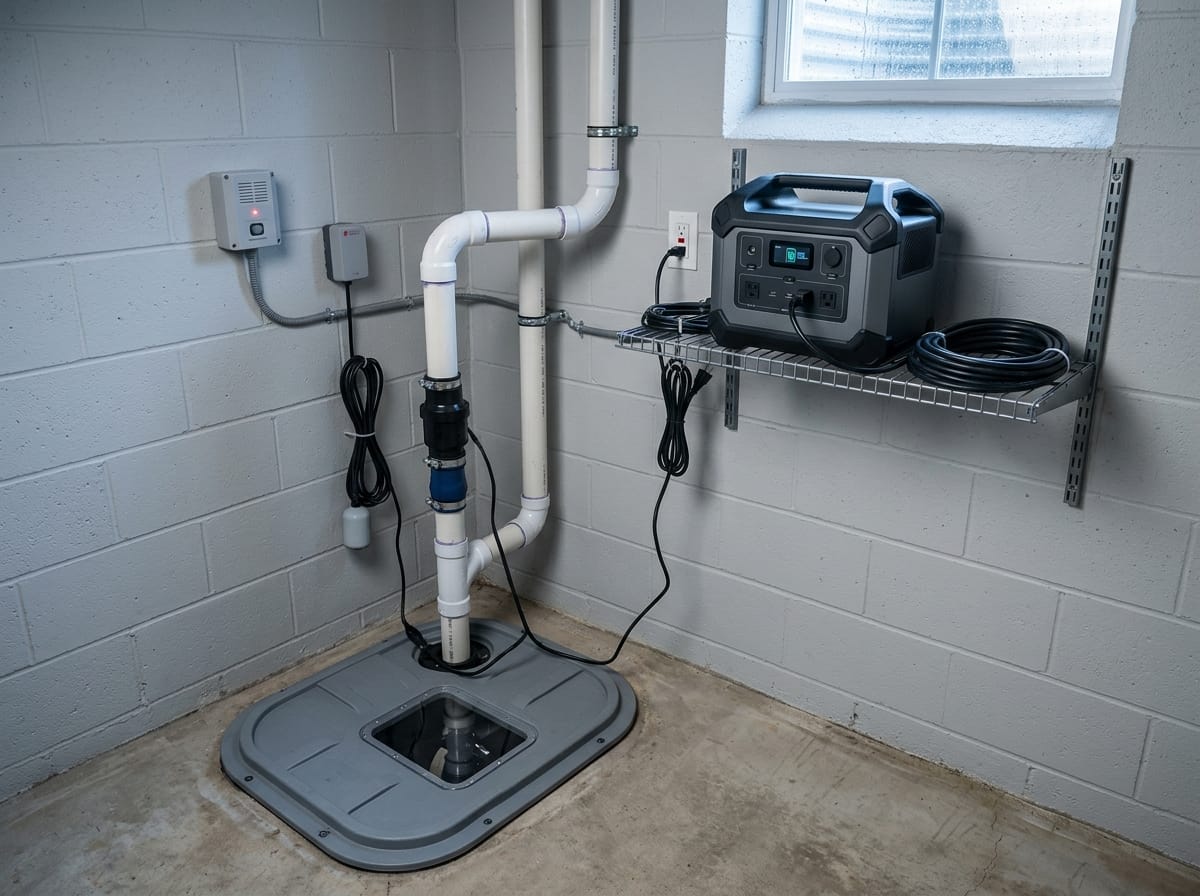
A sump pump often needs power at the exact moment the weather makes electricity least reliable. A sump pump backup can protect a basement when the primary pump is electrically compatible and the battery stays dry, but one successful test on a quiet day does not prove storm readiness. Incoming water can multiply cycling, a stuck float can prevent operation, and a failed check valve can make the same water return to the pit.
The direct answer is that many cord-connected 120V sump pumps can run from a suitably sized portable power station. The station must support normal running demand and motor startup, while the battery must cover the total minutes of pumping expected during the storm. Because water and electricity share the same space, placement, cord routing, outlet condition, alarms, and redundancy are as important as watts.
This guide helps plan compatibility and runtime. It does not replace a dedicated battery-backup pump, water-powered backup where appropriate, drainage repair, high-water alarm, professional generator system, or evacuation instructions. PowerLabPro has not tested your pump or basement. Follow the exact pump, station, electrical, and local safety requirements.
Quick answer
Possible: the exact pump voltage, continuous demand, startup demand, cord arrangement, and expected storm cycling fit the station.
Main uncertainty: groundwater inflow can increase dramatically during the event, making dry-weather runtime estimates unreliable.
Main safety rule: keep the station, plugs, and every connection above credible water level and away from splash.
Best protection: combine sump pump backup power with a second pumping path and a high-water alert.
Table of Contents
Sump Pump Backup: 7 Critical Storm Checks
A dependable sump pump backup must pass seven storm checks before anyone relies on it.
- Identify the exact pump. Record model, voltage, rated current or watts, cord and plug, horsepower, discharge requirements, and float type.
- Verify continuous output. The station must sustain the pump after startup with useful headroom.
- Verify motor startup. The inverter must support repeated automatic starts without tripping or abnormal pump behavior.
- Measure duty cycle. Record run time and time between starts under several water conditions.
- Keep power equipment dry. Elevate the station and connections above the flood zone while preserving ventilation and stable placement.
- Inspect the water system. Confirm float movement, check-valve operation, discharge path, basin condition, and primary drainage.
- Add redundancy and alerts. Plan for pump failure, battery exhaustion, station trip, and water inflow beyond the system’s capacity.
A sump pump backup can pass the output test and still fail the property-protection test. The battery may be large enough, yet the pump may clog, the discharge may freeze, the float may stick, or water may rise above the station. Treat the system as several failure layers, not one appliance.
Identify the Exact Pump and Basin Setup
Sump pumps differ in motor design, horsepower, voltage, discharge head, switch design, cord arrangement, and intended duty. Two pumps with similar housings can create different electrical and hydraulic demands. Read the label and manual, inspect the installation while it is dry, and record how the pump is connected.
| Item to verify | Why it matters | Where to check |
|---|---|---|
| Voltage and frequency | Must match station output | Pump label and manual |
| Rated amps or watts | Sets continuous-output requirement | Label, manual, measured operation |
| Startup or locked-rotor data | Screens motor-start compatibility | Manufacturer data or qualified measurement |
| Float or switch type | Controls start level and cycle frequency | Basin inspection and manual |
| Discharge height and pipe size | Affects hydraulic workload and run time | Installation and pump manual |
| Check valve and discharge condition | Prevents water returning and repeated cycles | Dry inspection and pump service |
| Cord and outlet condition | Affects safe connection and voltage drop | Qualified inspection |
Confirm whether the pump plugs directly into a receptacle or through a piggyback float-switch plug. Do not bypass the float for normal outage operation. Do not assume a nearby receptacle is safe because it looks dry. A qualified electrician should address damaged outlets, missing protection, questionable grounding, or evidence of moisture before the sump pump backup is tested.
Running Watts and Motor Startup
The station’s continuous output must support the pump while water is moving through the discharge pipe. Its surge capability must support the brief higher demand when the motor starts. Starting behavior can change with battery charge, cord voltage drop, pump condition, discharge head, and how long the motor has been idle.
Do not choose a station from horsepower alone. Horsepower is mechanical output and does not reveal the exact electrical input or startup event. Use the pump label and official documentation, then observe actual operation with properly rated equipment where permitted.
- Compare pump demand with the station’s continuous rating, not only its peak rating.
- Leave output margin for voltage stability and station temperature.
- Test several automatic starts rather than one manual run.
- Repeat the test after the battery is partly discharged when allowed by the station manual.
- Disconnect microwaves, heaters, kettles, and other large loads during pumping.
- Stop if the pump hums without moving water, cycles abnormally, trips the station, or heats the cord or plug.
Avoid voltage-reduction or “power lifting” modes unless both manufacturers support pump use. A sump pump backup is not successful when the motor starts only under abnormal voltage or repeated protection trips.
Storm Duty Cycle Controls Battery Runtime
A sump pump usually runs in cycles. Battery energy is consumed while the motor runs, by the inverter between cycles, and through conversion losses. The difficult variable is water inflow. Rainfall, soil saturation, groundwater, drainage design, foundation condition, pump capacity, basin size, and check-valve performance all affect how often the pump starts.
Measure run seconds per cycle and the time between cycles in dry weather, ordinary rain, and the heaviest safe condition available. Dry-weather observations are only a baseline. A severe storm can shorten the off-time until the pump operates almost continuously.
Example: a verified pump averaging 800 watts for one minute uses about 13Wh before losses. Ten cycles use about 133Wh, while 60 cycles use about 800Wh. If the pump runs for 30 minutes every hour, it uses about 400Wh per hour before losses. The same equipment therefore creates very different sump pump backup requirements as inflow changes.
Also record whether the water level falls decisively during a cycle. A pump that barely keeps pace may run for long periods and leave little protection if inflow increases. That is a drainage and capacity issue, not simply a battery-size issue.
Calculate Sump Pump Backup Energy
Calculate from total pump minutes or measured watt-hours per cycle. Then add inverter idle consumption, alarm or communication loads, conversion losses, and a large storm reserve.
Two useful formulas
Cycle method: required energy ≈ watt-hours per cycle × planned cycles + other essential watt-hours.
Run-time method: required energy ≈ pump watts × total run hours + other essential watt-hours.
Divide by a usable-energy factor below 1 to account for losses and reserve. These are planning estimates, not flood-protection guarantees.
| Pump behavior | Example energy before losses | What it means |
|---|---|---|
| 800W for 10 total minutes | About 133Wh | Brief cycling may fit a modest battery |
| 800W for 60 total minutes | About 800Wh | A 1kWh class leaves limited reserve |
| 1,000W for 3 total hours | 3,000Wh | Large or expandable storage is required |
| Near-continuous operation | Depends on watts and outage length | A portable battery may be the wrong primary plan |
The sump pump backup target should be based on a credible bad-weather scenario, not the lowest recorded cycle count. When the consequence is a finished-basement flood, conservative assumptions are justified.
Use This Sump Pump Backup Worksheet
Write the storm plan before shopping.
| Planning input | Your value | Decision use |
|---|---|---|
| Pump make and model | _____ | Links to official requirements |
| Voltage and plug | _____ | Compatibility gate |
| Running demand | _____ W or A | Continuous inverter requirement |
| Starting requirement | _____ W, VA, or A | Surge screening |
| Run time per cycle | _____ seconds/minutes | Energy per cycle |
| Worst observed interval | _____ minutes | Cycle count estimate |
| Expected outage window | _____ hours | Battery target |
| Safe station location | _____ | Water and ventilation gate |
| Second pumping method | _____ | Mechanical redundancy |
| Alarm and notification method | _____ | Failure awareness |
| Reserve threshold | _____ % | Response before battery exhaustion |
Use the PowerLabPro sizing guide after the load is measured. It helps combine the sump pump backup with a router, phones, lighting, or refrigerator without assuming every load can start at the same time.
Dry Placement Is a Non-Negotiable Rule
Do not place a portable power station on the basement floor beside the pit. Put it on a stable, load-rated surface above any credible water level, while maintaining the manufacturer’s ventilation clearances. The location should remain accessible without stepping into water.
Every plug, connector, extension, and adapter is part of the wet-location risk. Use only a cord type, gauge, length, and routing allowed by the pump and station manufacturers. Keep connections out of splash and condensation. Do not run cords through standing water, pinch them under doors, cover them with rugs, or create a trip path through an evacuation route.
A longer cord can introduce voltage drop at the exact moment the motor starts. An underrated cord can heat. A power strip may not be suitable for a motor or damp environment. When no dry, supported connection exists, a portable sump pump backup is not the right solution for that basement.
Check the Float, Valve, Discharge, and Drainage
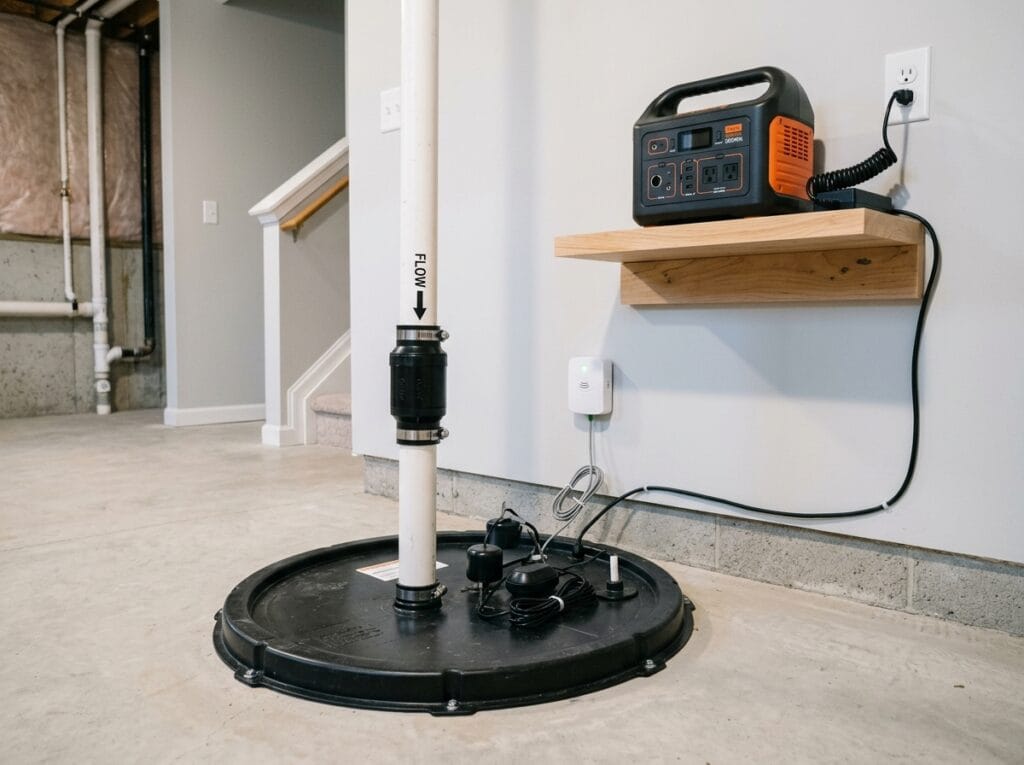
Electrical power cannot correct a stuck float, blocked intake, failed check valve, frozen discharge, collapsed pipe, or pump that is too small for the inflow. Test the pump according to its manual and inspect the water path before storm season.
- Confirm that the float moves freely and does not catch on the basin wall, cords, or pipe.
- Confirm that the pump starts and stops at sensible water levels.
- Listen for water returning to the pit after the pump stops, which may indicate a check-valve problem.
- Verify that the discharge path is open and protected from freezing where relevant.
- Keep the basin cover, cord routing, and pipe supports in serviceable condition.
- Address exterior grading, gutters, downspouts, and drainage problems that unnecessarily send water toward the foundation.
Maintenance reduces both flood risk and battery demand. A repaired check valve can prevent the sump pump backup from pumping the same water twice. Better drainage can reduce cycle frequency more effectively than another battery module.
Redundancy and High-Water Alerts Matter
One pump and one battery create several single points of failure. The pump can clog, the float can stick, the station can trip, the battery can be discharged, or water can rise faster than the pump removes it. A high-consequence basement deserves a second protection layer.
- A dedicated secondary battery-backup pump provides another pumping mechanism.
- A water-powered backup may be possible where municipal-water conditions and local rules allow it.
- A second AC pump can provide mechanical redundancy when the electrical plan supports it.
- A high-water alarm warns that the primary system is losing the race.
- Remote notification can help when the building is unoccupied, but it depends on power and communications.
- A professionally installed generator or permanent battery system may support longer severe-weather operation.
Choose redundancy according to potential damage, water history, occupancy, and response time. A finished basement or critical equipment room deserves a more robust sump pump backup than an unfinished space with low inflow and easy monitoring.
Portable Station vs Dedicated Backup Pump
| Option | Main advantage | Main limitation |
|---|---|---|
| Portable power station | Can serve other controlled outage loads | Still depends on the primary pump and dry manual energy management |
| Dedicated battery-backup pump | Adds a separate pump designed for backup duty | Battery and secondary pump require maintenance |
| Water-powered backup | Can operate without electricity in suitable homes | Uses municipal water and is not allowed or practical everywhere |
| Fuel generator | Can run longer with fuel and support more loads | Outdoor operation, fuel, maintenance, noise, and CO safety |
| Permanent home battery | Can provide automated protected circuits | Higher cost and professional design |
A portable station supplies electricity. It does not add a second pump. A dedicated backup pump adds mechanical redundancy but may not power other loads. Many strong plans use both roles rather than forcing one device to do everything.
The sump pump backup decision should be proportional to the loss. When a failure could cause tens of thousands of dollars in damage, permanent drainage and backup improvements may be more rational than relying on a movable battery alone.
Recharge Limits During a Storm
Storms are difficult times to depend on portable solar. Clouds, rain, shade, short daylight, and unsafe outdoor conditions can reduce or prevent charging. The station’s solar-input rating is not a promise of usable harvest. Do not put panels out during lightning, flooding, or dangerous wind.
Vehicle charging may help, but the rate can be small relative to continuous pumping. A fuel generator can recharge or run loads only when operated outdoors at a safe distance according to its manual and local guidance. Never bring a combustion generator into a basement, garage, doorway, or covered area.
Plan the sump pump backup as stored energy first. Treat recharge as a conditional extension. Preserve state of charge before the heaviest forecast period instead of assuming recovery will appear later.
When a Portable Power Station Is the Wrong Method
- No location keeps the station and connections dry above the flood zone.
- The pump startup repeatedly trips the station or causes abnormal operation.
- The pump requires a connection or cord arrangement prohibited by either manual.
- Water inflow can force near-continuous operation beyond realistic battery capacity.
- The basement is unoccupied and no reliable monitoring or automatic response exists.
- The primary pump, float, check valve, discharge, outlet, or drainage system is already unreliable.
- The property has frequent flooding and no second pumping path.
- Floodwater has reached electrical equipment or created an unsafe environment.
In these cases, stop treating a portable station as the main sump pump backup. Use a dedicated backup pump, professionally installed generator or battery system, drainage repair, high-water alarm, or relocation of vulnerable property. Follow local emergency and flood instructions when conditions are dangerous.
Useful Buying Guide, Product, and Review Paths
The best portable power station for sump pump backup Buying Guide owns the product shortlist for this use case. Use it only after the pump voltage, startup behavior, storm duty cycle, and dry placement have been verified.
For a measured 1kWh-class need, the Anker SOLIX C1000 Gen 2 Product page documents the verified unit, while the Anker SOLIX C1000 Gen 2 Review explains buyer-fit limits. The Anker C1000 Gen 2 versus EcoFlow DELTA 2 comparison provides another 1kWh-class decision path.
None of those pages guarantees that a specific pump will start or that a basement will remain dry. This sump pump backup article defines the load and risk; the commercial pages help compare equipment after the load is known.
Common Sump Pump Backup Mistakes
- Putting the station on the floor. The backup source must not sit in the flood zone.
- Sizing from horsepower alone. Verify exact running and starting demand.
- Testing one start. A storm can require dozens or hundreds of cycles.
- Using dry-weather intervals. Severe inflow can change runtime completely.
- Ignoring the check valve. Returning water can create unnecessary cycles.
- Using an undersized extension cord. Voltage drop and heat can cause failure.
- Relying on one pump. Electricity does not prevent mechanical failure.
- Skipping alarms. A failed system can flood silently.
- Assuming solar will recharge during the storm. Weather and safety may prevent it.
A strong sump pump backup is tested, elevated, monitored, and redundant. It does not depend on perfect weather or a single unobserved device.
Sump Pump Backup FAQ
Can a 1,000Wh power station run a sump pump?
It may run a compatible pump for a limited number of cycles. The inverter must handle startup, and the battery calculation must reflect storm duty cycle, losses, idle draw, and reserve.
How long will a portable power station run a sump pump?
Calculate pump watts multiplied by total run hours, or watt-hours per cycle multiplied by expected cycles. Elapsed outage time alone does not determine sump pump backup runtime.
Can the station stay in UPS mode?
Only when the manufacturer supports the pump load, transfer behavior is suitable, battery charging is managed, and the station remains dry and ventilated. Test alarms and failure behavior before relying on automatic operation.
Is a portable station better than a battery-backup pump?
They serve different roles. The station powers the existing pump and other loads. A dedicated backup system provides a second pump. High-risk properties often benefit from both electrical and mechanical redundancy.
Should I use an extension cord?
Follow both manuals. When a cord is allowed, it must be correctly rated, short enough to control voltage drop, routed dry, and protected from damage. Do not use a power strip in a damp area.
What battery reserve should I keep?
There is no universal percentage. Base the threshold on measured cycle energy, forecast uncertainty, response time, and the energy needed to run alarms or communications while a second plan is activated.
Final Decision
A portable power station can provide sump pump backup when the exact pump’s voltage, continuous draw, and startup demand fit the inverter, and when the battery can remain dry while supporting a conservative storm duty cycle.
Verify the pump and water path, test repeated starts, measure total run minutes, elevate every electrical connection, and add a second pumping or alert layer. Then use the sizing guide and the focused Buying Guide, Product, Review, or Comparison pages to choose equipment. The goal of sump pump backup is not merely to power a motor; it is to keep water below the damage line when conditions are worse than the first test.