
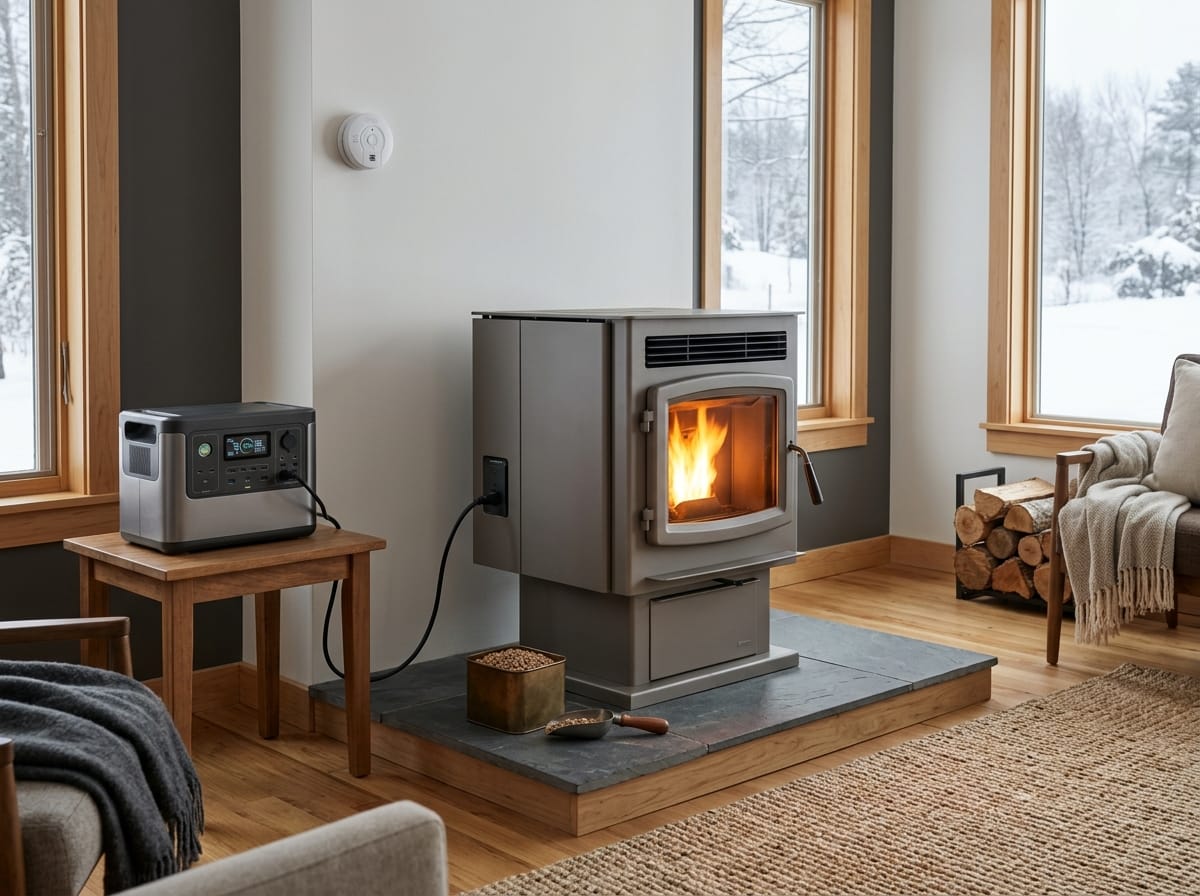
A pellet stove can keep a room warm only while fuel, airflow, controls, and electricity all remain available. During an outage, the fuel may still be in the hopper, but the igniter, auger, combustion blower, room-air blower, controller, and safety sensors still need power. Pellet stove runtime from a portable power station therefore depends on the complete operating cycle, not the lowest watt number shown after the fire is established.
The basic calculation is usable battery watt-hours divided by measured average stove watts. The difficult part is measuring honestly. A cold start can use more power than steady burning, thermostat operation can trigger relights, blower speed can rise with the heat setting, and the stove may need electricity after fuel feed stops so it can clear smoke and cool normally.
This guide is for cord-connected pellet stoves whose manuals allow operation from a compatible power source. It does not replace the stove manual, professional installation, vent inspection, working smoke and carbon-monoxide alarms, or a safe alternate heating plan. PowerLabPro has not tested your stove or battery.
Quick answer
Best measurement: watt-hours from a cold start through steady heating and a complete normal shutdown.
Largest temporary load: the electric igniter on many automatic-light stoves.
Ongoing loads: the auger, combustion blower, convection blower, controller, and safety sensors.
Critical reserve: enough battery to command shutdown and let every required fan and control finish normally.
Table of Contents
Pellet Stove Runtime: 7 Critical Backup Checks
A useful pellet stove runtime estimate passes seven checks before the household treats it as an overnight heating plan.
- Confirm the exact stove. Record model, voltage, rated input, waveform requirements, manual restrictions, and thermostat behavior.
- Capture cold ignition. Measure the igniter and startup sequence instead of beginning after the fire is established.
- Measure steady operation. Include auger cycling, combustion airflow, room-air blower, controls, and the intended heat setting.
- Measure shutdown. Record the energy required after fuel feed stops until the stove becomes safe to disconnect.
- Account for relights. Thermostat cycling can repeat the high-demand ignition period.
- Adjust for winter battery conditions. Cold can reduce usable energy or restrict charging.
- Maintain a fallback. Keep alarms, fuel, safe alternate heat, and a relocation plan for an outage longer than the battery.
The central mistake is dividing nameplate battery capacity by one steady-state reading. A realistic pellet stove runtime includes starting, changing fan speeds, cycling, inverter loss, battery reserve, and the final shutdown sequence.
Why a Pellet Stove Needs Electricity
A modern pellet stove is a coordinated mechanical and electronic system. An auger meters fuel from the hopper. A combustion or exhaust blower maintains airflow through the burn pot and vent. A convection blower moves heat into the room. A controller watches temperature, vacuum or pressure switches, doors, hoppers, and fault conditions. Many models also use an electric igniter.
| Electrical component | Role | Runtime effect |
|---|---|---|
| Igniter | Starts combustion on automatic-light models | Can create the largest temporary electrical load |
| Auger motor | Feeds pellets at timed intervals | Adds repeating motor cycles |
| Combustion blower | Maintains draft and exhaust flow | May operate through startup, burning, and shutdown |
| Convection blower | Moves heated room air | Demand changes with heat and fan settings |
| Controller and sensors | Manage combustion and safety | Need stable compatible power throughout operation |
| Thermostat function | Changes heat output or triggers relights | Can alter average demand substantially |
The stove label may show a maximum or circuit value rather than the average draw at every stage. Use the manual to understand what the number represents. A measured pellet stove runtime calculation should include every powered component that operates during the selected mode.
Measure a Complete Operating Cycle
Use a properly rated plug-in energy meter only when the stove manual and installation permit it. Measure from a cold start, through stable heating at the intended setting, and through the complete shutdown. A brief display reading after the room is warm will usually miss the most important transitions.
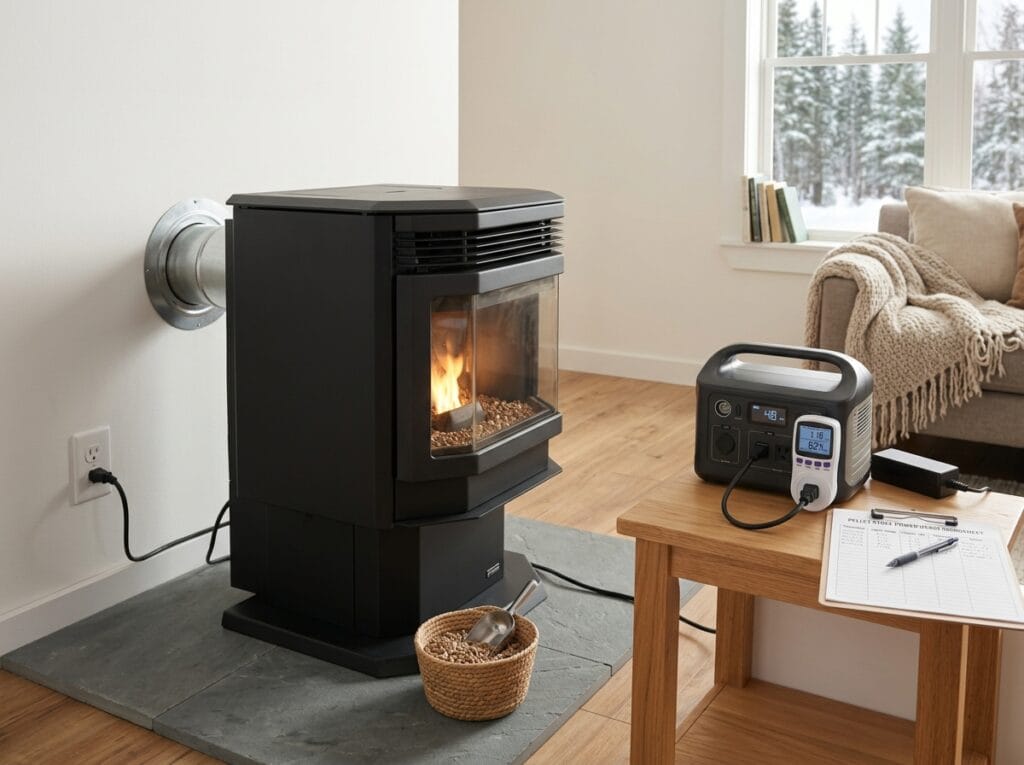
- Record the stove model, heat setting, fan setting, thermostat mode, room temperature, and outdoor temperature.
- Begin with a normal cold stove and a clean appliance prepared according to its manual.
- Record the highest observed demand during ignition and the watt-hours used until stable flame is established.
- Measure steady operation long enough to include multiple auger and blower cycles.
- Use the normal shutdown command and record energy until all required fans stop.
- Repeat the test at the heat settings likely to be used during an outage.
- Repeat thermostat operation when the plan allows the stove to turn down, stop, or relight.
Do not open energized panels, bypass sensors, defeat a door switch, or interrupt a shutdown to obtain a number. The purpose of the test is to create a safer pellet stove runtime plan while the stove behaves exactly as designed.
Ignition Can Change the Runtime Answer
Many automatic-light pellet stoves use an electric resistance igniter. The igniter may operate for several minutes while the auger and combustion blower also run. This can make starting demand much higher than a low steady-state reading.
The station must support both the temporary load and the total ignition energy. A 1kWh battery might appear adequate when the stove is already burning, yet repeated thermostat relights can reduce pellet stove runtime enough to break an overnight plan.
Some stoves reduce heat without fully extinguishing. Others may shut down and relight depending on thermostat settings and model behavior. Do not assume one strategy is more efficient without measurement. Record how the exact stove responds at the intended settings.
Calculate Pellet Stove Runtime Honestly
Begin with usable AC energy, not the full advertised battery capacity. Inverter loss, station idle demand, battery age, temperature, discharge limits, and a protected shutdown reserve reduce the energy available to the stove.
Planning formula
Estimated pellet stove runtime ≈ usable AC energy after reserve ÷ measured average stove watts
Usable AC energy should already account for conversion loss and the energy protected for a normal shutdown. The result is an estimate, not a winter guarantee.
Example: if the plan provides 850Wh after conversion loss and protected reserve, and the stove averages 120 watts during the measured operating period, the simple estimate is about seven hours. If average demand rises to 200 watts at a higher setting, the same energy supports a little over four hours.
| Usable AC energy | Measured average load | Simple estimate | What still matters |
|---|---|---|---|
| 850Wh | 100W | 8.5 hours | Cold-start and shutdown must already be included |
| 850Wh | 150W | 5.7 hours | Check relights and winter battery performance |
| 1,700Wh | 150W | 11.3 hours | Preserve communication and fallback reserve |
| Unknown | Lowest display reading | Not reliable | Measure a complete cycle |
These are math examples, not typical stove specifications. Actual pellet stove runtime may be shorter because of ignition, higher fan settings, repeated cycling, cold conditions, battery age, or inverter idle demand.
Use This Pellet Stove Runtime Worksheet
| Planning input | Your value | Decision use |
|---|---|---|
| Stove make and model | _____ | Links to the manual and electrical requirements |
| Voltage and rated input | _____ | Output compatibility |
| Cold-start energy | _____ Wh | Ignition allowance |
| Steady hourly energy | _____ Wh/hour | Main runtime input |
| Shutdown energy | _____ Wh | Protected reserve |
| Expected relights | _____ | Additional ignition energy |
| Planned heat setting | _____ | Operating-load context |
| Battery planning factor | _____ | Loss and reserve adjustment |
| Minimum battery threshold | _____ % | Time to begin shutdown |
| Alternate heat or shelter | _____ | Fallback if runtime is insufficient |
Use the PowerLabPro sizing guide to combine the stove with phones, a router, lighting, or refrigeration. Keep the pellet stove runtime calculation visible so another load cannot silently consume the shutdown reserve.
Protect Energy for a Normal Shutdown
When the user commands shutdown, fuel feed may stop while the combustion and convection fans continue. This helps clear smoke, burn remaining fuel, and cool the appliance. Cutting power during this period can cause smoke spillage or abnormal heat, depending on the stove and venting.
Measure shutdown watt-hours and preserve more than that amount. Set a conservative low-battery alert or discharge threshold only after confirming how the station behaves under load. Begin shutdown early enough that automatic cutoff cannot occur before the stove finishes.
Do not add pellets for one more hour when the battery is near the reserve threshold. A strong pellet stove runtime plan values controlled shutdown more than the final few minutes of heat. An alarm is useful only when someone can respond.
Cold Weather Changes Battery Performance
Winter creates a double challenge. The building needs more heat, so the stove may run at a higher setting, while a cold lithium battery can provide less usable performance. Many batteries also restrict charging below a stated temperature. Read the station’s operating and charging limits.
Keep the power station in a dry, ventilated location within its temperature range. Do not place it on the hearth, against the stove, under a hot-air outlet, or where ash can enter cooling openings. Keep the required clearance around both devices.
If the station has been stored cold, allow it to reach an acceptable temperature according to the manual before charging. Conservative pellet stove runtime planning assumes less usable energy in difficult winter conditions, not more.
UPS or EPS Mode Needs a Real Test
A station with UPS or EPS functionality may keep a compatible stove powered through a short utility interruption, but the feature must be tested. Confirm transfer time, output waveform, grounding behavior, continuous rating, charging behavior, and whether both manufacturers permit the arrangement.
A seamless transfer may prevent a forced shutdown or relight. It does not create unlimited pellet stove runtime. The battery can remain partly discharged from a previous event, the station can be switched off, or a fault can go unnoticed until utility power fails.
- Test utility loss during steady operation under safe, supervised conditions.
- Confirm that the stove does not reset, fault, or change fan behavior.
- Verify that the station can support cold ignition in the intended mode.
- Check that charging does not overheat or violate placement rules.
- Test the low-battery warning and normal shutdown procedure.
- Inspect the setup before every heating season.
Maintenance, Venting, and Carbon-Monoxide Safety
Backup power does not correct a dirty burn pot, blocked vent, failed gasket, worn blower, damaged sensor, or poor draft. EPA Burn Wise provides historical consumer resources about wood-burning appliance operation, installation, maintenance, and smoke reduction. The exact stove manual and local professional guidance remain controlling.
Maintain the burn pot, ash areas, heat exchangers, blowers, vent, door seals, and sensors according to the manual. Use approved pellets and keep fuel dry. A dirty or poorly vented stove can change combustion, electrical behavior, and heat output, making the previous pellet stove runtime test less representative.
- Keep working smoke and carbon-monoxide alarms with battery backup.
- Never block the combustion-air intake or exhaust vent.
- Stop operation if smoke enters the room, alarms sound, or the stove reports a safety fault.
- Keep the station away from heat, ash, moisture, and combustible clutter.
- Allow the stove to complete shutdown and cool before cleaning.
- Have installation, venting, and recurring faults reviewed by a qualified professional.
A pellet stove is a combustion appliance. The battery plan must preserve all controls and blowers intended to keep operation safe. Do not bypass a safety device to extend pellet stove runtime.
Solar and Recharge Limits in Winter
Portable solar can extend the plan, but winter harvest is variable. Short daylight, low sun angle, clouds, snow, shade, and panel temperature affect production. The station’s maximum solar-input rating is a ceiling, not an expected all-day output.
Compare daily stove watt-hours with conservative daily charging watt-hours. A panel array may replace part of overnight consumption on a clear day and very little during a storm. Preserve enough energy for evening operation and shutdown before counting on tomorrow’s sun.
A fuel generator can recharge the battery only when operated outdoors at the safe distance and placement required by its manual. Never operate a combustion generator in the home, garage, porch, doorway, or near air intakes. Vehicle charging may help but can be slow relative to overnight pellet stove runtime needs.
When a Portable Power Station Is the Wrong Method
- The stove manual prohibits the proposed power source or waveform.
- The station cannot support ignition, fan changes, or normal shutdown without faults.
- The required overnight energy exceeds realistic battery and recharge capacity.
- The station cannot remain within its temperature limits and away from heat and ash.
- The stove, vent, gaskets, blowers, or safety controls need repair.
- No one can respond to low-battery alarms or command shutdown.
- The household depends on continuous heat for vulnerable occupants or freeze protection without a more dependable fallback.
- The outage plan lacks working smoke and carbon-monoxide alarms.
In those cases, use another heating location, a professionally designed backup system, a larger verified power platform, or another safe heat source. The best answer is not always a longer pellet stove runtime; it is a winter plan that remains safe when equipment or weather does not cooperate.
Useful Product, Review, and Comparison Paths
A measured compact-stove plan may point to a 1kWh-class station. The Anker SOLIX C1000 Gen 2 Product page documents the verified unit, while the Anker SOLIX C1000 Gen 2 Review explains its practical limits. Neither page guarantees stove compatibility or overnight runtime.
The Anker SOLIX C1000 Gen 2 versus EcoFlow DELTA 2 comparison helps buyers evaluate two 1kWh-class paths after ignition, average demand, and shutdown reserve are known. Larger measured needs can move to the home-backup Buying Guide.
This pellet stove runtime guide owns the calculation and safety decision. Product, Review, Comparison, and Buying Guide pages are the next step only after the exact stove cycle has been measured.
Common Pellet Stove Runtime Mistakes
- Using the lowest watt reading. It omits ignition, fan changes, relights, and shutdown.
- Using full battery capacity. Conversion losses and reserve reduce deliverable AC energy.
- Running to zero. The stove needs energy for a normal shutdown.
- Ignoring thermostat relights. Repeated ignition can shorten runtime.
- Testing in mild weather. Higher heat settings and cold batteries change the result.
- Placing the station near heat or ash. Both can interfere with cooling and safety.
- Skipping maintenance. Dirty or failing components can alter operation.
- Assuming UPS mode is automatic protection. It still requires testing, monitoring, and a response plan.
- Depending on winter solar. Weather can prevent the expected recharge.
A credible pellet stove runtime estimate is conservative, measured, and tied to a shutdown threshold. It is not a single division made from two marketing numbers.
Pellet Stove Runtime FAQ
Can a 1,000Wh power station run a pellet stove overnight?
It may support some stoves for several hours, but overnight suitability depends on measured ignition, steady operation, relights, shutdown energy, inverter loss, cold-weather performance, and reserve.
Does a pellet stove use more electricity when starting?
Many automatic-light models use an electric igniter, so cold-start demand can be higher than low steady operation. Verify the exact stove and measure the complete ignition period.
Can I switch off the station while pellets are burning?
No. Use the stove’s normal shutdown command and allow every required fan and control to finish. Preserve enough battery to complete that process.
Does a pure sine wave inverter matter?
Use the waveform and electrical requirements stated by the stove manufacturer. Many electronically controlled appliances are best matched to stable pure-sine output, but the exact manual controls the decision.
Can solar panels keep the stove running?
Solar can extend or recover the battery, but winter production varies. Size storage from measured pellet stove runtime first, then model conservative seasonal charging.
What reserve should I keep for shutdown?
Measure the shutdown watt-hours for the exact stove and keep more than that amount. Add response margin so shutdown begins before the station reaches automatic cutoff.
Final Decision
Pellet stove runtime from a portable power station is usable AC energy divided by measured average stove demand, with ignition, relights, inverter loss, cold-weather effects, and a protected shutdown reserve included.
Measure a complete cycle, maintain the stove and vent, test the intended UPS or battery setup, and define the shutdown threshold before winter. Then use the sizing guide and relevant Product, Review, Comparison, or Buying Guide pages to select an equipment class. Keep working alarms and an alternate heat or shelter plan for any outage longer than the pellet stove runtime.