
Review
Anker SOLIX C2000 Gen 2 Review: Compact 2kWh Backup With Real Limits
A strong compact 2kWh choice for selected home essentials, refrigerator and communications backup, compatible RV use, vehicle camping, and mobile work. Skip it for 240V loads, full 30A RV behavior, whole-home wiring, or prolonged heavy demand without reliable recharging.
Linked Product Snapshot
Core specs
Buyer Fit
Pros and tradeoffs
Strengths
Pros
- 2,048Wh LiFePO4 capacity with 2,400W continuous output
- 41.7 lb body is comparatively manageable for the 2kWh class
- TT-30 outlet supports compatible 120V RV shore-power use
- Fast AC charging with up to 800W solar and optional alternator recovery
- One BP2000 Gen 2 battery can expand total capacity to roughly 4kWh
Tradeoffs
Cons
- TT-30 and standard AC outlets share the 2,400W continuous limit
- 800W solar ceiling may restrict repeated high-energy off-grid use
- No 240V output or installed whole-home capability
- 41.7 lb still requires a deliberate lifting and storage plan
- Expansion increases runtime but does not raise inverter output
This article may contain affiliate links. If you buy through these links, PowerLabPro may earn a commission at no extra cost to you. As an Amazon Associate I earn from qualifying purchases.
This Anker SOLIX C2000 Gen 2 review is for buyers who want more outage and RV runtime than a typical 1kWh station provides, but who do not want to move immediately to a much heavier 3kWh or 4kWh platform. The current US model combines a 2,048Wh LiFePO4 battery, 2,400W continuous AC output, 4,000W peak power, a TT-30 RV outlet, up to 800W solar input, app control, and a listed 10ms UPS transition.
The central decision in this Anker SOLIX C2000 Gen 2 review is whether a compact 2kWh system is enough for your real load plan. Its strongest use cases are selected home essentials, refrigerator and communications backup, a controlled small-RV setup, vehicle-supported camping, and mobile work. Its main limit is that all AC outlets, including TT-30, share the same 2,400W continuous ceiling.
This is research-led editorial analysis based on current Anker documentation, the official US product page, the verified PowerLabPro Product record, and the matching Amazon US identity for model A1783 and ASIN B0FVFGL38H. PowerLabPro has not performed hands-on or laboratory testing of this unit. Confirm the current listing, included accessories, warranty terms, load compatibility, and charging setup before purchase.
Anker SOLIX C2000 Gen 2 review: quick verdict
The Anker SOLIX C2000 Gen 2 is a strong middle-size choice for buyers who need a meaningful energy reserve without the bulk of a rolling home-backup platform. At 41.7 lb, it is not light, but it is comparatively manageable for a 2kWh station. The 2,400W inverter gives useful headroom for refrigerators, communications, work equipment, short kitchen tasks, RV loads, and selected tools when the combined demand is controlled.
This Anker SOLIX C2000 Gen 2 review is positive when the buyer has a written priority list and a credible recharge path. It is negative when the buyer expects whole-home behavior, 240V output, full 30A RV service, unlimited appliance combinations, or several days of heavy use without solar, grid, or vehicle recovery.
Best for, not ideal for, and the buyer decision
Best for: selected home essentials, refrigerator and communications backup, compatible 120V RV shore-power use, vehicle camping, and controlled mobile work.
Not ideal for: 240V loads, whole-home HVAC, full-service RV expectations, repeated stair carrying, or long high-watt operation without reliable recharging.
Main advantage: 2,048Wh capacity, 2,400W output, TT-30 connectivity, and fast charging in a comparatively compact 41.7 lb body.
Main drawback: the 800W solar ceiling and 2,400W total AC limit require load sequencing and recovery planning.
Better alternative if: a smaller 1kWh station is easier to move, a direct 2kWh competitor offers a feature you value more, or a larger 3kWh platform better fits expansion and home-backup needs.
Read the connected Anker SOLIX C2000 Gen 2 Product reference for the central model identity, verified specifications, ASIN, and purchase checks. This Anker SOLIX C2000 Gen 2 review focuses on the ownership decision, realistic scenarios, trade-offs, alternatives, and the reasons another product may fit better.
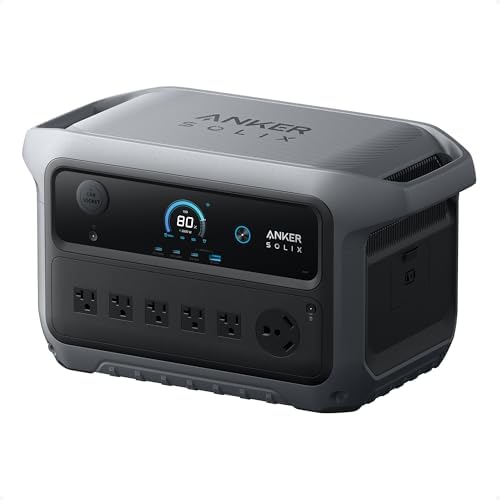
- Ultra-Efficient Power for Longer Runtime: Uses only 9W on standby, powering a dual-door fridge for up to 32 hours.
- Up to 4kWh Expandable Capacity: Add an expansion battery to reach 4kWh and run a dual-door fridge for up to 64 hours.
- Six Ways to Recharge, 100% in 58 Min: Experience lightning-fast recharging with AC and solar—fully charged in 58 minutes…
Table of Contents
Anker SOLIX C2000 Gen 2 review: verified specifications
| Specification | Current verified detail | Buyer meaning |
|---|---|---|
| Model | A1783 | Use the exact model and ASIN to avoid bundle or regional confusion. |
| Battery | 2,048Wh LiFePO4 | A serious selected-load reserve, not a fixed runtime promise. |
| Continuous AC output | 2,400W | The combined sustained AC limit across all outlets. |
| Peak power | 4,000W | Temporary startup headroom, not continuous output. |
| AC connections | Five NEMA outlets plus TT-30 | Useful connection choice without increasing total inverter capacity. |
| Solar input | Up to 800W, 11-60V, 17A max | Meaningful recovery with a compatible array and suitable weather. |
| AC charging | Up to 1,800W | Anker lists approximately 88 minutes under stated conditions. |
| AC plus solar | Up to 2,600W combined | Anker lists approximately 58 minutes under stated conditions. |
| USB-C | Two 140W ports plus one 15W port | Strong direct laptop and device charging. |
| UPS | 10ms listed transition | Potentially useful, but exact equipment must be tested. |
| Expansion | One BP2000 Gen 2 battery | Raises total capacity to roughly 4kWh without raising output. |
| Weight | 41.7 lb | Portable for the class, but still a deliberate two-hand lift for many users. |
The official source for this Anker SOLIX C2000 Gen 2 review is the Anker SOLIX US product page. It lists 2,048Wh capacity, 2,400W continuous output, 4,000W peak power, 800W solar input, TT-30 output, 10ms UPS behavior, one-battery expansion, and the current charging figures. Manufacturer examples are useful context, but they remain conditional test results.
Anker SOLIX C2000 Gen 2 review: 2,048Wh capacity and runtime
A 2,048Wh battery sits in a useful middle class. It can preserve communications and work devices for a long window, or support refrigeration and selected appliance use for a shorter window. It cannot create one universal runtime because actual results depend on inverter losses, battery temperature, standby draw, compressor cycling, device efficiency, and the other loads connected at the same time.
This Anker SOLIX C2000 Gen 2 review recommends separating energy from output. Watt-hours describe the stored reserve. Watts describe what the inverter can support at a given moment. A 100W average load may run for many hours, while a 1,500W heating or cooking load can consume the same battery quickly even if the inverter accepts it.
The best planning method is to list essential devices, estimate their average draw, add expected hours, then leave a reserve. The PowerLabPro sizing guide explains how to account for startup demand, conversion losses, and recovery. A practical outage plan normally gives first priority to refrigeration, communications, light, and work, while delaying heat-producing convenience loads.
For low and moderate loads, the battery size is a real advantage. A router, modem, laptop, monitor, phones, LED lighting, and a small fan can create a controlled communications and home-office setup. Add a refrigerator only after checking its running draw and startup behavior. This Anker SOLIX C2000 Gen 2 review does not treat a manufacturer refrigerator example as a guarantee for every kitchen.
Anker SOLIX C2000 Gen 2 review: 2,400W output and peak power
The 2,400W continuous rating is the main compatibility number. It applies to the combined AC load, not each outlet. The five standard outlets and TT-30 connector improve connection flexibility, but they do not multiply available power. A buyer should total every device that may operate together and leave room for cycling compressors or momentary changes.
Anker lists 4,000W peak power. In this Anker SOLIX C2000 Gen 2 review, peak power is treated as temporary startup headroom rather than a second sustained rating. It may help certain refrigerators, tools, or motor loads start, but it does not prove compatibility with every compressor, pump, air conditioner, saw, or appliance controller.
Load sequencing is the safest way to use the available inverter. Let refrigeration cycle normally, then operate a microwave, coffee maker, or tool charger separately instead of stacking every high-draw task. The station is most useful when the owner understands which loads are essential, which can wait, and which should never be connected without further verification.
Home-outage and refrigerator fit
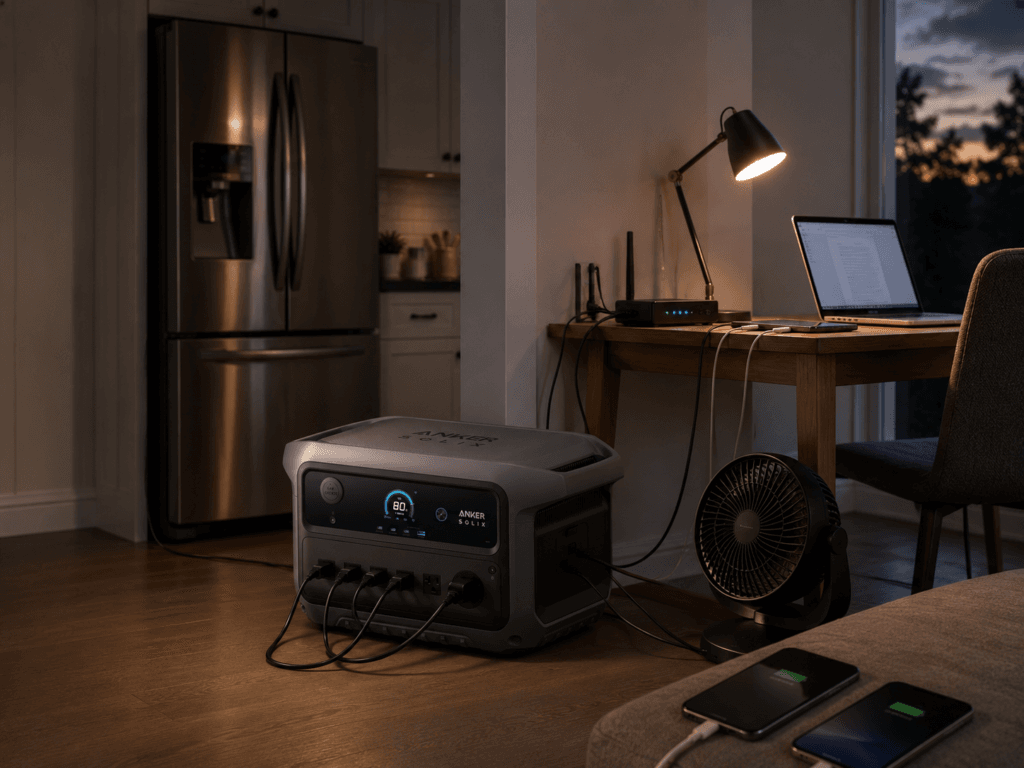
For a residential outage, the strongest role is selected direct-connected backup. A practical setup may include one refrigerator or freezer, modem and router, phone charging, laptop work, LED lighting, a small fan, and brief use of one moderate appliance. The exact combination must remain within the 2,400W continuous limit and the available energy reserve.
This Anker SOLIX C2000 Gen 2 review finds the product well suited to refrigerator-first planning when the appliance has been measured and the owner accepts variable runtime. Refrigerator behavior changes with room temperature, food load, door openings, compressor age, ice-making, and defrost cycles. A plug-in energy meter and a conservative reserve are more useful than a single headline runtime.
Do not backfeed household wiring or use an improvised cord. The station is not a replacement for a transfer switch, interlock, permanent battery, or standby generator. Central air conditioning, electric water heating, ranges, dryers, and many 240V pumps are outside its normal role. For wider preparation, combine the load plan with Ready.gov power-outage guidance.
RV and TT-30 fit
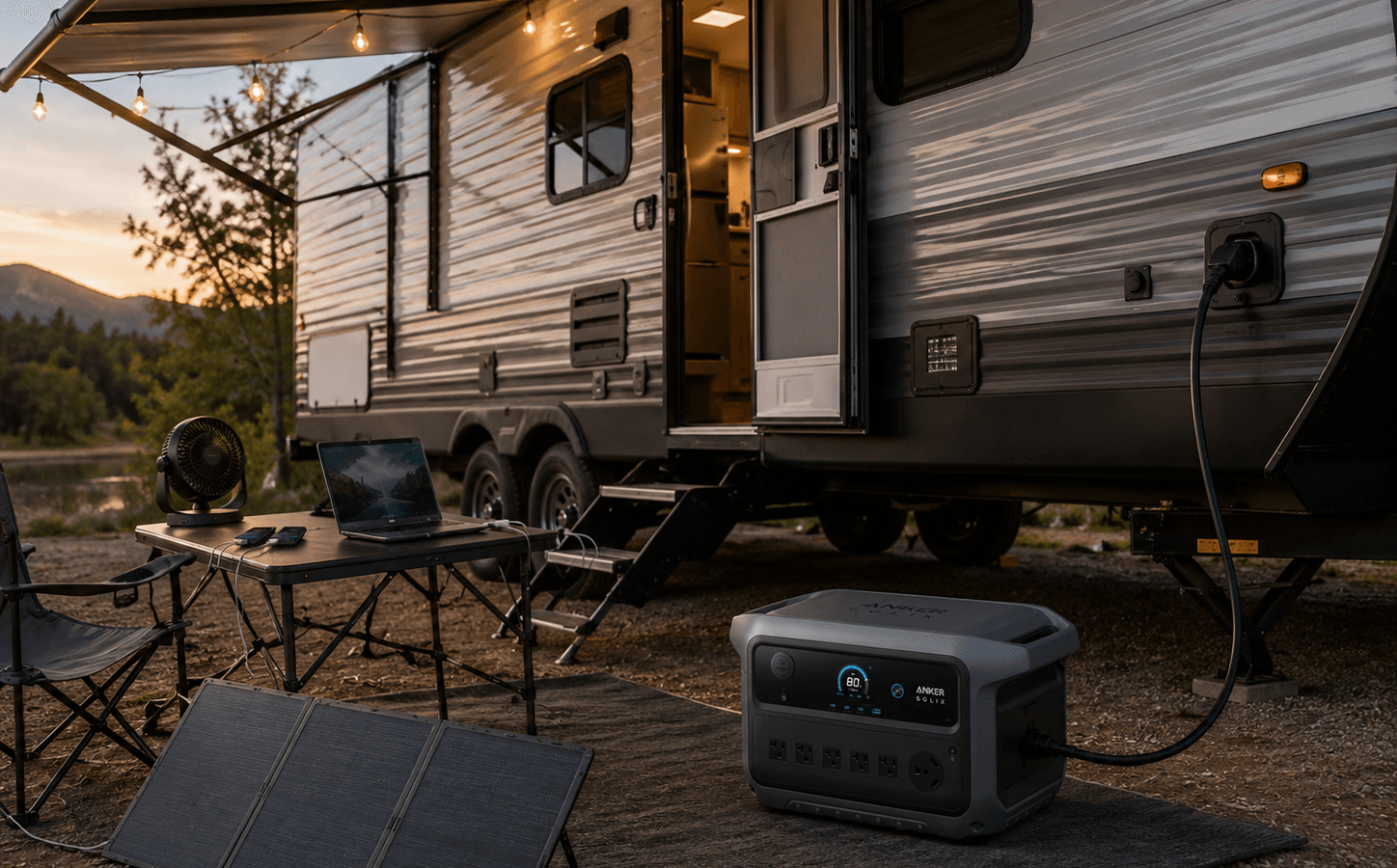
TT-30 is a major reason to consider this model for a small travel trailer or camper. It can connect to a compatible 120V shore-power inlet and let the RV distribution panel serve selected circuits. That is more convenient than running several separate household cords, but it does not remove the need to understand the RV converter, refrigerator mode, water heater, microwave, air conditioner, and battery charger.
The TT-30 output remains limited to 2,400W. This Anker SOLIX C2000 Gen 2 review does not describe it as full 30A service because the connector shape does not change the inverter. A travel trailer that normally uses a 30A pedestal can still exceed the station when several onboard appliances operate together. High-draw loads should be disabled or sequenced.
The best RV buyer knows the onboard load list and can test the setup before travel. Warm LED lighting, a small refrigerator, laptop work, fans, charging, and modest electronics are realistic priorities. An RV air conditioner may present both startup and runtime challenges, and electric heating can drain the battery quickly. Verify cable condition, polarity, grounding behavior, and any energy-management system.
Charging, solar, and alternator recovery
Fast charging is one of the strongest advantages. Anker lists up to 1,800W AC input and approximately 88 minutes for a full AC charge under stated conditions. Combined AC and solar can reach up to 2,600W, with a listed 58-minute full-charge figure. Real results vary with battery state, temperature, charging mode, utility voltage, and circuit conditions.
This Anker SOLIX C2000 Gen 2 review recommends checking the wall circuit before using maximum-rate charging. A high charging load should not share an undersized or heavily loaded circuit with another major appliance. Use the supplied cable and current instructions. A slower charging mode may be more appropriate when noise, circuit headroom, temperature, or battery-care preferences matter.
The solar input ceiling is 800W within the listed voltage and current limits. That is enough to make daytime recovery meaningful, but it is not guaranteed harvest. Clouds, shade, panel angle, season, cable loss, temperature, and array voltage affect production. Confirm open-circuit voltage and current before connecting third-party panels, especially in cold weather when panel voltage can rise.
An optional 800W alternator charger can support road recovery, but it is not the same as a standard 12V accessory socket. Vehicle and alternator capacity, cable routing, fuse protection, installation quality, and engine operation all matter. The best travel plan begins with a full battery and treats solar or alternator charging as a verified recovery method rather than a vague backup idea.
UPS behavior, app control, and expansion
Anker lists a 10ms UPS transition. That can help compatible routers, modems, computers, and selected electronics remain online during a utility interruption. It is not a universal zero-interruption guarantee. This Anker SOLIX C2000 Gen 2 review recommends testing the exact device chain, including adapters, power strips, monitors, storage devices, and restart behavior.
The Anker app adds Wi-Fi and Bluetooth monitoring, charging controls, Standard mode, Time-of-Use options, and Storm Guard behavior. These features can improve readiness and make it easier to reserve energy before severe weather. They do not change the battery capacity, inverter output, or device compatibility. Keep a basic offline operating plan because internet service may fail during an outage.
Expansion is limited to one BP2000 Gen 2 battery, taking the total reserve to roughly 4kWh. The added battery helps when the inverter already fits the loads and the problem is runtime. It does not raise the 2,400W continuous output or add 240V capability. Buyers who expect several expansion batteries or a broader home-integration path should choose a larger platform from the start.
Portability, storage, and noise
At 41.7 lb, the station is easier to manage than many larger backup systems, but it still needs a deliberate carry plan. Stairs, vehicle lift-in height, garage shelving, RV compartments, and the buyer’s physical limitations matter. The compact shape does not make the unit a casual one-hand carry, and the expansion battery adds a second heavy component.
This Anker SOLIX C2000 Gen 2 review favors protected storage near the likely use area. Keep the station dry, stable, ventilated, and secure during travel. Leave the vents unobstructed and avoid direct heat, condensation, loose cargo, and damaged cables. A unit stored behind several heavy items is less useful during an outage than one kept ready with labeled cords and a written load plan.
Anker lists 30dB operation below a 1,000W load. Fan behavior can change with charging rate, connected load, battery temperature, and room temperature, so the product should not be described as silent in every condition. Test normal charging and backup use before placing it next to a sleeping area, home office, or quiet campsite.
Anker SOLIX C2000 Gen 2 review: alternatives
Anker SOLIX C1000 Gen 2 for a lighter 1kWh plan
The Anker SOLIX C1000 Gen 2 review is the better path when portability matters more than duration. Its 1,024Wh battery is much smaller, but it is easier to move and can still support communication, work, lighting, CPAP planning after device verification, camping, and short appliance use. Choose it when the actual load list does not justify carrying 2kWh.
EcoFlow DELTA 2 Max for a direct expandable 2kWh comparison
The EcoFlow DELTA 2 Max review is the most direct 2kWh-class alternative. It is useful for buyers comparing ecosystem, expansion, charging behavior, app experience, port layout, and solar recovery rather than simply choosing by capacity. This Anker SOLIX C2000 Gen 2 review favors the Anker when TT-30 convenience and its specific size-and-weight balance are central.
Jackery Explorer 2000 v2 for a lighter fixed-capacity alternative
The Jackery Explorer 2000 v2 review is relevant for buyers who want a 2kWh-class battery with a lighter body and a simpler fixed-capacity ownership path. It gives up the Anker’s TT-30 and expansion route, so it is better when carrying ease matters more than RV shore-power convenience or future capacity growth.
Anker SOLIX F3000 for a larger backup platform
The Anker SOLIX F3000 review is the better comparison when the buyer needs a rolling 3kWh-class platform, more expansion potential, a larger solar path, or a more deliberate home-backup system. The trade-offs are greater weight, storage demand, and system complexity. Choose it only when those larger capabilities solve a real requirement.
The best alternative is defined by the unsolved problem. A smaller unit solves weight and cost. A direct 2kWh competitor may solve ecosystem or charging preferences. A larger platform solves output, duration, or integration needs. This Anker SOLIX C2000 Gen 2 review recommends the C2000 only when its particular balance of capacity, output, TT-30, expansion, and handling matches the buyer.
Anker SOLIX C2000 Gen 2 review: pros and cons
| Pros | Cons |
|---|---|
| 2,048Wh LiFePO4 capacity supports a meaningful selected-load plan. | TT-30 and standard AC outlets share one 2,400W continuous limit. |
| 2,400W continuous output and 4,000W peak power offer useful headroom. | 800W solar input may be limiting for repeated high-energy off-grid use. |
| TT-30 simplifies compatible 120V RV shore-power connection. | No 240V output or installed whole-home capability. |
| Fast AC charging and optional alternator charging improve recovery choices. | 41.7 lb still requires a deliberate lifting and storage plan. |
| One BP2000 Gen 2 battery can expand capacity to roughly 4kWh. | Expansion increases runtime but not inverter output. |
The pros in this Anker SOLIX C2000 Gen 2 review matter because they address real buyer problems: more outage duration than a 1kWh station, enough output for a broad controlled load mix, RV connection convenience, and several recovery methods. The cons matter just as much because they prevent the unit from becoming an assumed whole-home, 240V, or unlimited off-grid solution.
Anker SOLIX C2000 Gen 2 review FAQ
Can it run a refrigerator?
It can run many household refrigerators when the appliance’s running and startup demand stay within the inverter limits. Runtime varies with compressor cycling, ambient temperature, door openings, food load, defrost behavior, conversion losses, and other connected devices. Measure the appliance and keep a reserve rather than relying on one generic number.
Does TT-30 provide full 30A service?
No. The TT-30 output is listed at 120V and 2,400W maximum. The connector can simplify a compatible RV connection, but it does not turn the station into a 3,600W pedestal. Sequence high-draw onboard loads and verify the RV converter, refrigerator mode, water heater, microwave, and air-conditioner behavior.
Can it be expanded?
Yes. It supports one Anker SOLIX BP2000 Expansion Battery Gen 2, increasing total capacity to roughly 4kWh. Expansion does not raise the 2,400W continuous output, add 240V capability, or make an oversized appliance compatible. It is useful only when the original inverter already fits the load plan.
Is the 10ms UPS claim enough for sensitive equipment?
It may be enough for compatible equipment, but it is not a universal guarantee. Test the exact router, modem, computer, monitor, storage device, security system, or other electronics before relying on continuity. Follow manufacturer guidance for medical, life-safety, server, or data-critical equipment that requires a dedicated UPS or certified backup system.
Safety and purchase checks
Before ordering, confirm model A1783, ASIN B0FVFGL38H, the standalone power-station selection, seller, bundle contents, included cables, outlet layout, and current warranty terms. Amazon selectors can move between the base station, solar bundles, expansion batteries, bags, and alternator accessories. Do not rely on a saved price, stock message, or star rating.
This Anker SOLIX C2000 Gen 2 review also recommends checking every planned device label, startup requirement, and connection method. Keep the station dry, stable, ventilated, and away from damaged cords or trip hazards. Never backfeed household wiring. Use qualified electrical guidance for a transfer inlet, panel connection, RV electrical concern, or any code-governed installation.
Test important setups before storm season or travel. Label the refrigerator cord, router adapter, USB-C cables, RV cable, solar cable, and shutdown procedure. Record the normal watts shown on the display and decide what should be disconnected when the battery reaches a reserve threshold. A familiar selected-load plan is safer than improvising during an outage.
Anker SOLIX C2000 Gen 2 review: final recommendation
The conclusion of this Anker SOLIX C2000 Gen 2 review is positive for buyers who want a compact 2kWh station with 2,400W output, TT-30 RV convenience, fast charging, app control, and a limited expansion path. It is especially well suited to selected home essentials, refrigerator and communications planning, compatible small-RV use, vehicle camping, and controlled mobile work.
Skip it when the real requirement is 240V power, permanent whole-home wiring, full 30A RV behavior, several days of heavy loads, effortless portability, or expansion far beyond roughly 4kWh. In those cases, a smaller station may solve the handling problem, while a larger platform may solve the output, integration, or duration problem more honestly.
Read the connected Anker SOLIX C2000 Gen 2 Product reference, use the sizing guide, and verify the exact devices before buying. The strongest reason to choose this model is not one headline specification. It is the balance of energy, output, RV connectivity, recovery options, and manageable size for a buyer with a defined plan.
Testing Notes
- Manufacturer documentation reviewed: Anker SOLIX C2000 Gen 2 official US product page and published specifications.
- Retail identity verified: Amazon US model A1783, ASIN B0FVFGL38H.
- PowerLabPro has not performed hands-on or laboratory testing.