
Comparison
BLUETTI Elite 100 V2 vs Anker SOLIX C1000 Gen 2: Solar or Speed?
BLUETTI Elite 100 V2 vs Anker SOLIX C1000 Gen 2 compared for output, charging, solar input, UPS use, portability, expansion limits, and buyer fit.
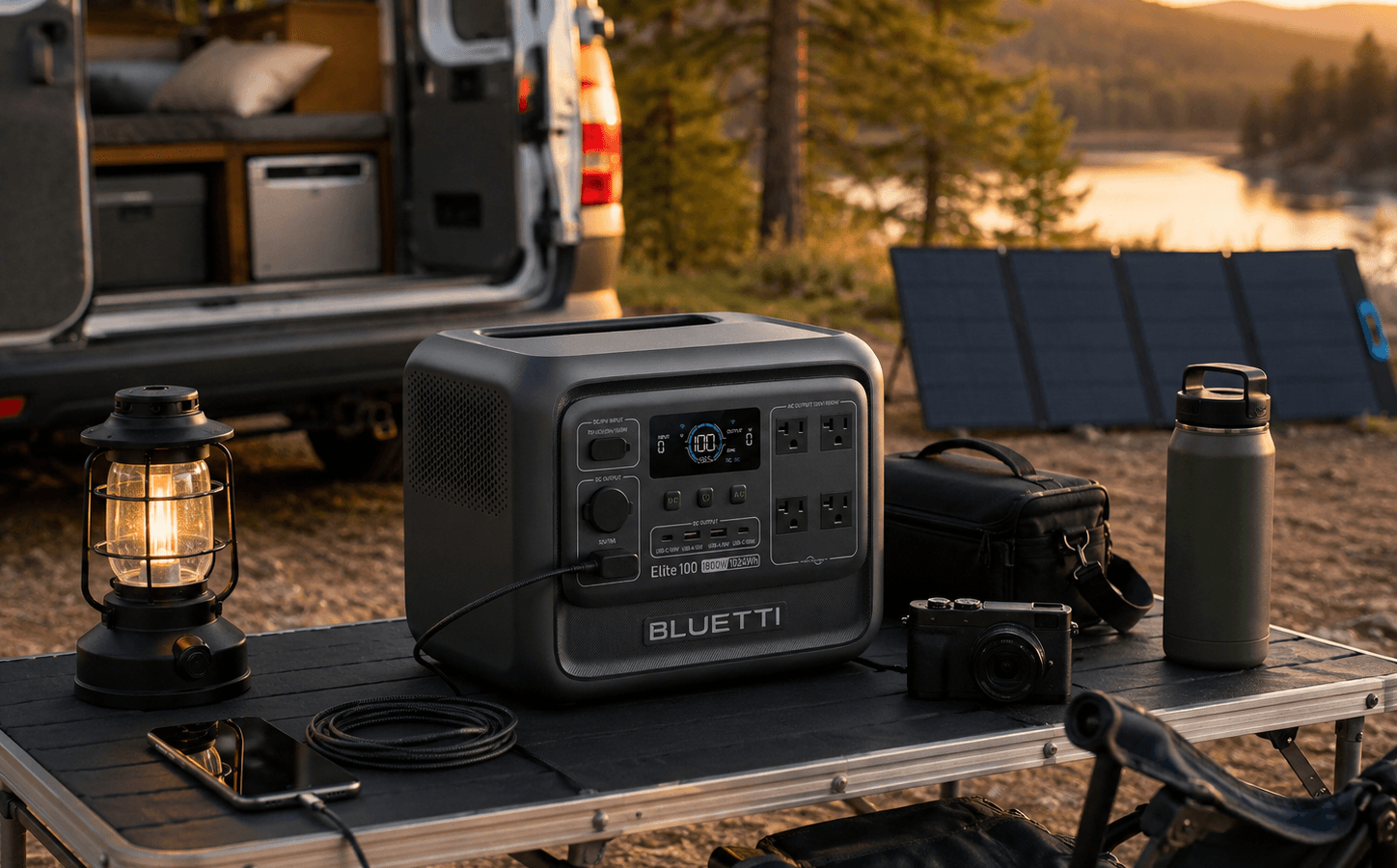
Product Matchup
Side-by-side summary
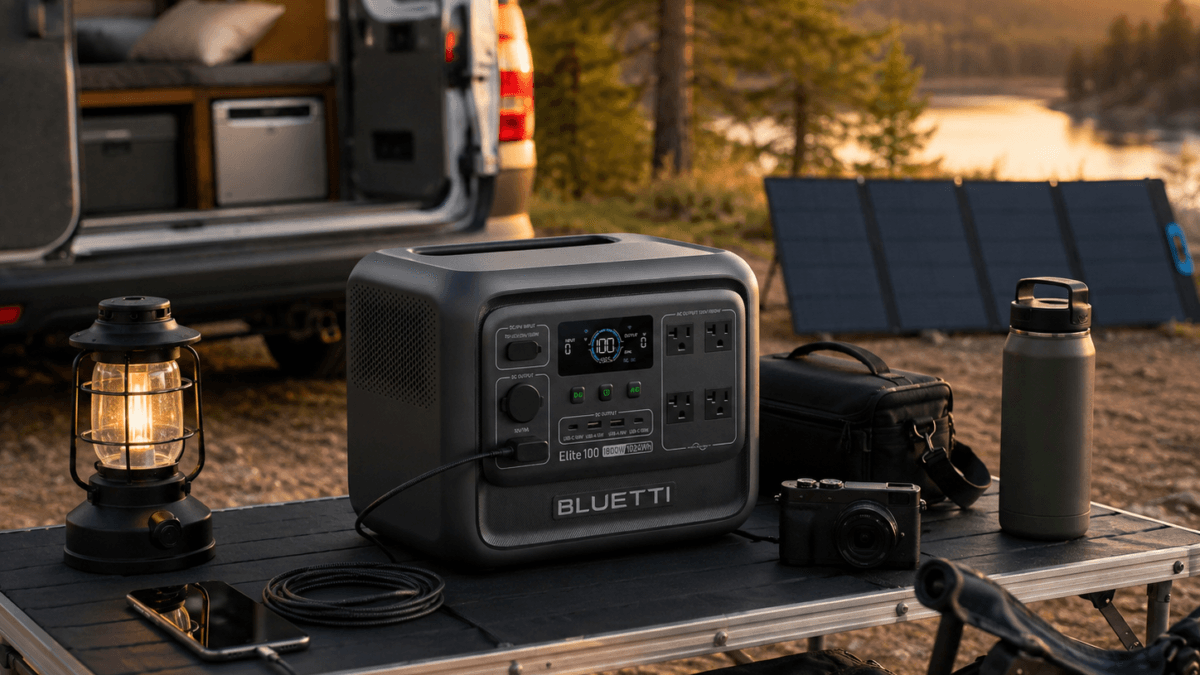
Product A
BLUETTI Elite 100 V2 Portable Power Station
A compact 1,024Wh LiFePO4 power station with 1,800W output, fast charging, 1,000W solar input, app control, and selected-load backup value.
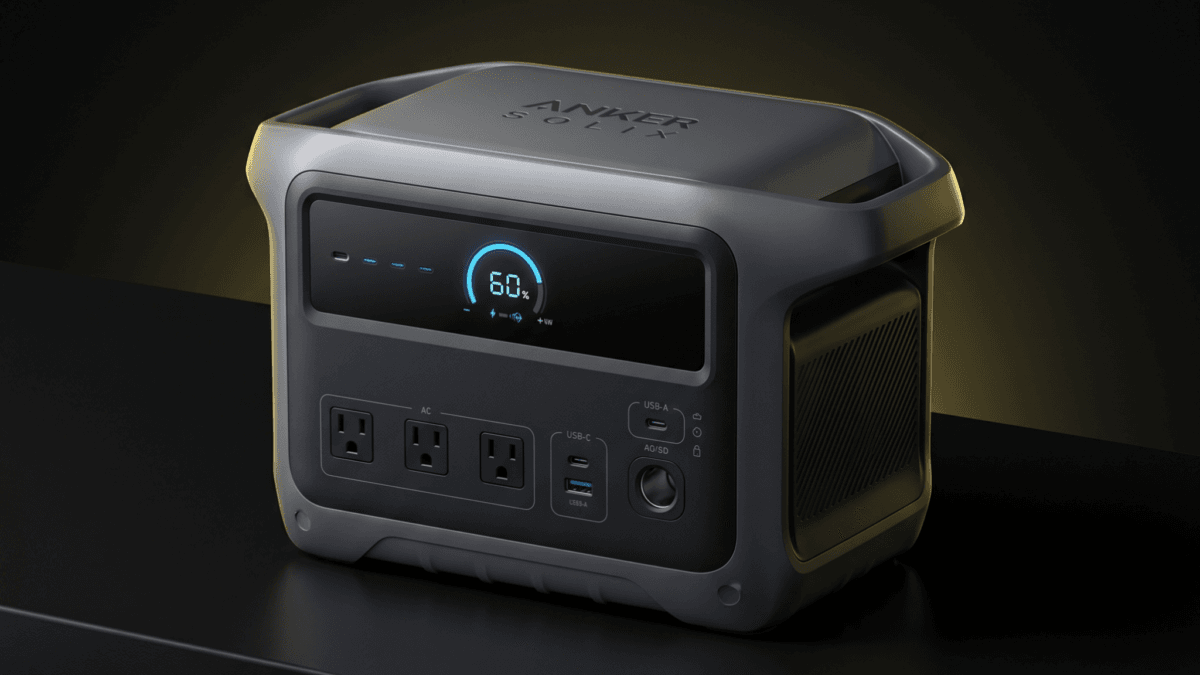
Product B
Anker SOLIX C1000 Gen 2 Portable Power Station
Compact 1,024Wh portable power station with 2,000W output, 3,000W peak, 49-minute fast AC recharge, 600W solar input, and 10 ms UPS support for home backup, camping, and RV use.
Spec Comparison
Core numbers
| Spec | BLUETTI Elite 100 V2 Portable Power Station | Anker SOLIX C1000 Gen 2 Portable Power Station |
|---|---|---|
| Capacity | 1024 Wh | 1024 Wh |
| AC Output | 1800 W | 2000 W |
| Solar Input | 1000 W | 600 W |
This article may contain affiliate links. If you buy through these links, PowerLabPro may earn a commission at no extra cost to you. As an Amazon Associate I earn from qualifying purchases.
BLUETTI Elite 100 V2 vs Anker SOLIX C1000 Gen 2 is a close 1kWh-class decision between two fixed-capacity LiFePO4 power stations. Both store 1,024Wh and weigh about 25 lb, but they prioritize recovery differently. The BLUETTI offers a higher 1,000W solar-input ceiling, while the Anker provides 2,000W of continuous AC output and a faster manufacturer-listed full wall charge.
The practical answer to BLUETTI Elite 100 V2 vs Anker SOLIX C1000 Gen 2 is not one universal winner. Choose BLUETTI for a solar-first plan, compatible resistive-load Power Lifting, and strong off-grid recovery potential. Choose Anker for higher sustained AC output, faster full AC recovery, and a mains-first apartment or home-office setup. Choose neither when you need battery expansion, 240V output, or multi-day high-load backup.
This comparison is research-led editorial analysis based on current manufacturer information, official support material, verified PowerLabPro Product records, and the matching U.S. Amazon identities. PowerLabPro has not performed hands-on testing of these two units. Confirm the current manuals, bundles, seller, warranty terms, and device requirements before buying.
BLUETTI Elite 100 V2 vs Anker SOLIX C1000 Gen 2: quick verdict
Best for solar-first recovery: BLUETTI Elite 100 V2.
Best for sustained AC output: Anker SOLIX C1000 Gen 2.
Best for wall-charge speed: Anker SOLIX C1000 Gen 2.
Best for portability: Tie. Their listed weights differ by only about 0.1 lb.
Best battery capacity: Tie. Both use a 1,024Wh LiFePO4 battery.
Overall winner: Tie by buyer scenario, not by specification count.
In BLUETTI Elite 100 V2 vs Anker SOLIX C1000 Gen 2, the most meaningful distinction is where the next charge comes from. The BLUETTI is better positioned for a larger compatible portable-solar array. The Anker is better positioned for buyers who expect reliable wall access and want the fastest stated full recharge. That difference matters more than minor variations in dimensions or outlet count.
The other decision in BLUETTI Elite 100 V2 vs Anker SOLIX C1000 Gen 2 is output. Anker lists 2,000W continuous output, compared with BLUETTI’s 1,800W continuous rating. BLUETTI separately lists Power Lifting up to 2,700W for compatible resistive loads. Power Lifting is not ordinary 2,700W continuous output and should not be used as a general motor, compressor, or electronics compatibility promise.
No layout selected.Table of Contents
BLUETTI Elite 100 V2 vs Anker SOLIX C1000 Gen 2: verified specifications
| Decision factor | BLUETTI Elite 100 V2 | Anker SOLIX C1000 Gen 2 | Buyer meaning |
|---|---|---|---|
| Battery | 1,024Wh LiFePO4 | 1,024Wh LiFePO4 | Capacity is a tie. Runtime depends on the load, conversion losses, settings, and temperature. |
| Continuous AC output | 1,800W | 2,000W | Anker has 200W more sustained inverter headroom. |
| Special or peak mode | Up to 2,700W Power Lifting for compatible resistive loads | 3,000W peak | Neither figure is a second continuous-output rating. |
| Maximum solar input | 1,000W, 12V to 60V, 20A maximum | 600W, 60V maximum | BLUETTI accepts a larger compatible solar array. |
| Fast AC charging | 1,200W TurboBoost; about 80% in 45 minutes and full in about 70 minutes under stated conditions | 1,600W UltraFast; full in 49 minutes under stated conditions | Anker has the faster stated full wall charge. |
| UPS-style transfer | 10 ms or less listed | 10 ms listed | Both require testing with the exact connected equipment. |
| Listed weight | About 25 lb | 24.9 lb | Portability is effectively a tie. |
| AC outlets | 4 | 3 | BLUETTI offers one more AC socket, but all outlets share the unit’s total output limit. |
| Battery expansion | No conventional integrated expansion | No expansion | Neither is the right platform for simple future capacity growth. |
The specification table makes BLUETTI Elite 100 V2 vs Anker SOLIX C1000 Gen 2 look simple, but headline winners need context. Anker’s 2,000W continuous output is useful only when the connected equipment fits its startup behavior and the battery provides enough duration. BLUETTI’s 1,000W solar ceiling is useful only with a compatible array, good sunlight, correct voltage, and enough panel area.
For current model details, review the official BLUETTI Elite 100 V2 page and the official Anker SOLIX C1000 Gen 2 page. The exact U.S. Amazon identities used in this comparison are ASIN B0F42CSQWG for BLUETTI and ASIN B0FN7MSY4L for Anker.
Same 1,024Wh capacity, different priorities
The battery side of BLUETTI Elite 100 V2 vs Anker SOLIX C1000 Gen 2 is a true tie on nameplate capacity. Both models list 1,024Wh and LiFePO4 chemistry. That makes this comparison cleaner than a matchup between different battery classes, because neither product starts with a basic stored-energy advantage.
A 1,024Wh label does not mean 1,024Wh will reach every AC device. The inverter, internal electronics, temperature, state of charge, cable losses, and device behavior reduce usable energy. Runtime also changes when a refrigerator cycles, a laptop battery becomes full, or a fan changes speed. Any universal hours estimate should therefore be treated as an example, not a guarantee.
Because capacity is equal, BLUETTI Elite 100 V2 vs Anker SOLIX C1000 Gen 2 comes down to how each product helps you use and replace that energy. Anker gives more continuous AC headroom and faster stated wall recovery. BLUETTI gives more solar-input headroom. A buyer with daily grid access may value Anker’s advantage more. A buyer with a larger portable-solar plan may value BLUETTI’s advantage more.
Continuous output and appliance compatibility
Anker has the straightforward output win in BLUETTI Elite 100 V2 vs Anker SOLIX C1000 Gen 2. Its 2,000W continuous rating is 200W higher than BLUETTI’s 1,800W rating. That extra margin can matter when several moderate devices run together or when a single appliance sits close to the BLUETTI limit.
BLUETTI changes the output discussion in BLUETTI Elite 100 V2 vs Anker SOLIX C1000 Gen 2 with Power Lifting. The manufacturer lists up to 2,700W for compatible resistive loads. A resistive heating appliance behaves differently from a compressor or motor. Power Lifting may adjust voltage to keep a compatible resistive device operating, so it should not be described as normal 2,700W output or used as proof that every higher-watt appliance will work.
The safest output conclusion for BLUETTI Elite 100 V2 vs Anker SOLIX C1000 Gen 2 is direct: Anker is better for ordinary sustained AC headroom. BLUETTI may be more flexible for a narrow group of compatible resistive appliances. Neither model should be selected from its larger temporary number alone.
AC charging speed and readiness
Anker has the wall-charging win in BLUETTI Elite 100 V2 vs Anker SOLIX C1000 Gen 2. Anker lists a 49-minute full charge through its app-enabled 1,600W UltraFast mode when the battery cells are within the stated temperature conditions. BLUETTI lists about 80% in 45 minutes and a full charge around 70 minutes through 1,200W TurboBoost under ideal conditions.
In a normal home routine, BLUETTI Elite 100 V2 vs Anker SOLIX C1000 Gen 2 favors Anker for recharge speed. BLUETTI remains fast enough for many buyers, but the manufacturer-listed full-charge difference is meaningful when rapid AC recovery is one of the main purchase reasons.
Solar input and off-grid recovery
BLUETTI has the clearest solar advantage in BLUETTI Elite 100 V2 vs Anker SOLIX C1000 Gen 2. Its listed 1,000W solar-input ceiling is 400W higher than Anker’s 600W ceiling. That creates more room for a larger compatible array and potentially faster recovery during strong sun.
The correct solar conclusion in BLUETTI Elite 100 V2 vs Anker SOLIX C1000 Gen 2 is therefore conditional. BLUETTI is the better platform for a serious compatible portable-solar plan. Anker can still recharge effectively from solar and may be sufficient for a smaller 200W to 600W setup. Use the portable solar-panel buying guide to plan around voltage, connectors, setup area, and realistic weather.
UPS-style use and home-office continuity
UPS-style performance is a tie on published transfer time in BLUETTI Elite 100 V2 vs Anker SOLIX C1000 Gen 2. BLUETTI lists 10 ms or less, while Anker lists 10 ms. Those numbers can be useful for routers, modems, selected computers, monitors, and communication equipment, but neither is a universal device guarantee.
For a home office, BLUETTI Elite 100 V2 vs Anker SOLIX C1000 Gen 2 favors Anker slightly only when the load approaches 1,800W or rapid wall recovery matters. For a modest router, laptop, monitor, phones, and lighting setup, both models have enough output and the same nameplate battery capacity. The deciding factors become port layout, charging preference, and solar plans.
Ports, size, weight, and daily handling
Portability is effectively a tie in BLUETTI Elite 100 V2 vs Anker SOLIX C1000 Gen 2. BLUETTI lists about 25 lb, while Anker lists 24.9 lb. A tenth of a pound is not a meaningful buyer advantage. Handle shape, storage location, cable access, and the path between a shelf, vehicle, desk, or campsite matter more.
Fixed capacity and expansion limits
Expansion is the shared weakness in BLUETTI Elite 100 V2 vs Anker SOLIX C1000 Gen 2. Anker states that the C1000 Gen 2 is not expandable. BLUETTI does not operate as a normal integrated expansion platform either. Its specialized B80 power-bank charging path is not the same as adding a seamless battery module to the base system.
Choose BLUETTI Elite 100 V2 vs Anker SOLIX C1000 Gen 2 only after deciding that fixed 1kWh capacity is acceptable. If future growth is likely, compare an expandable 2kWh or home-backup ecosystem before purchase. Paying slightly more for the correct architecture can be better value than replacing a fixed-capacity unit later.
Home outage and refrigerator planning
For short household outages, BLUETTI Elite 100 V2 vs Anker SOLIX C1000 Gen 2 can support a disciplined essentials plan. A router, phones, laptop, LED lights, a small fan, and selected charging loads are more realistic priorities than trying to run every convenience appliance. Both stations have enough inverter output for many combinations of these lower-draw devices.
In BLUETTI Elite 100 V2 vs Anker SOLIX C1000 Gen 2, Anker has a slight compatibility advantage for a refrigerator plus other simultaneous loads because of its 2,000W continuous rating. Runtime remains essentially tied because both batteries are 1,024Wh. The Anker output advantage does not create additional stored energy.
The apartment-buyer result in BLUETTI Elite 100 V2 vs Anker SOLIX C1000 Gen 2 depends on recharge access. Anker is stronger when fast wall recovery is available. BLUETTI is stronger when a larger solar setup can be deployed safely. The apartment-outage buying guide can help separate essential loads from unrealistic whole-apartment expectations.
Camping, RV, and mobile-work fit
For camping and RV support, BLUETTI Elite 100 V2 vs Anker SOLIX C1000 Gen 2 becomes a recovery question again. BLUETTI’s 1,000W solar ceiling is attractive when the trip includes enough panel area, good sun, and longer daytime recovery windows. Anker’s 600W ceiling may be entirely sufficient for a smaller, easier-to-deploy array.
For mobile work, BLUETTI Elite 100 V2 vs Anker SOLIX C1000 Gen 2 favors Anker when mixed AC tools and chargers need the extra 200W of continuous headroom. BLUETTI becomes more compelling when solar recovery at a remote location is the central requirement. In either case, keep the unit dry, protect cables, leave vents clear, and avoid operating it in a sealed hot vehicle.
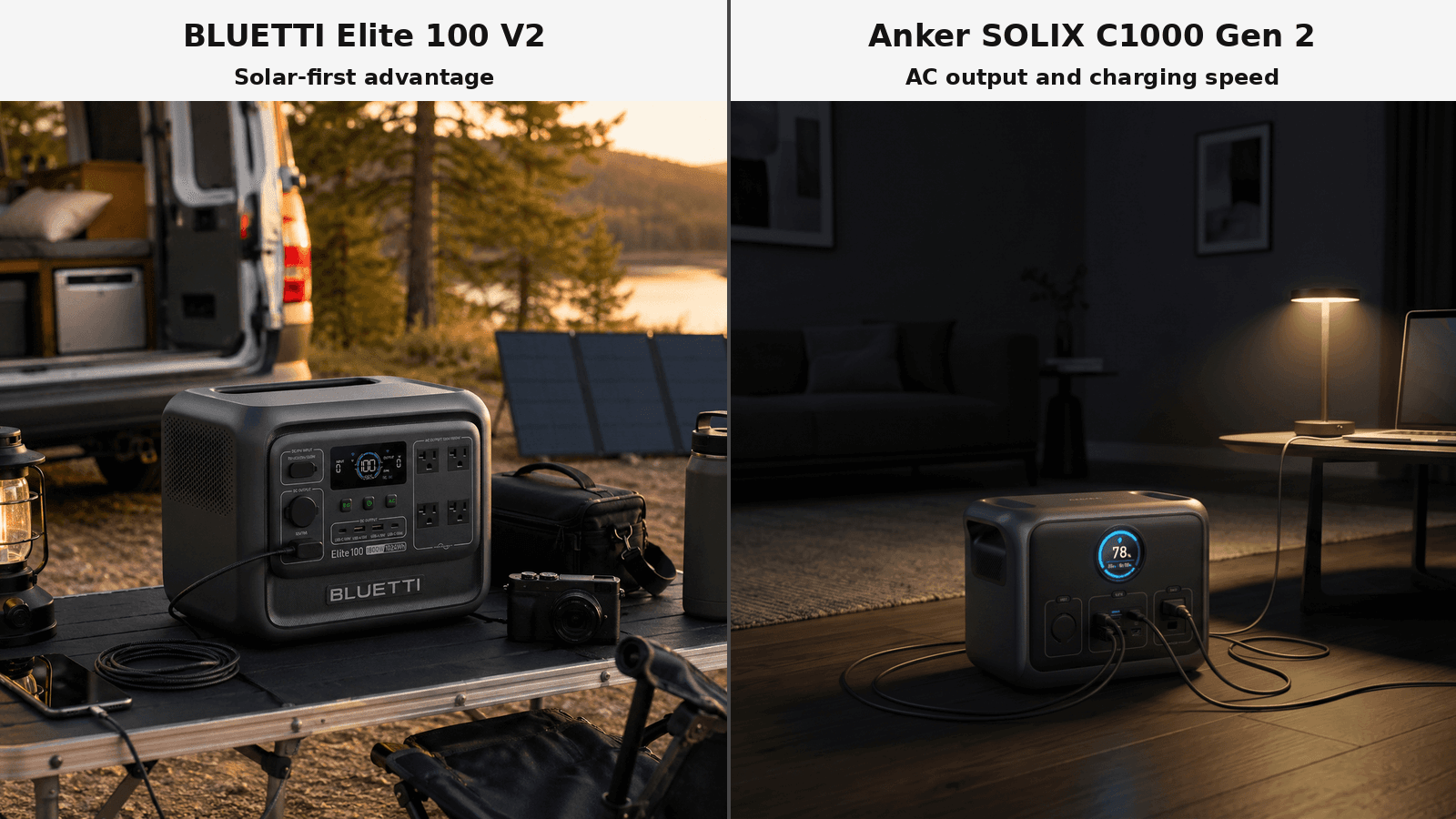
Buyer scenario matrix
| Buyer scenario | Better fit | Reason |
|---|---|---|
| Fast full wall recharge | Anker | 49-minute manufacturer-listed full charge under stated UltraFast conditions. |
| Large portable-solar array | BLUETTI | 1,000W solar ceiling compared with 600W. |
| Highest ordinary continuous AC output | Anker | 2,000W compared with 1,800W. |
| Compatible resistive heating load | BLUETTI, conditional | Power Lifting up to 2,700W, subject to compatibility and reduced-voltage behavior. |
| Router, laptop, monitor, and lights | Tie | Both have sufficient output, 1,024Wh capacity, and a roughly 10 ms transfer claim. |
| Portability | Tie | About 25 lb for both. |
| Multi-day refrigerator backup | Neither by default | Fixed 1,024Wh capacity may be too limited. |
| Future battery expansion | Neither | Neither provides a conventional integrated expansion path. |
| 240V or panel-connected backup | Neither | These are portable 120V stations, not installed whole-home systems. |
The scenario matrix is the most useful way to read BLUETTI Elite 100 V2 vs Anker SOLIX C1000 Gen 2. It prevents one specification from becoming a universal verdict. The better product is the one whose charging source, output margin, and fixed-capacity limit match the buyer’s actual plan.
Choose the BLUETTI Elite 100 V2 when
Choose BLUETTI in BLUETTI Elite 100 V2 vs Anker SOLIX C1000 Gen 2 when the solar plan is real, not hypothetical. A buyer who can deploy a compatible array above 600W has access to recovery headroom that Anker cannot accept. That can matter during longer camping stays, remote work, or outages with limited grid access.
The BLUETTI side of BLUETTI Elite 100 V2 vs Anker SOLIX C1000 Gen 2 is strongest for solar-first buyers who accept fixed 1,024Wh capacity and do not need the fastest possible full wall charge. Read the BLUETTI Elite 100 V2 Product page and the connected BLUETTI Elite 100 V2 Review before buying.
Choose the Anker SOLIX C1000 Gen 2 when
Choose Anker in BLUETTI Elite 100 V2 vs Anker SOLIX C1000 Gen 2 when ordinary continuous AC output is the priority. The 2,000W rating gives more sustained headroom for mixed devices and appliances than BLUETTI’s 1,800W rating, while both units carry the same 1,024Wh nameplate capacity.
The Anker side of BLUETTI Elite 100 V2 vs Anker SOLIX C1000 Gen 2 is strongest for apartment, home-office, and mains-first buyers who want more sustained output and faster full wall charging. Read the Anker SOLIX C1000 Gen 2 Product page and the connected Anker SOLIX C1000 Gen 2 Review for the full buyer context.
Choose neither power station when
Skip both sides of BLUETTI Elite 100 V2 vs Anker SOLIX C1000 Gen 2 when the real need is stored energy rather than output or charging speed. A fixed 1,024Wh battery can be excellent for communications and short essentials but inadequate for multi-day refrigeration, heating, cooling, pumps, or broad household coverage.
Finally, skip both options in BLUETTI Elite 100 V2 vs Anker SOLIX C1000 Gen 2 if the only required loads are phones, a router, one lamp, and occasional laptop charging. A smaller station may be lighter, cheaper, and easier to keep ready. Use the PowerLabPro sizing guide before paying for inverter headroom you will not use.
Connected PowerLabPro decision paths
The best next step after BLUETTI Elite 100 V2 vs Anker SOLIX C1000 Gen 2 is to validate the loads, not read another generic winner list. Start with running watts, startup demand, required hours, and the recharge source available after the first battery cycle.
| Decision question | Next PowerLabPro resource |
|---|---|
| How much capacity and output do my devices require? | What Size Power Station Do I Need? |
| How should I plan apartment essentials? | Portable Power Station for Apartment Outages |
| How long might a refrigerator run? | Refrigerator Backup Runtime Guide |
| How do I choose compatible portable panels? | Best Portable Solar Panels for Power Stations |
What to verify before buying
| Verify | Why it matters |
|---|---|
| Exact ASIN and model | Confirm B0F42CSQWG for BLUETTI or B0FN7MSY4L for Anker and check the current seller and bundle. |
| Continuous running watts | Use 1,800W for BLUETTI and 2,000W for Anker as the ordinary sustained limits. |
| Motor or compressor startup | A running-watt label may not reveal the starting demand. |
| Required watt-hours | Both units have 1,024Wh nameplate capacity, so long runtime may require a larger class. |
| Solar voltage and connector | Panel wattage alone does not prove compatibility. |
| Fast-charge conditions | Charging claims depend on mode, temperature, wall input, and state of charge. |
| UPS behavior | Test the exact connected device before relying on transfer performance. |
| Warranty and return terms | Commercial terms can change and may differ by seller or bundle. |
This checklist keeps BLUETTI Elite 100 V2 vs Anker SOLIX C1000 Gen 2 grounded in a real purchase. The correct model is not the one with the longest feature list. It is the one that fits the verified load, the required duration, the charging environment, and the buyer’s tolerance for fixed capacity.
BLUETTI Elite 100 V2 vs Anker SOLIX C1000 Gen 2 FAQ
Do both power stations have the same battery capacity?
Yes. In BLUETTI Elite 100 V2 vs Anker SOLIX C1000 Gen 2, both products list a 1,024Wh LiFePO4 battery. Real usable energy and runtime vary with inverter losses, load behavior, temperature, settings, and battery condition.
Which model has higher continuous output?
The Anker SOLIX C1000 Gen 2 has the higher ordinary continuous rating at 2,000W, compared with 1,800W for the BLUETTI Elite 100 V2. BLUETTI’s separate Power Lifting mode is for compatible resistive loads and is not normal 2,700W continuous output.
Which model is better for solar charging?
BLUETTI is better for maximum solar-input headroom in BLUETTI Elite 100 V2 vs Anker SOLIX C1000 Gen 2. It lists up to 1,000W, compared with Anker’s 600W. Actual charging depends on panel compatibility, voltage, sunlight, shade, angle, temperature, cabling, and battery state.
Which model is better as a UPS?
Neither has a universal UPS victory. BLUETTI lists 10 ms or less and Anker lists 10 ms. Test the exact router, computer, monitor, network device, or other equipment before relying on either station. Do not use a portable station as a substitute for certified life-safety backup.
Which model is better for refrigerator backup?
Anker has a small output advantage in BLUETTI Elite 100 V2 vs Anker SOLIX C1000 Gen 2, but refrigerator runtime is effectively tied because both batteries are 1,024Wh. The appliance’s startup behavior, cycling, ambient temperature, defrost cycle, and other connected loads determine the real result. Choose a larger-capacity model when long refrigerator duration is the primary requirement.
BLUETTI Elite 100 V2 vs Anker SOLIX C1000 Gen 2: final verdict
The final result of BLUETTI Elite 100 V2 vs Anker SOLIX C1000 Gen 2 is a scenario tie. BLUETTI is the better choice for buyers who will use its 1,000W solar-input ceiling and accept a roughly 70-minute stated full wall charge. Anker is the better choice for buyers who value 2,000W continuous output and a 49-minute stated full AC charge.
Their shared limits are just as important as their differences. Both have fixed 1,024Wh capacity, both weigh about 25 lb, both need exact-device UPS testing, and neither is a 240V or whole-home platform. A buyer who needs long-duration energy or integrated expansion should move to a different class rather than choosing between these two.
Use BLUETTI Elite 100 V2 vs Anker SOLIX C1000 Gen 2 as a recovery-method decision. Select BLUETTI when larger solar recovery is central. Select Anker when fast wall recovery and ordinary continuous-output margin are central. Select neither when capacity growth, multi-day runtime, or installed home backup is the actual problem.
Winners by Category
| Overall | Tie |
|---|---|
| Value | Tie |
| Portability | Tie |
| Output | Anker SOLIX C1000 Gen 2: Fast 1kWh Backup |
| Battery | Tie |
Final Verdict
Choose the BLUETTI Elite 100 V2 for greater solar-input headroom and compatible resistive-load Power Lifting. Choose the Anker SOLIX C1000 Gen 2 for higher continuous AC output and faster full wall charging. Choose neither for expansion, 240V, or multi-day high-load backup.