
Product Intelligence
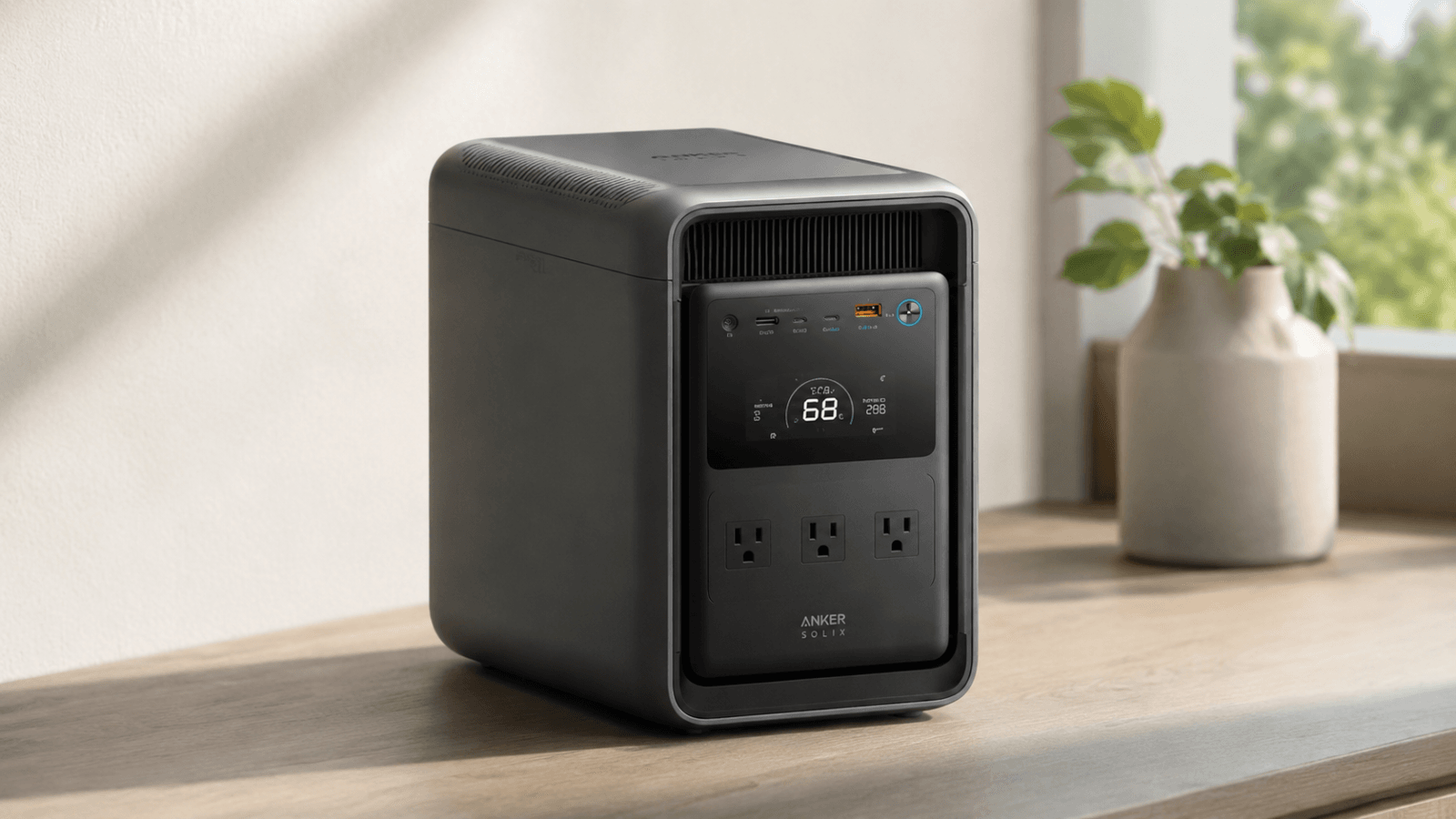
Compact 2kWh Essential-Load PickAnker SOLIX S2000 Portable Power Station: Compact 2kWh Essential Backup
A compact 2,010Wh LiFePO4 station for refrigerator, communications, home-office, lighting, and other selected essential loads. Its strength is a 35.7 lb 2kWh-class body and low-load efficiency emphasis; its main limits are 1,500W continuous output, 400W solar, fixed capacity, and no 12V car socket.
Specifications
Key specs
Buyer Fit
Fit signals
Best for
Pros
- 2,010Wh LiFePO4 capacity in a 35.7 lb body
- Low-load efficiency features target long essential-load runtime
- Five AC outlets plus two 140W USB-C ports
- UPS transition listed at 10ms or less
- App control includes charging, scheduling, TOU, and Storm Guard
Cons
- 1,500W continuous output is modest for the 2kWh class
- 400W solar ceiling limits aggressive off-grid recovery
- No add-on battery expansion
- No built-in 12V car-socket output
- Peak and SurgePad behavior do not replace the 1,500W continuous limit
Spec table
| Capacity | 2010 Wh |
|---|---|
| AC Output | 1500 W |
| Surge Output | 3000 W |
| Solar Input | 400 W |
| Battery | LiFePO4 |
| Warranty | 5 years; verify current US warranty and registration terms before purchase. |
| Expandability | No - fixed 2,010Wh capacity; no add-on battery expansion. |
| UPS / EPS | UPS transition ≤10ms; bypass limit 1,800W. Verify exact connected-device tolerance. |
| Recharge Time | Up to 1,600W UltraFast AC charging through the Anker app; Anker lists about 2.3 hours for a full charge under lab conditions. Standard AC input is lower. Solar input is up to 400W. |
This article may contain affiliate links. If you buy through these links, PowerLabPro may earn a commission at no extra cost to you. As an Amazon Associate I earn from qualifying purchases.
The Anker SOLIX S2000 portable power station is a compact 2,010Wh LiFePO4 battery system for buyers who care more about keeping essential loads alive for a long outage window than about running several high-watt appliances at once. Anker lists 1,500W continuous AC output, 3,000W peak output, up to 400W solar input, a UPS transition of 10ms or less, and a 35.7 lb body. That combination makes the S2000 unusually light for a 2kWh-class product, but it also creates clear limits around heating, cooking, air-conditioning, large pumps, and other demanding loads.
The central question is whether the Anker SOLIX S2000 portable power station matches a low-to-moderate-load backup plan. Its best use cases are refrigerator or freezer support after checking startup demand, modem and router backup, laptops and monitors, phones, LED lighting, fans, television, and other selected 120V essentials. Its main trade-offs are a relatively modest 1,500W continuous inverter, fixed capacity with no expansion battery, a 400W solar ceiling, and no built-in 12V car-socket output.
This Product page is research-led. PowerLabPro has not performed hands-on or laboratory testing of the Anker SOLIX S2000 portable power station. The product identity and specifications are based on current Anker SOLIX US documentation and the matching Amazon US listing for model AS220 and ASIN B0GY4TQ2P8. Manufacturer runtime, noise, charging, and efficiency examples are treated as conditional source claims rather than PowerLabPro results.
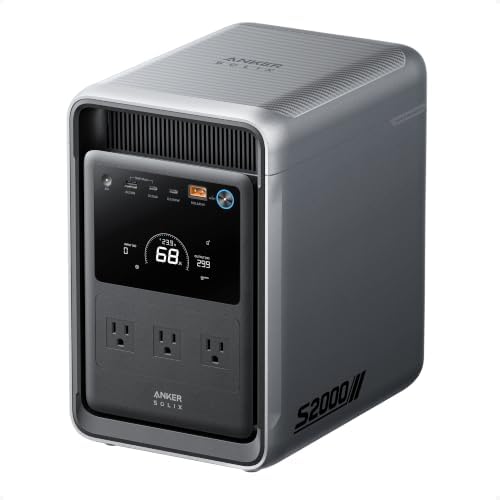
- 𝐔𝐩 𝐭𝐨 𝟑𝟓-𝐇𝐨𝐮𝐫 𝐅𝐫𝐢𝐝𝐠𝐞 𝐁𝐚𝐜𝐤𝐮𝐩: With 6W idle power draw and 10% higher efficiency, this power station runs 20% longer than …
- 𝟏𝟎,𝟎𝟎𝟎-𝐂𝐲𝐜𝐥𝐞 𝐋𝐅𝐏 𝐁𝐚𝐭𝐭𝐞𝐫𝐲: Powered by 314Ah LFP cells, S2000 has a 15-year lifespan, equivalent to 10,000 charge cycles.
- 𝐒𝐦𝐚𝐥𝐥𝐞𝐬𝐭 𝐚𝐧𝐝 𝐋𝐢𝐠𝐡𝐭𝐞𝐬𝐭 𝟐𝐤𝐖𝐡 𝐏𝐨𝐰𝐞𝐫 𝐒𝐭𝐚𝐭𝐢𝐨𝐧: 30% smaller and 25% lighter than the industry average, this power station meas…
Table of Contents
Anker SOLIX S2000 portable power station: quick buyer verdict
The Anker SOLIX S2000 portable power station is strongest when a buyer wants a long essential-load window without moving to a much heavier rolling system. The 2,010Wh battery is large enough to support meaningful refrigerator, communications, work, lighting, and device-charging plans, while the 35.7 lb body is easier to lift and store than many other 2kWh products. The catch is that the 1,500W continuous inverter is intentionally conservative for the capacity class.
- Best for: refrigerator and freezer planning, internet equipment, home-office continuity, lighting, fans, phones, and selected moderate 120V loads.
- Not ideal for: buyers who need 2,000W-plus continuous output, aggressive solar recovery, expansion batteries, a 12V car socket, or broad RV connectivity.
- Main advantage: 2,010Wh capacity in a compact 35.7 lb form with an efficiency-first low-load design.
- Main limitation: 1,500W continuous output and a 400W solar ceiling require deliberate load and recharge planning.
The Anker SOLIX S2000 portable power station makes the most sense for a household that has already decided which devices matter first. If the plan is one refrigerator, modem and router, a laptop, phones, several LED lights, and a fan, the S2000’s battery size can be more useful than a higher inverter rating. If the plan includes an electric kettle, microwave, coffee maker, space heater, induction plate, compressor tool, or air conditioner, those higher loads must be sequenced and verified.
Verified specifications and what they mean
| Specification | Current verified detail | Buyer meaning |
|---|---|---|
| Model | AS220 | Use the exact model with ASIN B0GY4TQ2P8 to avoid bundle or accessory confusion. |
| Battery capacity | 2,010Wh | Stored energy for a selected-load plan, not a guaranteed runtime. |
| Battery chemistry | LiFePO4 / LFP | Current Anker chemistry for this model. |
| Continuous AC output | 1,500W | The sustained AC load to plan around. |
| Peak output | 3,000W | Temporary startup headroom, not continuous output. |
| SurgePad | Up to 2,600W for supported devices | Load-management behavior, not a 2,600W continuous inverter rating. |
| AC outlets | 5 | Useful connection flexibility while total continuous output stays 1,500W. |
| Solar input | Up to 400W | Useful supplemental recovery, but modest for a 2kWh battery. |
| UltraFast AC input | Up to 1,600W through the app | Anker lists about 2.3 hours for a full charge under its lab conditions. |
| UPS transition | 10ms or less | Potentially useful for compatible electronics, but exact devices must be tested. |
| Bypass limit | 1,800W | Separate from the battery inverter’s 1,500W continuous rating. |
| USB | 2 × USB-C up to 140W each; 1 × USB-A 12W | Strong direct laptop and device charging. |
| 12V car socket | None | A real limitation for some RV and DC accessory users. |
| Expansion | No add-on battery | The system remains fixed at 2,010Wh. |
| Weight | 35.7 lb | Unusually manageable for the 2kWh class, but still a deliberate lift. |
| Dimensions | 8.2 × 11.1 × 12.7 in | A compact footprint for protected home or vehicle storage. |
The controlling manufacturer source for the Anker SOLIX S2000 portable power station is the current Anker SOLIX S2000 US product page. Anker’s current support material also identifies model AS220 and separates the inverter rating, UltraFast charging, solar ceiling, app functions, UPS behavior, and SurgePad feature. Those distinctions matter because a buyer should not combine unrelated numbers into a larger capability than the unit actually provides.
Why 2,010Wh matters more than a headline runtime
The Anker SOLIX S2000 portable power station starts with 2,010Wh of stored energy. That is the most important number when the goal is to keep modest essential loads operating for many hours. Capacity and output answer different questions. Output determines whether connected devices can run at the same time. Capacity determines how long the battery may support those devices after conversion losses, standby consumption, temperature, cycling, and the user’s reserve are considered.
A useful estimate begins with the average watts of each essential device. A router and modem may be low continuous loads. A laptop and monitor add more. A refrigerator cycles, so its average energy use may be far below its momentary compressor draw. A fan, television, or lighting adds another layer. The Anker SOLIX S2000 portable power station becomes attractive when those average loads stay modest enough for the battery’s energy reserve to matter more than a very large inverter.
Use the PowerLabPro power-station sizing guide to separate running watts, startup demand, watt-hours, conversion losses, reserve, and recharge time. Do not divide 2,010Wh by one appliance label and treat the answer as guaranteed runtime. Battery output efficiency changes with load, and real appliances can behave differently from their nameplate ratings.
The smartest plan for the Anker SOLIX S2000 portable power station is to reserve energy for the things that protect food, communications, work, and basic comfort. A microwave or coffee maker may fit beneath the inverter when used alone, but each high-watt minute reduces the remaining runtime for refrigeration and internet equipment. The S2000 rewards a buyer who is willing to prioritize and sequence.
1,500W output, 3,000W peak, and SurgePad limits
The 1,500W continuous rating is the main compatibility ceiling of the Anker SOLIX S2000 portable power station. Five AC outlets do not create five separate 1,500W supplies. All connected AC loads share the same inverter. A refrigerator, router, television, laptop charger, and lighting may fit comfortably, while a high-draw kitchen appliance can consume most of the available output by itself.
Anker also lists 3,000W peak output. Peak output is temporary headroom, typically relevant when a motor or compressor starts. It is not a second sustained rating. The Anker SOLIX S2000 portable power station should never be described as a 3,000W continuous station, and a buyer should not assume that every compressor, pump, saw, air conditioner, or refrigerator will start merely because its normal label wattage appears below the peak number.
SurgePad is another separate feature. Anker says it can support certain high-wattage devices up to 2,600W, but that does not turn the Anker SOLIX S2000 portable power station into a 2,600W continuous inverter. Resistive devices may be easier for load-management features than electronics or motor loads. Device behavior, voltage requirements, controls, and startup characteristics still need verification.
This output profile makes the S2000 a poor choice for buyers whose normal plan routinely exceeds 1,500W. If simultaneous cooking, heating, cooling, or tool operation is central to the use case, the Anker SOLIX C2000 Gen 2 Product page is the more relevant internal comparison because it trades some portability and low-load emphasis for substantially higher continuous output and expansion support.
Low-load efficiency and refrigerator backup
Anker positions the Anker SOLIX S2000 portable power station around low-load efficiency. The manufacturer currently publishes active-idle and standby figures of about 6W and 2W respectively. Those numbers are useful because inverter overhead matters during long, low-demand backup. A station that wastes less energy while supporting modest loads can preserve more of its 2,010Wh reserve for the devices the buyer actually cares about.
Refrigerator backup is the clearest example. A refrigerator usually does not draw its compressor wattage continuously. It cycles according to temperature, door openings, room conditions, defrost behavior, food load, and thermostat settings. The Anker SOLIX S2000 portable power station can therefore be a strong fit when the refrigerator’s startup demand is compatible and the buyer wants to stretch a 2kWh battery across many compressor cycles.
Anker advertises a refrigerator example of up to 35 hours under defined lab conditions. PowerLabPro does not treat that as a universal runtime. The PowerLabPro refrigerator runtime guide explains why appliance energy use, ambient temperature, door openings, conversion losses, and reserve change the result. Measure the actual refrigerator when possible and maintain a food-safety plan that does not depend on one optimistic number.
The same logic applies to a modem, router, laptop, small monitor, LED lighting, and phone charging. These are precisely the loads that make the Anker SOLIX S2000 portable power station interesting. A buyer who mainly wants low-to-moderate continuous backup can benefit from the large battery without paying a weight penalty as severe as many 2kWh systems.
Charging speed and the 400W solar ceiling
The Anker SOLIX S2000 portable power station supports up to 1,600W UltraFast AC charging through the Anker app. Anker currently lists about 2.3 hours for a full charge under its lab conditions. Standard charging is slower. These are manufacturer figures, and actual recharge time depends on battery temperature, state of charge, app mode, circuit voltage, load sharing, and thermal management.
A high-rate charge can place a substantial load on a household circuit. The Anker SOLIX S2000 portable power station should be charged with the supplied equipment and current instructions, without stacking another heavy appliance on an undersized or already stressed circuit. Faster charging is useful before a storm or between outage windows, but it should be selected deliberately rather than treated as the only normal operating mode.
The 400W solar ceiling is a more meaningful limitation. A 2,010Wh battery can take many hours to refill from solar even in good conditions, and real harvest is reduced by clouds, shade, panel angle, season, temperature, wiring loss, and battery acceptance. The Anker SOLIX S2000 portable power station is therefore better described as a home-backup unit with useful supplemental solar than as an aggressive off-grid solar platform.
Anker’s current support material specifies PV voltage and current limits and warns that panel configuration must remain within the allowed input. Buyers using third-party panels should verify open-circuit voltage, current, connector compatibility, and cold-weather voltage before connection. A panel’s headline wattage alone is not enough to prove compatibility with the Anker SOLIX S2000 portable power station.
UPS behavior, bypass power, and app control
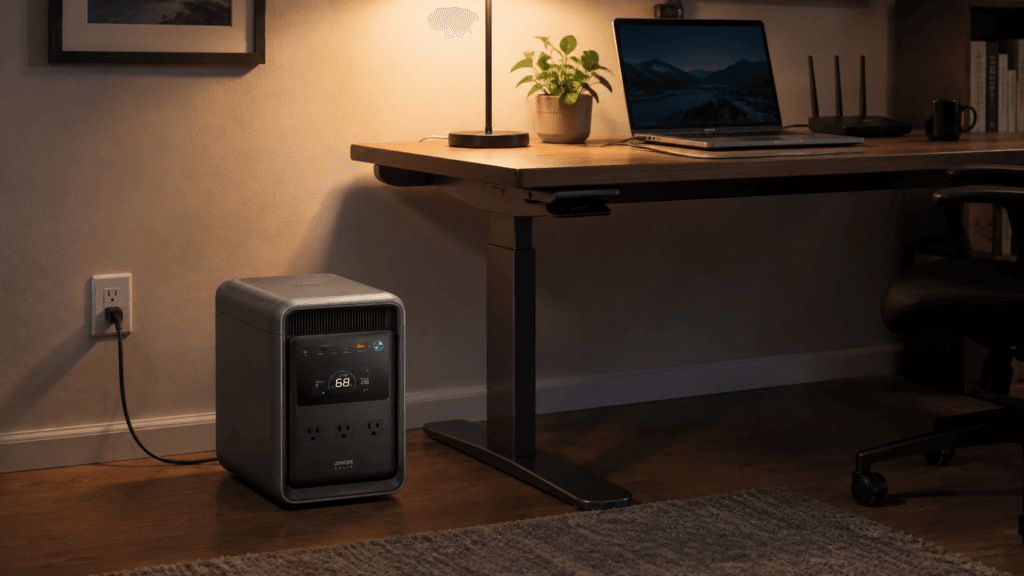
Anker lists a UPS transition of 10ms or less for the Anker SOLIX S2000 portable power station. That can be useful for compatible network equipment, a home-office setup, selected computers, and other electronics that tolerate the stated transition. It is not a universal zero-interruption guarantee. The actual modem, router, desktop, monitor, storage device, or other equipment should be tested before the user depends on continuity during an outage.
The bypass limit is another number that must remain separate. Anker lists up to 1,800W during bypass operation, while battery inverter output remains 1,500W continuous. A buyer should not use the 1,800W bypass figure to plan battery-only operation. When grid power disappears, the Anker SOLIX S2000 portable power station must still support the connected load within its battery-side limits.
The Anker app connects over Bluetooth and Wi-Fi and supports charging controls, schedules, Standard and Time-of-Use modes, Storm Guard, charging plans, charge and discharge limits, history, and diagnostic information. These features make the Anker SOLIX S2000 portable power station easier to prepare and monitor, but software cannot increase battery capacity, inverter output, solar input, or device compatibility.
Keep a basic offline procedure as well. Internet service may fail during a power outage, a phone may be unavailable, or another household member may need to operate the unit. Label priority cords, know how to read input and output from the display, and decide in advance which loads should be disconnected when the battery reaches a reserve threshold.
Ports and the unusual no-12V decision
The current Amazon listing describes eight output connections on the Anker SOLIX S2000 portable power station. Anker’s support material confirms two USB-C ports rated up to 140W each and one 12W USB-A port, leaving five AC outlets in the current US configuration. The dual high-power USB-C ports are particularly useful for laptops because they can reduce dependence on AC power bricks.
The unusual omission is a built-in 12V car socket. For a home-backup buyer, that may not matter. For RV, overlanding, portable refrigerator, compressor, or other 12V accessory use, it can be decisive. The Anker SOLIX S2000 portable power station is therefore not the most flexible choice for buyers who routinely run DC loads directly and want to avoid inverter conversion.
Outlet count should never be confused with available power. Five AC receptacles make it convenient to connect several low-watt devices, but the shared 1,500W limit still applies. Use correctly rated cables, avoid daisy-chained power strips, and do not create a cable arrangement that becomes a trip or overheating hazard during an outage.
Portability, storage, and noise
At 35.7 lb, the Anker SOLIX S2000 portable power station is comparatively easy to move for a 2kWh battery. That does not make it a casual one-hand device. Buyers with stairs, lifting limitations, high shelves, or frequent vehicle loading should plan the carry path. The compact 8.2 by 11.1 by 12.7 inch dimensions can make protected storage easier than a wide rolling platform.
Store and operate the Anker SOLIX S2000 portable power station in a dry, stable, ventilated location consistent with current Anker guidance. Do not block cooling paths, expose it to rain or standing water, place it beside damaged wiring, or trap heat around it. During vehicle transport, secure the unit so it cannot become loose cargo.
Anker markets noise around 30dB under specified light-load conditions. That is useful context for home-office or nighttime use, but actual fan behavior changes with charging rate, connected load, battery temperature, and room temperature. PowerLabPro does not describe the Anker SOLIX S2000 portable power station as silent under every condition.
Who should buy the S2000
The best buyer for the Anker SOLIX S2000 portable power station wants a relatively light 2kWh-class battery for selected essentials rather than a maximum-output platform. This can include a homeowner protecting refrigeration and communications, a remote worker who wants extended laptop and network continuity, a renter who needs indoor battery backup, or a camper whose loads are mainly AC and USB rather than 12V accessories.
- Refrigerator-first outage planning: when the appliance’s startup demand is verified and long cycling runtime matters.
- Home-office continuity: modem, router, laptop, monitor, phone charging, and lighting.
- Apartment or condo backup: selected direct-connected loads without generator fuel or exhaust.
- Moderate camping loads: lights, electronics, laptops, fans, and compatible AC devices where a 12V socket is not required.
For these buyers, the Anker SOLIX S2000 portable power station offers an unusual balance: substantially more energy than a 1kWh station, but less weight than many products in the 2kWh class. Its value depends on accepting the 1,500W ceiling and treating high-watt convenience devices as occasional, sequenced loads.
Who should skip the S2000
Skip the Anker SOLIX S2000 portable power station if the core requirement is high simultaneous AC output. A 2kWh battery does not compensate for a 1,500W inverter when the buyer wants to run several kitchen appliances, electric heating, a large compressor, air conditioning, or demanding tools at the same time. The higher-output C2000 Gen 2 is the more logical Anker comparison for those buyers.
Also skip the Anker SOLIX S2000 portable power station if future battery expansion is a firm requirement. The capacity is fixed. Buyers who expect their outage plan to grow beyond 2,010Wh should compare expandable systems before purchase rather than assuming an add-on battery will appear later.
The S2000 is also a weak fit for RV or overlanding buyers who depend heavily on direct 12V loads. There is no built-in car socket. A more suitable platform may offer a native 12V output, a TT-30 connection, alternator-charging support, or a broader DC ecosystem. Choose based on the connection plan, not just battery capacity.
What to verify before purchase
| Verify | Why it matters |
|---|---|
| Model AS220 and ASIN B0GY4TQ2P8 | Confirms the current US standalone S2000 identity. |
| Combined running watts | AC loads share the 1,500W continuous ceiling. |
| Startup demand | Refrigerators, compressors, pumps, and tools can surge well above normal draw. |
| Required runtime | 2,010Wh must cover conversion losses, standby use, cycling, and a reserve. |
| Solar array voltage and current | The S2000 accepts up to 400W within Anker’s published electrical limits. |
| Need for expansion | There is no add-on battery path. |
| Need for 12V DC | The unit has no built-in car socket. |
| UPS tolerance | A 10ms-or-less claim is not a guarantee for every sensitive device. |
| Charging circuit | UltraFast charging can draw substantial AC power. |
| Current seller, bundle, and warranty | Retail selectors and included accessories can change. |
Before ordering the Anker SOLIX S2000 portable power station, confirm the standalone station is selected rather than a solar bundle, accessory, or unrelated Anker product. The exact PowerLabPro Amazon destination uses ASIN B0GY4TQ2P8. Do not rely on a saved price, star rating, stock message, coupon, or promotional badge because those can change independently of the product identity.
Related PowerLabPro decision paths
If the Anker SOLIX S2000 portable power station is attractive mainly because of its 2kWh capacity but the 1,500W ceiling feels restrictive, compare the Anker SOLIX C2000 Gen 2. It is heavier, but it offers higher continuous output, more solar input, a native TT-30 outlet, a 12V car socket, and a limited expansion path. That makes it better for mixed appliance or RV use.
If portability is more important than long runtime, the Anker SOLIX C1000 Gen 2 is a lighter 1kWh-class alternative with higher continuous output relative to capacity. Buyers who want a more aggressive solar and expansion ecosystem can compare the EcoFlow DELTA 2 Max. These alternatives solve different problems rather than simply being larger or smaller versions of the S2000.
Safety and operating boundaries
Use the Anker SOLIX S2000 portable power station only in a dry, stable, ventilated location and follow the current manufacturer instructions. Inspect cables, keep vents clear, avoid trip hazards, and stop using equipment that is damaged, swollen, leaking, unusually hot, or behaving abnormally. Keep the station away from rain, standing water, combustible materials, and heat sources.
Never backfeed household wiring with the Anker SOLIX S2000 portable power station. A portable battery does not replace a transfer switch, breaker interlock, inlet, permanent home battery, or standby generator. Electrical work that connects to building wiring should use code-compliant equipment and qualified guidance. For broader outage preparation, see Ready.gov power-outage guidance.
Medical, life-safety, fire, security, or data-critical equipment should follow the device manufacturer’s backup requirements. A general UPS transition claim does not prove suitability for a particular device. Test ordinary noncritical setups before an outage so the household understands the load order, charging process, cable layout, and shutdown procedure.
Anker SOLIX S2000 portable power station FAQ
Can it run a refrigerator?
The Anker SOLIX S2000 portable power station can support many household refrigerators when the appliance’s startup and running demand remain within the inverter limits. Runtime varies with compressor cycling, room temperature, door openings, defrost cycles, food load, conversion losses, battery reserve, and other connected devices. Measure the actual refrigerator when possible.
Is 3,000W the continuous output?
No. The Anker SOLIX S2000 portable power station is rated for 1,500W continuous AC output. Anker lists 3,000W peak and separate SurgePad behavior up to 2,600W for supported devices. Those figures do not replace the 1,500W sustained inverter rating.
Can it use an expansion battery?
No. The Anker SOLIX S2000 portable power station has fixed 2,010Wh capacity and no add-on battery expansion path. Buyers who need more stored energy later should choose an expandable platform from the start.
Does it have a 12V car socket?
No. Current Anker documentation for the Anker SOLIX S2000 portable power station lists the AC and USB outputs but no built-in 12V car-socket output. That matters for some RV refrigerators, compressors, coolers, and other DC accessories.
Can it work as a UPS?
Anker lists a UPS transition of 10ms or less for the Anker SOLIX S2000 portable power station. Test the exact connected equipment before relying on it. Follow dedicated manufacturer guidance for medical, life-safety, server, security, or other critical devices that require specific backup characteristics.
Final Product decision
The Anker SOLIX S2000 portable power station is a strong fixed-capacity 2kWh option for buyers whose priorities are refrigeration, communications, home-office continuity, lighting, phones, fans, and other selected 120V essentials. Its 35.7 lb body and efficiency-first positioning make it particularly interesting when long low-load backup matters more than maximum inverter output.
Skip the Anker SOLIX S2000 portable power station when the real requirement is 2,000W-plus continuous output, fast 800W-to-1,000W solar recovery, expansion batteries, native 12V accessory power, or a broader RV and off-grid connection set. In those cases, the product’s compactness does not solve the actual problem.
Choose this model only after confirming AS220, ASIN B0GY4TQ2P8, the planned loads, startup demand, required runtime, safe placement, and recharge path. The paired PowerLabPro Review will own the deeper buyer decision and alternatives analysis, while this Product record remains the central identity, specification, affiliate, and routing reference.