
Review
Anker SOLIX S2000 Review: Compact 2kWh Backup With a 1,500W Limit
A strong fixed-capacity 2kWh choice for refrigerator, communications, and home-office backup when the load plan stays under 1,500W. Its 35.7 lb body and low-load efficiency emphasis are real advantages; 400W solar, no expansion, and no 12V car socket make the C2000 Gen 2 or another platform better for higher-output or modular buyers.
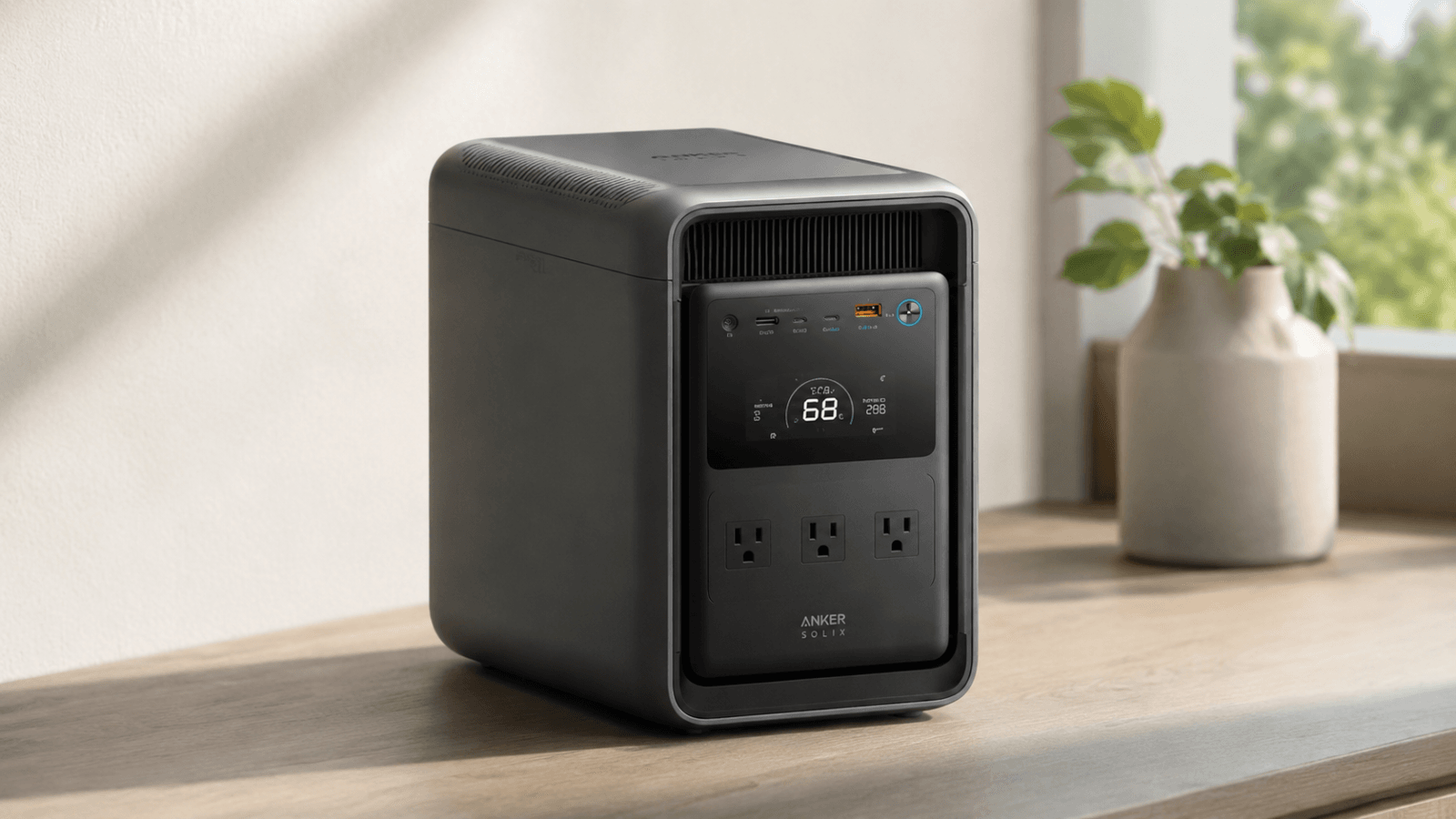
Linked Product Snapshot
Core specs
Buyer Fit
Pros and tradeoffs
Strengths
Pros
- 2,010Wh capacity and low-load efficiency suit long essential-load backup
- 35.7 lb body is unusually manageable for the 2kWh class
- Five AC outlets plus dual 140W USB-C support practical home-office setups
- UPS transition is listed at 10ms or less for compatible devices
- Anker app adds charging control, schedules, TOU, Storm Guard, and history
Tradeoffs
Cons
- 1,500W continuous output limits simultaneous high-draw appliances
- 400W solar input is slow for repeated high-energy off-grid recovery
- Fixed capacity with no expansion-battery path
- No built-in 12V car socket reduces RV and DC-load flexibility
- SurgePad and peak ratings must not be treated as continuous output
This article may contain affiliate links. If you buy through these links, PowerLabPro may earn a commission at no extra cost to you. As an Amazon Associate I earn from qualifying purchases.
This Anker SOLIX S2000 review is for buyers who want a 2kWh-class battery for long essential-load backup but do not need a high-output 2,000W-plus inverter. The current US model combines a 2,010Wh LiFePO4 battery, 1,500W continuous AC output, 3,000W peak output, a 400W solar ceiling, a listed UPS transition of 10ms or less, dual 140W USB-C ports, five AC outlets, app control, and a relatively manageable 35.7 lb body.
The central decision in this Anker SOLIX S2000 review is whether the S2000’s efficiency-first design is more valuable to you than the higher output, faster solar recovery, 12V connectivity, or expansion path offered by some competing 2kWh stations. It is strongest for refrigerators, freezers, communications, home-office equipment, lighting, fans, phones, and other low-to-moderate 120V loads. It is weaker for electric heating, sustained cooking, air conditioning, demanding tools, RV DC loads, or buyers who expect future battery expansion.
This is research-led editorial analysis based on current Anker SOLIX documentation, current support material, the exact Amazon US identity for model AS220 and ASIN B0GY4TQ2P8, and the connected PowerLabPro Product record. PowerLabPro has not performed hands-on or laboratory testing of this unit. Manufacturer runtime, charging, noise, cycle-life, and efficiency figures are treated as conditional source claims rather than PowerLabPro test results.
Anker SOLIX S2000 review: quick verdict
The conclusion of this Anker SOLIX S2000 review is positive for a specific buyer: someone who wants about 2kWh of stored energy in a compact body and expects most backup loads to stay well under 1,500W. The S2000 is not trying to be the strongest inverter in its class. Its appeal is that the battery is large relative to the continuous load profile, which can make refrigerator, internet, office, lighting, and other modest essentials more practical during a long outage.
This Anker SOLIX S2000 review becomes much less positive if the buyer equates 2,010Wh capacity with permission to run every appliance. Capacity does not raise the continuous AC ceiling. A microwave, kettle, coffee maker, toaster, heater, hair dryer, induction plate, compressor, or air conditioner can use most or all of the 1,500W inverter by itself, and some devices can exceed it. The S2000 is a selected-load station, not a whole-home or high-output replacement.
Best for, not ideal for, and the buyer decision
Best for: refrigerator and freezer planning, modem and router backup, laptop and monitor use, phones, LED lighting, fans, television, and other selected 120V essentials.
Not ideal for: 2,000W-plus continuous loads, aggressive solar recovery, battery expansion, 12V car-socket accessories, full RV shore-power behavior, or whole-home expectations.
Main advantage: 2,010Wh capacity in a 35.7 lb body with a low-load efficiency emphasis.
Main drawback: 1,500W continuous output and 400W solar input are modest for the 2kWh class.
Better alternative if: the C2000 Gen 2 better fits higher-output or RV needs, the C1000 Gen 2 solves a lighter 1kWh plan, or an expandable EcoFlow or another 2kWh platform better fits future growth.
Read the connected Anker SOLIX S2000 Product reference for the central model identity, specifications, ASIN, affiliate destination, and purchase checks. This Anker SOLIX S2000 review owns the deeper decision, including runtime logic, scenarios, trade-offs, alternatives, and reasons another product may fit better.
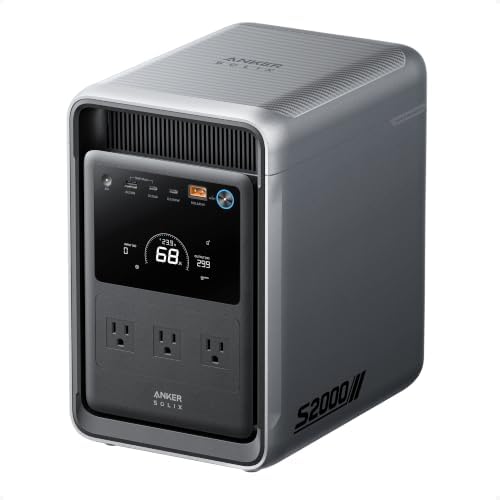
- 𝐔𝐩 𝐭𝐨 𝟑𝟓-𝐇𝐨𝐮𝐫 𝐅𝐫𝐢𝐝𝐠𝐞 𝐁𝐚𝐜𝐤𝐮𝐩: With 6W idle power draw and 10% higher efficiency, this power station runs 20% longer than …
- 𝟏𝟎,𝟎𝟎𝟎-𝐂𝐲𝐜𝐥𝐞 𝐋𝐅𝐏 𝐁𝐚𝐭𝐭𝐞𝐫𝐲: Powered by 314Ah LFP cells, S2000 has a 15-year lifespan, equivalent to 10,000 charge cycles.
- 𝐒𝐦𝐚𝐥𝐥𝐞𝐬𝐭 𝐚𝐧𝐝 𝐋𝐢𝐠𝐡𝐭𝐞𝐬𝐭 𝟐𝐤𝐖𝐡 𝐏𝐨𝐰𝐞𝐫 𝐒𝐭𝐚𝐭𝐢𝐨𝐧: 30% smaller and 25% lighter than the industry average, this power station meas…
Table of Contents
Anker SOLIX S2000 review: verified specifications
| Specification | Current verified detail | Decision impact |
|---|---|---|
| Model | AS220 | Confirms the current US S2000 identity. |
| Battery | 2,010Wh LiFePO4 | Large energy reserve for selected loads, not a fixed runtime promise. |
| Continuous AC output | 1,500W | The sustained combined AC limit. |
| Peak output | 3,000W | Temporary startup headroom, not continuous power. |
| SurgePad | Up to 2,600W for supported devices | Load-management behavior, not a 2,600W inverter rating. |
| AC outlets | 5 | Connection flexibility without increasing total output. |
| Solar input | Up to 400W | Useful supplemental recovery but slow for a full 2kWh battery. |
| UltraFast AC charging | Up to 1,600W through app control | Fast grid recovery when circuit and conditions allow. |
| UPS | 10ms or less listed transition | Potentially useful for compatible networking and office loads. |
| Bypass | 1,800W maximum | Separate from the 1,500W battery inverter limit. |
| USB | 2 × USB-C up to 140W; 1 × USB-A 12W | Strong direct laptop and device charging. |
| 12V car socket | None | Reduces DC and RV accessory flexibility. |
| Expansion | None | Capacity remains fixed at 2,010Wh. |
| Weight | 35.7 lb | A portability advantage within the 2kWh class. |
| Dimensions | 8.2 × 11.1 × 12.7 in | Compact storage footprint. |
| Amazon identity | B0GY4TQ2P8 | Confirm the standalone S2000 before checkout. |
The official source for this Anker SOLIX S2000 review is the current Anker SOLIX S2000 US product page, supplemented by Anker’s current S2000 support material. The Product page and support documentation separate 1,500W continuous output, 3,000W peak output, SurgePad behavior, 1,800W bypass, 400W solar input, and 1,600W UltraFast charging. Keeping those values separate prevents a buyer from combining unrelated modes into one unsupported capability claim.
The 2,010Wh runtime proposition
The most important finding in this Anker SOLIX S2000 review is that the product’s value comes from the relationship between capacity and intended load. A 2,010Wh battery can preserve low-to-moderate essentials for far longer than a typical 1kWh station, but the result depends on actual average watts, inverter losses, standby draw, temperature, battery settings, device cycling, and the reserve the owner chooses to keep.
A buyer should build a load budget rather than chase one runtime number. Modem and router equipment may be modest continuous loads. A laptop, monitor, phones, lighting, television, and fan add predictable energy use. A refrigerator or freezer cycles. The Anker SOLIX S2000 review becomes favorable when the combined average load is modest enough that 2,010Wh can create a meaningful outage window without forcing frequent high-watt operation.
Use the PowerLabPro sizing guide to separate watts from watt-hours. A device can fit beneath the 1,500W inverter and still drain the battery quickly. Conversely, a refrigerator may have a high startup moment but a much lower average hourly energy use. This Anker SOLIX S2000 review treats output compatibility and runtime as two separate buyer questions.
The best outage strategy is a priority order. Refrigeration and communications usually come before convenience loads. Laptop work, lighting, phones, and fans can follow. Cooking or heating should be short and sequenced if used at all. The S2000’s battery is large enough to support thoughtful choices, but not large enough to make energy discipline irrelevant.
Why low-load efficiency is the real differentiator
Anker’s low-load efficiency emphasis is the most distinctive part of this Anker SOLIX S2000 review. The manufacturer publishes approximately 6W active-idle and 2W standby figures under its stated conditions. Those values matter because a power station can spend many hours supporting a refrigerator between compressor cycles, a router, or a laptop that is not drawing anywhere near the inverter’s full rating. Lower overhead can preserve more stored energy for the actual load.
This is not a PowerLabPro laboratory measurement. The Anker SOLIX S2000 review uses the manufacturer figures as evidence of design intent and explains where that intent could matter. Actual system efficiency varies with AC or USB use, load level, battery state, temperature, firmware, charging state, and power-management behavior. Buyers should watch the display during a controlled home test to understand their own setup.
The S2000 therefore makes more sense for a refrigerator, router, monitor, fan, lights, and device chargers than for a 1,500W heater running continuously. The first group gives the battery time to demonstrate its endurance. The second turns a 2kWh battery into a relatively short high-draw energy source. That distinction is more useful than simply comparing capacity numbers across products.
1,500W output versus 2,010Wh capacity
The main limitation in this Anker SOLIX S2000 review is the 1,500W continuous inverter. Many competing 2kWh products are designed around 2,000W or more. The S2000 can still power a broad collection of essentials, but it requires more deliberate sequencing. A refrigerator and communications load may coexist comfortably, while a microwave, coffee maker, kettle, toaster, hair dryer, or heater can consume most of the available output alone.
Anker’s 3,000W peak rating is not an excuse to ignore the continuous limit. This Anker SOLIX S2000 review treats peak power only as temporary startup headroom. Motors, compressors, pumps, saws, and air conditioners have model-specific startup behavior. Some can start successfully; others can trip the inverter or behave unpredictably. The actual appliance label, manual, and controlled test matter more than a generic surge claim.
SurgePad also needs careful interpretation. Anker says supported high-watt devices can operate up to a higher figure, but SurgePad is not a replacement for the 1,500W continuous inverter rating. The Anker SOLIX S2000 review does not recommend purchasing this model for a 2,000W-plus normal load simply because a load-management feature exists. Choose an inverter that natively fits the sustained requirement.
If high output is central, the connected PowerLabPro ecosystem already has a stronger Anker alternative. The Anker SOLIX C2000 Gen 2 review covers a 2kWh-class unit with substantially more continuous output, more solar input, a TT-30 outlet, a 12V car socket, and limited expansion. The trade-off is additional weight and a different efficiency-versus-output balance.
Refrigerator and freezer outage scenario
Refrigeration is one of the strongest reasons to consider the product in this Anker SOLIX S2000 review. A refrigerator or freezer may draw relatively little energy on average compared with a continuous heating appliance, but the compressor can demand more power during startup. The S2000 makes sense when that startup behavior is compatible and the buyer wants the 2,010Wh battery to cover repeated compressor cycles over a long outage.
Anker publishes an example of up to 35 hours for a refrigerator under defined lab conditions. This Anker SOLIX S2000 review does not present that as a universal result. Runtime changes with refrigerator size, room temperature, thermostat setting, door openings, food load, ice-making, defrost cycles, compressor age, conversion losses, and every other connected device. Use a plug-in energy meter when possible.
The PowerLabPro refrigerator runtime guide explains how to estimate cycling loads and maintain a reserve. A refrigerator-first S2000 plan can also include a modem and router, phones, LED lighting, and short laptop sessions. The buyer should avoid spending the same battery on prolonged electric cooking or heating if food preservation is the priority.
A freezer can follow the same planning method, but a chest freezer, upright freezer, refrigerator-freezer combination, and older appliance can have very different energy profiles. The Anker SOLIX S2000 review therefore recommends measuring the exact appliance rather than assuming that one manufacturer’s refrigerator example automatically applies to a different compressor or climate.
Home-office, router, and UPS scenario
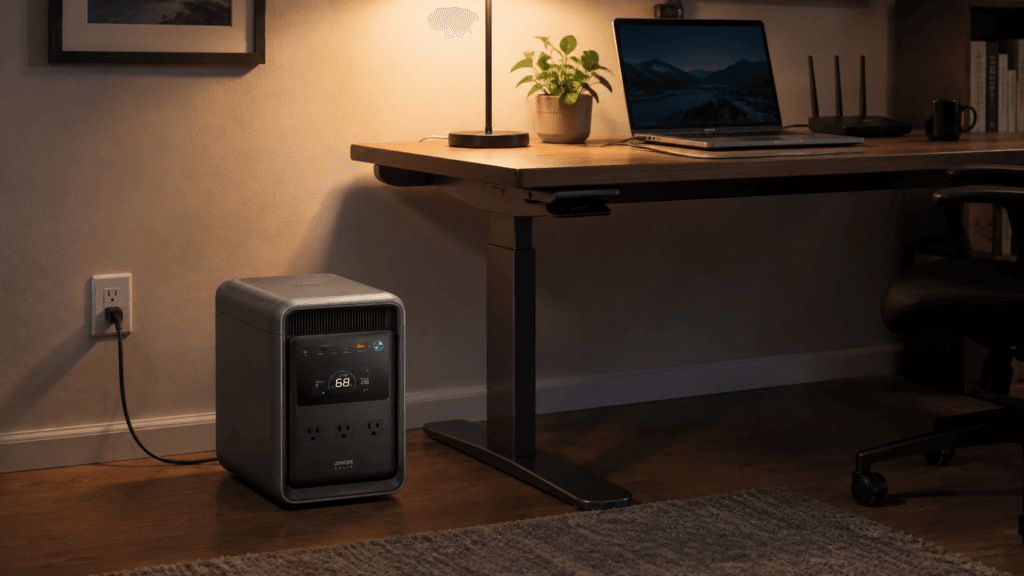
A home office is another strong scenario in this Anker SOLIX S2000 review. Two 140W USB-C ports can charge capable laptops directly, while the AC outlets can support a monitor, modem, router, small network switch, desk lighting, or another compatible device. Direct USB-C charging may reduce conversion steps for some laptops and preserves AC outlets for devices that actually require them.
Anker lists a UPS transition of 10ms or less. This Anker SOLIX S2000 review treats that as a compatibility feature rather than a zero-interruption guarantee. Test the exact router, modem, desktop, monitor, storage device, docking station, or network equipment before relying on continuity. A device can restart even when a general transition figure appears suitable.
The 1,800W bypass limit is separate from the 1,500W battery inverter. During normal grid operation, a connected load may be able to use the higher bypass ceiling. When utility power disappears, the Anker SOLIX S2000 review assumes the system must fall back to the 1,500W battery-side limit. Do not design a UPS setup that becomes overloaded precisely when the outage begins.
The app can help with charge limits, schedules, Standard and Time-of-Use modes, Storm Guard, Fast Charging Plan behavior, history, and diagnostics. These features make readiness easier but do not replace an offline procedure. A household should know which cords belong to the modem, router, laptop, and lights even if internet access or a phone is unavailable.
Charging and the 400W solar limit
Grid charging is a strength in this Anker SOLIX S2000 review. Anker lists UltraFast AC input up to 1,600W when enabled through the app and describes a full-charge window of about 2.3 hours under its lab conditions. Real charging speed varies with battery temperature, state of charge, circuit conditions, app mode, thermal management, and whether the unit is also powering loads.
The 400W solar ceiling is the opposite. It is useful for supplemental daytime recovery but relatively modest for a 2,010Wh battery. This Anker SOLIX S2000 review would not choose the S2000 for a buyer whose primary goal is aggressive solar cycling every day. Clouds, shade, panel angle, season, temperature, cable loss, and battery acceptance will push real harvest below the headline panel rating.
Anker’s current support material lists voltage and current limits for the PV input and requires a compatible panel configuration. Third-party panels should be checked for open-circuit voltage, current, connector type, and cold-weather voltage before connection. A nominal 400W array is not automatically safe or useful just because its wattage matches the Anker SOLIX S2000 review solar ceiling.
For repeated off-grid use, compare the S2000’s 400W solar input with alternatives that accept 800W or 1,000W. The trade-off may be more weight, more cost, or a different product ecosystem. For home outages where the battery is normally charged from the wall and solar is secondary, the lower solar ceiling may be acceptable.
Ports, no 12V socket, and practical setup
The current US configuration in this Anker SOLIX S2000 review provides five AC outlets, two USB-C ports up to 140W each, and one 12W USB-A port. That is a practical mix for home electronics. Laptop users benefit from the high-power USB-C connections, while the five AC outlets make it easy to separate refrigerator, networking, monitor, and lighting connections without immediately adding a power strip.
The missing feature is a 12V car socket. This Anker SOLIX S2000 review treats that as a real non-fit for some RV, overlanding, and DC accessory buyers. A 12V cooler, compressor, portable refrigerator, or other vehicle-oriented device may be more convenient or efficient on a native DC output. The S2000 is more home-essential and USB/AC oriented than RV-connection oriented.
Five AC outlets still share the same 1,500W continuous rating. Avoid daisy-chained power strips and extension setups that create heat or trip hazards. Keep the station dry, stable, ventilated, and close enough to priority loads that cables do not cross doorways or create an emergency obstacle.
Portability, storage, and noise
Portability is one of the strongest positives in this Anker SOLIX S2000 review. At 35.7 lb, the unit is easier to move than many 2kWh-class stations, although it still requires deliberate lifting. Buyers should think about stairs, vehicle height, storage shelf strength, grip, and their own physical limitations before assuming the compact body is easy for everyone.
The 8.2 by 11.1 by 12.7 inch footprint is compact enough for many protected home, garage, closet, or vehicle locations. The Anker SOLIX S2000 review favors storage near the likely use area with labeled cords and a documented priority list. A backup battery buried behind heavy boxes is less useful when the lights go out.
Anker markets noise around 30dB under specified light-load conditions. Actual fan behavior depends on charging rate, connected load, battery temperature, and room temperature. This Anker SOLIX S2000 review does not call the station silent in every condition. Buyers using it near a sleeping area or office should test normal charging and operating behavior before an emergency.
Anker SOLIX S2000 review: alternatives
Anker SOLIX C2000 Gen 2 for higher-output 2kWh backup
The Anker SOLIX C2000 Gen 2 review is the most important alternative when the buyer likes Anker but needs more continuous output. It is heavier, but it offers a higher inverter ceiling, more solar input, a TT-30 RV outlet, a 12V car socket, and a limited expansion path. Choose it when high-output flexibility matters more than the S2000’s lighter body and low-load emphasis.
Anker SOLIX C1000 Gen 2 for a lighter 1kWh plan
The Anker SOLIX C1000 Gen 2 review is better when the load plan needs less energy and portability matters more. It has roughly half the capacity but a strong inverter for the class and a much easier carry profile. This Anker SOLIX S2000 review favors the S2000 when refrigerator or long communications runtime justifies doubling stored energy.
EcoFlow DELTA 2 Max for stronger solar and expansion
The EcoFlow DELTA 2 Max review is relevant for buyers who want a more expandable 2kWh ecosystem and a higher solar ceiling. The trade-off is a heavier product. Choose it when daily solar recovery or future battery growth is part of the plan rather than an optional idea.
Jackery Explorer 2000 v2 for another fixed 2kWh approach
The Jackery Explorer 2000 v2 review gives buyers another fixed-capacity 2kWh path. It is worth comparing when simple ownership, weight, charging behavior, outlet layout, brand preference, and current bundle availability matter more than expansion. The better choice depends on the verified load list and connection needs.
The alternative section is where this Anker SOLIX S2000 review becomes decisive. The S2000 is not automatically better because it is lighter, and a competitor is not automatically better because it has a larger inverter. Choose the model that solves the actual limitation: runtime, output, solar recovery, DC connectivity, expansion, handling, or ecosystem.
Anker SOLIX S2000 review: pros and cons
| Pros | Cons |
|---|---|
| 2,010Wh capacity gives a meaningful reserve for selected essentials. | 1,500W continuous output is modest for the 2kWh class. |
| 35.7 lb body is comparatively manageable. | 400W solar ceiling is slow for repeated high-energy recovery. |
| Low-load efficiency features suit refrigerator, network, and office use. | No add-on battery expansion. |
| Five AC outlets and two 140W USB-C ports are practical for home electronics. | No built-in 12V car socket. |
| UPS transition is listed at 10ms or less for compatible devices. | Peak and SurgePad figures require careful interpretation. |
The pros in this Anker SOLIX S2000 review all support the same buyer: someone who values long moderate-load backup and lower weight. The cons support the opposite buyer profile: someone who wants higher inverter output, fast solar cycling, an expandable battery system, or RV/DC connections. That makes the decision clearer than a generic score.
Anker SOLIX S2000 review FAQ
Can the S2000 run a refrigerator?
It can run many refrigerators when startup and running demand stay within the documented limits. This Anker SOLIX S2000 review does not guarantee a fixed runtime. Compressor cycling, ambient temperature, door openings, food load, defrost behavior, conversion losses, battery reserve, and other connected devices all change the result.
Is 1,500W enough for home backup?
It is enough for many selected essentials but not for every combination of appliances. The Anker SOLIX S2000 review recommends adding the normal running watts of every device that may operate together and checking startup behavior separately. High-draw heating, cooking, cooling, and tool loads may need sequencing or a different station.
Can the S2000 be expanded?
No. Capacity is fixed at 2,010Wh. This Anker SOLIX S2000 review recommends choosing an expandable platform now if future runtime growth is a firm requirement rather than assuming an add-on battery can be added later.
Is 400W solar enough?
It can provide useful daytime recovery, but 400W is modest for a 2,010Wh battery. The Anker SOLIX S2000 review considers it adequate when wall charging is primary and solar is supplemental. Buyers planning frequent off-grid cycling should compare higher-input alternatives.
Can I rely on the UPS feature for sensitive equipment?
Anker lists a transition of 10ms or less, but exact equipment must be tested. This Anker SOLIX S2000 review does not treat that number as a universal guarantee. Follow manufacturer guidance for medical, life-safety, server, security, or data-critical equipment that requires a dedicated UPS or certified backup solution.
Safety and purchase checks
Before ordering, confirm model AS220, ASIN B0GY4TQ2P8, the standalone S2000 selection, seller, bundle contents, included cables, current outlet layout, and warranty terms. Amazon selectors can change. This Anker SOLIX S2000 review does not rely on a saved price, discount, stock statement, star rating, or temporary promotional badge.
Use the station in a dry, stable, ventilated location. Inspect cables, keep vents clear, avoid overloaded extensions and daisy-chained strips, and do not backfeed household wiring. A portable power station is not a substitute for required transfer equipment, permanent home wiring, or a standby generator. For broader outage planning, see Ready.gov power-outage guidance.
Test ordinary noncritical setups before storm season. Label the refrigerator cord, modem, router, laptop chargers, USB cables, and lighting. Decide which loads should be disconnected if the battery reaches a reserve threshold. The safest S2000 plan is one that the household already understands before the outage begins.
Anker SOLIX S2000 review: final recommendation
The final recommendation in this Anker SOLIX S2000 review is to buy it when the priority is long low-to-moderate-load backup in a compact 2kWh package. Refrigerator and freezer planning, communications, home-office equipment, phones, lighting, fans, and selected 120V essentials are the use cases that best exploit the 2,010Wh battery and 35.7 lb body.
Skip it when the real problem is high continuous output, fast solar recovery, future capacity expansion, native 12V accessory power, or broad RV connectivity. In those cases, this Anker SOLIX S2000 review favors the C2000 Gen 2 or another platform that solves those requirements directly rather than asking the buyer to work around the S2000’s design limits.
Read the connected Anker SOLIX S2000 Product reference, verify the exact loads and startup demand, and confirm the current listing before purchase. The strongest reason to choose the S2000 is not a universal best-product claim. It is the specific balance of 2,010Wh capacity, low-load efficiency, manageable weight, useful AC and USB connections, and honest acceptance of a 1,500W continuous limit.
Testing Notes
- PowerLabPro has not performed hands-on or laboratory testing of the Anker SOLIX S2000.
- This review is based on current Anker SOLIX manufacturer documentation, official support information, verified product identity, and independent research.
- The reviewed US model is Anker SOLIX S2000 model AS220, matched to Amazon ASIN B0GY4TQ2P8.
- Manufacturer runtime, charging, noise, efficiency, cycle-life, and performance figures are treated as source claims rather than PowerLabPro test results.
- Actual runtime, charging speed, noise, efficiency, and device compatibility can vary with load, temperature, battery state, settings, firmware, and operating conditions.
- PowerLabPro separates the S2000's 1,500W continuous output, 3,000W peak rating, SurgePad behavior, and 1,800W bypass limit rather than treating them as interchangeable output specifications.
- The S2000's refrigerator-runtime examples are manufacturer test results under specified conditions and should not be treated as guaranteed household runtime.
- UPS compatibility should be verified with the exact connected equipment before the S2000 is relied on for uninterrupted operation.