
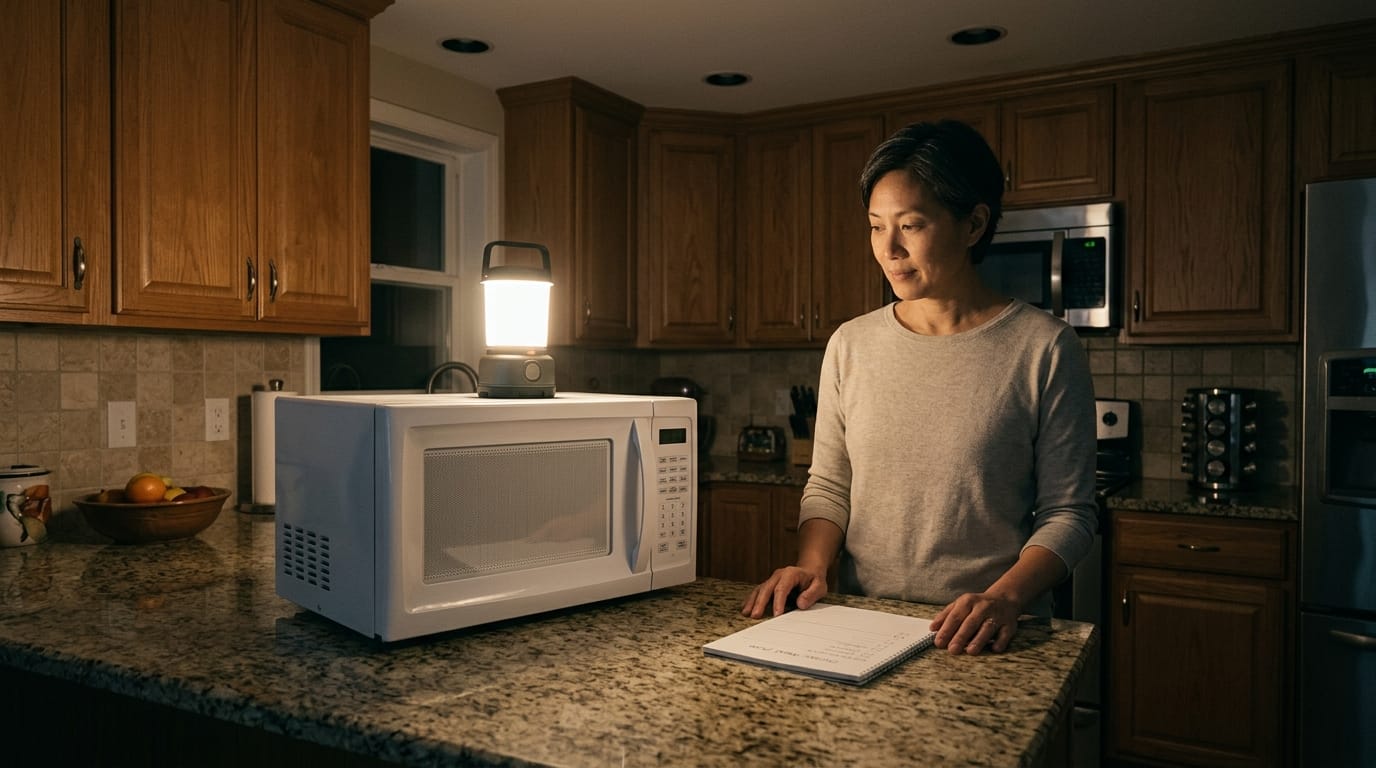
Can a portable power station run a microwave? In many cases, yes, but the answer depends on the microwave’s actual electrical input, the power station’s continuous AC output, and how much battery energy you are willing to spend on a short cooking task. The number printed on the microwave door may be cooking output, not the watts the appliance draws from the outlet.
This guide shows how to verify the right numbers before you connect anything. It uses current manufacturer specifications as examples, including Panasonic and GE models where cooking watts are lower than electrical input watts. The article is research-led and does not claim hands-on testing. Always check the label and manual for your exact microwave and the AC-output rules for your exact power station.
If you are asking can a portable power station run a microwave during an outage, start with compatibility, then calculate energy use in minutes rather than imagining hours of continuous microwave operation. That approach gives a more realistic backup plan and helps protect battery capacity for refrigeration, communications, lighting, or other higher-priority loads.
For a fast pre-purchase check, can a portable power station run a microwave should be answered with three verified values: microwave input watts, station continuous AC watts, and intended cooking minutes.
Table of Contents
Can a Portable Power Station Run a Microwave? Quick Answer
A reliable answer to can a portable power station run a microwave starts with the appliance label, not the battery size.
Yes, many portable power stations can run a cord-and-plug countertop microwave when the station’s continuous AC output is comfortably above the microwave’s verified electrical input and the connection follows both manufacturers’ instructions. The most common sizing mistake is comparing inverter output only with the microwave’s advertised cooking watts.
For example, Panasonic lists its NN-SG138S at 1,000W microwave cooking power but 1,550W microwave power consumption on 120V/60Hz power. GE lists the JES1657DMWW at 1,150W microwave output and 1,600W electrical input at 120V. Those examples show why “1,000-watt microwave” does not necessarily mean a 1,000W load on the battery inverter.
So, can a portable power station run a microwave? It can when the continuous output, outlet rating, waveform and appliance requirements all line up. Battery capacity determines how many cooking minutes you can support, but more watt-hours cannot fix an inverter that is undersized for the microwave’s actual input.
A simple rule for planning is to separate two questions. First, can the station sustain the microwave without overload or violating either manual? Second, how much energy will the intended cooking time consume? Answer both before deciding that a setup is useful.
Check the Microwave’s Actual Electrical Input
For model-specific sizing, can a portable power station run a microwave is answered by verified input data rather than a category average.
The most important number is the microwave’s electrical input, sometimes called power consumption, input watts, rated input, or rated power. Look for it on the appliance rating label or in the exact owner’s manual. If only amperage is listed, do not invent a wattage value from a generic microwave. Use the manufacturer’s documentation or ask the manufacturer for the model-specific rating.
When someone asks can a portable power station run a microwave, this is the first verification step because two appliances sold as “1,000W microwaves” can have different electrical demands. Cooking power describes energy delivered to food under a standardized test method. It does not describe all of the electricity drawn by the magnetron, high-voltage electronics, fan, turntable motor, controls, and internal losses.
Panasonic’s current support material for model NN-SG138S provides a clear illustration: 1,000W cooking power and 1,550W power consumption. GE’s product specifications for JES1657DMWW list 1,150W microwave watts and 1,600W electrical input. Neither example should be treated as a universal microwave value. They demonstrate why the exact model matters.
Write down the model number, voltage, input watts or amperage, plug type, and any dedicated-circuit or grounding instruction. If the label is unreadable and the manual cannot be found, the compatibility check is incomplete. Do not compensate for missing information by buying a larger battery and assuming it will work.
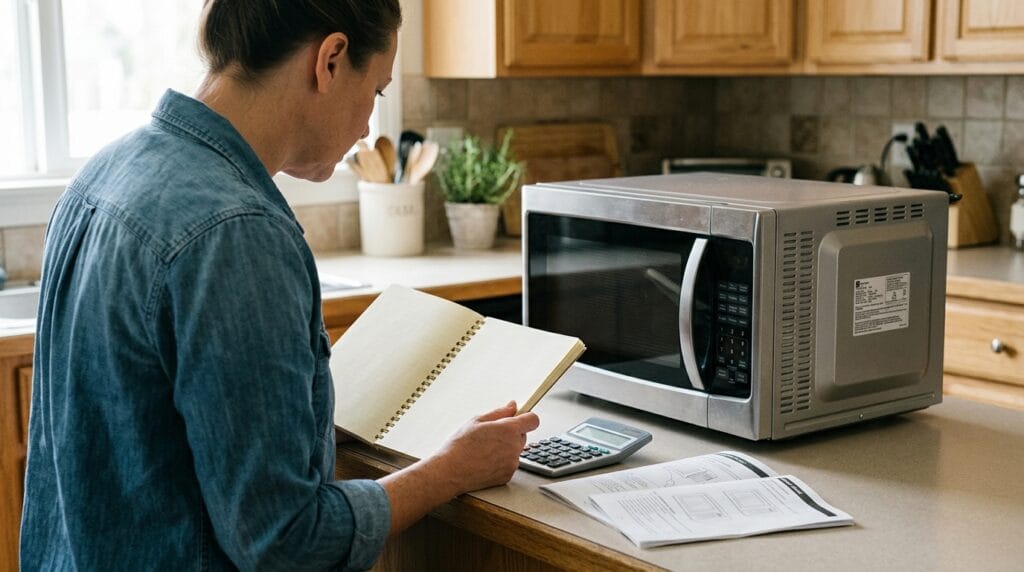
Cooking Watts vs. Input Watts: Why the Number on the Front Can Mislead
The reason can a portable power station run a microwave can be misjudged is that output watts and input watts describe different things.
Cooking watts are useful for comparing heating performance, but they are the wrong number for inverter sizing when the manufacturer publishes a higher electrical input. A power station has to supply what the microwave draws from its AC outlet, not just the portion converted into microwave energy inside the oven.
This distinction explains why can a portable power station run a microwave is not answered by matching a 1,000W microwave with a 1,000W inverter. In the Panasonic example, a station limited to 1,000W continuous AC output would be below the listed 1,550W consumption. In the GE example, it would be below the listed 1,600W electrical input.
Use the larger verified input figure for compatibility. Then add any headroom required by the power-station manual or your own conservative load plan. Do not use a station’s short-duration surge number as though it were continuous output, and do not assume an overload mode or voltage-lowering feature is suitable unless both manufacturers support the application.
The practical buyer lesson is simple: the microwave’s front-panel wattage can be a cooking-performance figure, while the station must handle the appliance’s wall-input demand. That distinction can prevent an expensive mismatch.
Make Sure the Power Station Can Sustain the Microwave Load
On the station side, can a portable power station run a microwave becomes a continuous-output question before it becomes a capacity question.
After you know the appliance input, inspect the power station. Continuous AC output is the central specification. The station should support the microwave’s verified input without relying on a momentary peak rating. Also check any per-outlet current limit, total AC-bank limit, pure-sine-wave requirement, overload behavior, and operating-temperature restriction published for the exact station.
Can a portable power station run a microwave when the inverter rating exactly equals the appliance input? That is not a comfortable planning margin. A 1,600W microwave on a 1,600W continuous inverter leaves no meaningful room for rounding, another connected load, or model-specific behavior. A station manual may also impose conditions that are not visible in a headline wattage.
Disconnect or avoid other large AC loads during microwave use unless the total has been calculated. A refrigerator, coffee maker, toaster, space heater, hair dryer, or air conditioner can push a system beyond its continuous limit when used at the same time. Multiple outlets on the station do not create multiple independent inverters.
If the station shuts down, displays an overload warning, smells abnormal, becomes unusually hot, or repeatedly trips protection, stop the attempt. Do not keep resetting protection as a substitute for correct sizing.
How Much Battery Does a Microwave Use?
For energy planning, can a portable power station run a microwave should be translated into minutes of operation and watt-hours consumed.
Microwaves are high-power appliances, but they are usually used for short periods. That is why minutes are a better planning unit than hours. The basic AC-energy calculation is:
AC energy (Wh) = microwave input watts × cooking minutes ÷ 60
For a hypothetical 1,000W electrical input, five minutes uses about 83Wh and ten minutes uses about 167Wh at the AC-load level. At 1,250W, five minutes is about 104Wh and ten minutes about 208Wh. At 1,600W, five minutes is about 133Wh and ten minutes about 267Wh.
| Microwave electrical input | 5 minutes | 10 minutes | Interpretation |
|---|---|---|---|
| 1,000W | 83Wh | 167Wh | AC-load energy only |
| 1,250W | 104Wh | 208Wh | AC-load energy only |
| 1,600W | 133Wh | 267Wh | AC-load energy only |
These figures are not guaranteed battery drain. The station must convert DC battery energy to AC, and the inverter, electronics, battery temperature, state of charge, age, reserve settings, and protective cutoffs affect usable energy. If you apply an efficiency or usable-energy factor, label it clearly as a planning assumption unless it is supported by documentation or measurement for the exact station.
This is why can a portable power station run a microwave is often a better question than “how many hours will it run?” A 1,000Wh-class battery may have enough stored energy for several short cooking cycles, but the inverter still has to support the microwave’s electrical input every time the oven runs.
Preserve a reserve. During an outage, spending 250Wh on cooking may be reasonable for one household and a poor trade for another. If the same battery must keep food cold, maintain communications, or support lighting, build a load priority list before using a high-draw cooking appliance.
Can a Portable Power Station Run a Microwave? 7-Check Compatibility Worksheet
A worksheet makes can a portable power station run a microwave a repeatable check instead of a marketing assumption. Use these seven checks before connecting the load.
- Identify the exact microwave. Record the model number from the rating plate or manual.
- Find electrical input, not only cooking output. Record input watts, power consumption, or the manufacturer’s electrical rating. If the manual gives only amperage and voltage, use model-specific documentation rather than a generic internet number.
- Confirm continuous AC output. The station must support the verified appliance input. Do not substitute peak or surge output for continuous output.
- Check outlet and connection requirements. Confirm plug, grounding, voltage, frequency, outlet current limit, and any manufacturer requirement for a dedicated circuit.
- Decide the real cooking minutes. Estimate the two-minute, five-minute, or ten-minute cycles you expect during the outage instead of calculating hours of continuous operation.
- Calculate energy use and preserve reserve. Multiply verified input watts by minutes and divide by 60. Then account for conversion losses with documented data or a clearly labeled planning factor.
- Verify the physical setup. Keep the station dry, stable, ventilated, and within its operating-temperature range. Follow the microwave manual for grounding and connection. Do not use an extension cord, adapter, or improvised wiring when the appliance instructions prohibit it.
If any check is unresolved, the answer to can a portable power station run a microwave is “not verified yet.” The fix is more information, not a bigger guess.
Countertop vs. Built-In Microwaves During an Outage
Connection method matters because can a portable power station run a microwave does not automatically mean the appliance can be rewired or moved from its approved installation.
Countertop microwaves are the simplest case for temporary battery backup because they are normally cord-and-plug appliances, but even those can have specific circuit and grounding requirements. Panasonic’s support guidance says its microwaves should be operated on a separate circuit and a grounded 120V, 60Hz outlet, with certain listed models requiring at least a 20A circuit. Whirlpool likewise advises readers to refer to the exact owner’s manual for model-specific electrical requirements.
Built-in and over-the-range microwaves deserve more caution. Their installation may involve cabinetry, ventilation, a dedicated receptacle in a specific location, or other installation requirements. Do not pull out a built-in appliance, modify wiring, create a temporary cord, or bypass an installation method just to connect it to a portable battery.
Can a portable power station run a microwave that is built in? The electrical load may be within the station’s capability, but electrical compatibility alone does not authorize a different connection method. If the appliance is not designed for straightforward cord-and-plug temporary use, follow the installation manual and use qualified electrical help where required.
A portable power station is not a transfer switch and should never be used to backfeed a household circuit. If your plan involves energizing fixed wiring rather than plugging an appliance directly into an approved station outlet, stop and use a properly designed transfer or backup system.
Common Microwave Backup Mistakes
Most wrong answers to can a portable power station run a microwave come from mixing cooking watts, input watts, peak inverter output, and battery capacity.
- Using cooking watts as input watts. This can undersize the inverter because cooking output may be substantially lower than electrical consumption.
- Buying on surge output. A large peak number does not replace adequate continuous AC output.
- Ignoring the exact model. Microwave labels, manuals, electrical input, plug requirements, and installation methods vary.
- Assuming every 1kWh battery can run every microwave. Battery capacity and inverter capability solve different problems. A large battery with a small inverter can still be incompatible.
- Calculating unrealistic continuous runtime. Microwaves usually operate in short cooking cycles. Energy planning should reflect the minutes you actually expect to cook.
- Using an extension cord or adapter to reach the station. Follow the microwave manufacturer’s connection rules. A temporary outage is not permission to defeat grounding or create a weak high-current connection.
- Running several high-draw appliances together. The microwave may fit by itself but overload the station when combined with another large AC load.
- Treating an inverter shutdown as harmless trial and error. Repeated overloads mean the setup needs to be reassessed.
- Ignoring battery reserve. A hot meal can be useful, but the outage plan should decide how much energy can be spent on cooking without compromising higher-priority loads.
If you keep asking can a portable power station run a microwave after these checks, the remaining unknown is usually model-specific. Read the two manuals and resolve that unknown rather than relying on a generic product-category claim.
How to Size a Portable Power Station for Microwave Use
A complete answer to can a portable power station run a microwave includes the other loads that must share the same battery during the outage.
Size from the load plan, not from the microwave alone. Start with the microwave’s verified electrical input because that sets the minimum inverter requirement. Then estimate the total cooking minutes and convert them to watt-hours. After that, add the energy budget for the refrigerator, router, lights, phones, laptop, and any other selected load.
Can a portable power station run a microwave and a refrigerator during the same outage? Often the battery may have enough total energy, but simultaneous inverter load is a separate question. A refrigerator compressor can start while the microwave is running, so a safer plan may be to avoid simultaneous high-draw operation unless the exact startup and continuous requirements are verified.
Use the PowerLabPro sizing guide to build the full load list rather than choosing a battery by microwave wattage alone. The sizing process separates watts from watt-hours, considers startup behavior, and helps you decide which loads deserve priority.
For apartment outages, a microwave can be a useful short-duration cooking load because a battery station avoids combustion exhaust. That does not make every station or apartment setup suitable. Check the appliance, station, lease or building constraints where relevant, and the physical cable path. The PowerLabPro apartment backup guide can help after the electrical requirement is known.
The final sizing question is not simply can a portable power station run a microwave. It is whether the same station can run the microwave for the intended minutes while still preserving enough output and energy for the rest of your outage plan.
Decide Whether Microwave Cooking Is Worth the Battery Energy
In an outage, can a portable power station run a microwave is only half the decision; the other half is whether cooking is the best use of limited stored energy.
A microwave can be a practical outage appliance because it can heat food quickly, but it is still a high-power load. A ten-minute cooking cycle at 1,600W represents about 267Wh at the AC-load level before conversion losses. That can be a meaningful share of a compact battery.
Decide what must remain powered before you cook. Refrigeration may protect food, a router and charged phones may preserve communications, and lighting may matter after dark. The correct hierarchy depends on the household, but the point is to make the trade deliberately.
Can a portable power station run a microwave and still leave useful reserve? That depends on battery capacity, other loads, and outage duration. A short outage with a large battery may make microwave use easy. A multi-day outage with poor recharge options can make the same cooking task expensive in energy terms.
Solar input does not guarantee recovery. A station’s maximum solar-input specification is a charging ceiling, not promised daily harvest. Weather, panel orientation, shade, temperature, cable limits, and daylight hours affect actual energy recovered. Do not spend battery energy based on solar production you have not realistically budgeted.
If cooking becomes an important repeated load during longer outages, compare the microwave with other safe cooking methods that fit your emergency plan. Any combustion appliance must follow its own ventilation and location rules and should never be brought indoors simply to save battery energy.
That is why can a portable power station run a microwave belongs inside a load-priority plan, not as an isolated appliance claim.
Frequently Asked Questions
The questions below keep can a portable power station run a microwave tied to specific electrical and energy checks.
What size power station do I need for a microwave?
Start with the microwave’s verified electrical input and choose a station whose continuous AC output can support it with appropriate margin. Then calculate the watt-hours for the number of cooking minutes you expect. Battery capacity alone is not enough.
Can a 1,000W power station run a 1,000W microwave?
Not necessarily. A microwave advertised as 1,000W may be describing cooking output while drawing substantially more from the outlet. Panasonic’s NN-SG138S, for example, is listed at 1,000W cooking power and 1,550W power consumption. Check the exact input watts.
Can a portable power station run a microwave for ten minutes?
If the inverter can sustain the appliance, calculate AC energy as input watts × 10 ÷ 60. A 1,600W input corresponds to about 267Wh at the AC-load level for ten continuous minutes. Actual battery draw will be higher because of conversion losses and station overhead.
Can a portable power station run a microwave from an extension cord?
Follow the appliance manual. Do not use an extension cord or adapter when the manufacturer prohibits it. The safer plan is a direct, compatible connection to the station’s built-in grounded AC outlet while observing both manuals.
Can a portable power station run a microwave and refrigerator together?
Maybe, but total inverter load and refrigerator startup behavior must be verified. It can be smarter to pause other large loads while cooking rather than assume the station can handle every appliance simultaneously.
Does a microwave need pure sine wave power?
Use the microwave manufacturer’s requirements and the power-station manual. Many current portable stations provide pure sine wave AC, but do not assume waveform compatibility from category labels alone.
Is microwave backup worth the battery use?
It can be. Short cooking cycles may use less energy than people expect when calculated in minutes. The trade depends on the battery reserve needed for refrigeration, communications, lighting, and the expected outage duration.
Final Decision
The buyer-focused answer to can a portable power station run a microwave is conditional, measurable, and model-specific.
Can a portable power station run a microwave? Yes, many can, but only after the exact appliance input and station output have been matched. Do not size from cooking watts printed on the microwave door. Use electrical input or power consumption from the exact rating label or manual, then compare it with the station’s continuous AC capability.
Next, calculate energy in minutes. Multiply input watts by cooking minutes and divide by 60, then account for documented conversion losses or a clearly labeled planning factor. Preserve reserve for the rest of the outage plan.
The most useful purchase decision comes after those checks. If the microwave needs 1,550W or 1,600W from the outlet, a 1,000W continuous inverter is not made suitable by adding more battery capacity. If the inverter is adequate but the battery is small, short cooking cycles may still be practical.
When you need to choose a station, use the PowerLabPro sizing guide to combine the microwave with your refrigerator, communications, lighting, and other selected loads. That turns can a portable power station run a microwave from a yes-or-no question into a complete outage-energy decision.
Once those values are known, can a portable power station run a microwave becomes a straightforward compatibility and energy-budget decision rather than a guess.