
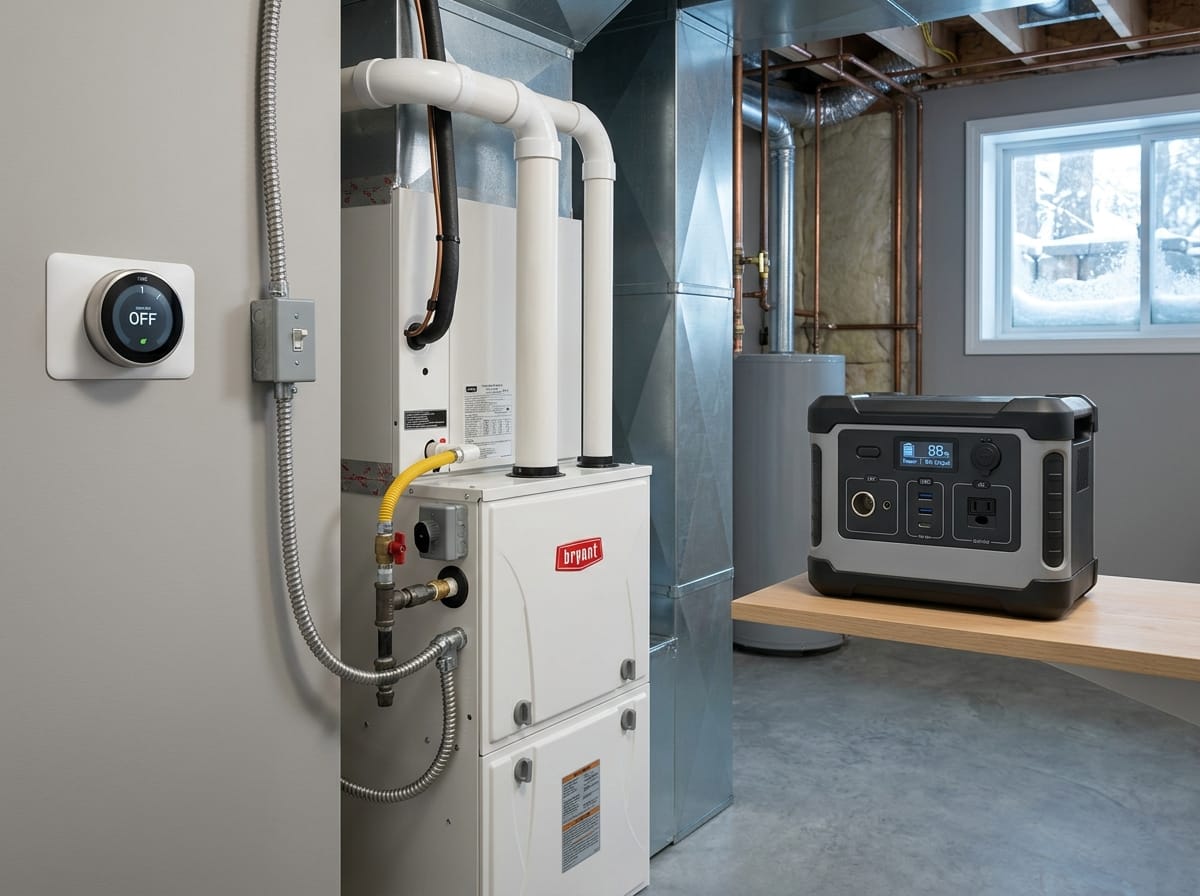
A winter outage creates a confusing situation: the gas supply may still be available, but the furnace stops because its blower, controls, ignition system, and safety sequence need electricity. A gas furnace backup can keep some forced-air systems operating, but it must support the complete furnace cycle and connect through an approved electrical method.
The direct answer is that a properly sized portable power station can run some 120V gas furnaces. The station must handle standby electronics, draft inducer startup, ignition, gas-valve controls, the circulation blower, possible condensate equipment, and normal shutdown. Most furnaces are hardwired, so electrical compatibility is only half of the decision. The other half is safe transfer, isolation, neutral and grounding behavior, and code compliance.
This guide applies to natural-gas, propane, or oil forced-air equipment whose heat comes from fuel. It does not size electric resistance furnaces, heat pumps, central air conditioners, boilers, or portable electric heaters. PowerLabPro has not tested your furnace. The equipment manual, heating contractor, electrician, and local requirements control the final gas furnace backup plan.
Quick answer
Possible: the exact furnace uses compatible power, the entire heating cycle fits the station, and a qualified electrician installs or approves the transfer method.
Not enough: measuring only the circulation blower or reading a generic “furnace watts” chart.
Main installation issue: most residential furnaces are hardwired to a dedicated branch circuit.
Main runtime issue: cold-weather duty cycle can rise sharply, so measured average energy matters more than one low watt reading.
Table of Contents
Gas Furnace Backup: 7 Critical Power Checks
A reliable gas furnace backup passes seven separate checks. The order matters because a larger battery cannot repair an unsafe connection or an incompatible electrical source.
- Confirm the heating system. Verify that it is a gas, propane, or oil forced-air furnace rather than a heat pump or electric furnace.
- Identify the full electrical load. Include controls, inducer, ignition, blower, thermostat transformer, condensate pump, humidifier, and required accessories.
- Verify voltage, frequency, and waveform. Use the nameplate and installation manual rather than assumptions.
- Measure startup and sustained demand. Capture an entire cycle, including motor starts and speed changes.
- Install safe transfer equipment. Isolate utility power and preserve required polarity, neutral, grounding, and circuit protection.
- Calculate winter energy. Use measured average watt-hours during representative cold-weather cycling, plus losses and reserve.
- Keep a heating fallback. Know where occupants will go and how pipes will be protected if the battery, furnace, fuel, or venting fails.
The critical distinction is between “the blower runs” and “the furnace completes a normal heating cycle.” A gas furnace backup is successful only when the appliance starts, proves airflow, ignites, heats, circulates air, shuts down, and repeats without faults.
A Gas Furnace Still Depends on Electricity
Fuel creates the heat, but electricity coordinates safe combustion and moves that heat through the home. Depending on the model, the sequence may involve a thermostat, control board, transformer, draft inducer, pressure switch, igniter, gas valve, flame sensor, circulation blower, limit switches, and post-purge timing. High-efficiency condensing furnaces may also depend on a condensate pump.
The US Department of Energy furnace and boiler guidance explains that furnaces heat air and distribute it through ducts. DOE also notes that many mid-efficiency systems use exhaust-fan control and electronic ignition, while maintenance of forced-air systems includes blower controls, combustion checks, venting, and carbon-monoxide testing. Those details show why a gas furnace backup is a complete-system problem rather than a fan-only problem.
| Electrical component | When it operates | Why it matters to backup |
|---|---|---|
| Control board and transformer | Standby and every cycle | Needs stable compatible power |
| Draft inducer | Before and during combustion | Adds a motor start before the main blower |
| Ignition and gas-valve controls | At startup and flame proving | Must complete the safety sequence normally |
| Circulation blower | During heat delivery and cooldown | Often the largest sustained electrical load |
| Condensate pump or humidifier | Intermittently, where installed | Adds another load and failure point |
| Thermostat and zoning controls | As configured | Can change cycle frequency and accessory demand |
If the station powers only part of this sequence, the furnace may lock out, stop before cooldown, or repeatedly attempt ignition. A working gas furnace backup must support the behavior the appliance was designed to perform.
Identify the Exact Furnace and Circuit
Start with the furnace nameplate, exact model, installation manual, service switch, breaker, and accessory list. Record supply voltage, minimum circuit ampacity, maximum overcurrent protection, motor information, and wiring requirements. These values describe the equipment and branch circuit, but they may not equal actual consumption at every operating stage.
Confirm whether the thermostat controls a conventional furnace, a heat pump with auxiliary heat, or a dual-fuel system. A thermostat screen that says “heat” does not prove the home has a simple gas furnace. Outdoor equipment, installer records, and model numbers settle the question.
Also identify everything powered from the furnace circuit. A condensate pump plugged into a nearby receptacle may be essential to high-efficiency operation. A powered humidifier may be optional during an outage. Zoning panels and dampers can alter startup sequence and average demand. The gas furnace backup load sheet should distinguish required equipment from conveniences.
Measure the Complete Heating Cycle
The best runtime input is watt-hours measured over complete cycles under representative conditions. A qualified technician or electrician can capture standby, inducer startup, ignition, blower startup, steady heating, blower-speed changes, burner shutdown, and the final blower or inducer run.
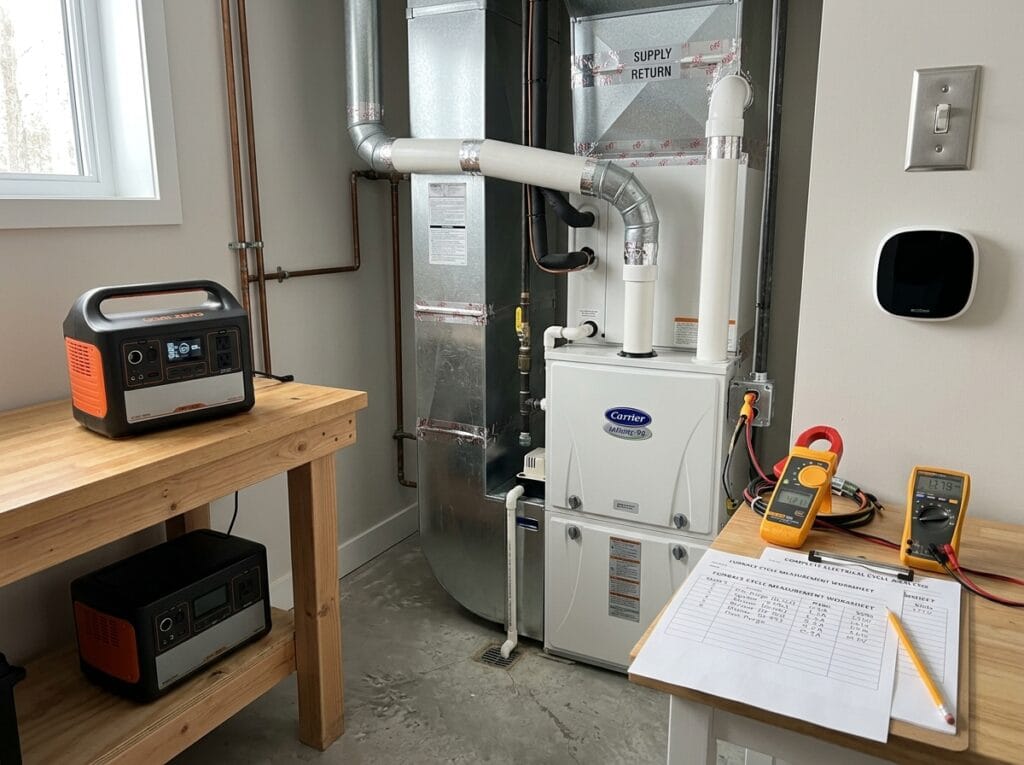
- Record outdoor temperature, thermostat setting, furnace stage, blower setting, and filter condition.
- Begin after the furnace has been idle long enough to complete a normal call for heat.
- Measure the highest sustained load and any brief motor-start events.
- Record total watt-hours until the furnace returns to standby.
- Repeat several cycles and note how cycle length changes as the home warms.
- Include condensate equipment or required controls on separate circuits.
- Use the higher representative cycle or hourly average for the battery plan.
Do not measure only the blower after ignition. Do not open energized compartments or clamp conductors unless qualified to do so. The point of testing is to improve the gas furnace backup, not to create an electrical or combustion hazard.
A mild fall-day test can understate winter demand. A colder house, stronger wind, longer recovery period, or higher thermostat setting can keep the furnace running more often. Test data should be treated as a baseline with margin, not a promise.
Continuous Output and Motor Startup
The station’s continuous AC rating must support the highest sustained furnace load with useful headroom. Its temporary surge capability must support the inducer and circulation-blower starting events. Peak output duration and voltage regulation matter; a large number printed without context does not confirm motor compatibility.
Older permanent-split-capacitor blowers and newer electronically commutated motors can behave differently. A high-efficiency motor may use less energy after startup, yet the control electronics may be more sensitive to abnormal voltage, waveform, neutral, or grounding conditions. The exact manual and a real test decide whether the gas furnace backup is stable.
- Use continuous output for the sustained load and surge output only for brief starts.
- Leave margin for blower speed changes and required accessories.
- Avoid running microwaves, kettles, space heaters, or other large loads while the furnace operates.
- Do not use voltage-reduction or appliance-lifting modes unless both manufacturers support the furnace application.
- Test repeated cycles at several battery states of charge when the station manual permits it.
- Stop if the furnace faults, motors sound abnormal, voltage sags, or the station trips.
Calculate Gas Furnace Backup Runtime
Runtime depends on average electrical demand across repeated heating cycles. One cycle may include several hundred watts for part of the time and much lower standby consumption between calls. Measure watt-hours per cycle or average watt-hours per representative hour, then apply a reserve.
Planning formula
Required nominal battery capacity ≈ (measured average furnace watts + other average watts) × heating hours ÷ usable-energy factor
The usable-energy factor represents inverter losses and the reserve required for continued operation, communication, and an orderly response if the outage lasts longer.
Example: if the complete furnace averages 350 watts across cycling and essential communication averages 30 watts, eight hours requires 3,040Wh before losses and reserve. With a planning factor of 0.85, the nominal target is about 3,576Wh. That example does not describe your furnace, and output compatibility must still be verified.
| Measured average furnace load | Heating target | Energy before losses | Planning meaning |
|---|---|---|---|
| 200W | 8 hours | 1,600Wh | A 2kWh class may offer limited reserve |
| 350W | 8 hours | 2,800Wh | A 3kWh or expandable plan becomes more realistic |
| 500W | 12 hours | 6,000Wh | Large storage and a recharge strategy are required |
| Unknown | Overnight | Cannot calculate | Measure a complete cycle first |
Battery temperature and age can reduce usable energy. Inverter idle demand continues even between furnace cycles. The gas furnace backup calculation should also preserve energy for alerts, lighting, and relocation rather than planning to reach automatic shutdown.
Use This Gas Furnace Backup Worksheet
A written worksheet prevents a product page from replacing the load analysis.
| Planning input | Your value | How it is used |
|---|---|---|
| Furnace make and model | _____ | Links the plan to the manual |
| System type | Gas, propane, oil, heat pump, or other | Confirms correct article and load class |
| Supply voltage and circuit | _____ | Electrical compatibility |
| Highest sustained demand | _____ W | Continuous inverter requirement |
| Observed starting event | _____ W, VA, or A | Surge requirement |
| Measured cycle energy | _____ Wh | Runtime calculation |
| Cold-weather duty cycle | _____ cycles/hour | Winter energy estimate |
| Required accessories | _____ | Combined output and energy |
| Transfer method | _____ | Installation gate |
| Fallback temperature and location | _____ | Safety plan |
After the worksheet is complete, use the PowerLabPro sizing guide to combine furnace energy with other essential loads. Keep the gas furnace backup assumption separate from electric heating, which can require far more power.
Hardwired Furnaces Need Safe Transfer Equipment
Most residential furnaces are hardwired to a dedicated branch circuit through a service switch or disconnect. Supplying that circuit from a portable source requires an approved method that isolates utility power, preserves required conductors and polarity, protects the circuit, and handles the source’s neutral and grounding configuration.
Do not replace the service switch with a homemade cord, use a double-male cable, backfeed a receptacle, or connect bare conductors to a station. A qualified electrician should evaluate a listed transfer switch, inlet, interlock, subpanel, or manufacturer-specific home-integration system. A heating technician should confirm that the furnace completes normal operation from the proposed source.
Improper generator connections can energize wiring unexpectedly. Although a battery station has no combustion engine, the isolation principle still applies when it supplies building wiring. A safe gas furnace backup must never expose utility workers, occupants, or equipment to an unintended energized circuit.
Cold Weather Changes the Battery Plan
Winter creates two pressures at once. The home loses heat faster, increasing furnace duty cycle, while a cold battery may deliver less usable performance or restrict charging. Keep the station within its specified operating and charging temperature range, but do not place it against the furnace, flue, warm-air plenum, or any location that blocks ventilation.
Plan for the home’s recovery period after an outage begins. A furnace may run almost continuously while raising indoor temperature from a cold start, then cycle less often. That first recovery period can consume a large share of the gas furnace backup energy budget.
Recharge planning must also account for winter conditions. Short daylight, snow, clouds, and low sun angle can reduce portable-solar harvest. Vehicle charging may be slow relative to a multi-kilowatt-hour battery. A multi-day plan should include another heating location, fuel availability, and pipe-protection actions.
Protect Combustion and Carbon-Monoxide Safety
Backup electricity does not make a damaged furnace safe. DOE recommends professional maintenance that includes venting, heat-exchanger condition, combustion, blower controls, and carbon-monoxide checks. It also recommends working carbon-monoxide alarms. Maintain smoke and CO alarms with battery backup before relying on a gas furnace backup.
- Never block combustion-air openings, return grilles, supply registers, flues, or vents.
- Do not operate a fuel generator indoors or in an attached garage to recharge the station.
- Stop using the furnace if alarms sound, occupants feel ill, venting is damaged, or combustion appears abnormal.
- Keep alarm batteries current and follow the alarm manufacturer’s placement instructions.
- Have the furnace serviced before winter when maintenance is overdue or behavior is irregular.
- Do not treat a consumer battery as a life-safety heating system.
A power station can preserve normal furnace controls only when the appliance itself is safe and maintained. The gas furnace backup should support the safety sequence, never bypass it.
Reduce Heating Demand Without Blocking the System
Reducing heat loss extends battery runtime. Lower the thermostat to a safe, moderate setting rather than trying to maintain normal comfort in every room. Close curtains at night, address obvious drafts, and avoid unnecessary exterior-door opening. Wear layers and concentrate activity in a smaller occupied area.
Do not close so many registers that airflow falls outside furnace requirements. Do not cover return grilles, alter dampers, or use an unapproved filter. A severely restricted system can overheat, trip limit controls, or reduce comfort. Ask the heating contractor what room-closing or zoning strategy is acceptable.
A clean filter of the manufacturer-required type may help the blower operate normally. Replacing an overdue filter is maintenance, not a way to force a smaller gas furnace backup. Measure again if filter condition or blower settings change significantly.
When a Portable Power Station Is the Wrong Method
- The system is actually an electric furnace, heat pump with auxiliary heat, or another high-demand heating system.
- The exact electrical requirements or required accessories cannot be verified.
- The furnace faults or behaves differently on inverter power.
- No safe, listed transfer method is available for the hardwired circuit.
- The battery cannot remain dry, ventilated, and within its temperature limits.
- The expected cold-weather duty cycle exceeds realistic storage and recharge.
- The home depends on heat for medical safety, freeze protection, or vulnerable occupants without a more dependable fallback.
- The furnace, venting, heat exchanger, or alarms require repair.
In those situations, a professionally installed standby or portable-generator solution, permanent battery system, alternate heated location, or building-envelope improvement may be more appropriate. The best gas furnace backup is the one that keeps the home safe without creating a wiring or combustion shortcut.
Useful Product, Review, and Buying Guide Paths
After measurement, a 2kWh-class station may be a useful comparison point for some efficient 120V furnaces. The Anker SOLIX C2000 Gen 2 Product page documents its verified equipment identity, while the Anker SOLIX C2000 Gen 2 Review explains buyer-fit limits. Those pages do not confirm furnace compatibility or replace professional transfer work.
A measured plan that needs roughly 2kWh can also use the Jackery Explorer 2000 Plus versus EcoFlow DELTA 2 Max comparison. Larger or expandable needs can move to the home-backup Buying Guide.
The correct content path is deliberate: this gas furnace backup guide defines electrical, installation, and runtime requirements; Product, Review, Comparison, and Buying Guide pages help evaluate equipment after those requirements are known.
Common Gas Furnace Backup Mistakes
- Measuring only the blower. The complete furnace sequence includes controls, ignition, inducer, blower, and accessories.
- Confusing gas heat with a heat pump. Compressor and auxiliary-heat loads require a different analysis.
- Using peak output as continuous output. The station must sustain the full cycle.
- Improvising a plug or backfeed cord. Hardwired equipment needs safe isolation and transfer.
- Testing only in mild weather. Winter duty cycle and recovery load can be much higher.
- Ignoring condensate equipment. A high-efficiency furnace may need another powered device to operate normally.
- Skipping CO alarms and maintenance. Backup power does not repair combustion or venting faults.
- Planning to drain the battery completely. Preserve energy for shutdown, communication, and relocation.
A strong gas furnace backup plan assumes that cold weather, battery temperature, and outage duration may be worse than the first test.
Gas Furnace Backup FAQ
Can a 1,000Wh power station run a gas furnace?
It may support some efficient furnaces for a limited period, but only after the complete cycle, starting behavior, transfer method, and usable battery energy are verified. Capacity alone does not answer the question.
How many watts does a furnace blower use?
There is no safe universal figure. Motor type, blower speed, furnace size, duct resistance, controls, and accessories change demand. Measure the complete furnace rather than copying a blower estimate.
Can an electrician add a backup inlet for the furnace?
A qualified electrician can determine whether a listed transfer switch, inlet, interlock, subpanel, or other approved method fits the circuit and local rules. The solution must also match the station’s output and neutral-grounding design.
Will UPS or EPS mode work with a furnace?
Only when transfer time, waveform, voltage, continuous output, grounding arrangement, charging behavior, and installation are compatible with the exact furnace. Test the full gas furnace backup under professional guidance where appropriate.
Can I use a space heater instead?
Portable electric heaters create a large continuous load and can drain batteries quickly. They also have placement and fire-safety requirements. Compare the measured furnace energy rather than assuming resistance heat is simpler.
How much battery is needed overnight?
Multiply measured average furnace watts by the planned hours, add other essential loads, then account for losses and reserve. Repeat the estimate for colder conditions and a longer recovery cycle.
Final Decision
A portable power station can provide gas furnace backup when the exact furnace, complete electrical cycle, motor starts, accessories, transfer equipment, winter duty cycle, and battery reserve are all verified. Running the blower is not enough; the furnace must complete normal operation without electrical or combustion faults.
Begin with the manual, maintenance status, professional load measurement, and a safe transfer design. Then use the sizing guide and relevant Product, Review, Comparison, or Buying Guide pages to select an equipment class. Keep working alarms and a cold-weather relocation plan for any outage that exceeds the gas furnace backup.