
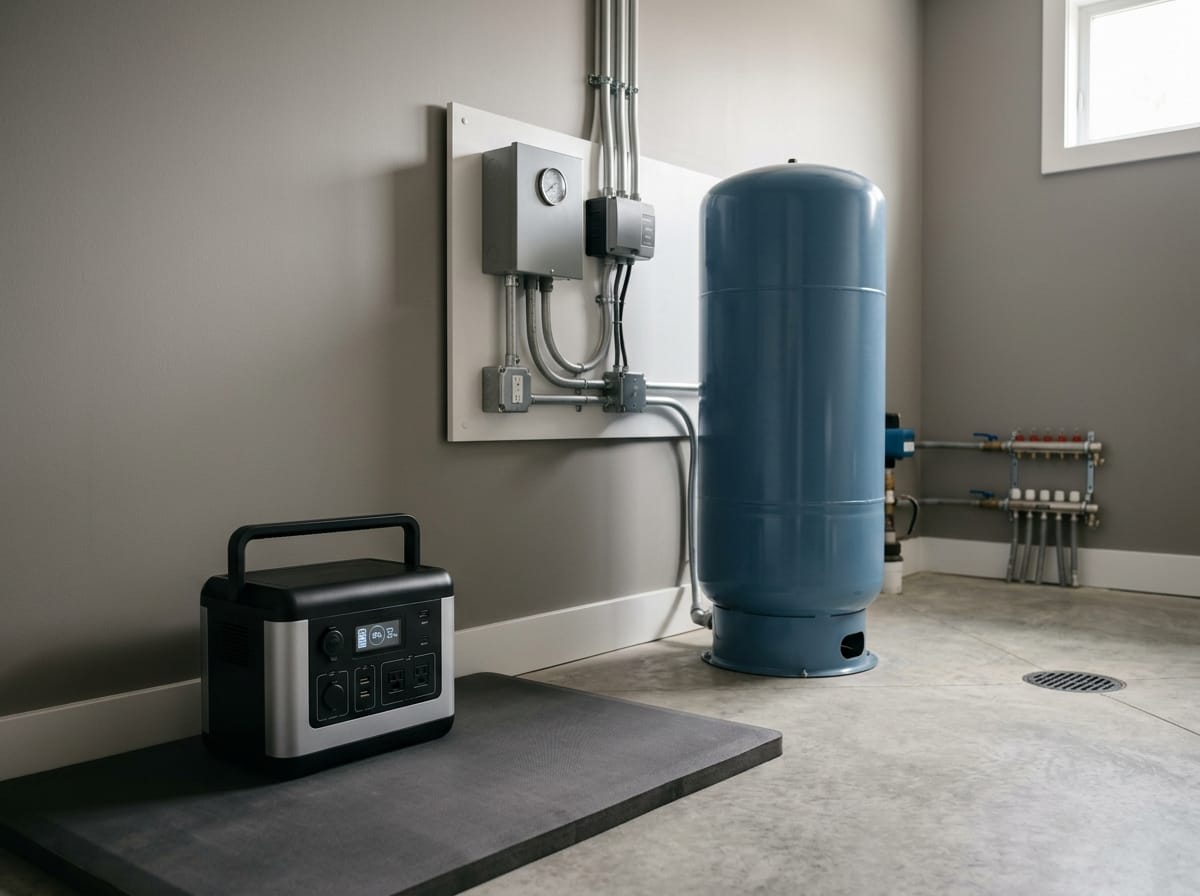
A power outage can turn a working private well into a silent pipe within seconds. A well pump backup plan can restore limited household water, but this is not a load to size from horsepower alone. The exact pump voltage, motor-start behavior, control equipment, pressure-tank condition, wiring method, and expected water use all decide whether a portable power station is a practical solution.
The direct answer is that some portable power stations can run some well pumps. A cord-connected 120V pump is usually the simplest case. A hardwired 240V submersible pump requires a true compatible 120/240V source and a professionally designed transfer path. A large watt rating does not correct the wrong voltage, and a successful one-time start does not prove that the well pump backup will survive repeated cycles during a long outage.
This guide is for US household planning. It does not authorize panel work, improvised adapters, backfeeding, or modification of pump controls. PowerLabPro has not tested your pump or installation. Use the pump manual, control-box information, well records, and a qualified well contractor or electrician as the controlling sources.
Quick answer
Possible: the exact pump voltage, running demand, starting demand, controls, and connection method are verified before the power station is selected.
Most common deal breaker: the pump needs 240V but the proposed station provides only ordinary 120V output.
Runtime question: battery demand is driven by total pump minutes and number of starts, not by the length of the outage alone.
Best plan: combine a tested well pump backup with stored drinking water, reduced water use, and a non-electric fallback.
Table of Contents
Well Pump Backup: 7 Critical Power Checks
A dependable well pump backup starts with seven gates. Passing one gate does not compensate for failing another. Work through them in order before comparing products.
- Identify the complete system. Record the pump, motor, pressure switch, pressure tank, control box, variable-frequency drive, soft starter, and any treatment equipment that must run.
- Match voltage and phase. Confirm whether the system is 120V or 240V and single-phase. Do not create 240V by combining unrelated outlets or using an unsupported adapter.
- Verify continuous electrical demand. Use manufacturer documentation, labels, and professional measurement rather than a generic horsepower chart.
- Verify motor startup. The inverter must support the starting event long enough for the motor to accelerate without a trip or abnormal voltage.
- Measure cycle energy. Determine how many watt-hours one representative pressure-tank refill consumes.
- Plan safe transfer and isolation. Hardwired systems require listed equipment and professional installation that prevents utility backfeed.
- Preserve a water and battery reserve. Define the minimum state of charge and stored-water supply that remain available when conditions worsen.
The central buyer mistake is treating well pump backup as a single wattage question. It is a voltage question, an inverter question, an energy question, and an installation question at the same time.
Map the Exact Well System Before Sizing Power
The pump may be underground and impossible to read directly, but the rest of the system usually leaves clues. Look for the well-completion record, installation invoice, motor or control-box label, pressure-switch cover, disconnect, breaker identification, and service notes. Photograph labels without opening energized equipment. A well contractor can often identify an inaccessible submersible pump from records or electrical testing.
A well pump backup assessment should include every component that controls or depends on pump operation. A conventional pressure-switch system behaves differently from a variable-speed constant-pressure system. A three-wire submersible motor may use a separate control box. Water softeners, treatment pumps, ultraviolet systems, and booster pumps may be on different circuits and should not be silently included in the same runtime claim.
| Record | Why it matters | Where to verify |
|---|---|---|
| Pump and motor model | Connects the plan to official electrical data | Well record, invoice, label, contractor |
| Voltage and phase | Determines whether the station can supply the circuit | Motor, control box, breaker, manual |
| Control equipment | Can change starting behavior and waveform requirements | Control panel, drive, soft-starter documentation |
| Pressure settings | Affects when the pump starts and stops | Pressure switch and service record |
| Tank drawdown | Affects water delivered per pump cycle | Tank manual and professional inspection |
| Connection type | Determines whether professional transfer equipment is needed | Cord, disconnect, panel, electrician |
Do not copy an electrical value from a visually similar pump online. Model families can include several voltage, horsepower, and control variants. The well pump backup decision must stay tied to the exact installed equipment.
Voltage Is the First Non-Negotiable Gate
Many residential submersible pumps use 230V or 240V, while some shallow-well, jet, booster, and smaller pump systems use 115V or 120V. The label and manual decide. A station with several ordinary 120V receptacles is still a 120V source unless the manufacturer explicitly provides a supported split-phase 120/240V configuration.
A 120V-only station cannot directly run a 240V well pump. A step-up transformer is not a casual workaround because the transformer, motor starting current, overcurrent protection, grounding, waveform, and connection method all need engineering and code review. For most homeowners, the safer path is a power platform designed to provide the required voltage and a professionally installed transfer arrangement.
Voltage matching is necessary but not sufficient. The well pump backup must also provide the correct frequency, a waveform accepted by the controls, enough continuous output, and enough temporary starting capability. Neutral and grounding behavior can matter when a portable source is connected to building wiring, which is another reason to involve an electrician.
Running Load and Motor Startup Are Different Tests
Once the motor is running, the station must sustain its normal electrical demand with useful headroom. At startup, the motor may require substantially more current for a brief period. The station’s marketing peak number does not by itself prove compatibility because peak duration, voltage regulation, battery state of charge, temperature, and protection logic affect the result.
Use published motor or pump data when available. An electrician or pump professional can measure operating current and starting behavior with suitable instruments. Do not place an ordinary plug-in meter on a hardwired pump or open a control box to obtain a number. The measurement method must match the circuit and the equipment.
- Compare normal pump demand with the station’s continuous AC rating, not its short peak rating.
- Confirm that the surge specification applies at the required voltage and configuration.
- Leave output headroom for control equipment and voltage drop.
- Test multiple automatic starts after a professional connection is installed.
- Repeat the test at a lower battery state of charge when the station manual permits it.
- Stop if the pump chatters, stalls, trips, overheats, or behaves differently from utility operation.
Do not rely on voltage-reduction, “power lifting,” or similar modes unless the pump and power-station manufacturers explicitly support motor use. A well pump backup that starts by delivering abnormal voltage can create more risk than resilience.
Pressure Tank Behavior Changes Battery Demand
A pressure tank stores a usable volume of water under pressure. It allows the household to draw water before the pump must start again. A healthy, correctly sized tank can reduce starts. A waterlogged tank, failed bladder, incorrect precharge, leaking check valve, or narrow pressure range can cause short cycling and make the well pump backup work much harder.
Do not estimate available gallons from the tank’s outside size. The usable drawdown is smaller than total tank volume and depends on pressure settings. Have the tank and switch inspected when the pump starts after very small water draws, cycles rapidly, or behaves irregularly. Fixing the water system may save more battery than buying a larger station.
For planning, record how much water the household can use between pump starts and how long one refill takes. The result connects lifestyle to energy. A shower, laundry cycle, livestock watering, or leaking toilet can trigger far more pump operation than drinking, handwashing, and brief toilet use.
Measure a Complete Pump Cycle Safely
The most useful energy number is watt-hours for one representative tank-refill cycle. The test begins when the pressure switch calls for water and ends when the pump stops at the cut-out pressure. It should be performed with instruments and methods appropriate for the installed circuit. A qualified professional can also observe starting current and voltage at the same time.
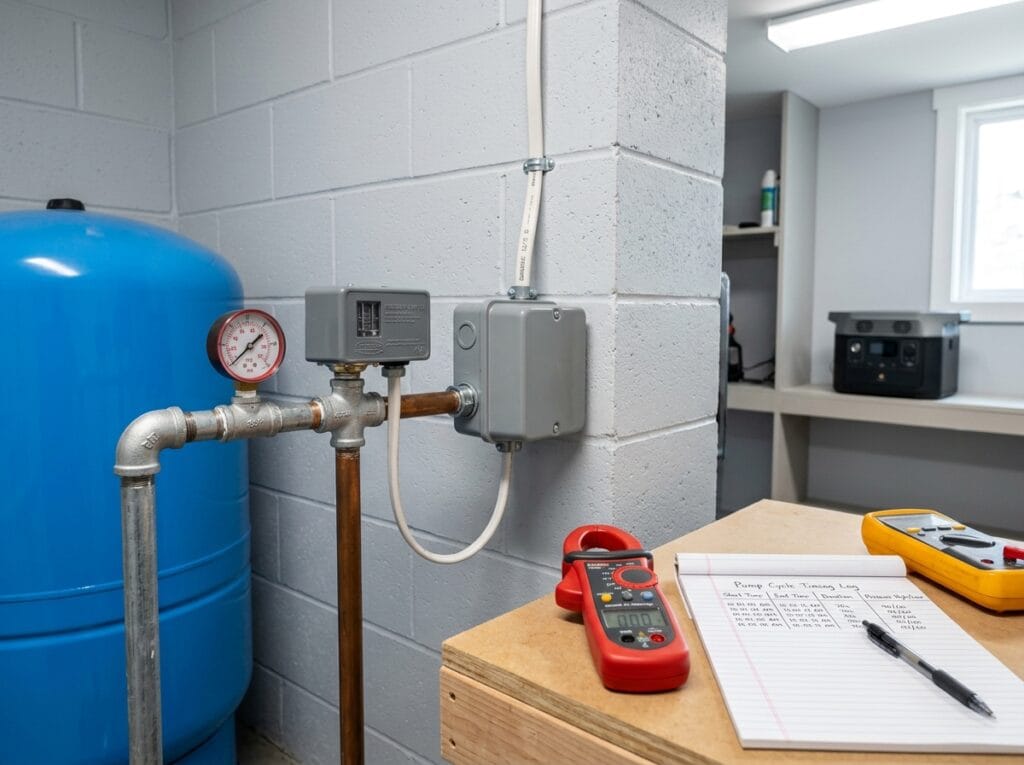
- Confirm that the pump, tank, switch, check valve, and controls are in normal working condition.
- Record starting and stopping pressure, if safely available from the system gauge.
- Measure operating watts or volt-amps with appropriate professional equipment.
- Measure total run time for a normal refill cycle.
- Calculate or record watt-hours used during that cycle.
- Repeat several cycles and use the higher representative result for planning.
- Note whether other treatment or booster equipment starts during the same water event.
A mild-use test is not the entire well pump backup plan. Deep wells, low recovery, unusually high demand, irrigation, freezing conditions, and equipment problems can change cycle duration. Build a margin around measured normal behavior rather than treating one reading as a guarantee.
Calculate Well Pump Backup Energy by Cycles
Use cycle energy rather than pretending that a well pump runs continuously. The basic planning method is measured watt-hours per cycle multiplied by the number of expected cycles. Then add energy for controls, treatment equipment that must operate, inverter losses, and a protected reserve.
Planning formula
Required nominal battery capacity ≈ (watt-hours per pump cycle × planned cycles + other essential watt-hours) ÷ usable-energy factor
A usable-energy factor below 1 represents inverter losses and reserve. Use the station manufacturer’s information where available. The result is a planning estimate, not guaranteed runtime.
Example: suppose a professionally measured refill cycle uses 180Wh. Ten cycles require 1,800Wh before losses and reserve. If essential communication loads add 200Wh and the planning factor is 0.85, the nominal battery target is about 2,353Wh. The station must still pass the voltage and motor-start tests.
| Measured cycle energy | Planned cycles | Pump energy before losses | Decision meaning |
|---|---|---|---|
| 100Wh | 8 | 800Wh | A 1kWh class may still leave little reserve |
| 180Wh | 10 | 1,800Wh | A 2kWh class becomes a more realistic starting point |
| 250Wh | 16 | 4,000Wh | The plan moves toward large or expandable storage |
| Unknown | Unknown | Cannot calculate | Measure before buying |
These figures are examples only. They are not typical pump specifications. A well pump backup can use less energy with modest demand and a healthy tank, or much more when the pump runs longer and household demand stays high.
Use This Well Pump Backup Worksheet
Write the plan down before comparing products. Blank cells reveal uncertainty that a product page cannot solve.
| Planning input | Your value | Decision use |
|---|---|---|
| Pump and motor model | _____ | Links the plan to official documentation |
| Voltage and phase | _____ | Compatibility gate |
| Continuous operating demand | _____ W or A | Continuous inverter requirement |
| Starting requirement | _____ W, VA, or A | Motor-start requirement |
| Energy per refill cycle | _____ Wh | Battery calculation |
| Expected cycles | _____ | Outage water budget |
| Other essential loads | _____ Wh | Combined energy |
| Usable-energy factor | _____ | Loss and reserve allowance |
| Safe connection method | _____ | Professional installation gate |
| Stored-water reserve | _____ gallons | Fallback if power or pump fails |
Use the PowerLabPro sizing guide after the electrical and cycle data are known. It helps combine the well pump backup with refrigeration, communication, lighting, or other carefully controlled loads without double-counting battery capacity.
Choose the Right Power-Station Path
A small cord-connected 120V pump and a hardwired 240V submersible pump belong to different equipment classes. Start with the connection and voltage, then choose output, then choose battery capacity. Reversing that order is how buyers end up with a large battery that cannot energize the circuit.
| Well situation | Likely planning path | Reject the plan when |
|---|---|---|
| Cord-connected 120V pump | Compatible pure-sine 120V station with verified startup margin | The pump manual prohibits the connection or startup trips |
| Hardwired 120V pump | Professionally installed transfer or inlet plus compatible output | No listed isolation method is available |
| Hardwired 240V pump | True supported 120/240V platform plus professional transfer design | The station is 120V only or uses an unsupported pairing |
| Variable-speed system | Manufacturer-compatible source and controller review | The drive or controls reject the inverter output |
| Pump plus treatment equipment | Combined output and energy assessment | Required equipment cannot be separated or supported safely |
A well pump backup can be portable in the sense that the battery equipment moves, but the connection to a hardwired well circuit should not be improvised each time. A permanent, labeled, code-compliant transfer path gives the household a repeatable procedure and prevents dangerous utility backfeed.
Recharge and Solar Limits During a Long Outage
Solar charging can extend a well pump backup, but the station’s solar-input rating is only a ceiling. Weather, season, shade, panel angle, cable loss, battery temperature, and controller limits determine real harvest. Water demand may peak during the same hot, cloudy, or stormy conditions that make recovery uncertain.
Compare watt-hours produced with watt-hours consumed. A short high-power pump cycle may be easy for a large inverter but still consume energy faster than a small panel array replaces it. Preserve enough state of charge for the next necessary water cycle and for communication. Do not schedule discretionary water use merely because the sun is visible.
- Use conservative seasonal solar estimates rather than panel nameplate watts multiplied by daylight hours.
- Keep the power station dry and within its charging-temperature limits.
- Keep panels outdoors and route cables without creating trip or mowing hazards.
- Do not assume vehicle charging or solar can recover a deeply discharged large battery quickly.
- Plan how the household will obtain water when weather prevents recharge.
Reduce Water Demand Before Buying More Battery
The cheapest way to extend well pump backup runtime is to reduce pumping. Store clean drinking water before an expected outage. Fill suitable sanitation containers. Repair leaks. Delay laundry and dishwashing. Use low-flow fixtures carefully. Coordinate showers instead of letting demand occur randomly throughout the day.
Water conservation must remain sanitary. Follow local public-health instructions after flooding, well damage, loss of pressure, or suspected contamination. Battery power does not prove that well water is safe to drink. A boil-water notice or disinfection requirement can apply even when the pump runs normally.
A practical household plan separates drinking and cooking water from water used for toilet flushing or cleaning. That lets the well pump backup serve the most valuable needs first and preserves an emergency reserve if the pump, inverter, or transfer equipment fails.
When a Portable Power Station Is the Wrong Method
- The pump voltage or electrical configuration cannot be verified.
- The station cannot provide the required 240V output or supported split-phase configuration.
- The pump repeatedly trips, stalls, or behaves abnormally on inverter power.
- No listed, code-compliant transfer method is available for the hardwired circuit.
- The water demand requires far more storage and recharge than the household can manage.
- The equipment must operate automatically while no one can monitor battery state or faults.
- The well serves a life-safety, livestock, fire-suppression, or medically critical need without a more dependable fallback.
- The installation is wet, damaged, flooded, or otherwise unsafe to energize.
In those cases, the better well pump backup may be a professionally installed generator or battery system, a dedicated cistern or storage tank, a hand-pump option where technically appropriate, or a planned alternative water source. The right answer is the method that reliably supplies water, not the method with the most attractive battery specification.
Useful Product and Comparison Paths
Product pages become useful only after the load sheet is complete. For a verified 240V well system, the EcoFlow DELTA Pro 3 Product page documents a current single-unit 120/240V platform, and the EcoFlow DELTA Pro 3 Review explains its buyer-fit limits. Neither page confirms compatibility with your pump or replaces transfer design.
Buyers comparing larger home-backup platforms can use the Jackery 5000 Plus versus Anker F3800 Plus comparison. The home-backup Buying Guide provides a wider shortlist after voltage, startup, and energy requirements are known.
This is the correct relationship between informational and commercial content: the well pump backup guide defines the problem; Product, Review, Comparison, and Buying Guide pages help evaluate equipment that may fit the verified problem.
Common Well Pump Backup Mistakes
- Buying by horsepower. Mechanical horsepower does not reveal voltage, controls, starting current, or cycle energy.
- Ignoring the pressure tank. Short cycling can multiply starts and waste battery energy.
- Confusing peak and continuous output. A station must both start and sustain the pump.
- Assuming two 120V outlets equal 240V. Only a manufacturer-supported split-phase system provides the required configuration.
- Backfeeding home wiring. Improvised connections can energize conductors unexpectedly and endanger workers and occupants.
- Planning from outage hours. Pump runtime is driven by water use and cycles, not elapsed time alone.
- Skipping stored water. Every electrical system can fail or outlast its recharge plan.
- Ignoring contamination risk. Restored pressure does not guarantee safe water after flood or well damage.
A strong well pump backup plan is conservative by design. It assumes that demand may increase, weather may limit recharge, and equipment may not perform exactly like a brochure.
Well Pump Backup FAQ
Can a portable power station run a 1/2 HP well pump?
Possibly, but 1/2 HP is not enough information. Verify voltage, phase, running current, starting requirement, controls, and connection method for the exact pump. A 120V and a 240V motor with the same horsepower require different well pump backup paths.
Can a 120V power station run a 240V well pump?
Not directly. The source must provide the voltage and electrical configuration required by the pump. Do not use an unsupported adapter, combine unrelated outlets, or improvise panel wiring.
How long will a battery run a well pump?
Calculate watt-hours per refill cycle, multiply by expected cycles, add other loads, and account for losses and reserve. The answer changes with water use, pressure-tank drawdown, pump depth, system condition, and recharge.
Does a soft starter solve the problem?
A soft starter may change motor-start behavior, but it must be approved for the exact motor and controls and installed by a qualified professional. It does not correct a voltage mismatch or create a safe transfer path.
Can solar keep a well pump running indefinitely?
No general guarantee is possible. Solar production varies, while water demand and pump energy can rise. Size storage first, model conservative recovery, and keep a non-solar water reserve.
Should the well pump share the battery with a refrigerator?
Only after simultaneous output and total energy are calculated. Avoid overlapping motor starts, preserve communication energy, and assign water-use priorities. A separate load schedule can make the same well pump backup safer and more useful.
Final Decision
A portable power station can support a well pump backup when the exact voltage, phase, continuous demand, motor startup, controls, cycle energy, and transfer method are all verified. The strongest plan begins with the installed well system, not with a battery catalog.
Collect the records, have the circuit and transfer method reviewed, measure representative cycles, and set a strict water budget. Then use the sizing guide and the relevant Product, Review, Comparison, or Buying Guide pages to evaluate equipment. Keep stored water and a non-electric contingency so the well pump backup remains useful even when an outage exceeds the battery, recharge source, or pump itself.