
Buying Guide
Portable Power Station for Ebike Charging: 3 Practical Picks
Portable power station for ebike charging guide with three verified picks for lightweight field top-ups, 1kWh all-around charging, and larger multi-battery or multi-device trips.
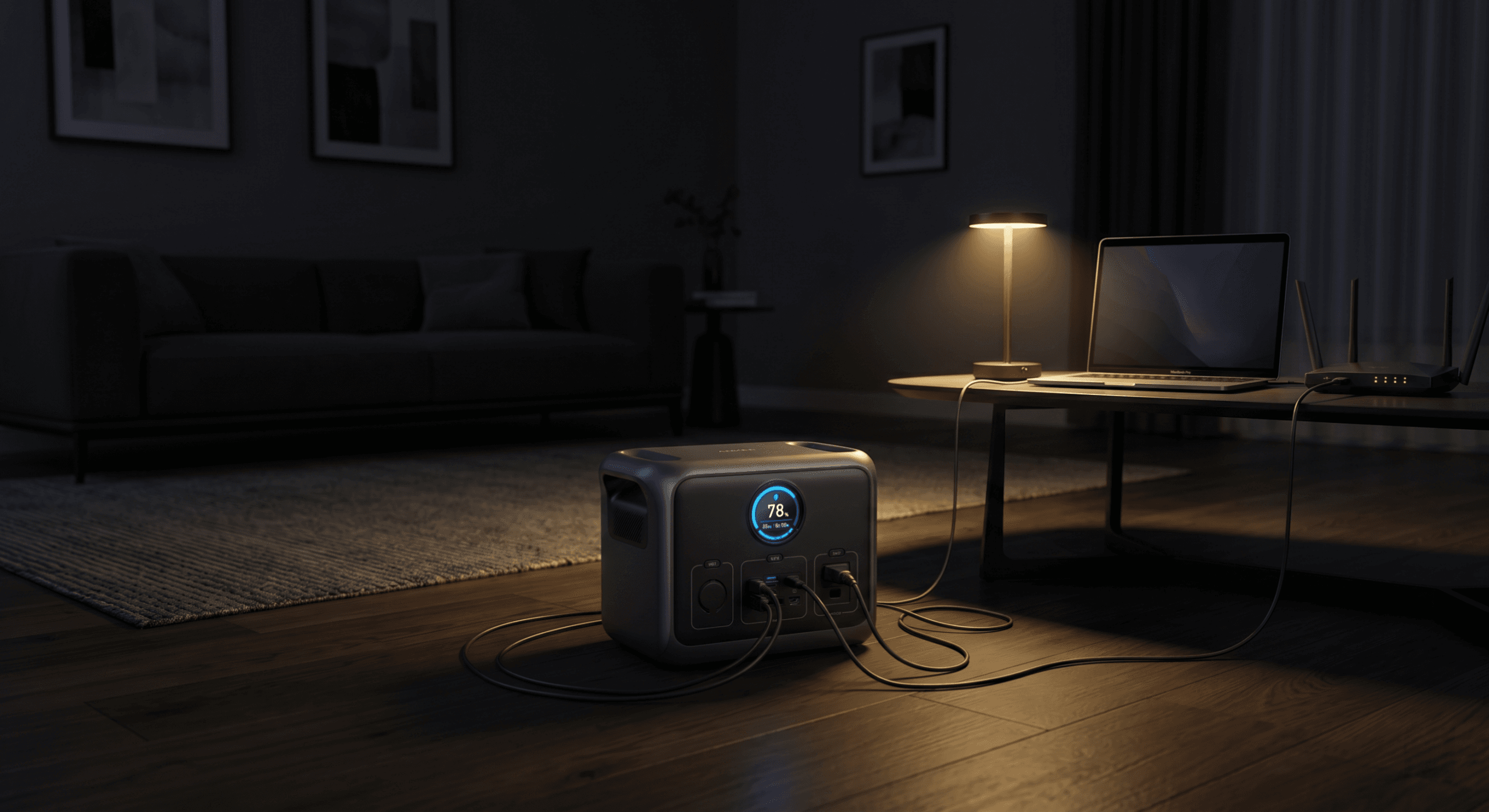
Product Shortlist
Featured products
Product
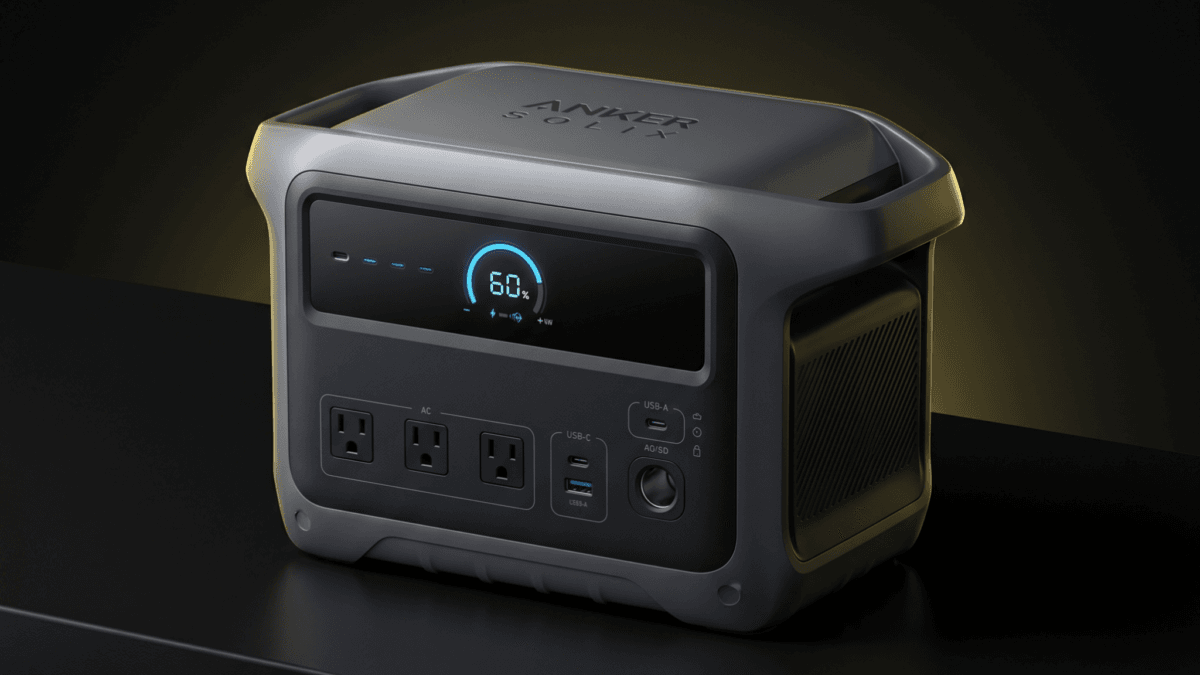
Anker SOLIX C1000 Gen 2 Portable Power Station
Compact 1,024Wh portable power station with 2,000W output, 3,000W peak, 49-minute fast AC recharge, 600W solar input, and 10 ms UPS support for home backup, camping, and RV use.
Product
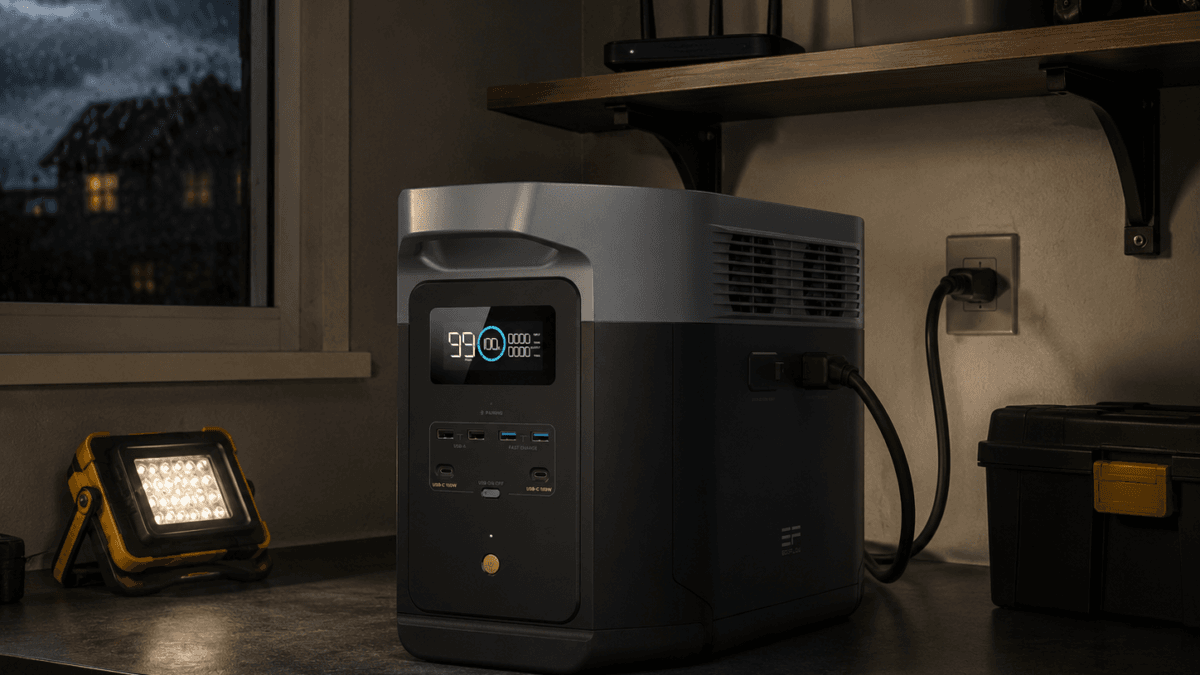
EcoFlow DELTA 2 Max
The EcoFlow DELTA 2 Max portable power station delivers 2048Wh LiFePO4 capacity, 2400W output, and fast 43-minute charging. Built for expandable home backup, RV solar use, and buyers who need room to grow.
Product
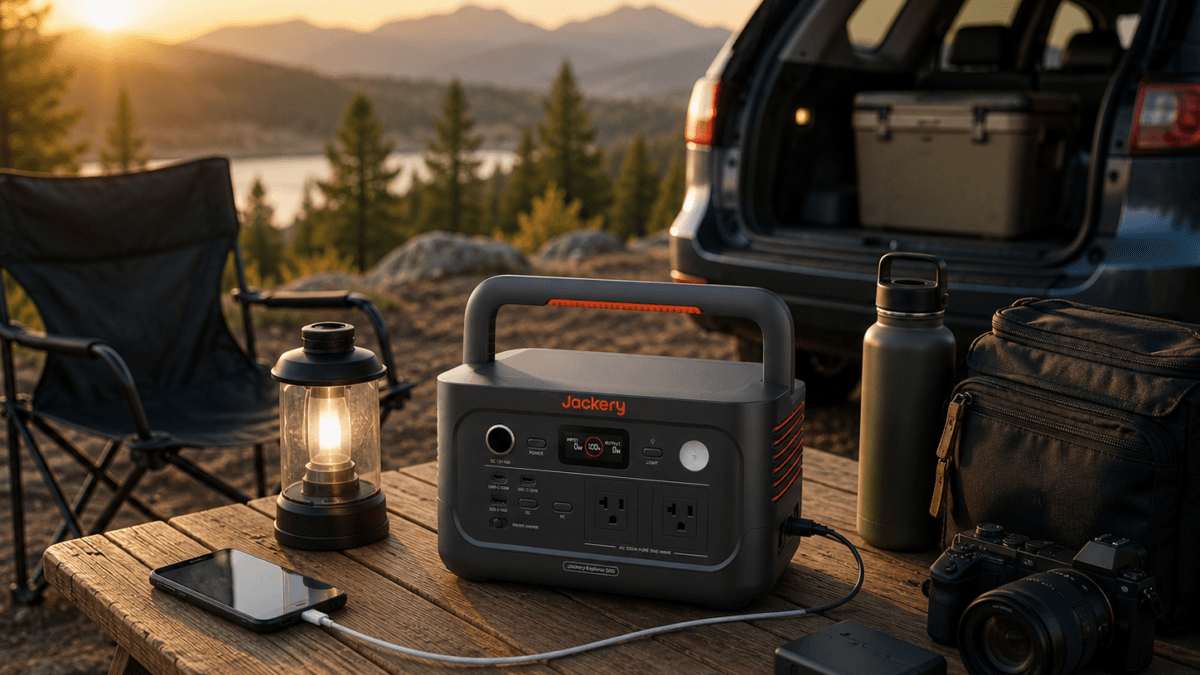
Jackery Explorer 500 v2 Portable Power Station
A lightweight 640Wh LiFePO4 power station with 500W AC output and dual 100W USB-C ports for camping, travel, remote work, and controlled device backup.
This article may contain affiliate links. If you buy through these links, PowerLabPro may earn a commission at no extra cost to you. As an Amazon Associate I earn from qualifying purchases.
A portable power station for ebike charging is most useful when you need the bike’s normal charger away from a wall outlet. The right station must cover the charger’s AC input, provide enough watt-hours for the amount of recharge you actually need, and still leave reserve for navigation, phones, lights, a laptop, or camp equipment.
This guide compares three verified PowerLabPro Product records with deliberately different roles. The Anker SOLIX C1000 Gen 2 is the balanced 1kWh choice for most riders. The Jackery Explorer 500 v2 is the lightweight field-top-up option. The EcoFlow DELTA 2 Max is the larger 2kWh base for multiple batteries, two riders, longer trips, or mixed camp loads.
PowerLabPro has not performed hands-on e-bike charging tests with these three stations. Recommendations are based on current manufacturer documentation, verified central Product records, connected Reviews, and buyer-fit analysis. This guide therefore does not promise a fixed number of e-bike charges from any station.
- Quick pick for most riders: Anker SOLIX C1000 Gen 2 for a balanced 1,024Wh charging reserve without moving into a roughly 50 lb 2kWh chassis.
- Best lightweight choice: Jackery Explorer 500 v2 when the goal is a partial top-up and easy carrying.
- Best larger reserve: EcoFlow DELTA 2 Max when several batteries or substantial non-bike loads share the station.
- Look elsewhere: the approved e-bike charger exceeds the station’s output, the battery is damaged or recalled, you need charging while sleeping or unattended, or a much smaller wall-power solution already covers the trip.
Table of Contents
How to choose a portable power station for ebike charging
Start with the e-bike, not the power station. Find the battery capacity in watt-hours if the manufacturer provides it, then read the approved charger label for AC input watts or volts and amps. The station’s continuous AC output must comfortably cover the charger. The battery capacity determines how much energy is available for a partial or full recharge after conversion losses.
Do not assume a 500Wh station will fully recharge a 500Wh e-bike battery. The power station loses energy through its inverter, the charger loses energy during AC-to-DC conversion, and the bike battery itself does not accept every watt without loss. The useful question is how much range or state-of-charge margin you need before the next wall outlet, not how many perfect theoretical charges fit into a specification table.
Weight also matters because a station that stays in a vehicle has a different job from one that gets carried to a campsite. A 12.6 lb Jackery is much easier to move than a 2kWh station around 50 lb. If the same station must also support refrigeration, Starlink, cameras, laptops, or several e-bike chargers, extra watt-hours may justify the heavier base.
Quick comparison of the three picks
| Pick | Verified key specs | Distinct role | Main trade-off |
|---|---|---|---|
| Anker SOLIX C1000 Gen 2 | 1,024Wh, 2,000W continuous, 600W solar, about 24.9 lb | Best balanced one-bike charging base | Less energy than a 2kWh station for several packs |
| Jackery Explorer 500 v2 | 512Wh, 500W continuous, 200W solar, about 12.6 lb | Lightweight partial top-up and day-trip use | Small energy reserve and 500W inverter |
| EcoFlow DELTA 2 Max | 2,048Wh, 2,400W continuous, 1,000W solar, about 50 lb | Several batteries, mixed camp loads, longer trips | Much heavier to move |
The roles are deliberately different. Anker is the default because 1,024Wh gives useful charging margin without moving into a 50 lb chassis. Jackery is the mobility pick. EcoFlow is the energy-reserve pick. None is automatically compatible with every e-bike charger, and none changes the charging rules of the e-bike battery.
1. Anker SOLIX C1000 Gen 2: best overall balance
The Anker SOLIX C1000 Gen 2 is the strongest all-around recommendation for many riders because its 1,024Wh battery creates meaningful charging reserve while the station remains manageable at about 24.9 lb. Its 2,000W continuous inverter is far above the input requirement of one ordinary e-bike charger, leaving practical headroom for a laptop, phone charger, lighting, or another small verified load.
Up to 600W of solar input gives the Anker a useful recovery path at a campsite or base vehicle when the panel and conditions support it. It is more comfortable than a 512Wh station for a deeper recharge, yet much easier to justify than a 2kWh station when one primary e-bike and ordinary electronics are the main loads.
Best for: one-bike trips, weekend camping, a trailhead vehicle, van travel, or a garage charging bridge where a useful 1kWh reserve matters.
Not ideal for: several large e-bike batteries that need deep charging before the next grid connection, or riders who only need a small emergency top-up.
Main advantage: useful 1,024Wh capacity with 2,000W continuous output in a roughly 24.9 lb package.
Main trade-off: it provides only half the nominal energy of the DELTA 2 Max when multiple packs share the station.
Why it belongs in this guide: it is the most balanced bridge between carry weight and meaningful charging energy.
Better alternative if: choose Jackery when every pound matters, or EcoFlow when two riders and camp loads need substantially more stored energy.
Related Review: Anker SOLIX C1000 Gen 2 Review. See the Anker SOLIX C1000 Gen 2 Product page for the verified central record.
Official source: Anker SOLIX C1000 Gen 2 product information.
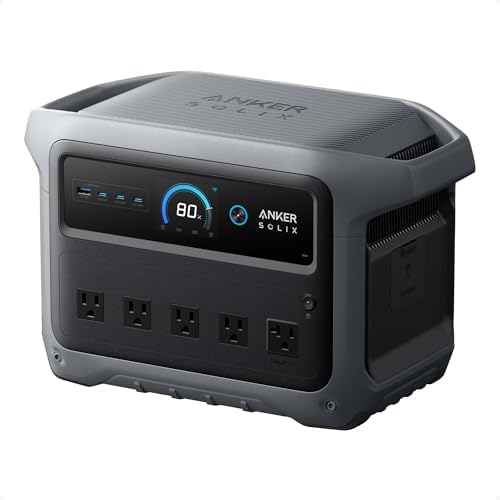
- 49 Min UltraFast Recharging: With upgraded HyperFlash tech, fully recharge at 1,600W—for outage prepping, camping trips,…
- 2,000W Output via 10 Ports: Delivers 2,000W (3,000W peak) and 1,024Wh capacity. Power up to 10 devices—ideal for emergen…
- Compact and Portable: Easily carry, store, and move from room to room, your RV, or even on beach and park outings. C1000…
2. Jackery Explorer 500 v2: best lightweight option
The Jackery Explorer 500 v2 is the portability-first choice. Current Jackery support data lists 512Wh capacity, 500W total continuous AC output, up to 200W solar input, and about 12.6 lb weight. It is much easier to move from a trunk to a picnic table or campsite than the larger stations in this guide.
Its limitation is energy rather than ordinary charger compatibility. An approved e-bike charger whose AC input stays below the 500W inverter ceiling may operate correctly, but a 512Wh power station cannot deliver a perfect 512Wh into the bike battery after conversion losses. This is therefore a partial-top-up station first, not a universal full-recharge promise.
Best for: riders who prioritize low carry weight, a modest range extension, smaller e-bike batteries, and electronics such as phones, lights, or camera gear.
Not ideal for: repeated deep charging of a large e-bike battery, two-bike trips, or any charger that approaches or exceeds the 500W continuous limit.
Main advantage: about 12.6 lb weight with 512Wh of useful portable energy.
Main trade-off: the smallest charging reserve in the shortlist.
Why it belongs in this guide: it defines the genuinely portable end of e-bike charging instead of forcing every rider into a 1kWh or 2kWh station.
Better alternative if: choose Anker when one deeper recharge matters more than low weight, or EcoFlow when several batteries share the same base.
Related Review: Jackery Explorer 500 v2 Review. See the Jackery Explorer 500 v2 Product page.
Official source: Jackery Explorer 500 v2 support information.

- Reliable Power On-the-Go: The Jackery Explorer 500 v2 offers 512Wh capacity, delivering 500W rated power and 1000W surge…
- Camping Essential: Weighing just 14 lbs, the Explorer 500 v2 is the lightest LiFePO4 power station of its size. Its comp…
- Built to Last 10+ Years: Featuring a LiFePO4 battery with 6000 charge cycles, the Explorer 500 v2 guarantees more than 1…

3. EcoFlow DELTA 2 Max: best larger energy reserve
The EcoFlow DELTA 2 Max is the larger-base recommendation when a trip involves several e-bike batteries, two riders, or substantial non-bike loads. Its 2,048Wh battery stores twice the nominal energy of the Anker and four times the Jackery. The 2,400W continuous inverter leaves extensive headroom above ordinary charger demand when total draw is verified.
EcoFlow also supports up to 1,000W solar input and expansion to 6,144Wh with compatible extra batteries. That makes it the strongest base-camp option when solar recovery, refrigeration, communications, or several days of charging matter. Those capabilities are excessive for a rider who only wants a small top-up at the trailhead, and the roughly 50 lb chassis is a real handling trade-off.
Best for: two-bike trips, multiple batteries, van or base-camp charging, and riders whose battery also supports refrigeration, networking, or work gear.
Not ideal for: riders carrying the station far from a vehicle or anyone who only needs one small top-up.
Main advantage: 2,048Wh of base energy with 2,400W continuous output, 1,000W solar input, and a supported expansion path.
Main trade-off: roughly 50 lb weight makes it a staged base rather than a light field battery.
Why it belongs in this guide: it covers the high-energy end of the problem without pretending a compact station can serve several packs indefinitely.
Better alternative if: choose Anker when 1kWh is enough and portability matters more, or Jackery when a partial charge is the whole mission.
Related Review: EcoFlow DELTA 2 Max Review. See the EcoFlow DELTA 2 Max Product page.
Official source: EcoFlow DELTA 2 Max product information.

- Fuel up 80% in Only 43 Mins: With DELTA 2 Max’s upgraded tech, combine up to 1000W solar input with AC for world-leading…
- 10-Year Long-Lasting LFP Battery: LFP battery chemistry provides 3000 cycles till it lowers to 80% capacity. That’s 6 mo…
- Expandable Capacity from 2kWh to 6kWh: Triple the capacity of DELTA 2 Max with up to 2 extra solar powered batteries. Cu…
Size the station from your e-bike battery and charger
Record the e-bike battery capacity first. Manufacturers may list watt-hours directly or provide voltage and amp-hours, which can be multiplied to estimate nominal watt-hours. Then read the approved charger label. The charger’s AC input is what the portable station’s inverter must supply. Keep margin rather than choosing a station whose ceiling is almost identical to the charger demand.
Next decide whether the goal is an emergency partial top-up, one substantial recovery, or several charges across a trip. A 512Wh station can be useful even when it cannot refill the pack, because a rider may only need enough energy to return to a vehicle or campsite. A 2kWh station is more reasonable when two bikes or several days of charging are part of the plan.
Do not forget the other loads. Phone navigation, lights, a laptop, refrigerator, fan, camera batteries, and camp electronics all draw from the same reserve. Use the PowerLabPro sizing guide to create a complete watt-hour budget instead of sizing the station from the bike alone.
Build an energy budget instead of guessing recharge counts
A useful planning sheet has four numbers: the bike battery’s nominal watt-hours, its starting state of charge, the power station’s remaining watt-hours, and the energy that must be reserved for everything else. A rider who only needs a safe return margin may require far less energy than one trying to refill a nearly empty battery before morning.
Add conversion losses as a planning margin instead of promising a fixed percentage. The power station converts battery DC to AC, the e-bike charger converts AC to the battery’s charging voltage, and the bike battery-management system controls the final charging stage. Temperature and charge taper can also change what happens near full charge.
After the first controlled charge, use the station display as feedback. Record how much e-bike state of charge was gained and how much station capacity was consumed. That observation is more useful for the next trip than a theoretical charge-count claim that ignores the exact bike, charger, temperature, and starting state.
Why the original e-bike charger matters
The normal safe workflow is straightforward: plug the e-bike’s manufacturer-supplied or manufacturer-approved charger into the station’s AC outlet, then connect the charger to the e-bike battery exactly as the bike maker specifies. The power station acts as a portable wall outlet. It does not become a substitute battery-management system.
Avoid improvised DC cables, so-called universal chargers, modified battery packs, or connectors selected only because they physically fit. Battery voltage, charging profile, communication, polarity, temperature sensing, and battery-management behavior can differ. A portable power station does not make an incompatible charger safe.
Day rides, camping, and multi-battery trips
For a day ride, the lightweight Jackery can be enough when the goal is a partial charge during lunch or reserve at the vehicle. For camping, the Anker is the stronger default because it balances energy and carry weight. For a two-rider trip, a van base, or a weekend with several large packs, the EcoFlow provides the most comfortable energy margin.
Plan charging time as well as energy. A large power station cannot make the e-bike charger work faster than its own output profile. A slow charger may need hours regardless of whether the station inverter is rated for 500W, 2,000W, or 2,400W. That affects whether charging happens during a meal stop, overnight while the rider remains present, or after the bikes are parked for the day.
What to pack with the power station
Carry the manufacturer-approved e-bike charger, the station AC cable, any verified solar or vehicle-charging cable, and weather protection that does not block ventilation. A properly rated extension cord can help separate the bike battery from a vehicle or camp table, but the cord must be undamaged and placed where it will not create a trip hazard.
Keep product manuals or offline copies available outside cellular coverage. Label chargers when several riders have similar-looking connectors. If solar is part of the trip, verify panel voltage, current, connectors, and the station’s limits before leaving home. A missing proprietary adapter can make a large battery useless as a recovery system.
Solar recovery and vehicle charging
Solar can extend a multi-day trip, but it works best as a daily energy-recovery plan rather than a promise of instant e-bike charging. Jackery accepts up to 200W, Anker up to 600W, and EcoFlow up to 1,000W under the current product limits used for this guide. Actual harvest depends on panel design, sun angle, shade, season, temperature, cable loss, and battery state.
Vehicle charging can also support travel, but ordinary 12V accessory charging may be slow. Do not assume a cigarette-lighter socket will restore a large station during a short drive. Verify the vehicle, cable, fuse, and accessory requirements before using any higher-power alternator solution.
Common e-bike charging mistakes
- Matching watt-hours one-for-one: a 500Wh station will not deliver a perfect 500Wh into the e-bike battery after conversion losses.
- Ignoring the charger label: the inverter must safely cover the approved charger’s AC input.
- Buying too much station: a roughly 50 lb 2kWh unit is unnecessary when the job is a small trailhead top-up.
- Buying too little energy: a compact station can disappoint when two large packs and camp electronics share the reserve.
- Using an unapproved charger: connector fit does not prove electrical or battery-management compatibility.
E-bike battery charging safety
The U.S. Consumer Product Safety Commission advises owners to use the charger supplied or recommended by the micromobility-device manufacturer, follow charging instructions, remain present while charging, and avoid charging while sleeping. CPSC also warns against modified or unapproved batteries and chargers. Review the current CPSC micromobility safety guidance alongside the e-bike manual.
Keep the e-bike battery, charger, and power station dry and ventilated. Stop using a battery that is damaged, swollen, unusually hot, recalled, water-damaged, or behaving abnormally. Do not leave the charging setup unattended in a vehicle, tent, or sleeping area. The portable station changes where electricity comes from, not the safety requirements of a lithium-ion e-bike battery.
Final recommendation by rider type
For most riders, choose the Anker SOLIX C1000 Gen 2. Its 1,024Wh battery provides substantially more charging margin than a 512Wh station while remaining around half the weight of the 2kWh EcoFlow. The 2,000W inverter is also far above the demand of one ordinary e-bike charger, leaving headroom for other small verified loads.
Choose Jackery Explorer 500 v2 when low weight and a partial top-up are the priorities. Choose EcoFlow DELTA 2 Max when several batteries, two riders, longer camping, or mixed loads make 2,048Wh useful. The best portable power station for ebike use is the smallest verified system that supplies the required charging energy, works with the approved charger, and remains practical to carry and recover.
FAQ
Can a portable power station charge an e-bike?
Yes, when you use the e-bike manufacturer-approved charger and the charger’s AC input stays within the station’s output limits. Do not connect the portable station directly to the bike battery unless the bike manufacturer explicitly supports that method.
How large should the power station be?
Match capacity to the e-bike battery watt-hours, desired amount of recharge, number of batteries, conversion losses, and other devices sharing the station. A 1kWh station is a practical middle class for many one-bike trips, but the correct size depends on the exact battery and charger.
Is a 500Wh station enough?
It can be enough for a partial top-up or some smaller batteries. It should not be assumed to fully recharge a 500Wh e-bike battery because conversion losses reduce the energy delivered to the pack.
Is e-bike charging from a power station safe?
Use the supplied or manufacturer-recommended bike charger, charge while present, keep the setup dry and ventilated, and follow the battery maker’s instructions. A portable station does not make a damaged, recalled, modified, or incompatible battery or charger safe.
Final Recommendation
For most riders, the Anker SOLIX C1000 Gen 2 is the best balanced choice because its 1,024Wh battery provides useful charging reserve while its 2,000W inverter and 24.9 lb weight remain practical. Choose the Jackery Explorer 500 v2 when portability and a partial field top-up matter most. Choose EcoFlow DELTA 2 Max when several e-bike batteries, two riders, or larger camp loads justify a 2,048Wh platform.
Frequently Asked Questions
Can a portable power station charge an e-bike?
Yes, when you use the charger supplied or recommended by the e-bike manufacturer and the charger's AC input stays within the power station's continuous-output limit. Do not bypass the bike charger unless the bike manufacturer explicitly supports another method.
How large should a portable power station for ebike charging be?
Match the station to the e-bike battery watt-hours, charger input watts, number of batteries, desired amount of recharge, other devices sharing the station, and conversion losses. A 1kWh station is a practical middle class for many one-bike trips, but the correct size depends on the exact battery and charger.
Is a 500Wh power station enough for an e-bike?
It can be enough for a partial top-up or some smaller packs, but it should not be assumed to fully recharge a 500Wh e-bike battery because inverter, charger, and battery losses reduce the energy delivered to the pack.
Is e-bike charging from a portable power station safe?
Use the supplied or manufacturer-recommended bike charger, remain present while charging, keep the battery and charger dry and ventilated, and follow current battery-safety guidance. Stop using damaged, recalled, modified, swollen, water-damaged, or overheating batteries or chargers.