
Comparison
BLUETTI Elite 200 V2 vs Anker SOLIX C2000 Gen 2: Output or Expandability?
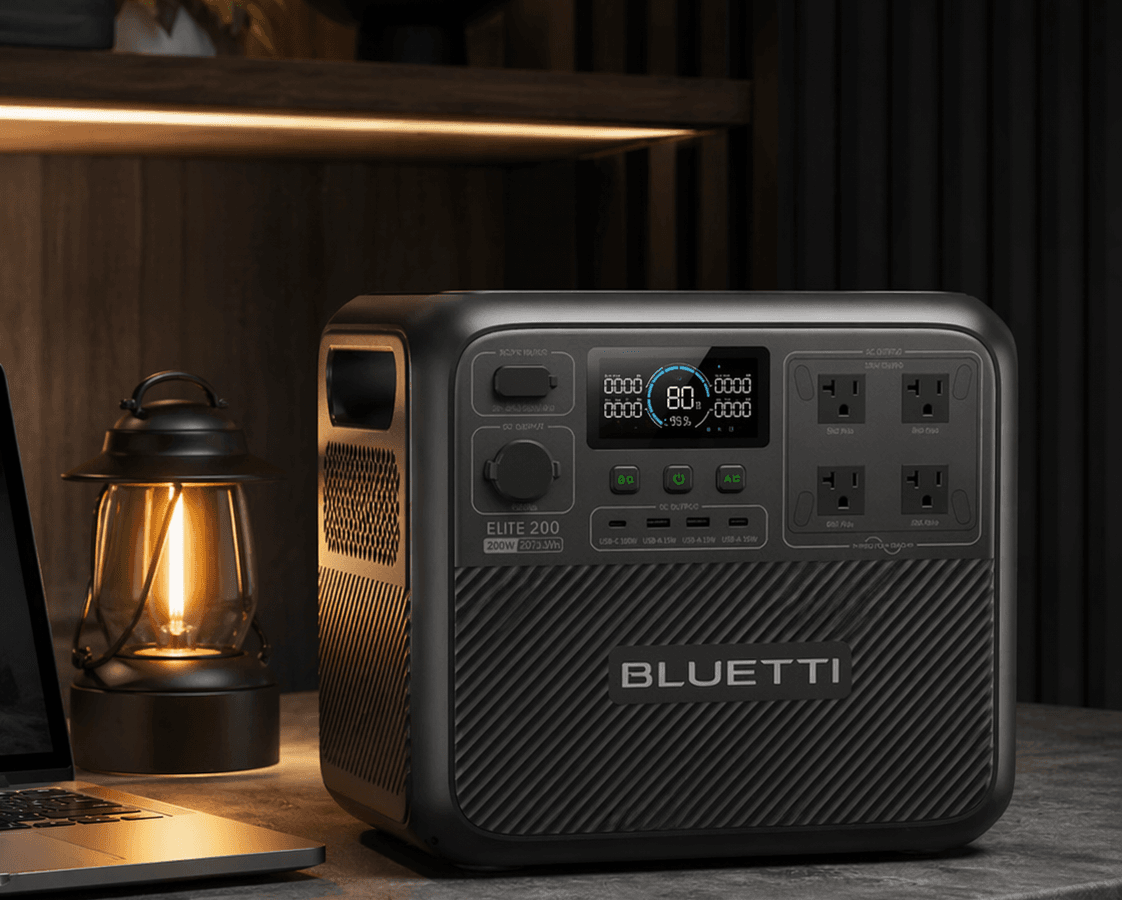
BLUETTI Elite 200 V2 vs Anker SOLIX C2000 Gen 2 compares two 2kWh LiFePO4 power stations for output, capacity, portability, solar recovery, UPS use, expansion, RV fit, and selected home backup.
Product Matchup
Side-by-side summary
Product A
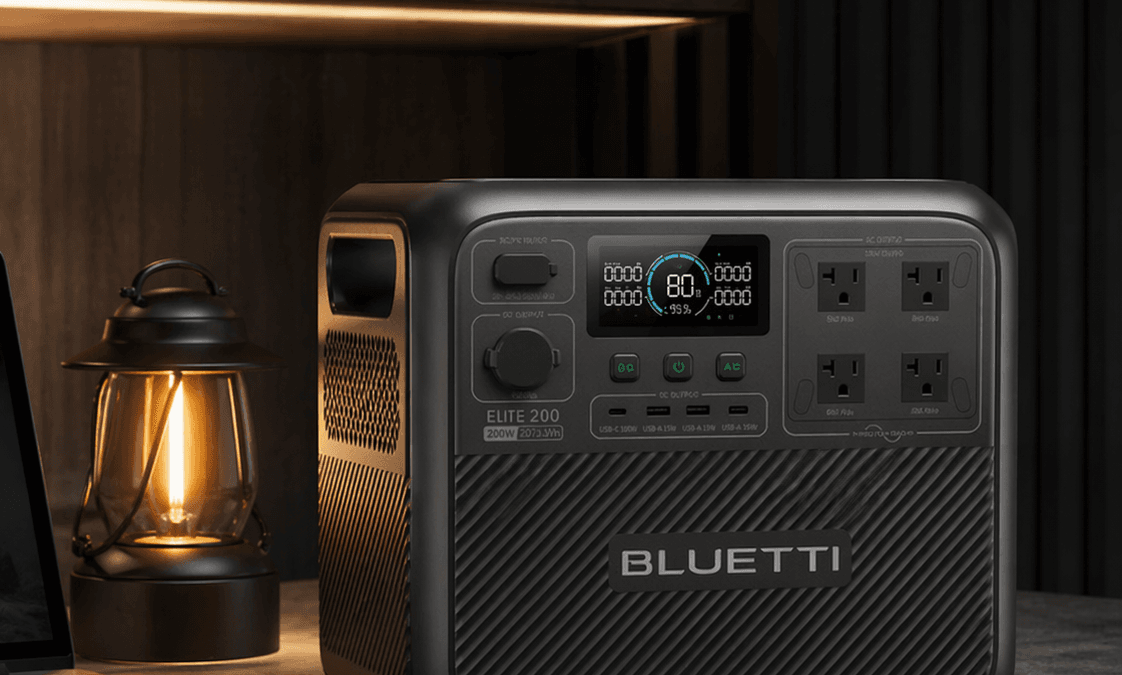
BLUETTI Elite 200 V2 Portable Power Station
Fixed-capacity 2,073.6Wh LiFePO4 power station with 2,600W continuous AC output, up to 1,000W solar input, Wi-Fi and Bluetooth app control, UPS mode with ≤15 ms switchover, and no listed expansion-battery path.
Product B
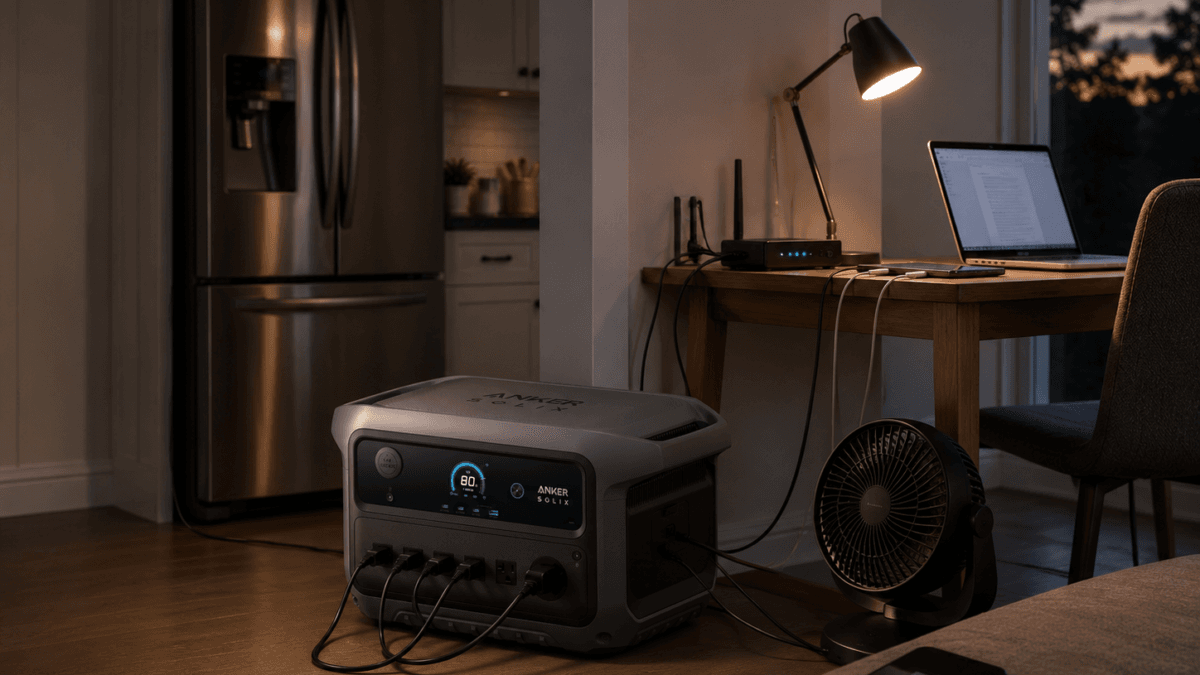
Anker SOLIX C2000 Gen 2 Portable Power Station
A 2,048Wh LiFePO4 portable power station for selected home essentials, refrigerator planning, RV shore-power support, camping, and mobile work. Its main strength is 2,400W output in a comparatively compact 41.7 lb body; its main limit is the need to sequence heavy loads and plan recovery.
Spec Comparison
Core numbers
| Spec | BLUETTI Elite 200 V2 Portable Power Station | Anker SOLIX C2000 Gen 2 Portable Power Station |
|---|---|---|
| Capacity | 2073.6 Wh | 2048 Wh |
| AC Output | 2600 W | 2400 W |
| Solar Input | 1000 W | 800 W |
This article may contain affiliate links. If you buy through these links, PowerLabPro may earn a commission at no extra cost to you. As an Amazon Associate I earn from qualifying purchases.
BLUETTI Elite 200 V2 vs Anker SOLIX C2000 Gen 2 is a close 2kWh-class decision between a fixed-capacity BLUETTI with slightly more battery and continuous output, and a lighter Anker with TT-30 RV connectivity and a supported expansion path. BLUETTI stores 2,073.6Wh and supplies 2,600W continuous AC output. Anker stores 2,048Wh, supplies 2,400W continuous output, and weighs 41.7 lb versus 53.35 lb for BLUETTI.
This BLUETTI Elite 200 V2 vs Anker SOLIX C2000 Gen 2 comparison is research-led. PowerLabPro has not performed hands-on testing of these two units. The analysis uses current manufacturer documentation, verified central Product records, connected Reviews, and the exact U.S. Amazon identities. BLUETTI’s 3,900W Power Lifting feature is treated correctly as a special mode for supported pure resistive loads, not as a 3,900W continuous or general surge rating.
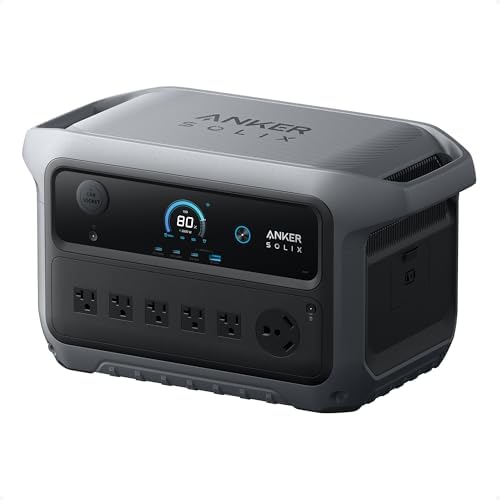
Table of Contents
BLUETTI Elite 200 V2 vs Anker SOLIX C2000 Gen 2 quick verdict
The quick verdict in BLUETTI Elite 200 V2 vs Anker SOLIX C2000 Gen 2 is that BLUETTI wins the battery and continuous-output categories by small but real margins, while Anker clearly wins portability. BLUETTI has 2,073.6Wh versus 2,048Wh and 2,600W continuous output versus 2,400W. Anker is about 11.65 lb lighter and can add one BP2000 Gen 2 expansion battery for roughly 4kWh total capacity.
Overall stays tied because the buyer problem changes the answer. Choose BLUETTI when a fixed 2kWh battery, higher continuous output, and 1,000W solar ceiling fit the plan. Choose Anker when lower weight, TT-30 RV convenience, a 10 ms UPS claim, and future runtime growth matter more. Value is also left tied because bundles and prices move, while fixed simplicity and expansion capability create different kinds of value.
Verified side-by-side specifications
| Buyer factor | BLUETTI Elite 200 V2 | Anker SOLIX C2000 Gen 2 |
|---|---|---|
| Battery capacity | 2,073.6Wh LiFePO4 | 2,048Wh LiFePO4 |
| Continuous AC output | 2,600W | 2,400W |
| Temporary high-draw behavior | 3,900W Power Lifting for supported pure resistive loads; not continuous output | 4,000W peak power |
| Solar input | Up to 1,000W | Up to 800W |
| Weight | 53.35 lb | 41.7 lb |
| Expansion | No compatible expansion battery listed in current documentation | One BP2000 Gen 2 battery, roughly 4kWh total |
| UPS | 15 ms or less manufacturer-listed | 10 ms manufacturer-listed |
| RV connection | Standard AC and DC outputs; verify exact RV connection plan | TT-30 outlet plus standard 120V outlets |
| Best fit | Fixed high-output 2kWh backup | Lighter expandable 2kWh home and RV backup |
These figures explain why BLUETTI Elite 200 V2 vs Anker SOLIX C2000 Gen 2 is not a simple specification sweep. The BLUETTI advantages are modest in battery size but more meaningful in continuous output and solar ceiling. Anker’s weight and expansion advantages affect ownership every time the station is moved or when a longer outage exposes the limits of the base battery.
Battery capacity and runtime planning
BLUETTI wins base capacity in BLUETTI Elite 200 V2 vs Anker SOLIX C2000 Gen 2, but the margin is only 25.6Wh. That is too small to create a practical runtime guarantee by itself. Both should be treated as 2kWh-class batteries whose useful duration depends on inverter losses, device cycling, standby draw, temperature, reserve settings, and the actual combination of AC and DC loads.
A refrigerator, freezer, router, laptop, lights, fan, television, coffee maker, microwave, CPAP after device verification, or RV appliance can fit very different energy profiles. A 100W average essential load may provide a long bridge. A 1,500W heating or cooking load can drain either base battery quickly. Capacity is the energy budget; it should not be confused with the inverter’s ability to start or sustain a load.
Use the PowerLabPro sizing guide to build the load list before purchase. If 2kWh is enough, the fixed BLUETTI can remain simple. If measurements show that the same compatible loads need roughly twice the runtime, Anker’s expansion path becomes a meaningful advantage without replacing the base unit.
Continuous output and special high-draw modes
BLUETTI wins continuous output in BLUETTI Elite 200 V2 vs Anker SOLIX C2000 Gen 2. Its 2,600W rating gives 200W more sustained headroom than Anker’s 2,400W rating. That can matter when several medium loads operate together or when one appliance sits close to the Anker ceiling. It is still important to verify outlet-specific limits, wiring, and the startup behavior of motors and compressors.
BLUETTI’s 3,900W Power Lifting must be described carefully. It is a manufacturer feature for supported pure resistive loads and does not convert the Elite 200 V2 into a 3,900W continuous station. It also is not a general surge rating that should be applied to every motor, compressor, pump, or electronic appliance. The normal planning figure remains 2,600W continuous.
Anker lists 4,000W peak power for the C2000 Gen 2. Peak power is temporary startup headroom, not another continuous rating and not additional stored energy. In BLUETTI Elite 200 V2 vs Anker SOLIX C2000 Gen 2, compare 2,600W and 2,400W for sustained use, then verify any special startup requirement separately.
Portability and placement
Anker wins portability decisively. At 41.7 lb, the C2000 Gen 2 is about 11.65 lb lighter than the 53.35 lb Elite 200 V2. Both are substantial batteries, but the difference matters for RV loading, garage shelves, vehicle camping, work trailers, stairs, and moving a station from storage to the outage setup.
Do not reduce portability to weight alone. Measure the storage space, handles, lifting height, cable route, ventilation, and where an expansion battery might sit. Anker’s advantage is strongest for buyers who move the station frequently. If the station stays in one protected location, BLUETTI’s extra weight may matter less than output or solar recovery.
AC charging and solar recovery
BLUETTI lists up to 1,800W AC charging and says the Elite 200 V2 can reach 80% in about one hour and full charge in about 1.4 hours under stated temperature conditions. Anker lists up to 1,800W AC input and about 88 minutes for AC-only charging under stated U.S. conditions. Both are fast enough that a normal wall circuit can be a major part of readiness, but real results vary with circuit capacity, temperature, battery state, and charging settings.
BLUETTI has the higher solar ceiling at up to 1,000W versus 800W for Anker. That 200W difference can help a buyer with enough compatible panel capacity and good sun, but it should not be treated as guaranteed daily energy. Panel voltage, current, open-circuit voltage in cold weather, connectors, shade, cable loss, panel temperature, and battery state control actual recovery.
Anker can combine AC and solar input up to 2,600W under its stated conditions, while BLUETTI also offers fast mixed-use charging behavior. The better BLUETTI Elite 200 V2 vs Anker SOLIX C2000 Gen 2 recovery plan is the one matched to the charging sources the buyer actually has, not the largest laboratory input number.
Fixed capacity versus expansion
Expansion is the clearest structural difference in BLUETTI Elite 200 V2 vs Anker SOLIX C2000 Gen 2. Current BLUETTI Elite 200 V2 documentation does not list a compatible expansion-battery path. Anker supports one BP2000 Gen 2 expansion battery, adding another 2,048Wh and raising the system to roughly 4kWh.
Fixed capacity is not automatically a disadvantage. A buyer who knows 2,073.6Wh is enough can avoid another battery, cable, storage location, cost, and charging consideration. Expansion is useful only when the base inverter already fits the loads and the remaining problem is duration. Adding an Anker battery does not raise the 2,400W continuous inverter ceiling or create 240V output.
Choose the architecture that matches the likely ownership path. A simple fixed system is easier to understand and store. A modular system offers a way to grow after real outage measurements prove the need. Buying expansion before the base station has been tested can turn flexibility into unnecessary complexity.
UPS behavior, app control, and sensitive loads
Both products advertise fast UPS-style transfer for compatible equipment. BLUETTI lists 15 ms or less and specifically cautions that the Elite 200 V2 is not intended as a high-performance UPS for data servers or workstations that require one. Anker lists 10 ms. Neither figure guarantees compatibility with every computer, router, security system, aquarium, medical device, or other sensitive load.
Test the exact equipment before an outage. A modem and router may tolerate transfer differently from a desktop workstation or medical device. Equipment with dedicated life-safety, medical, server, or zero-transfer requirements should follow its own manufacturer’s backup guidance rather than a general portable-power specification.
Both brands provide app control. BLUETTI documents Wi-Fi and Bluetooth management for UPS modes, charging, monitoring, and firmware. Anker supports Wi-Fi and Bluetooth with charging controls and other operating modes. App features are useful for preparation, but keep an offline operating plan in case internet access is unavailable during the outage.
Selected home backup implications
For home use, BLUETTI Elite 200 V2 vs Anker SOLIX C2000 Gen 2 should be framed around selected cord-connected loads. Refrigeration, communications, lights, laptop work, a fan, television, and short appliance use can form a practical 2kWh plan when startup and running watts are verified. High-watt resistance heating, large air conditioners, electric cooking, and multiple simultaneous heavy appliances can consume either battery quickly.
Neither unit supplies native 240V or automatically becomes a whole-home system. Never backfeed a household receptacle. Use direct appliance connections or properly designed transfer equipment when appropriate. Pumps, compressors, and refrigeration should be tested because startup demand can differ significantly from normal running watts.
For current product limits, use BLUETTI Elite 200 V2 official product information and Anker SOLIX C2000 Gen 2 official information. For general outage preparation, review Ready.gov power-outage guidance.
RV, camping, and off-grid use
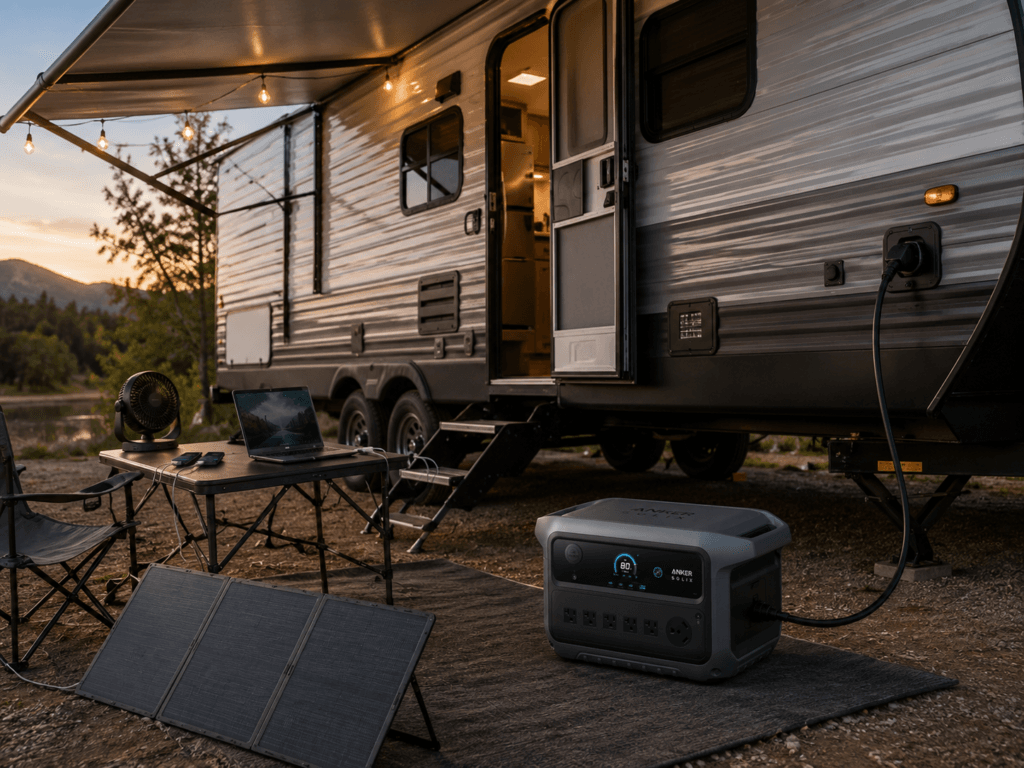
Anker has the clearer RV connection advantage because the C2000 Gen 2 includes a TT-30 outlet. Its TT-30 path still shares the station’s 2,400W continuous inverter limit, so it is not the same as unlimited 30A campground service. RV air conditioning, microwaves, water heating, converter charging, and other high-draw loads may need sequencing.
BLUETTI can be a strong campsite or off-grid station when standard outlets, 2,600W continuous output, and the 1,000W solar ceiling are more useful than TT-30 convenience. A buyer can use an appropriate RV connection only when the complete cable and electrical setup is compatible. Do not improvise adapters or assume that an outlet shape guarantees the correct voltage, current, or grounding behavior.
For vehicle-supported camping, Anker’s lower weight may be the bigger advantage. For a semi-fixed off-grid setup with a larger compatible solar array, BLUETTI’s extra solar input can be more useful. In both cases, secure the station during travel, keep vents clear, and protect the battery and cables from water and cargo damage.
Who should choose BLUETTI Elite 200 V2
Choose BLUETTI in BLUETTI Elite 200 V2 vs Anker SOLIX C2000 Gen 2 when the buyer wants the stronger fixed base: 2,073.6Wh, 2,600W continuous output, up to 1,000W solar input, and no need to manage expansion batteries. It is a good fit for planned home essentials, campsite or off-grid use, and buyers whose load list benefits from the extra continuous-output margin.
- Best for: fixed 2kWh backup, higher simultaneous AC demand, larger solar recovery, and buyers who prefer one self-contained station.
- Not ideal for: future battery expansion or frequent lifting where 53.35 lb becomes burdensome.
- Main advantage: 2,600W continuous output and 1,000W solar input.
- Main trade-off: heavier fixed-capacity design.
Read the BLUETTI Elite 200 V2 Product page and connected Review for exact model identity, specifications, and alternatives.
Who should choose Anker SOLIX C2000 Gen 2
Choose Anker in BLUETTI Elite 200 V2 vs Anker SOLIX C2000 Gen 2 when 2,400W output is enough and the buyer values lower weight, TT-30 RV use, a 10 ms UPS claim, and the option to double stored energy with one BP2000 Gen 2. It is a strong middle-ground platform for home essentials, RVs, vehicle camping, and buyers who want a growth path without moving into a 3kWh rolling station.
- Best for: lighter 2kWh ownership, compatible RV TT-30 use, fast recovery, and expansion to roughly 4kWh.
- Not ideal for: loads that genuinely need more than 2,400W continuous or buyers wanting native 240V.
- Main advantage: 41.7 lb weight plus a practical expansion path.
- Main trade-off: slightly less continuous output and solar input.
Read the Anker SOLIX C2000 Gen 2 Product page and connected Review for the verified identity and deeper decision analysis.
Decision checklist before checkout
Before closing the BLUETTI Elite 200 V2 vs Anker SOLIX C2000 Gen 2 decision, record the heaviest simultaneous AC load and the startup behavior of every compressor or motor. If the normal combination can approach 2,400W, BLUETTI’s extra 200W may provide useful margin. If the real load stays comfortably below 2,400W, output should move down the priority list.
Then estimate daily watt-hours and decide whether expansion is likely. If roughly 2kWh covers the target, a fixed BLUETTI can remain simple. If the same load needs close to 4kWh during longer outages, Anker’s BP2000 Gen 2 support can prevent a platform change. Measure the storage and lifting route as well because 41.7 lb versus 53.35 lb can change who can deploy the station safely.
Finally, verify the current ASIN, seller, included cables, solar connectors, warranty, RV connection, and charging accessories. Do not assume a bundle includes an expansion battery, solar panel, alternator charger, or adapter unless the active listing says so. Current product identity matters more than a saved price or promotional image.
Important limitations and common mistakes
The first mistake in BLUETTI Elite 200 V2 vs Anker SOLIX C2000 Gen 2 is calling Power Lifting a 3,900W continuous or general surge rating. It is not. The second is assuming Anker’s 4,000W peak is a continuous 4,000W inverter. It is temporary headroom. The third is treating a small capacity difference as a guaranteed runtime win.
Also avoid buying an expansion battery before proving a runtime shortfall, designing solar from wattage alone, treating UPS transfer time as universal device compatibility, or backfeeding household wiring. Keep either product dry, ventilated, stable, and within the current manual’s operating limits. Test noncritical loads before an outage and keep a written load and recharge plan.
Final buyer-specific recommendation
The final BLUETTI Elite 200 V2 vs Anker SOLIX C2000 Gen 2 recommendation is a tie overall. Choose BLUETTI when the priority is 2,600W continuous output, a 1,000W solar ceiling, and a simple fixed 2,073.6Wh station. Choose Anker when lower weight, TT-30 RV connectivity, a 10 ms UPS claim, and the option to grow to roughly 4kWh better match the ownership plan.
Neither product should be chosen from one headline specification. Write down running watts, startup demand, daily watt-hours, required reserve, solar or wall recovery, storage location, lifting route, and whether expansion is realistically needed. The better station is the one that solves the actual constraint with the least unnecessary complexity.
FAQ
Which has more battery capacity?
BLUETTI Elite 200 V2 has 2,073.6Wh versus 2,048Wh for Anker C2000 Gen 2. The 25.6Wh difference is real but too small to promise a meaningful universal runtime advantage.
Is BLUETTI Power Lifting the same as continuous output?
No. BLUETTI lists 2,600W continuous AC output. Its 3,900W Power Lifting mode is for supported pure resistive loads and should not be treated as a 3,900W continuous or general surge rating.
Which one is expandable?
Anker C2000 Gen 2 supports one BP2000 Gen 2 expansion battery, bringing total energy to roughly 4kWh. Current BLUETTI Elite 200 V2 documentation does not list a compatible expansion-battery path.
Winners by Category
| Overall | Tie |
|---|---|
| Value | Tie |
| Portability | Anker SOLIX C2000 Gen 2 Portable Power Station: 2kWh Backup Fit |
| Output | BLUETTI Elite 200 V2 Portable Power Station |
| Battery | BLUETTI Elite 200 V2 Portable Power Station |
Final Verdict
Choose BLUETTI Elite 200 V2 when slightly more base capacity, 2,600W continuous output, 1,000W solar input, and a simple fixed-capacity 2kWh platform fit the plan. Choose Anker SOLIX C2000 Gen 2 when lower weight, TT-30 RV convenience, faster stated UPS switching, and an expansion path to about 4kWh matter more. Neither is a universal overall winner because one favors fixed high-output simplicity while the other favors portability and future runtime growth.