
Comparison
Jackery HomePower 3600 Pro Max vs EcoFlow DELTA Pro 3: Lighter 240V Backup or More Capacity?
Jackery HomePower 3600 Pro Max vs EcoFlow DELTA Pro 3 compares two 4,000W 120/240V platforms for capacity, weight, solar recovery, expansion, home backup, RV use, and buyer fit.
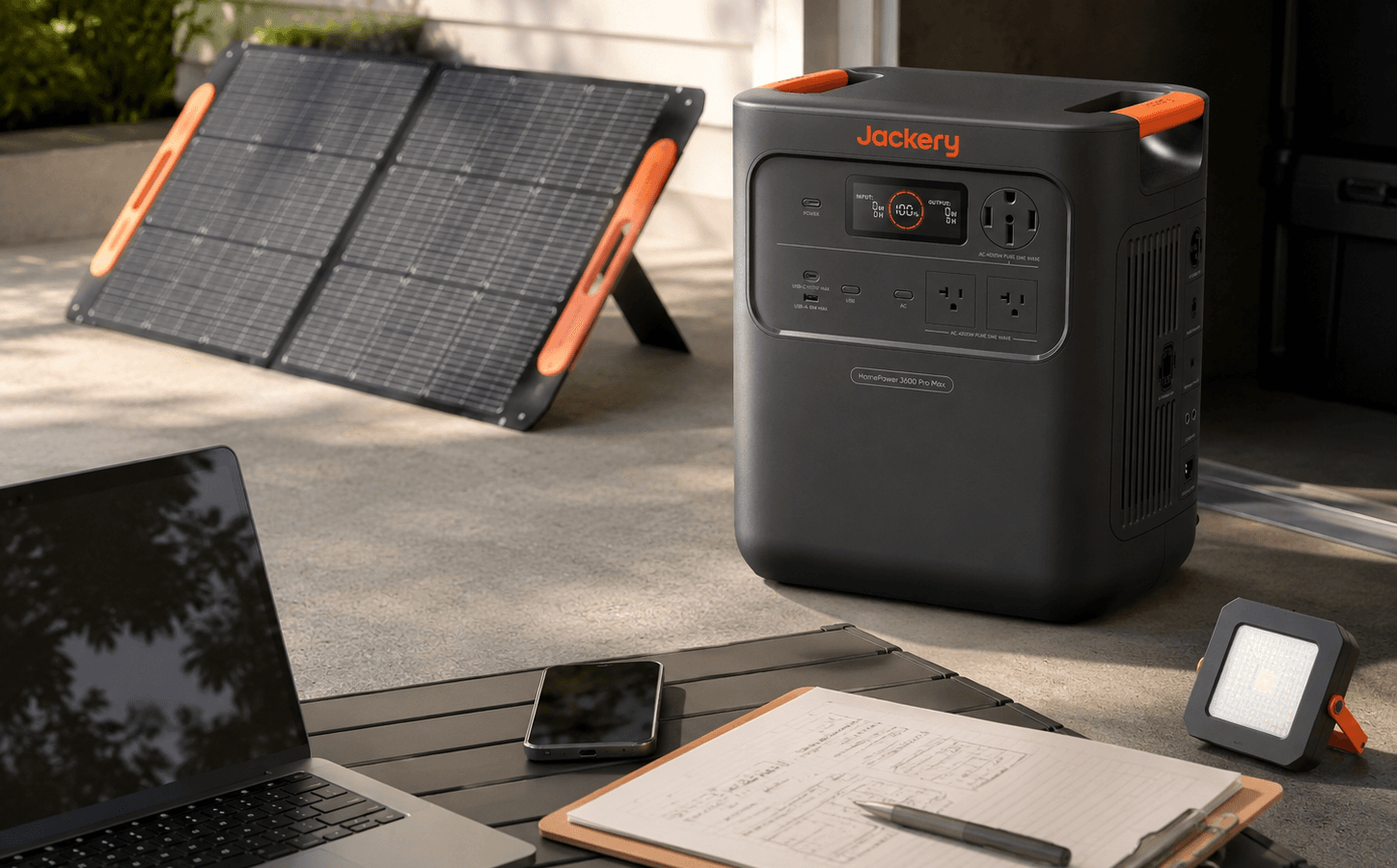
Product Matchup
Side-by-side summary
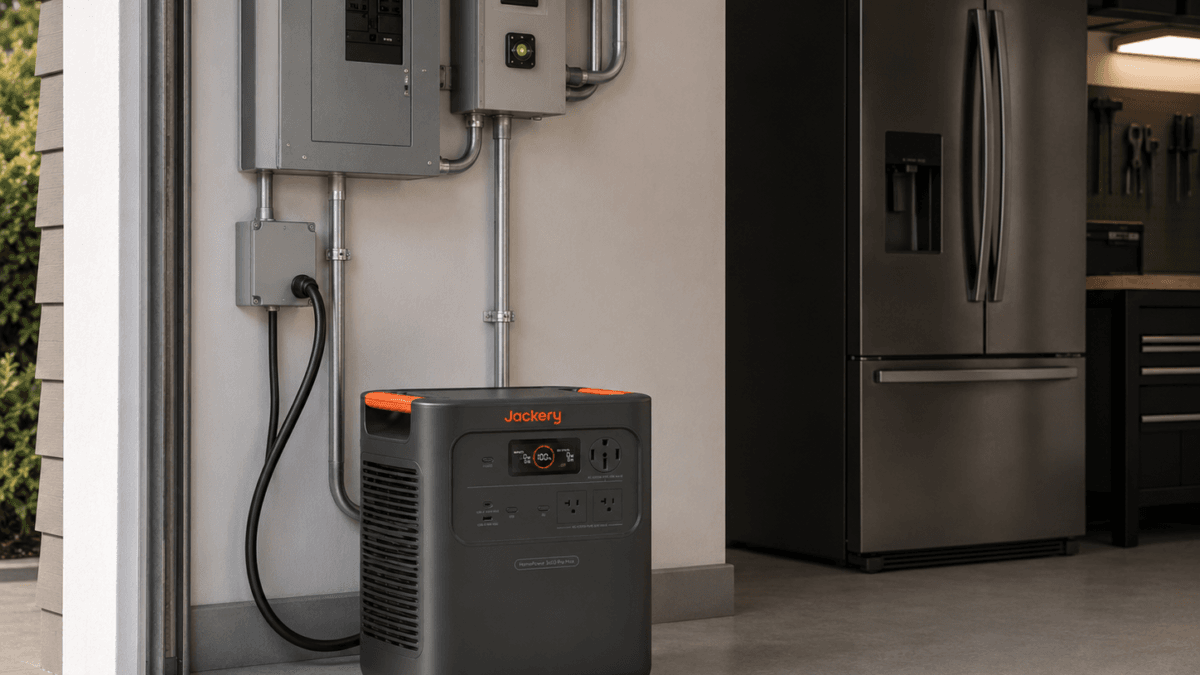
Product A
Jackery HomePower 3600 Pro Max
A 3,584Wh LiFePO4 portable power station with 4,000W 120/240V output for measured essential-load backup, compatible selected-circuit planning, and staged expansion. Its trade-off is a 73.85 lb base unit that needs a planned operating location.
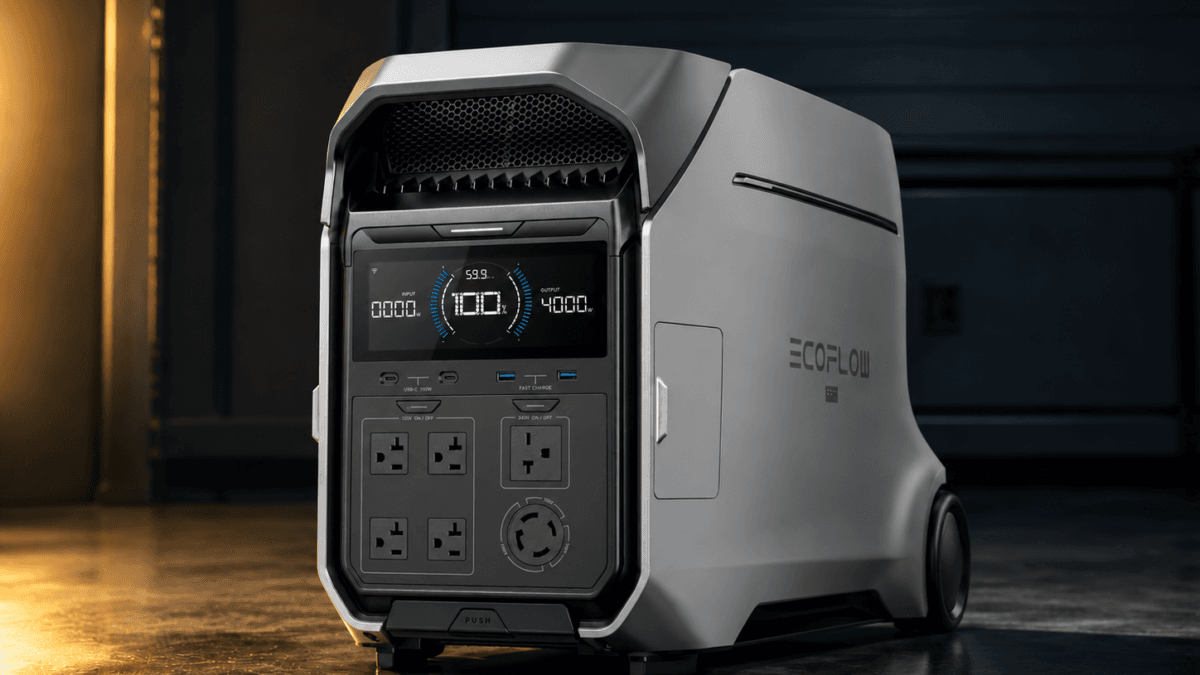
Product B
EcoFlow DELTA Pro 3
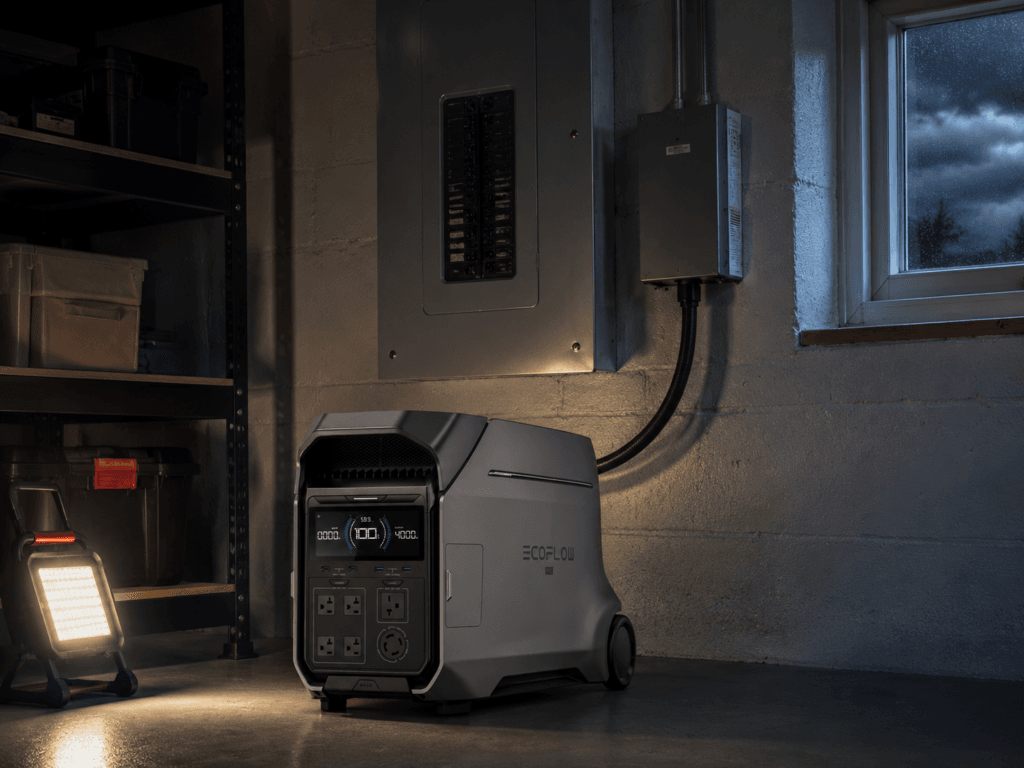
The EcoFlow DELTA Pro 3 power station delivers 4096Wh LiFePO4 capacity, 4000W output, and single-unit 120V/240V support with up to 2600W solar input. Built for whole-home essential backup, well pumps, and transfer switch setups, expandable to 48kWh.
Spec Comparison
Core numbers
| Spec | Jackery HomePower 3600 Pro Max | EcoFlow DELTA Pro 3 |
|---|---|---|
| Capacity | 3584 Wh | 4096 Wh |
| AC Output | 4000 W | 4000 W |
| Solar Input | 1200 W | 2600 W |
This article may contain affiliate links. If you buy through these links, PowerLabPro may earn a commission at no extra cost to you. As an Amazon Associate I earn from qualifying purchases.
Jackery HomePower 3600 Pro Max vs EcoFlow DELTA Pro 3 is a close 240V backup decision because both platforms provide 4,000W rated continuous AC output, but the similarities stop there. Jackery uses a 3,584Wh LiFePO4 battery in a remarkably lighter 73.85 lb chassis and does not support add-on battery packs according to Jackery’s current support documentation. EcoFlow starts at 4,096Wh, weighs 113.54 lb, accepts up to 2,600W of solar input, and can expand with compatible DELTA Pro 3 extra batteries.
This Jackery HomePower 3600 Pro Max vs EcoFlow DELTA Pro 3 comparison is based on current manufacturer documentation, verified PowerLabPro Product records, paired Reviews, and the exact U.S. Amazon product identities. PowerLabPro has not performed hands-on testing of either station. The goal is to identify which buyer problem each platform solves better without treating a larger battery, lower weight, or bigger ecosystem as a universal advantage.

Table of Contents
Jackery HomePower 3600 Pro Max vs EcoFlow DELTA Pro 3 quick verdict
The quickest way to understand Jackery HomePower 3600 Pro Max vs EcoFlow DELTA Pro 3 is to separate fixed-capacity portability from expandable energy. Both are rated at 4,000W continuous output. Jackery stores 3,584Wh and weighs about 73.85 lb. EcoFlow stores 4,096Wh and weighs 113.54 lb. Jackery is therefore dramatically easier to move for its output class, while EcoFlow offers 512Wh more base energy and a compatible expansion path.
Jackery wins portability. EcoFlow wins battery capacity and expansion. Continuous output is a tie because both list 4,000W rated output, even though their outlet layouts and temporary peak behavior differ. Value is left tied because prices and bundles change, and a fixed 3,584Wh system can be better value for a buyer who never needs expansion while the larger EcoFlow ecosystem can be better value for a buyer who does.
Verified specifications and what they mean
| Buyer factor | Jackery HomePower 3600 Pro Max | EcoFlow DELTA Pro 3 |
|---|---|---|
| Battery capacity | 3,584Wh LiFePO4 | 4,096Wh LFP |
| Rated continuous output | 4,000W at 240V; current support also lists 120V output limits | 4,000W total 120V/240V |
| Peak / temporary output | Up to 8,000W at 240V under manufacturer-stated conditions | 8,000W surge; X-Boost is load management, not extra battery energy |
| Solar input | Up to 1,200W, low-voltage solar path | Up to 2,600W total high- and low-PV input |
| Weight | 33.5 kg / about 73.85 lb | 51.5 kg / 113.54 lb |
| Expansion batteries | Not supported in current Jackery support data | Up to about 12kWh on one unit with two compatible extra batteries |
| UPS | 10 ms manufacturer-listed | 10 ms manufacturer-listed |
| Key electrical connection | NEMA 14-50 120V/240V interface, subject to system output limits | 120V outlets plus 240V 6-20R and L14-30R connections |
The most important lesson in Jackery HomePower 3600 Pro Max vs EcoFlow DELTA Pro 3 is that similar output does not make the products interchangeable. Jackery is a lighter fixed-capacity platform. EcoFlow is a heavier modular platform. One buyer may value moving the station from storage to a transfer inlet without managing a 100-plus-pound chassis. Another may accept the weight because the planned outage requires extra battery modules or higher solar-recovery headroom.
Capacity and runtime differences
EcoFlow has the battery advantage in Jackery HomePower 3600 Pro Max vs EcoFlow DELTA Pro 3. The difference is 512Wh at the base-unit level. That is useful energy, but it should be translated into the actual average load instead of treated as an abstract win. A refrigerator, freezer, router, lights, work equipment, furnace blower, pellet stove, or pump has a different duty cycle and startup profile from a high-watt cooking or heating appliance.
Neither nameplate capacity is the same as usable AC energy at the outlet. Inverter losses, standby use, battery reserve settings, temperature, cycling, and power-factor behavior affect runtime. A household with a 250W average essential load may find either base battery sufficient for a useful outage window. A household averaging 1,500W because of heating, cooling, or pumping can consume either battery much faster than the product size suggests.
The correct Jackery HomePower 3600 Pro Max vs EcoFlow DELTA Pro 3 runtime decision starts with the PowerLabPro sizing guide. Add running watts, note compressor or motor startup demand, estimate required operating hours, keep a reserve, and decide when recharging becomes possible. Buy the extra 512Wh only when it supports a real duration target rather than simply making one column larger.
Continuous output and 240V architecture
Continuous output is effectively tied in Jackery HomePower 3600 Pro Max vs EcoFlow DELTA Pro 3. Jackery lists 4,000W rated 240V output and current support documentation also distinguishes its 120V limits. EcoFlow lists 4,000W total continuous 120V/240V output. Both can therefore serve serious selected-load plans when the load, outlet, voltage, current, and transfer equipment are compatible.
Jackery lists a NEMA 14-50 interface for 120V/240V applications, but its support page explicitly notes that the 50A socket rating does not increase the power station’s maximum output. EcoFlow provides a 240V 6-20R and a 120V/240V L14-30R alongside its 120V outputs. The plug that happens to fit is not enough. Verify the appliance and the complete connection path before assuming either station can safely serve a load.
A pump, compressor, air conditioner, workshop machine, or RV can impose startup demand that differs from running watts. Peak figures help describe temporary headroom, but they are not continuous ratings. In Jackery HomePower 3600 Pro Max vs EcoFlow DELTA Pro 3, neither side earns an output win simply because a temporary number looks larger. The relevant winner is the unit whose continuous rating and outlet architecture fit the actual equipment.
Portability is the biggest Jackery advantage
Portability is the clearest category win in Jackery HomePower 3600 Pro Max vs EcoFlow DELTA Pro 3. The HomePower 3600 Pro Max weighs about 73.85 lb, roughly 39.7 lb less than the 113.54 lb DELTA Pro 3. That difference matters in a garage, RV, work trailer, cabin, or outage plan where the station may need to move through doors, across a threshold, or between storage and an inlet location.
Seventy-four pounds is still not lightweight. Plan a two-hand lift, cart, ramp, or stable staging location when needed. The advantage is relative: Jackery delivers 4,000W 240V-rated output in a chassis that is substantially easier to handle than many 4kWh-class rolling stations. Buyers with stairs or physical limitations should still plan the deployment path rather than assuming a portable product is automatically easy to carry.
Charging and solar recovery
EcoFlow wins solar headroom in Jackery HomePower 3600 Pro Max vs EcoFlow DELTA Pro 3. The DELTA Pro 3 accepts up to 2,600W total solar input. Jackery’s current support data lists up to 1,200W through its low-voltage dual-channel solar arrangement and specifically says the HomePower 3600 Pro Max does not support a roof high-voltage solar-system input. That distinction can matter during long outages.
Higher input capacity is useful only when the buyer has compatible panels and real sun. EcoFlow’s 2,600W ceiling may justify a larger array for faster daytime recovery. Jackery’s 1,200W ceiling may be enough for a household whose daily essential energy is modest or whose primary recovery source is the grid. Shade, panel angle, temperature, voltage, current, cable loss, and weather reduce field production on both systems.
Jackery lists roughly 2.5 hours for AC charging under its current support conditions. EcoFlow offers multiple recharge routes and fast AC recovery. Do not turn a best-case recharge time into an outage promise. A practical Jackery HomePower 3600 Pro Max vs EcoFlow DELTA Pro 3 plan asks how much energy can be recovered between morning and evening, what circuit or solar array will supply it, and whether charging can occur while priority loads remain protected.
Fixed capacity versus modular expansion
Expansion is a decisive difference in Jackery HomePower 3600 Pro Max vs EcoFlow DELTA Pro 3. Jackery’s August 2026 support page states that battery packs are not supported for the HomePower 3600 Pro Max. EcoFlow lists support for two DELTA Pro 3 extra batteries on a single inverter, raising a one-unit system to about 12kWh. Larger EcoFlow configurations require additional system components and should be treated as a separate installation decision.
Fixed capacity can be a benefit. A 3,584Wh buyer who already knows the required runtime avoids extra batteries, cables, cost, floor space, and system complexity. Expansion is valuable when the buyer expects the load plan to grow or has measured a longer outage requirement. Do not buy an expandable platform merely because a maximum capacity looks impressive. Expansion solves an energy-duration problem, not a voltage or inverter-output problem.
Home backup and transfer-equipment implications
For selected home loads, Jackery HomePower 3600 Pro Max vs EcoFlow DELTA Pro 3 should be planned around a priority list. Refrigeration, communications, lighting, a few outlets, selected heating controls, and verified pump loads may fit. Electric water heating, large resistance heating, central air conditioning, ranges, dryers, and simultaneous heavy loads can change the required energy and output dramatically.
Jackery explicitly positions the NEMA 14-50 interface for home backup, RV, and high-power uses while warning that the socket rating does not change station output. EcoFlow supports home-integration accessories in its ecosystem. Neither product should be backfed through a wall receptacle. Use the proper inlet and transfer equipment, follow the current manual, and involve a qualified electrician when the plan reaches household wiring or code-governed work.
For current first-party limits, see Jackery’s HomePower 3600 Pro Max support specifications and EcoFlow’s DELTA Pro 3 specifications. For emergency planning beyond product selection, see Ready.gov power-outage guidance.
RV, cabin, and mobile-work implications
RV and mobile users may find the Jackery weight advantage especially important in Jackery HomePower 3600 Pro Max vs EcoFlow DELTA Pro 3. A 73.85 lb station is still substantial, but it is more realistic to move than a 113.54 lb station when the vehicle does not have a permanent battery bay. The NEMA 14-50 interface can also be relevant to compatible 50A RV systems, subject to the power station’s actual output limits.
EcoFlow may be the better mobile base when a fixed installation, larger solar array, or extra batteries are already part of the vehicle or cabin plan. Weight matters less when the station stays in one location and energy recovery matters more. Secure either unit against movement, keep ventilation clear, protect it from water, and route cables so they cannot be crushed by doors, slides, cargo, or foot traffic.
Who should choose Jackery HomePower 3600 Pro Max
Choose Jackery in Jackery HomePower 3600 Pro Max vs EcoFlow DELTA Pro 3 when 3,584Wh already covers the measured runtime and the most important practical need is a lighter 4,000W 120/240V platform. It is a strong fit for selected home circuits, 50A-RV-style connection planning, work trailers, and buyers who prefer a fixed-capacity system rather than building a modular battery stack.
- Best for: buyers prioritizing lower weight, 4,000W 240V output, simple fixed capacity, and a NEMA 14-50 connection path.
- Not ideal for: buyers who know they need more than 3,584Wh without replacing or adding a second system.
- Main advantage: unusually low weight for this output class.
- Main trade-off: less base capacity, lower solar input, and no supported expansion battery.
Use the Jackery HomePower 3600 Pro Max Product page and the connected Review for the exact model, affiliate destination, specifications, and deeper alternatives.
Who should choose EcoFlow DELTA Pro 3
Choose EcoFlow in Jackery HomePower 3600 Pro Max vs EcoFlow DELTA Pro 3 when the 4,096Wh base battery, 2,600W solar ceiling, and extra-battery expansion path solve needs that matter more than portability. It is stronger for a buyer who expects the backup system to grow, can stage the heavier chassis permanently, or wants a larger daily solar-recovery budget during off-grid or extended-outage use.
- Best for: modular backup, larger solar arrays, a 4kWh starting reserve, and buyers who want the broader DELTA Pro ecosystem.
- Not ideal for: frequent movement where the additional 39-plus pounds becomes the main ownership problem.
- Main advantage: more base energy plus expansion and solar headroom.
- Main trade-off: substantially more weight than the Jackery.
Use the EcoFlow DELTA Pro 3 Product page and the connected Review for the central identity and deeper buyer analysis.
Decision checklist before checkout
Before closing the Jackery HomePower 3600 Pro Max vs EcoFlow DELTA Pro 3 decision, write down the exact 120V and 240V loads, the heaviest simultaneous combination, and the startup behavior of every motor or compressor. Then estimate daily watt-hours and decide how much reserve must remain for communications, lighting, refrigeration, and safe shutdown. If 3,584Wh covers that plan, Jackery’s fixed capacity may be enough. If the plan clearly exceeds it, EcoFlow’s larger base battery and expansion path become more valuable.
Next, measure the physical deployment route and the recharge system. Confirm whether 73.85 lb versus 113.54 lb changes who can move the station safely, and verify that the planned cable path reaches the intended inlet without creating a trip or weather hazard. Compare the solar array you can actually deploy with the 1,200W Jackery and 2,600W EcoFlow input ceilings. Finally, confirm the current Amazon ASIN, seller, included cables, warranty terms, and any transfer or solar accessories before purchase rather than assuming a bundle contains everything shown in marketing photos.
Important limitations and buying mistakes
The first mistake in Jackery HomePower 3600 Pro Max vs EcoFlow DELTA Pro 3 is choosing by output alone. Both are 4,000W-class products, so the decision should move immediately to battery energy, weight, outlet type, solar, expansion, and the actual load profile. The second mistake is treating a 50A receptacle as 50A of available station output. Jackery’s own support guidance says the outlet rating does not override the system’s maximum output.
The third mistake is expecting 240V capability to remove the need for transfer equipment or electrical planning. The fourth is assuming manufacturer runtime or recharge examples will match every household. The fifth is buying EcoFlow extra batteries before proving a runtime shortfall, or rejecting Jackery solely because it cannot expand when 3,584Wh already covers the real need. A smaller, simpler system is often the better system when it fits.
Final buyer-specific recommendation
The final Jackery HomePower 3600 Pro Max vs EcoFlow DELTA Pro 3 choice is a tie overall because each product has a clear buyer. Pick Jackery when portability and simplicity are decisive: 73.85 lb, 3,584Wh, 4,000W 240V output, and no expansion-battery management. Pick EcoFlow when a 4,096Wh starting battery, 2,600W solar input, and modular capacity are worth the additional weight.
Do not manufacture a winner from specifications that solve different problems. A buyer who moves the station regularly may experience the Jackery weight advantage every time it is used. A buyer preparing for multi-day outages may experience the EcoFlow expansion advantage every time the base battery falls short. Measure the loads, required hours, solar opportunity, electrical connection, and moving route, then choose the architecture that removes the actual constraint.
FAQ
Which has more battery capacity?
EcoFlow DELTA Pro 3 has 4,096Wh versus 3,584Wh for the Jackery HomePower 3600 Pro Max. That gives EcoFlow a 512Wh base-capacity advantage before expansion.
Which is easier to move?
Jackery is substantially lighter at about 73.85 lb versus 113.54 lb for EcoFlow. Both require safe handling, but the difference is large enough to make portability a real Jackery advantage.
Which is better for future expansion?
EcoFlow. The DELTA Pro 3 supports compatible extra batteries, while Jackery’s current August 2026 support page says the HomePower 3600 Pro Max does not support battery packs.
Winners by Category
| Overall | Tie |
|---|---|
| Value | Tie |
| Portability | Jackery HomePower 3600 Pro Max: Practical 4,000W 240V Backup |
| Output | Tie |
| Battery | EcoFlow DELTA Pro 3 Power Station |
Final Verdict
Choose the Jackery HomePower 3600 Pro Max when a substantially lighter 120/240V platform, 3,584Wh base battery, NEMA 14-50 connection, and simple fixed-capacity ownership fit the plan. Choose the EcoFlow DELTA Pro 3 when 4,096Wh base capacity, 2,600W solar input, and modular extra-battery expansion matter more than the additional weight. Continuous output is effectively tied at 4,000W, so the real decision is portability and simplicity versus energy, solar, and expansion.