
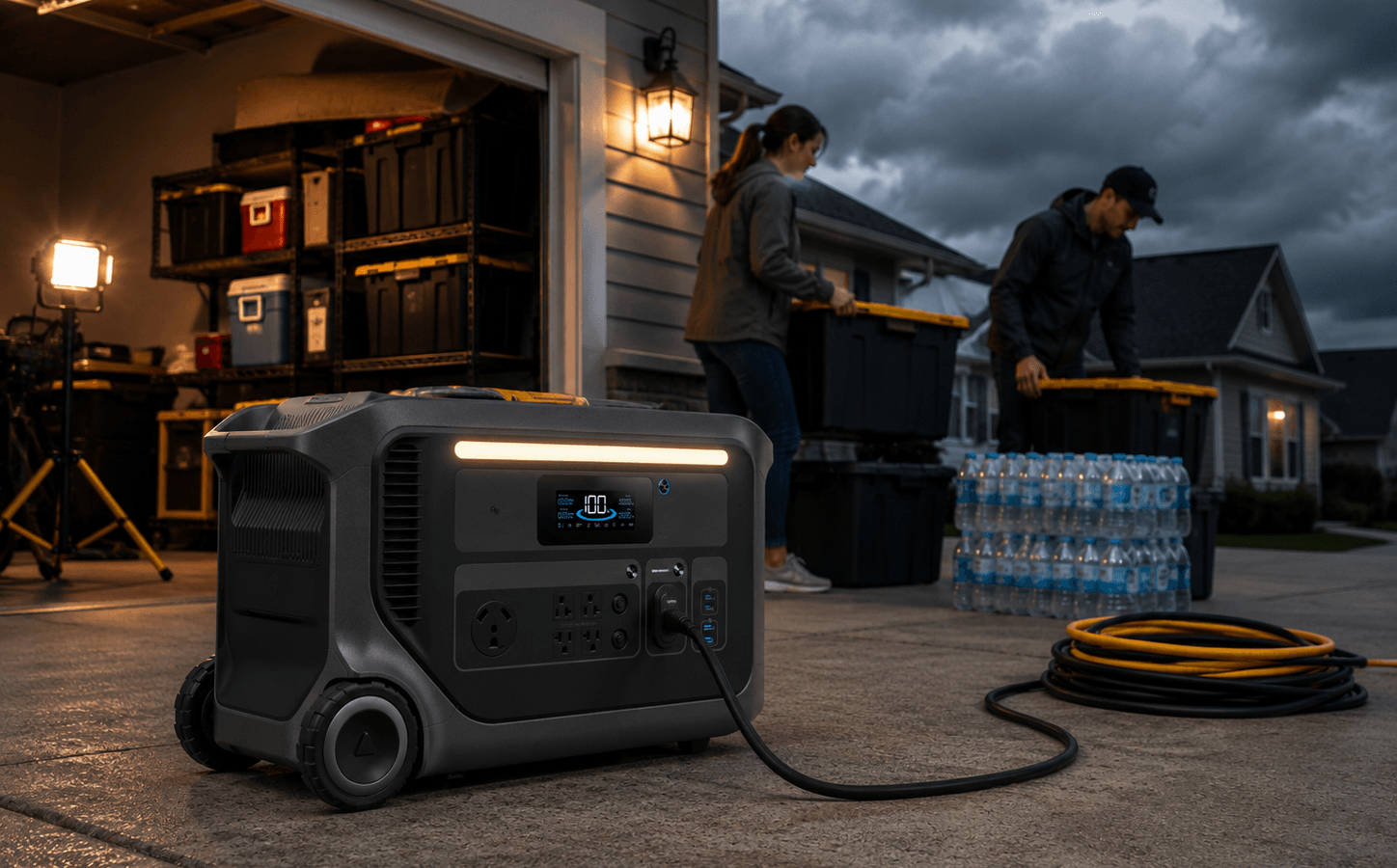
Product Intelligence
Serious Backup PickAnker SOLIX F3000 Portable Power Station
A 3,072Wh LFP rolling portable power station for essential home backup, RV power, solar charging, and expandable outage planning.
Specifications
Key specs
Buyer Fit
Fit signals
Best for
Pros
- 3,072Wh LFP capacity fits serious essential-backup planning
- Up to 2,400W solar input gives it a stronger extended-outage use case
- TT-30R and Anderson outputs make it more useful for RV buyers
- Expandable battery path gives room to grow beyond the base unit
- Rolling design is easier to move than fixed backup equipment
Cons
- 91.5 lb weight makes it poor for stairs or frequent lifting
- 240V output requires two F3000 units and a Double Voltage Hub
- Some home-backup features require extra accessories
- NEMA 5-20R outlets are limited to 2,400W max so outlet path matters
- Overkill for light apartment backup or phone and laptop use
Spec table
| Capacity | 3072 Wh |
|---|---|
| AC Output | 3600 W |
| Surge Output | 7200 W |
| Solar Input | 2400 W |
| Weight | 201.7 lb |
| Battery | LFP / LiFePO4 |
| Warranty | 5-year warranty listed by Anker; verify current coverage before use as a sales claim |
| Expandability | Supports BP3000 expansion battery path; up to 3 BP3000 units per official Anker page |
| UPS / EPS | UPS: 20 ms listed |
| Recharge Time | AC: under 3 hours; solar: up to 2,400W under ideal conditions; 3,600W generator/TT-30 path supported |
Disclosure: This article may contain affiliate links. If you buy through these links, PowerLabPro may earn a commission at no extra cost to you. As an Amazon Associate I earn from qualifying purchases.
Anker SOLIX F3000 Review: Powerful 3kWh Backup, But Not for Everyone
This anker solix f3000 review is for buyers who need serious backup power, not a small battery for phones and lights. The F3000 is a 3,072Wh portable power station with strong solar input, expansion support, and enough output flexibility to matter during outages, RV trips, garage projects, and planned emergency setups.
The goal of this anker solix f3000 review is simple: help you decide whether this power station fits your actual backup plan before you spend money on more battery than you need. The F3000 can make sense for home essentials, RV solar setups, and longer outage planning, but it is not the right unit for every buyer.
That does not mean everyone should buy it. The F3000 is heavy, accessory-dependent for some home backup features, and easy to overspend on if your real loads are modest. It makes the most sense when you need more than a compact 1kWh power station but do not want to jump straight into a fixed whole-home battery system.
Table of Contents
Anker SOLIX F3000 Review: Fast Verdict
The short version of this anker solix f3000 review is that the F3000 is a strong pick for buyers who want a serious 3kWh-class portable power station for essential home backup, RV power, solar-supported outages, and heavier portable loads. Its best feature is balance. It gives you real output and expansion potential without becoming as large as Anker’s bigger tower-style backup systems.
Choose the F3000 if you need backup power for essentials like refrigeration, Wi-Fi, lights, laptops, fans, selected kitchen appliances, RV gear, or worksite tools. Avoid it if you only need a small emergency battery, live upstairs without easy storage, or expect one portable unit to act like a complete automatic whole-home backup system.
Bottom line: The Anker SOLIX F3000 is best treated as a serious essential-backup platform. It is not cheap, light, or casual. It becomes compelling when your backup plan includes real appliances, solar recharging, RV use, or future expansion.
- Best for: home essentials, RV power, solar charging, garage backup, extended outage planning.
- Not ideal for: small apartments, stairs, low-budget buyers, light phone/laptop-only backup.
- Main caution: single-unit 240V expectations are wrong. 240V requires two F3000 units and the proper hub.

- Massive 3,600W Pass-Through Charging: No more interruptions during outages. Recharge with a 120V generator and run appli…
- Less Power Waste, Longer Backup Time: With ultra-low idle power consumption, F3000 achieves 125 hours of AC idle standby…
- Ultra 2,400W Solar Recharging: Charge fast outdoors with portable and rigid solar panel compatibility. Just plug into th…
Anker SOLIX F3000 Review Specs
A useful anker solix f3000 review has to look past the headline numbers. The F3000’s spec sheet looks simple from a distance: 3,072Wh and 3,600W. The important details are more specific. Not every outlet carries the same limit, and some of the bigger home-backup features depend on extra accessories or paired units.
| Spec | Verified value | Buyer meaning |
|---|---|---|
| Capacity | 3,072Wh | Large enough for serious essential-backup planning, not just device charging. |
| Battery type | LFP | A good chemistry choice for frequent backup use and longer ownership. |
| AC output | 2,400W max from NEMA 5-20R; 3,600W max from TT-30R path | Strong output, but buyers must match the appliance and cable to the correct output path. |
| AC surge power | 7,200W | Helpful for startup loads, but still requires appliance-by-appliance verification. |
| Solar input | Up to 2,400W total | Useful for long outages and RV use when panels and sunlight are planned properly. |
| UPS | 20 ms listed | Useful for some backup needs, but not a substitute for checking critical-device requirements. |
| Expansion | Up to 3 BP3000 expansion batteries for one F3000 system | Can grow into a larger backup setup, but cost, space, and weight increase quickly. |
| 240V support | Requires two F3000 units and Double Voltage Hub | Do not expect 240V from one standalone F3000. |
| Weight | 91.5 lb | Movable on wheels, but not easy to carry. |
| Dimensions | 25.6 × 11.8 × 14.8 in | More storage-friendly than some larger backup systems, but still a large battery. |
Specs above should be checked against Anker SOLIX’s official F3000 specifications before final publication, especially if the manufacturer updates bundles, accessories, or product-page wording.
What Stands Out in This Anker SOLIX F3000 Review
The F3000 is not just a bigger version of a camping battery. It is built around a more serious use case: keeping selected high-value loads running when normal power is not available.
1. The capacity is practical for essentials
At 3,072Wh, the F3000 gives you enough battery to think beyond phones and laptops. It can support an outage plan built around refrigeration, communication, lighting, fans, small appliances, and work devices, as long as you manage loads instead of trying to run everything at once.
2. The solar input is not an afterthought
A large battery with weak solar input can be frustrating during extended outages. The F3000’s dual solar input design gives it a stronger case for buyers who want to recharge during daylight instead of treating the battery as a one-time reserve.
3. The output story is strong, but easy to misunderstand
The F3000 has a serious output ceiling, but the outlet path matters. The NEMA 5-20R outlets and TT-30R output are not the same. Buyers who want to run heavier loads should verify the wattage, startup surge, plug type, cable, and connection method before assuming compatibility.
4. The expansion path is useful for the right buyer
The expansion battery option gives the F3000 a longer life inside a PowerLabPro content strategy. It can start as a single-unit review and later support comparison content around home backup kits, RV solar kits, and whole-home-adjacent backup planning.
Who Should Buy the Anker SOLIX F3000?
The F3000 is best for buyers who already know they need a serious portable power station and want enough headroom to run selected appliances, not just personal electronics.
Buy it for essential home backup
If your outage plan includes a refrigerator, Wi-Fi, lights, phones, laptops, fans, and a few selected appliances, the F3000 belongs on the shortlist. It gives you more working room than a compact unit while staying more flexible than a fixed battery installation.
Buy it for RV and campsite power
The F3000 also makes sense for RV owners who want strong output, solar charging, and a rolling design. The Anderson DC output and TT-30R path make it more RV-relevant than many smaller stations, but RV buyers still need to check their exact wiring and load requirements.
Buy it if solar recovery matters
If you want to stretch backup runtime across multiple days, solar input matters almost as much as battery capacity. The F3000’s solar input gives it a stronger extended-outage story than low-input power stations.
Buy it if you may expand later
A single F3000 can work as a serious starting point. Expansion batteries change the use case from “large portable station” toward “planned backup system.” That path is useful for buyers who want to grow slowly instead of buying a bigger setup immediately.
Before choosing this size, check your load list with PowerLabPro’s portable power station sizing guide. Buying too much battery adds cost and weight. Buying too little leaves you disappointed when the lights go out.
Who Should Avoid the Anker SOLIX F3000?
The F3000 is easy to admire and still wrong for some buyers.
- Skip it for light backup: If you only need phones, a router, laptops, LED lights, and a small fan, a smaller unit may be easier to store and move.
- Skip it for upstairs apartments: At 91.5 lb, this is not a stair-friendly battery.
- Skip it if you expect automatic whole-home backup from one box: Home integration depends on accessories, safe wiring, load selection, and correct setup.
- Skip it if budget is the main constraint: The F3000 is a serious system. Smaller units can be smarter if your loads are modest.
- Skip it if you do not want to plan cables and outlets: Heavy-load use requires careful outlet and wattage matching.
Anker SOLIX F3000 Review Notes Before You Buy
This anker solix f3000 review should be read as a buyer-fit guide, not a lab test. The recommendations here are based on verified manufacturer-listed specs, product positioning, outlet limitations, capacity, solar input, expansion support, and realistic backup planning.
The main decision is not whether the F3000 is powerful. It is. The real decision is whether your home backup, RV, or solar charging needs are large enough to justify a 91.5 lb power station with a 3,072Wh battery and expansion path.
Anker SOLIX F3000 for Home Backup
The F3000 is strongest when used as an essential-load backup system. That means you choose what matters before the outage: refrigerator, router, lights, phones, laptop, fan, small medical-support devices where appropriate, and selected appliances that stay within the unit’s limits.
The wrong way to judge the F3000 is to ask whether it can run “the house.” That question is too broad. A better question is: which circuits, appliances, and devices actually need backup, and how long do they need to run?
For direct plug-in backup, the F3000 can support a practical emergency setup without any permanent installation. For circuit-level backup, buyers need to understand transfer equipment, inlet boxes, smart meter accessories, local code, and safe installation requirements. Anything involving a home panel should be handled carefully and professionally.
PowerLabPro buyer note
Do not size backup power from the biggest number on the box. Start with the loads you actually need. A refrigerator and Wi-Fi router are different from a microwave, space heater, dryer, well pump, or air conditioner.
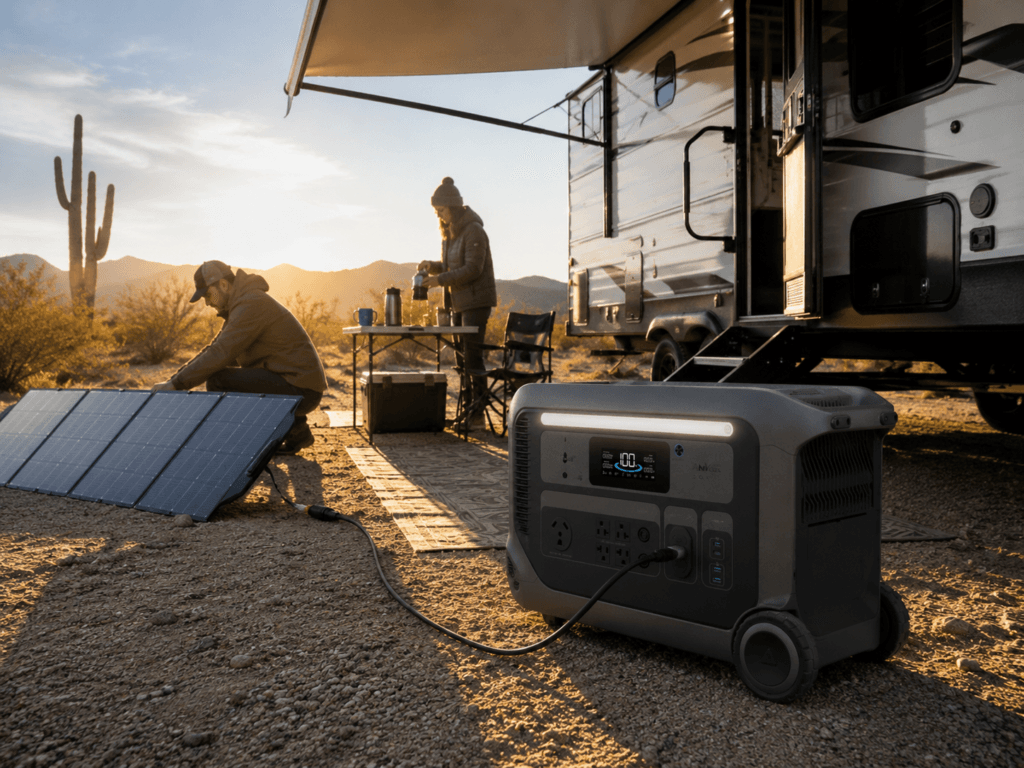
Anker SOLIX F3000 for RV and Off-Grid Use
The RV case is one of the better reasons to choose the F3000 over a smaller station. It has the capacity and output to feel useful beyond basic device charging, and the rolling design makes more sense around campsites, garages, and flat storage areas than it does inside tight apartments.
For RV buyers, the key value is flexibility. You can use the F3000 for campsite power, solar-supported charging, DC output needs, and selected AC loads. The practical limit is not just wattage. It is your plug type, total draw, startup surge, solar setup, and how often you are willing to recharge.
Do not assume every RV appliance is appropriate. Air conditioners, heaters, induction cooktops, and large battery chargers can change the math quickly. The F3000 is capable, but a capable battery still needs a realistic load plan.
Anker SOLIX F3000 Solar Charging
Solar charging is one of the reasons the F3000 deserves attention. The official specs list two PV inputs: a high-PV input rated up to 1,600W and a low-PV input rated up to 800W. Combined, that gives the unit up to 2,400W of solar input under the right setup.
That does not mean every buyer will see perfect solar recharge numbers. Panel wattage, voltage limits, wiring, shade, panel angle, temperature, and weather all matter. Treat the solar input as serious potential, not a guaranteed daily result.
The best buyer for this feature is someone planning beyond a single short outage. Solar input becomes more valuable when the power is out for more than one day, when you are camping away from hookups, or when you want to keep a backup battery useful without relying only on wall charging.
Main Trade-Offs Before You Buy
It is portable, but not light
The wheels and pull handle help. The weight still matters. A 91.5 lb battery is manageable on flat ground and much less pleasant around stairs, small closets, or frequent loading into a vehicle.
It has strong output, but outlet limits matter
The F3000’s output is one of its strengths, but buyers need to read the port limits carefully. A normal household-style outlet and a TT-30R output are not interchangeable. Match the load to the correct outlet path before relying on it.
It can expand, but expansion changes the purchase
Expansion batteries can turn the F3000 into a much more serious backup setup. They also add cost, weight, storage space, and setup complexity. Expansion is a good path for buyers with real outage needs, not casual backup buyers.
It can support 240V, but not by itself
A single F3000 provides 120V output. For 240V output, Anker states that two F3000 units must be connected with the Double Voltage Hub. That distinction should be made clearly in the article and product data.
How the F3000 Fits Against Other Power Stations
The F3000 sits between compact portable stations and heavier whole-home backup systems. That position is its advantage. It is stronger than smaller 1kWh and 2kWh stations for appliance backup, but easier to place and move than larger tower-style systems.
| Buyer type | Better fit | Reason |
|---|---|---|
| Phones, router, laptop, lights | Smaller portable station | Lower cost, lower weight, easier storage. |
| Fridge, router, lights, fans, selected appliances | Anker SOLIX F3000 | Good mix of capacity, output, solar input, and expansion potential. |
| Large home circuits, 240V appliances, long outage plan | Larger backup system or paired/expanded setup | More capacity and correct hardware may be required. |
| RV/off-grid buyer with solar panels | Anker SOLIX F3000 or similar 3kWh-class unit | High capacity and solar input matter more away from hookups. |
Anker SOLIX F3000 Review FAQ
Is the Anker SOLIX F3000 good for home backup?
Yes, the Anker SOLIX F3000 can be a strong home backup option for selected essentials. It is best used for planned loads such as refrigeration, router backup, lights, fans, laptops, and carefully chosen appliances. It should not be treated as automatic whole-home backup from one standalone unit.
Can the Anker SOLIX F3000 run a refrigerator?
It may support refrigerator backup depending on the refrigerator’s running wattage, startup surge, usage pattern, temperature, and what else is connected. Anker publishes refrigerator runtime examples, but buyers should verify their own appliance draw before relying on any portable power station for food storage.
Does the Anker SOLIX F3000 provide 240V power?
Not by itself. A single F3000 provides 120V output. Anker states that 240V output requires two F3000 units connected with the Double Voltage Hub.
How heavy is the Anker SOLIX F3000?
The official listed weight is 91.5 lb. It has wheels and a pull handle, but it is still not a lightweight carry unit.
How much solar input does the Anker SOLIX F3000 support?
The official specs list up to 2,400W total solar input, split between a high-PV input and a low-PV input. Buyers must verify panel voltage, current, wiring, and compatibility before connecting solar panels.
Is the Anker SOLIX F3000 better than the F3800 Plus?
Not always. The F3000 is easier to place and move, while the F3800 Plus is aimed at larger backup needs. The better choice depends on required capacity, output, 240V needs, storage space, and budget. A dedicated comparison article should verify both spec sheets before making a final recommendation.
Final Verdict: Anker SOLIX F3000 Review Recommendation
The final recommendation in this anker solix f3000 review is clear: choose the F3000 if you need a serious portable power station for essential home backup, RV power, solar charging, and planned outage use. It gives you enough capacity and output to support real appliances while staying more flexible than a fixed whole-home system.
Choose a smaller power station if your backup plan is limited to phones, a router, laptops, lights, and a fan. Choose a larger system or paired setup if you need 240V output, circuit-level backup, or longer runtime across heavy loads.
The F3000 is not the right answer for every buyer. It is the right answer when your backup plan is big enough to justify the weight, cost, solar input, and expansion path. Verify your appliance wattage, connection method, solar panel setup, and current Amazon availability before purchase.