
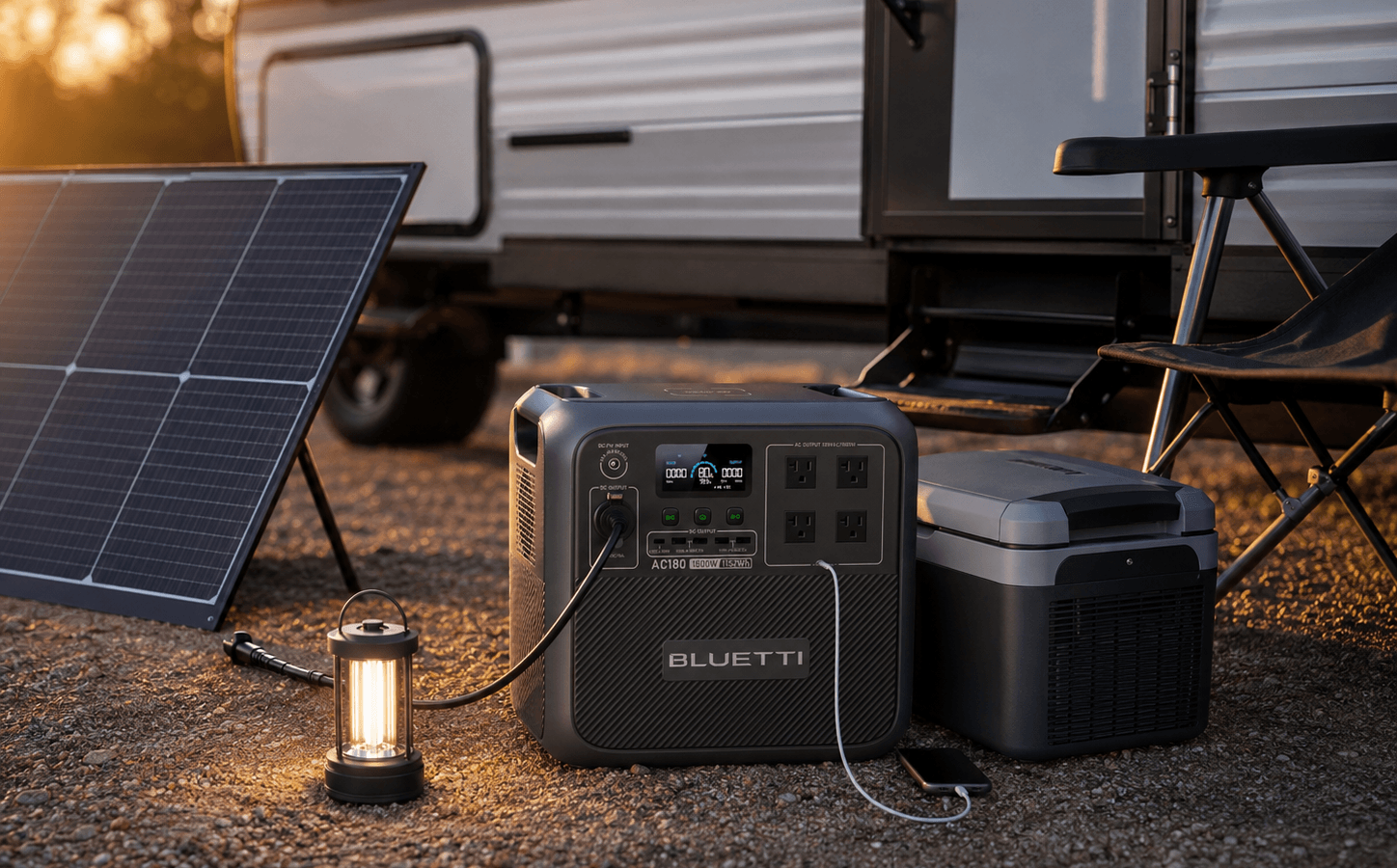
Product Intelligence
Fast 1.15kWh backupBLUETTI AC180: Fast 1.15kWh Backup
The BLUETTI AC180 portable power station delivers 1152Wh LiFePO4 capacity with 45-minute fast charging and 20ms UPS switchover. Built for apartment backup, CPAP users, and buyers who need fast recharge with reliable UPS.
Specifications
Key specs
Buyer Fit
Fit signals
Best for
Pros
- 1,152Wh LiFePO4 base capacity
- 1,800W total AC output across four outlets
- Up to 1,440W Turbo charging
- Up to 500W solar input
- One 100W USB-C port
- Bluetooth app control
- 5-year warranty
Cons
- 1,152Wh is limited for long appliance-heavy outages
- No conventional capacity-expansion path
- Power Lifting is not 2,700W continuous output
- 500W solar input is a ceiling, not a guaranteed harvest
- Not a 240V or whole-home platform
- No manufacturer-published fast-transfer time on the current product page
Spec table
| Capacity | 1152 Wh |
|---|---|
| AC Output | 1800 W |
| Surge Output | 2700 W |
| Solar Input | 500 W |
| Weight | 35.3 lb |
| Battery | LiFePO4 |
| Warranty | 5 years |
| Expandability | No capacity expansion. B80, B230, and B300 batteries can charge AC180 through Power Bank Mode with required cables, but they do not expand AC180 capacity. |
| UPS / EPS | N/A - current official product page does not separately publish a specific transfer-time figure. |
| Recharge Time | AC Turbo Mode: up to 1,440W and approximately 1.3 to 1.8 hours to full charge under stated conditions. Solar: up to 500W with a 12 to 60V open-circuit-voltage range and 10A limit; actual recovery varies. |
This article may contain affiliate links. If you buy through these links, PowerLabPro may earn a commission at no extra cost to you. As an Amazon Associate I earn from qualifying purchases.
BLUETTI AC180 bottom line: the BLUETTI AC180 is a 1,152Wh portable power station for buyers who need more reserve than a compact electronics battery provides but do not need a heavier 2kWh system. It combines 1,800W of total AC output, four 120V outlets, a 500W solar-input ceiling, fast 1,440W Turbo charging, Bluetooth app control, and a 35.27 lb carry weight. It fits a measured essentials plan for apartment outages, home-office continuity, camping, road trips, and selected RV use. It is not a whole-home, 240V, medical-backup, or conventional modular-battery platform.
The main reason to consider the BLUETTI AC180 is the balance of output, recharge speed, and manageable size. It can power a practical mix of communication devices, work equipment, lights, phone chargers, a fan, and selected appliances when their combined demand is planned. Its 1,152Wh battery remains a finite reserve. High-watt cooking, heating, cooling, and motor-driven loads can consume that reserve quickly even when the inverter has enough headroom for a short run.
This Product page is a source-backed central reference, not a hands-on test report. Read the connected Review for deeper buyer trade-offs. Before purchase, confirm the current standalone Amazon listing, included accessories, solar-panel compatibility, your own appliance demand, and the latest manufacturer documentation.
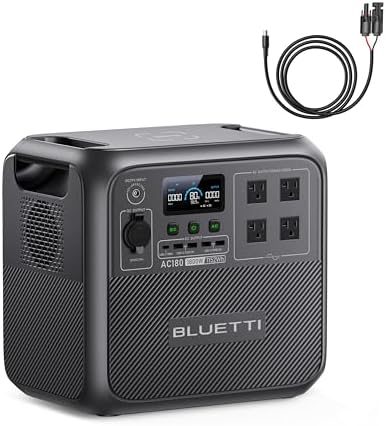
- [Charged in 1 Hour] – The AC180 packs a 1152Wh LiFePO4 battery, which can be fully charged in just 1 hour at 1440W AC in…
- [Power All Your Needs] – The AC180 boasts 1800W output and 11 outlets to handle almost anything you plug in. With a tap …
- [Solar Fast Charge] – Built-in MPPT charge controller for up to 500W solar input. Fully charge AC180 solar generator in …
Table of Contents
BLUETTI AC180: Quick Product Reference
The BLUETTI AC180 is a mid-size LiFePO4 power station that sits between a small desk-side battery and a larger rolling backup platform. Its 1,152Wh capacity creates a meaningful reserve for selected loads. Its 1,800W inverter makes a broad range of everyday devices compatible, subject to their real running and startup demand. This is a versatile product class, but it rewards buyers who plan how energy will be used rather than treating every outlet as normal wall power.
- Best for: apartment outages, home-office continuity, camping, road trips, compatible RV use, and a controlled refrigerator-plus-essentials plan.
- Not ideal for: whole-home circuits, 240V equipment, frequent stair carrying, long appliance-heavy outages, and buyers who need a conventional battery-expansion system.
- Main advantage: fast 1,440W Turbo charging plus 1,800W total AC output in a 35.27 lb platform.
- Main drawback: 1,152Wh can be used quickly by heating, cooking, cooling, and other high-watt appliances.
- Better alternative if: you need a larger fixed reserve, a true modular-capacity path, 240V capability, or lighter electronics-first backup.
The BLUETTI AC180 is most useful when it stays ready in one planned location with its wall cable, solar leads, essential adapters, and a written priority list. That preparation turns a portable station into a practical outage tool. It also prevents a common mistake: using a large share of the battery on a convenience appliance before the router, lighting, work equipment, or food-protection plan has been secured.
BLUETTI AC180 Specifications and Buyer Meaning
| Specification | Verified information | Buyer meaning |
|---|---|---|
| Battery capacity | 1,152Wh | A useful reserve for selected essential loads, not a universal runtime promise. |
| Battery chemistry | LiFePO4, 3,500 or more cycles to 80% listed | Designed for repeated use when stored and operated within manufacturer guidance. |
| Continuous AC output | 1,800W total across four 120V/15A outlets | The normal combined-load limit for AC planning. |
| Surge power | 2,700W | Short startup support, not a continuous 2,700W budget. |
| Power Lifting mode | Up to 2,700W for compatible high-power heating devices | Special load handling, not normal continuous output and not for air conditioners or washing machines. |
| Solar input | 500W maximum, 12 to 60V open-circuit voltage, 10A | Useful recovery potential with a compatible array and realistic sunlight. |
| AC charging | Up to 1,440W Turbo Mode | Manufacturer lists about 1.3 to 1.8 hours for a full charge under stated conditions. |
| Car charging | 12V or 24V vehicle input | Travel recovery path, slower than wall charging. |
| USB-C | One port up to 100W | Useful for compatible laptops without occupying an AC outlet. |
| USB-A | Four USB-A ports, split across two 15W groups | Useful for phones and accessories, but not a replacement for high-watt USB-C charging. |
| Other output | 12V/10A regulated car outlet and 15W wireless charging pad | Can keep lower-draw devices off the AC outlets. |
| App control | BLUETTI App via Bluetooth | Useful for monitoring and selecting charging modes near the unit. |
| Weight and dimensions | 35.27 lb; 13.39 × 9.72 × 12.48 in | Plan a stable operating surface and realistic carrying route. |
| Warranty | 5 years | Confirm the current coverage and seller terms at checkout. |
| Amazon ASIN | B0CG3D72QC | Confirm the live standalone listing, seller, accessories, and return terms before purchase. |
Source note: The official BLUETTI AC180 product page is the controlling source for capacity, output, ports, input limits, dimensions, battery data, warranty, and capacity-expansion limits. The Amazon listing is used to confirm the current U.S. product identity and ASIN.
The BLUETTI AC180 has enough output to make several everyday loads compatible. That does not mean they are all good runtime choices. Capacity, output, and input solve different parts of the decision. Capacity is stored energy. Output is the amount of power available at one time. Solar or wall input is the potential recovery path. The buyer needs all three to match the same use case.
Who the BLUETTI AC180 Fits
The BLUETTI AC180 fits a buyer who wants a serious portable reserve but can still benefit from a single-unit format. It is a good middle-size choice for a renter, homeowner, camper, RV user, or remote worker who needs more than a small electronics battery but does not need to carry a 2kWh or 3kWh system.
- Apartment and condo buyers: quiet stored power for a router, phone charging, laptop work, lighting, a fan, and carefully selected short-use loads.
- Home-office users: a measured reserve for networking equipment, laptops, monitors, charging, and work lights when the load list is tested in advance.
- Camping and RV users: useful AC, USB-C, 12V, and solar options for a controlled travel setup that does not require an oversized rolling platform.
- Refrigerator-plus-essentials planners: buyers who will test the exact refrigerator and keep additional loads modest, rather than expecting a universal runtime.
- Fast-recharge buyers: owners who value a quick wall-charge path before severe weather, travel, or the next use cycle.
For these buyers, the BLUETTI AC180 offers practical output headroom without the storage burden of a much larger station. It is not light enough to ignore handling, but its 35.27 lb weight is more manageable than many 2kWh systems. The right placement still matters. Choose a stable, dry, ventilated surface with enough room for cables and no need for repeated lifting.
Use the PowerLabPro power-station sizing guide before selecting a capacity class. List the devices that must remain on, their likely running watts, any startup behavior, and the number of hours that actually matter. That process is more reliable than buying based on the largest number in a product title.
Who Should Skip the BLUETTI AC180
The BLUETTI AC180 is not the right choice when the buyer already knows the plan needs either much longer duration or a larger electrical platform. Its output is useful, but the base battery remains 1,152Wh. It also does not provide native 240V or a conventional add-on battery route that converts it into a larger integrated system.
- Whole-home expectation buyers: a portable station does not replace code-compliant transfer equipment, professional electrical design, or an installed home battery.
- High-draw heating and cooling buyers: space heaters, portable air conditioners, electric cooking devices, and similar loads can drain the reserve quickly.
- Long-outage refrigerator buyers: a refrigerator may be compatible, but a multi-day food-protection plan usually points to a larger-capacity system and recovery strategy.
- 240V buyers: the AC180 is a 120V portable station, not a 240V solution.
- Conventional expansion-first buyers: B80, B230, and B300 batteries can charge the AC180 through Power Bank Mode with required cables, but BLUETTI says they do not expand AC180 capacity.
- Critical-equipment buyers: medical, life-safety, server, and security equipment should follow the device maker’s dedicated backup requirements.
Capacity, Output, and Runtime Reality
The BLUETTI AC180 has two different strengths: a 1,152Wh battery and a 1,800W total inverter. The battery describes the stored energy available over time. The inverter describes what can operate at one moment. A buyer needs both numbers to fit the load plan. A station can have enough output to run a high-watt appliance briefly while still losing a meaningful part of the battery reserve in that short session.
The four AC outlets share the same 1,800W total budget. They do not create four separate 1,800W supplies. A router, laptop, light, and fan may use modest power together. A kettle, microwave, hair dryer, heater, coffee maker, or induction appliance can use much more. The practical goal is to protect the loads that matter first, then use short-duration convenience loads only when the remaining energy supports the plan.
BLUETTI lists 2,700W surge power and a 2,700W Power Lifting mode for compatible high-power heating devices. Those are not substitutes for the 1,800W continuous rating. The manufacturer specifically says not to use Power Lifting for an air conditioner or washing machine. Plan normal loads at 1,800W or below, leave appropriate margin, and test any important motor or compressor device before an outage.
A refrigerator can be a sensible priority load for the BLUETTI AC180 when the specific appliance is within the output limit and has been tested. Refrigerator runtime varies with compressor startup behavior, cycling, room temperature, door openings, and all other connected equipment. BLUETTI’s own runtime formula cautions that its estimate is not suitable for compressor loads. That is why a generic refrigerator-hour claim is not responsible planning.
A practical order of use is communications and lighting first, work and food protection second, and high-watt comfort devices last. Direct USB-C charging can help a compatible laptop avoid an AC adapter. That can preserve an AC outlet for something that needs it and reduce unnecessary conversion losses.
Charging, Solar Recovery, and Battery Care
Fast wall charging is a real strength of the BLUETTI AC180. BLUETTI lists up to 1,440W input in Turbo Mode and approximately 1.3 to 1.8 hours for a full charge under stated conditions. The app also offers Silent, Standard, and Turbo charging modes. Fast charging is useful before a trip or expected outage. It should still be understood as a manufacturer-stated condition, not a promise for every wall circuit, temperature, battery state, or operating environment.
The solar-input ceiling is 500W, with a stated 12 to 60V open-circuit voltage range and a 10A limit. That can produce useful daytime recovery when the array is correctly matched. It is not a guaranteed 500W harvest. Panel orientation, shade, weather, temperature, cable losses, battery state, and the array’s electrical characteristics all affect real solar power.
BLUETTI lists approximately 2.8 to 3.3 hours for a 500W solar setup under prime sunshine, ideal orientation, and low temperature. Treat that as planning context, not an everyday promise. Verify panel open-circuit voltage, total input current, MC4 connection, polarity, and the current manual before connecting solar. Do not casually combine panels or exceed the published input limits.
The BLUETTI AC180 also accepts 12V or 24V vehicle input. This can be useful for road travel and supplemental recovery, but it is much slower than the Turbo charging route. Store the appropriate cable with the station and avoid treating a normal drive as a replacement for a wall or solar recovery plan during a longer outage.
For routine ownership, follow BLUETTI’s storage guidance. The official page advises recharging the unit to 40% to 60% every three to six months during storage. Keep it upright, dry, and away from freezing temperatures while charging. Good storage practice is part of the long-term value of a LiFePO4 power station.
Ports, App Control, and Capacity Limits
The BLUETTI AC180 offers four 120V AC outlets, one 100W USB-C port, four USB-A ports, a 12V/10A regulated car outlet, and a 15W wireless charging pad. This selection gives a buyer multiple ways to connect low-draw electronics while reserving the AC outlets for devices that cannot use USB-C or DC power. Port count adds convenience, but it does not change the shared inverter limit or the finite battery capacity.
Bluetooth app control can make it easier to monitor the station and choose its charging mode. The app is a management tool, not an automatic safety system. It does not replace load calculations, correct solar wiring, dry placement, sound cable condition, or a test of the actual devices you expect to power.
The official product page does not separately publish a specific fast-transfer UPS time for the AC180. Treat pass-through charging as a useful feature, but do not assume it meets the requirements of sensitive, medical, life-safety, server, or security equipment. Test the exact device first and follow its manufacturer guidance for backup power.
Capacity expansion needs equally careful wording. BLUETTI states that the AC180 does not support capacity expansion with B80, B230, or B300 batteries. Those products can charge the AC180 through Power Bank Mode with the required cable. This can be a useful recovery arrangement in a narrow scenario, but it does not create a standard integrated modular system or change the AC180’s 1,152Wh internal battery capacity.
Practical Use Cases
Apartment and short home outages
For an outage, the BLUETTI AC180 works best as a selective essential-load reserve. A router, phone charging, laptop work, LED lighting, a fan, and a refrigerator after compatibility testing form a realistic plan. The station becomes less convincing when every kitchen device, heater, entertainment system, and convenience load is connected at once.
Apartment owners should plan placement before a weather event. Use a stable, dry surface with ventilation around the station and clear cable routing. Store the wall cable, solar leads, chargers, and a written list of priority loads together. This approach makes a portable station more useful than simply owning one in a closet.
Camping, road trips, and compatible RV use
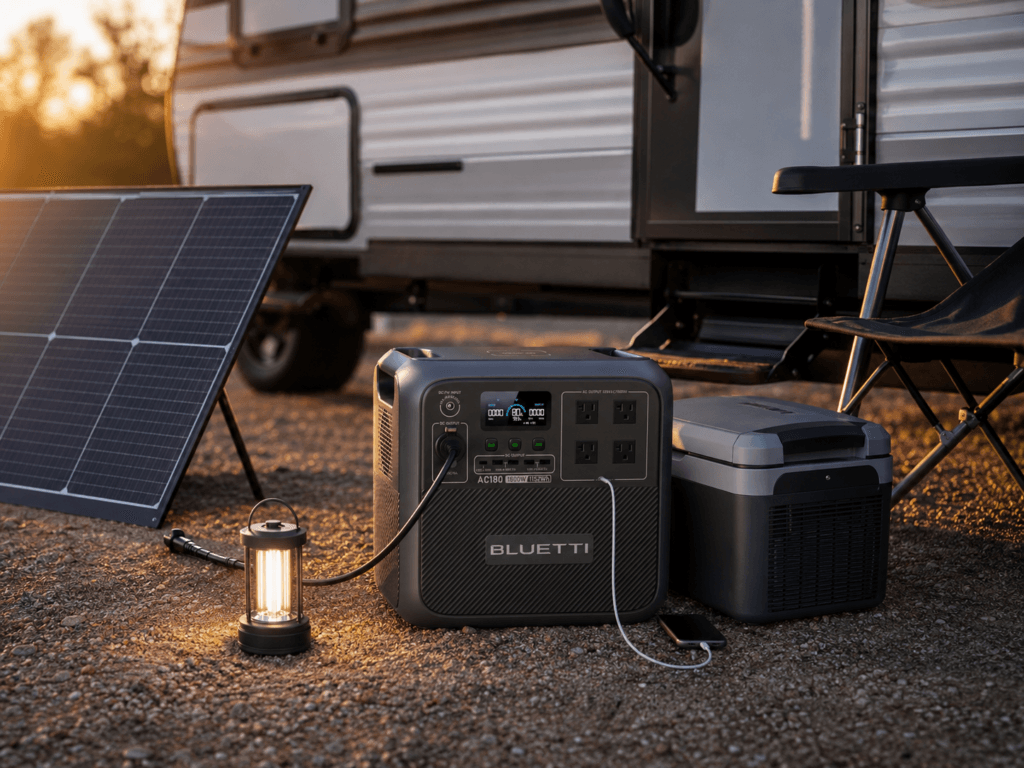
For travel, the BLUETTI AC180 can support lighting, phones, cameras, laptop work, selected cooking tasks, portable refrigeration with tested startup behavior, and other modest equipment. The 500W solar ceiling can be helpful during a multi-day trip when the panels are electrically compatible and weather conditions allow useful recovery.
The better travel plan keeps lower-draw devices running steadily, uses high-watt appliances only when necessary, and recovers energy in daylight. It does not assume that a portable battery makes every RV appliance a normal everyday load. Stable placement, dry conditions, ventilation, and safe cable routing still matter away from home.
Home-office and mobile-work power
A remote-work load profile can be favorable for the BLUETTI AC180 because routers, laptops, phones, task lights, and many monitors use less power than heating or cooking appliances. Use USB-C where practical, keep nonessential peripherals disconnected, and test the full workspace before an outage. The station can be a useful bridge through a short interruption when the plan remains disciplined.
For mobile work, identify each charger’s real draw and total run time rather than choosing from a nameplate alone. Camera gear, battery chargers, communications equipment, lighting, and selected corded tools may fit the output budget. A full jobsite or unrestricted high-draw tool plan is a different category and may need a dedicated generator or a larger purpose-built system.
What to Verify Before Buying
| Verify | Why it matters |
|---|---|
| Priority-load watts and needed hours | They determine whether 1,152Wh is sufficient for your actual plan. |
| Combined AC demand | All four AC outlets share the 1,800W total output rating. |
| Compressor or motor startup behavior | Running watts alone may not show a refrigerator, pump, or tool’s complete demand. |
| Solar-array voltage, current, connectors, and polarity | The solar input is limited to 12 to 60V open circuit, 10A, and 500W maximum. |
| Charging mode and wall circuit | Turbo charging uses up to 1,440W under stated conditions. |
| Power continuity for exact equipment | Do not assume a particular transfer time for sensitive or critical devices. |
| Carrying route and operating location | 35.27 lb requires a stable, dry, ventilated place with realistic handling. |
| Current listing and accessories | Confirm ASIN B0CG3D72QC, seller, bundle, included cables, and current warranty coverage. |
For broader preparation, read Ready.gov’s power-outage guidance. Never backfeed a home electrical panel through a wall outlet, use improvised high-current adapters, or treat a portable power station as a replacement for appropriate transfer equipment or a manufacturer-approved medical-device backup plan.
Related Decision Paths
Read the connected BLUETTI AC180 review for deeper buyer trade-offs and alternatives. This Product page remains the central reference for exact model identity, verified specifications, Product Data, ASIN, and the affiliate-card destination.
Buyers who want a newer 1kWh class with a stated fast-transfer feature and higher solar-input ceiling can compare the EcoFlow DELTA 3 Plus Product reference. Buyers who need a larger capacity class for refrigerator-plus-essentials planning should compare the BLUETTI AC200L Product reference. The best choice depends on the device list, desired duration, recharge path, handling limits, and expansion requirement.
BLUETTI AC180 FAQ
Is the BLUETTI AC180 good for home backup?
The BLUETTI AC180 can be a good fit for a short, measured essential-load plan. It can support communications, lighting, laptops, charging, fans, and selected appliances when the combined demand and expected hours fit the battery. It is not a whole-home replacement.
Can the BLUETTI AC180 run a refrigerator?
The BLUETTI AC180 may support some refrigerators when the appliance is within the output limit, but runtime depends on compressor behavior, startup demand, temperature, cycling, door openings, and other connected loads. Test the exact refrigerator before relying on it during an outage.
How fast does the BLUETTI AC180 recharge?
BLUETTI lists up to 1,440W Turbo charging and approximately 1.3 to 1.8 hours for a full charge under stated conditions. It also lists 0% to 80% in 45 minutes. Actual timing varies with battery state, temperature, input source, and operating conditions.
How much solar input does the BLUETTI AC180 support?
The BLUETTI AC180 supports up to 500W solar input with a stated 12 to 60V open-circuit voltage range and a 10A limit. Actual solar harvest depends on the compatible array, wiring, panel orientation, shade, weather, temperature, and battery state.
Is the BLUETTI AC180 expandable?
No. BLUETTI says the AC180 does not support capacity expansion with B80, B230, or B300 batteries. Those products can charge the AC180 through Power Bank Mode with the required cable, but they do not create a conventional integrated expansion system.
Does the BLUETTI AC180 have a published fast-transfer UPS specification?
The current official product page does not separately publish a specific transfer-time figure. Test exact equipment before relying on power continuity, and follow the device maker’s backup requirements for medical, life-safety, security, or server equipment.
Final Product Decision
The BLUETTI AC180 is a practical 1.15kWh power station for buyers who need 1,800W of output, fast wall charging, 500W solar recovery potential, and a manageable one-unit format. It is strongest for apartment outages, home-office continuity, travel, camping, compatible RV use, and carefully controlled refrigerator-plus-essentials planning.
Skip the BLUETTI AC180 when the real requirement is long appliance runtime, 240V power, whole-home coverage, conventional capacity expansion, or critical-device backup with specified transfer behavior. Start with the loads that must stay on, determine the number of hours that matter, verify the recharge path, and choose the smallest verified system that actually solves the problem.