
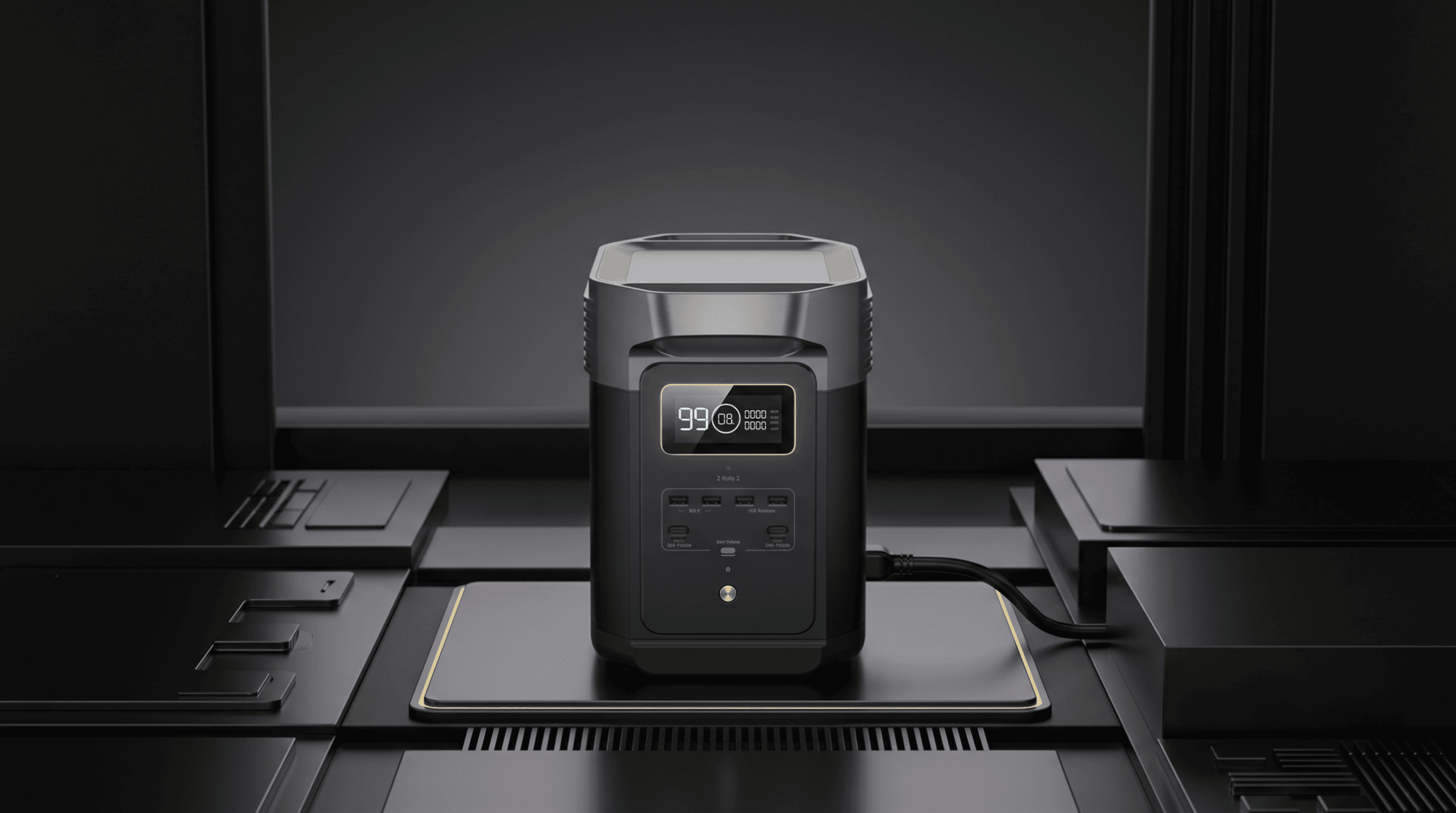
Product Intelligence
Practical 1kWh backupEcoFlow DELTA 2: Practical 1kWh Backup
The EcoFlow DELTA 2 is a 1024Wh portable power station with a LiFePO4 battery, 1800W AC output, 500W max solar input, Wi-Fi and Bluetooth app control, and support for one extra battery to expand capacity. It is a strong fit for home backup, camping, RV use, and emergency power.
Specifications
Key specs
Buyer Fit
Fit signals
Best for
Pros
- 1,024Wh LFP base capacity
- 1,800W total AC output across six outlets
- Up to 500W solar input
- Fast 1,200W X-Stream AC charging
- One compatible extra-battery path to 1–3kWh
- Two 100W USB-C ports
- 5-year warranty
Cons
- 1,024Wh is limited for long appliance-heavy outages
- X-Boost is not a 2,200W continuous-output rating
- EPS is not a specified fast-transfer UPS
- Only one extra battery is supported
- Solar recovery depends on panel setup and conditions
- Not a whole-home or 240V backup platform
Spec table
| Capacity | 1024 Wh |
|---|---|
| AC Output | 1800 W |
| Surge Output | 2700 W |
| Solar Input | 500 W |
| Weight | 26.5 lb |
| Battery | LiFePO4 |
| Warranty | 5 years |
| Expandability | Supports one DELTA 2 Smart Extra Battery or DELTA Max Smart Extra Battery; manufacturer lists 1–3kWh expansion. |
| UPS / EPS | Yes - EPS supported |
| Recharge Time | AC: 1,200W maximum; manufacturer lists 0–80% in 50 minutes and 0–100% in 80 minutes under stated conditions. Solar: up to 500W; manufacturer lists 3–6 hours in stated 400W or 2 × 220W panel configurations. |
This article may contain affiliate links. If you buy through these links, PowerLabPro may earn a commission at no extra cost to you. As an Amazon Associate I earn from qualifying purchases.
EcoFlow DELTA 2 bottom line: this is a 1,024Wh LiFePO4 portable power station for a buyer who needs more than a phone-and-router battery but does not need a heavy 2kWh or 3kWh backup platform. It combines 1,800W total AC output, six AC outlets, up to 500W solar input, fast AC charging, app control, and one compatible extra-battery path. It is useful for apartment outages, home-office continuity, camping, light RV use, and short essential-load plans. It is not a whole-home or 240V backup system.
The EcoFlow DELTA 2 works best when the owner starts with a written load list. A router, phones, laptop, lighting, a fan, selected refrigerator support, or camping gear create a manageable 1kWh plan. A heater, air conditioner, electric cooking appliance, pump, or several high-draw devices can use the stored energy quickly even when the inverter has enough output to start or run the load.
This Product page is a source-backed central reference, not a hands-on test report. The connected Review covers the deeper buyer decision. Before purchase, verify the exact Amazon bundle, compatible extra battery, panel voltage, appliance demand, and any electrical connection method you plan to use.

- Full Charge in 56 Min. With DELTA3’s upgraded technology combining 500W solar input and 1500W max AC input, a full charg…
- Flexible Expansion up to 5kWh. The DELTA 3 Series integrates with EcoFlow’s ecosystem, allowing expansion up to 5kWh wit…
- Durable and Reliable for 10 Years. Powered by LiFePO4 (LFP) cells, with 4000 cycles to 80%, offering 25% more durability…
Table of Contents
EcoFlow DELTA 2: Quick Product Reference
The EcoFlow DELTA 2 sits in the practical middle of the portable-power market. It has enough stored energy for a controlled essentials plan and enough inverter headroom for many common household, travel, and work loads. Its 27 lb weight remains manageable for many owners, but it is still large enough that storage, carrying route, and cable organization should be decided before an outage or trip.
- Best for: apartment outages, home-office continuity, RV weekends, camping, remote work, and short essential-load backup with a realistic recharge path.
- Not ideal for: multi-day appliance-heavy outages, whole-home circuits, 240V equipment, high-draw heating or cooling, and buyers who need more than one extra battery.
- Main advantage: 1,024Wh of LFP capacity, 1,800W total AC output, six AC outlets, 500W solar input, and fast 1,200W AC charging in a 27 lb platform.
- Main limitation: capacity, not output, is usually the limiting factor when high-watt appliances run for more than a short period.
A buyer should treat the EcoFlow DELTA 2 as a planned reserve. It can provide useful capability for selected devices, but the right setup depends on which devices must remain on, how many watts they draw together, and how long the owner needs to operate before AC, solar, or car charging is available.
EcoFlow DELTA 2 Specifications and Buyer Meaning
| Specification | Officially listed information | Buyer meaning |
|---|---|---|
| Battery capacity | 1,024Wh | A practical short-outage and travel reserve, not a fixed runtime promise. |
| Battery chemistry | LFP / LiFePO4; 3,000 cycles to 80%+ listed | Suitable for repeated use, while real aging still varies with temperature and storage. |
| Total AC output | 1,800W across six outlets | Use this continuous rating for combined-load planning. |
| AC surge | 2,700W listed | Short startup margin; it does not add continuous output or stored energy. |
| X-Boost | 2,200W maximum device power | Load-management capability for selected appliances, not a 2,200W continuous inverter rating. |
| Solar input | 11–60V, 15A, 500W maximum | Useful recovery ceiling with compatible panels and real sun conditions. |
| AC charging | 1,200W X-Stream maximum | EcoFlow lists 0–80% in 50 minutes and 0–100% in 80 minutes under stated conditions. |
| Car charging | 12V/24V, 8A maximum | A travel recovery path, but substantially slower than wall charging. |
| Expansion | One compatible extra battery; manufacturer markets 1–3kWh | Useful for a measured runtime increase, but not a large modular system. |
| Connectivity | Wi-Fi and Bluetooth | Supports EcoFlow app monitoring and settings control. |
| USB-C output | Two ports, up to 100W each | Can reduce use of AC adapters for compatible laptops and accessories. |
| Other DC output | Two 12W USB-A, two 18W USB-A, 12.6V/10A car socket, two DC5521 ports | Useful for a managed mix of devices without occupying every AC outlet. |
| Weight and dimensions | 27 lb; 15.7 × 8.3 × 11 in | Portable for many people, but carrying and placement still need planning. |
| Warranty | 5 years listed | Confirm current eligibility and seller conditions before purchase. |
| Amazon ASIN | B0B9XB57XM | Confirm the live listing, bundle, seller, and included accessories before buying. |
Source note: The official EcoFlow DELTA 2 product page is the controlling source for the battery, output, charging, solar, ports, dimensions, and expansion boundaries. The Amazon listing is used only to verify the current U.S. model identity and ASIN.
The EcoFlow DELTA 2 should be selected because it solves a defined 1kWh problem, not because it has a high output number on a product page. Capacity describes the energy reserve. Output describes what may run at one time. Solar and AC input describe potential recovery. Expansion changes future duration, cost, and storage. These numbers work together but should not be treated as interchangeable.
Who the EcoFlow DELTA 2 Fits
The EcoFlow DELTA 2 fits a buyer who wants one portable unit for several modest roles. It can sit in an apartment for outage readiness, move into a vehicle for camping, support a small RV electronics plan, or protect home-office basics during a short interruption. Its strongest use is controlled versatility rather than maximum duration.
- Apartment and condo buyers: quiet battery power for a router, phone, laptop, LED lighting, fan, and selected limited appliances without storing a larger rolling platform.
- Home-office users: a manageable reserve for internet, laptop work, monitors, charging, and work lights when the loads are checked in advance.
- Camping and light RV users: practical AC, USB-C, 12V, and solar options for a controlled device and accessory plan.
- First-time backup buyers: owners who need more than a small electronics battery but have not yet demonstrated a need for a larger 2kWh-plus platform.
- Expansion-aware owners: users who may need one compatible extra battery after testing actual runtime, rather than buying more capacity immediately.
For these buyers, the EcoFlow DELTA 2 is often easier to live with than a larger station. It can be moved, stored, and recharged more easily, while the 1,800W output gives more compatibility than a small 300W or 600W device-first power station. The trade-off is that high-output compatibility does not produce long high-watt runtime.
Use the PowerLabPro power-station sizing guide before selecting any battery size. Start with the must-run device list, include running and starting demand where relevant, then decide how many hours of reserve are actually required.
Who Should Skip the EcoFlow DELTA 2
The EcoFlow DELTA 2 is a poor fit when the plan is already clearly larger than a 1kWh reserve. A higher-output inverter can run some large devices briefly, but it cannot turn 1,024Wh into a long-duration energy supply. Buyers who need a refrigerator-first strategy for many hours, a pump, a 240V circuit, or several appliances at once should evaluate a larger battery class first.
- Whole-home expectation buyers: a portable 1kWh station is not a substitute for a designed home-energy system, code-compliant transfer equipment, or professional installation.
- High-draw heating and cooling buyers: space heaters, portable air conditioners, cooking appliances, and similar loads consume stored energy quickly.
- Long refrigerator-runtime buyers: a refrigerator can be a workable priority load, but the actual compressor behavior and required duration may point to a larger capacity class.
- 240V buyers: the EcoFlow DELTA 2 is a 120V portable station, not a 240V platform.
- Multi-battery growth buyers: one compatible extra battery may not be enough when a planned system needs substantial future expansion.
- Critical-device buyers: medical, life-safety, server, and other sensitive equipment should follow the device maker’s dedicated backup requirements.
Capacity, Output, and Runtime Reality
The EcoFlow DELTA 2 has two separate strengths: a 1,024Wh battery reserve and a 1,800W total AC-output rating. The battery tells you how much energy can be stored. The inverter tells you whether a device or combination of devices may operate at the same time. A power station can be strong in one category and limited in the other, so both numbers must be evaluated together.
A 1,800W inverter can make many everyday loads compatible, but it does not make high-watt loads efficient. A short microwave use, a kettle, a space heater, an induction appliance, a coffee maker, or a compressor-driven device can use a large part of the available energy. The most durable backup plan protects communications, lighting, food planning, and essential work first, then treats comfort loads as discretionary.
EcoFlow lists a 2,700W surge capability and 2,200W X-Boost maximum device power. Neither number should replace the 1,800W continuous-output rating in a load calculation. Surge supports brief startup events. X-Boost is load management for selected compatible appliances. It is not a normal 2,200W inverter rating and it does not create additional battery capacity.
The EcoFlow DELTA 2 can support selected refrigerator use when the specific appliance fits the output limit and the owner has realistic runtime expectations. Compressor cycling, startup behavior, room temperature, door openings, and the other connected devices all change the result. Test the exact refrigerator before depending on it during an outage and use a larger battery if food protection is the primary reason for buying.
A clear priority order is more useful than a generic runtime promise: communications and lighting first, work or essential device support second, and high-draw convenience devices last. The lower the average load, the longer a 1kWh reserve remains useful. Direct USB-C charging can also preserve AC-outlet capacity for devices that cannot charge from USB-C.
AC Charging, Solar Recovery, and Car Charging
Fast AC recovery is one of the EcoFlow DELTA 2 advantages. EcoFlow lists 1,200W X-Stream charging and a 0–80% charge in 50 minutes or a 0–100% charge in 80 minutes under stated conditions. Actual results can vary with the wall source, temperature, battery state, and the charging mode in use. It is still a practical readiness feature for an owner who charges before a forecast outage, travel day, or camping trip.
The solar input is listed at up to 500W, with a published range of 11–60V and 15A. That can support useful daytime recovery during a longer outage, but the 500W figure is a ceiling rather than a guaranteed harvest. Panel compatibility, angle, shade, weather, wiring, cable losses, temperature, and the battery’s current state determine actual solar performance.
EcoFlow lists solar charging examples around 3–6 hours for a 400W or two 220W-panel setup under stated conditions. Treat that as planning context, not a daily promise. A smaller panel array, cloud cover, partial shade, winter sun, or poor orientation can lengthen the result significantly. The best solar plan matches panel open-circuit voltage and current to the published input boundary before the panels are connected.
The EcoFlow DELTA 2 also accepts 12V or 24V vehicle charging at up to 8A. That can be useful while traveling, but it is much slower than the 1,200W wall-charging path. Use car charging as a supplementary recovery option and avoid assuming that a typical drive will replace a day of high-watt appliance use.
For every charging route, keep cables dry and undamaged, allow ventilation, and follow the current manual. Solar modules, vehicle adapters, and AC cables are part of the total system. A fast-charge claim only helps when the actual setup safely supports it.
Expansion, EPS, App Control, and Port Planning
The EcoFlow DELTA 2 can use one compatible DELTA 2 Smart Extra Battery or DELTA Max Smart Extra Battery. EcoFlow markets a 1–3kWh capacity range depending on the battery chosen. This path can make sense when a controlled test shows that the 1,024Wh base battery is close but does not meet the desired runtime.
Expansion is not automatically the best value. An extra battery adds cost, storage space, weight, charging considerations, and another piece of equipment to keep ready. Buyers who already know they need much more than 3kWh, higher output, or 240V should compare larger base platforms before committing to a 1kWh model plus accessories.
EcoFlow describes the DELTA 2 as an EPS emergency-power supply with automatic switching. It should not be described as a published fast-transfer UPS because the current official product page does not provide a specific quick-transfer figure. Test the exact router, laptop, monitor, or other equipment before relying on continuity behavior, and do not substitute a portable station for certified medical, life-safety, or dedicated high-performance UPS equipment.
Wi-Fi and Bluetooth connect the EcoFlow DELTA 2 to the EcoFlow app for monitoring and settings. The physical port set includes six AC outlets, two 100W USB-C ports, four USB-A ports, a 12.6V car socket, and two DC5521 outputs. Port quantity is helpful, but all AC devices still share the one 1,800W total budget. The best arrangement keeps high-priority loads on their most efficient appropriate port.
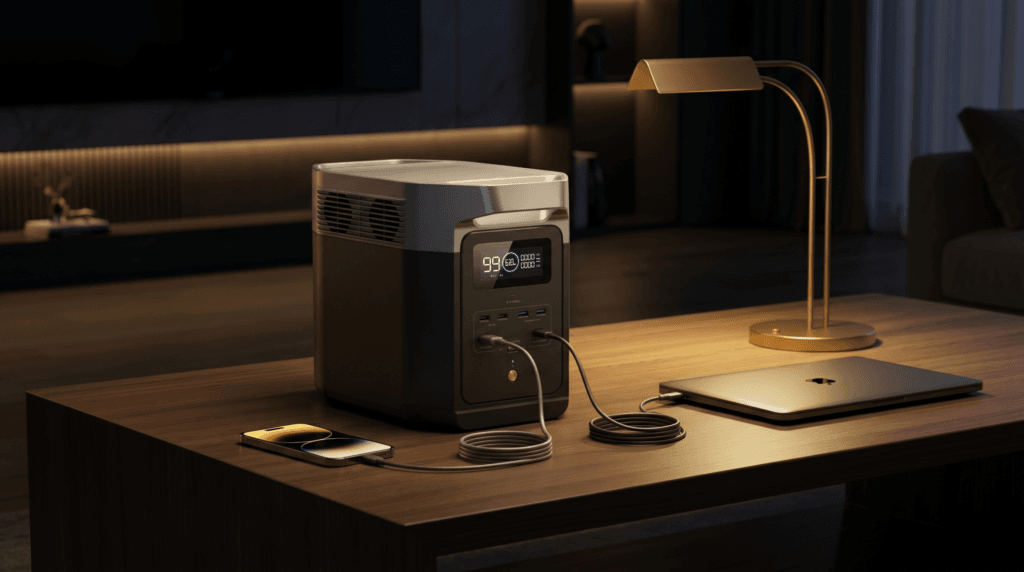
At 27 lb, placement still matters. Keep the station upright on a stable dry surface with ventilation around it and clear cable routing. Plan where it will sit before an outage starts, especially in an apartment, RV, garage, or camping setup. A portable station is most useful when the load list, charging accessories, and needed cables are stored together.
What to Verify Before Buying the EcoFlow DELTA 2
| Verify | Why it matters |
|---|---|
| Priority-load running watts and required hours | They determine whether 1,024Wh is sufficient or whether a larger capacity class is needed. |
| Starting demand for refrigerators, pumps, compressors, or other motor loads | Running watts may not show startup behavior. |
| Combined AC load | All six AC outlets share the 1,800W total rating. |
| Solar panel voltage, current, and connector plan | The solar input is limited to 11–60V, 15A, and 500W maximum. |
| Extra-battery compatibility | Only one DELTA 2 Smart Extra Battery or DELTA Max Smart Extra Battery is supported. |
| EPS behavior for the exact connected device | Auto-switching should be tested; it is not a published fast-transfer UPS specification. |
| Home-circuit connection method | Any panel, inlet, or transfer equipment must follow a code-compliant design and qualified installation path. |
| Placement and carrying route | 27 lb is manageable for many users but still requires a stable, dry, ventilated location. |
| Current Amazon listing | Confirm ASIN B0B9XB57XM, the included accessories, seller, and product identity before purchase. |
For general planning, read Ready.gov’s power-outage guidance. Never backfeed a home electrical panel through a wall outlet, use damaged or improvised high-current adapters, or treat a portable station as a substitute for code-compliant transfer equipment or a manufacturer-approved medical-device backup plan.
Related Decision Paths
Read the connected EcoFlow DELTA 2 review for deeper buyer trade-offs and alternatives. This Product page remains the central record for model identity, structured specifications, ASIN, Product Data, and the affiliate-card destination.
Buyers who want a newer 1kWh EcoFlow with faster listed solar input and a stated under-10ms UPS feature should compare the EcoFlow DELTA 3 Plus Product reference. Buyers who need a larger runtime reserve should use the sizing guide before stepping into a 2kWh-plus system. The right choice depends on the actual load list, desired duration, charging path, and carrying constraints.
EcoFlow DELTA 2 FAQ
Is the EcoFlow DELTA 2 good for home backup?
The EcoFlow DELTA 2 can be a strong fit for a short-outage essential-load plan that prioritizes communications, lighting, laptops, phones, fans, and selected appliances. It is not a whole-home replacement. Larger loads and longer duration require a bigger capacity plan and, where appropriate, a proper connection method.
Can the EcoFlow DELTA 2 run a refrigerator?
It can support many refrigerators when the appliance fits the 1,800W output limit, but runtime depends on the refrigerator’s actual draw, compressor cycling, startup behavior, temperature, door openings, and other connected loads. Test the exact appliance and choose more capacity if refrigerator duration is the primary goal.
How much solar input does the EcoFlow DELTA 2 support?
The EcoFlow DELTA 2 supports up to 500W solar input, with an 11–60V and 15A published input range. Actual solar harvest depends on compatible panels, wiring, angle, temperature, shade, and weather.
Is the EcoFlow DELTA 2 expandable?
Yes. It supports one compatible DELTA 2 Smart Extra Battery or DELTA Max Smart Extra Battery. EcoFlow markets a 1–3kWh capacity range depending on the extra battery selected. Confirm the current compatibility details before purchase.
Does the EcoFlow DELTA 2 have UPS backup?
EcoFlow describes EPS emergency-power-supply auto-switching. The official Product page does not publish a specific fast-transfer time, so it should not be treated as a defined UPS solution for sensitive, medical, server, or life-safety equipment. Test the exact device first.
How heavy is the EcoFlow DELTA 2?
EcoFlow lists the unit at 27 lb. It is portable for many buyers, but it still needs a stable carrying route, safe storage location, and a dry ventilated operating surface.
Final Product Decision
The EcoFlow DELTA 2 is a practical 1kWh backup choice for a buyer who needs a portable LFP battery with 1,800W output, useful AC and USB-C ports, up to 500W solar input, fast wall charging, and one sensible expansion path. It is strongest for apartment outages, mobile work, camping, light RV use, and short essential-load planning with an available recovery route.
Skip the EcoFlow DELTA 2 when the real requirement is long appliance runtime, 240V output, whole-home coverage, multiple expansion batteries, or a portable station that acts like a specified fast-transfer UPS. Begin with the device list, the intended runtime, the available recharge route, and safe placement. Then choose the smallest verified system that actually meets the need.