
Product Intelligence
Expandable 2kWh backupJackery Explorer 2000 Plus: Expandable 2kWh Backup
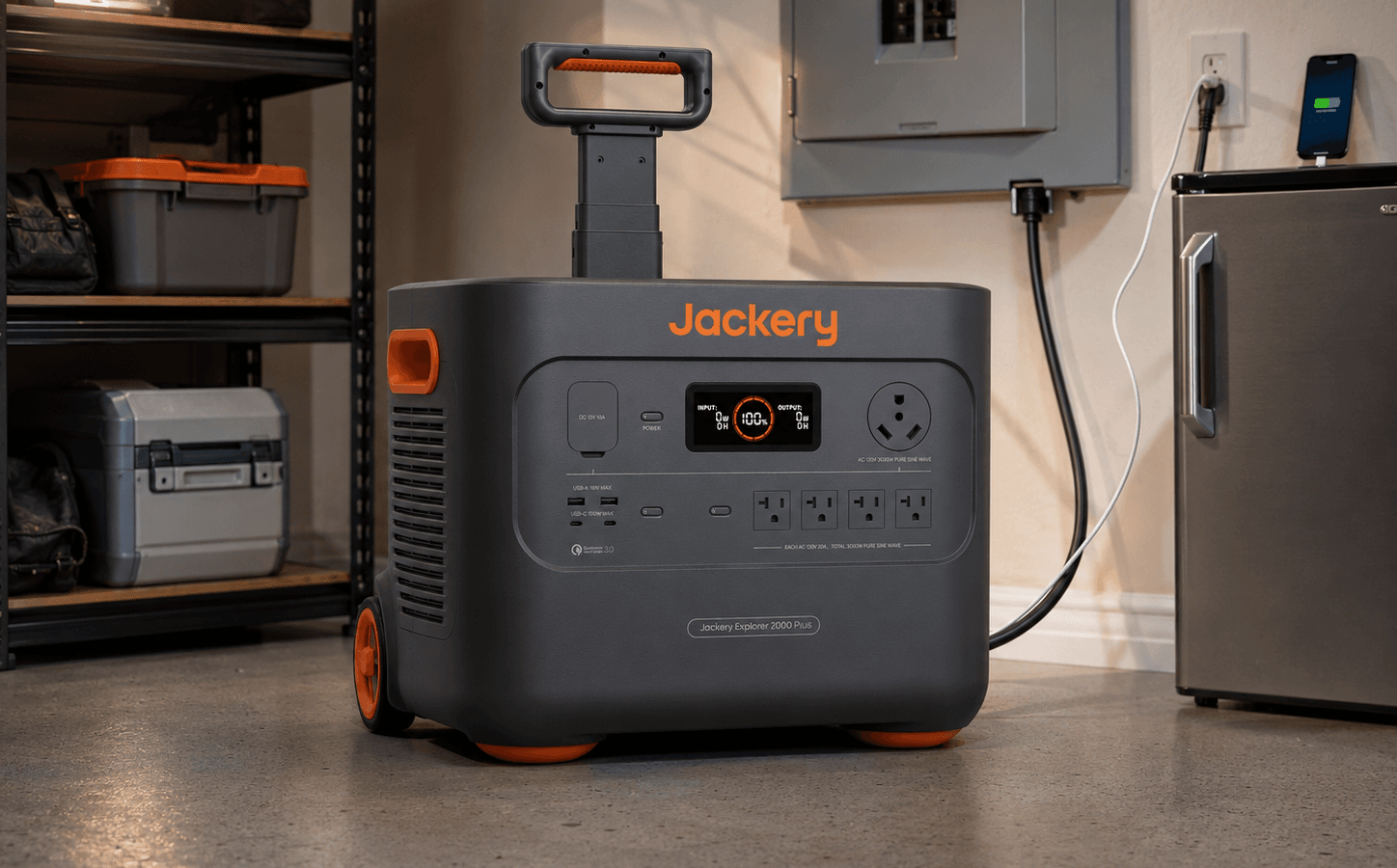
The Jackery Explorer 2000 Plus is a 2042.8Wh LiFePO4 portable power station with 3000W AC output, 6000W surge power, 1400W max solar input, EPS support, and expandable capacity from 2kWh up to 24kWh for home backup, RV power, and off-grid use.
Specifications
Key specs
Buyer Fit
Fit signals
Best for
Pros
- 2,042.8Wh LiFePO4 base capacity
- 3,000W AC output with 6,000W surge
- Five 120V AC outlets
- 2–24kWh expandable system range
- Up to 1,400W DC input
- Two 100W USB-C ports
- 20ms EPS listed
- 3+2-year warranty at jackery.com
Cons
- 61.5 lb chassis requires planned handling
- 120/240V and 6,000W require documented parallel operation
- Expansion adds cost, cables, and storage needs
- Solar time depends on a large compatible array and real conditions
- 20ms EPS is not a universal critical-device guarantee
- App connection details are not separately clarified on the current official page
Spec table
| Capacity | 2042.8 Wh |
|---|---|
| AC Output | 3000 W |
| Surge Output | 6000 W |
| Solar Input | 1400 W |
| Weight | 61.5 lb |
| Battery | LiFePO4 |
| Warranty | 3-year warranty plus 2 extra years free for purchases at jackery.com, subject to current program terms. |
| Expandability | 2–24kWh system range. Jackery lists 6,000W and 120/240V only in documented parallel operation using a double 2000 Plus kit. |
| UPS / EPS | 20ms EPS listed by Jackery. Test exact connected equipment before relying on it. |
| Recharge Time | AC adapter: full charge in 2 hours under Jackery-stated conditions. Solar: Jackery lists 2 hours with six SolarSaga 200W panels under stated conditions; actual recovery depends on conditions, input limits, and battery state. |
This article may contain affiliate links. If you buy through these links, PowerLabPro may earn a commission at no extra cost to you. As an Amazon Associate I earn from qualifying purchases.
Jackery Explorer 2000 Plus bottom line: this is a 2,042.8Wh LiFePO4 power station for buyers who need more than a compact outage battery but still want a modular portable system. Jackery lists 3,000W AC output, 6,000W surge, five 120V AC outlets, two 100W USB-C ports, 20ms EPS, 61.5 lb weight, and an expansion path from 2kWh to 24kWh. A single Jackery Explorer 2000 Plus is a 120V unit. Its 120/240V, 6,000W configuration is a separate documented parallel system, not a base-unit feature.
The Jackery Explorer 2000 Plus is strongest for a planned refrigerator-plus-essentials, RV, off-grid, or larger mobile-work setup when the buyer can name the loads, the required hours, and the recharge plan. It is not a whole-home promise, a casual carry battery, or a universal backup solution for medical or life-safety equipment.
This Product page is a source-backed central reference, not a hands-on test. The connected Review covers deeper buyer trade-offs. Before purchase, confirm the current standalone listing, exact bundle, accessories, and current Jackery documentation.

- Magnificent Performance: Featuring up to 2,042.8 Wh gigantic capacity, the Jackery 2000 Plus Power Station can power a r…
- Ultra Fast Charging: Charge directly from the sun or via wall outlet, conveniently, quickly and additionally worry free….
- 2kWh – 24kWh Flexible Expansion: The Jackery Explorer 2000 Plus supports up to 5 expandable battery packs, featuring pow…
Table of Contents
Jackery Explorer 2000 Plus: Quick Product Reference
The Jackery Explorer 2000 Plus sits in the modular 2kWh category. Its 2,042.8Wh base battery can be meaningful for a measured essential-load plan. The 3,000W inverter creates more headroom than a small electronics station, but capacity still determines how long the plan can last. A high-watt appliance can be compatible with the output rating yet still use a large portion of the stored energy quickly.
- Best for: planned refrigerator-plus-essentials coverage, RV trips with a compatible 120V connection, solar-supported recovery, and buyers who may need added capacity later.
- Not ideal for: small-device backup, frequent lifting, unverified 240V loads, high-draw comfort appliances, or an automatic whole-home expectation.
- Main advantage: high base output plus a 2–24kWh expansion path.
- Main limitation: the 61.5 lb base unit needs planned placement, and 240V requires a separate parallel configuration.
The Jackery Explorer 2000 Plus is most convincing when it has a defined role. It may be stored near a selected-load outage kit, used for an RV electrical plan that has been checked in advance, or paired with compatible solar panels for recovery after a battery test. It becomes less convincing when a buyer expects every appliance to work normally for an unlimited period.
Jackery Explorer 2000 Plus Specifications and Buyer Meaning
| Specification | Current source-backed information | Buyer meaning |
|---|---|---|
| Battery capacity | 2,042.8Wh | Stored energy for a defined priority-load plan, not a universal runtime claim. |
| Battery chemistry | LiFePO4; 4,000 cycles to 70% or more capacity listed | Designed for repeated use when stored and operated within current guidance. |
| AC output | 3,000W maximum; 6,000W surge listed | Sets the shared output budget; surge is not continuous power. |
| AC outlets | Five 120V outlets: four 20A plus one 25A | Multiple plugs share the same system output limit. |
| USB and 12V output | Two 100W USB-C, two 18W USB-A, and 12V/10A car outlet | Useful for low-draw electronics without occupying AC outlets. |
| AC charging | 120V/60Hz, 15A maximum; full charge in 2 hours listed | Jackery-stated result that varies with conditions and battery state. |
| DC and solar input | Up to 1,400W DC input under published voltage and paired-input limits | Array design must respect the current manual and electrical boundaries. |
| Solar-charge claim | 2 hours with six SolarSaga 200W panels under stated conditions | Planning context, not a universal solar-runtime promise. |
| EPS | 20ms listed | Test the exact connected equipment before relying on continuity. |
| Expansion | 2–24kWh system range | More runtime is available, with added cost, cables, storage, and setup. |
| 120/240V configuration | 6,000W and 120/240V in documented parallel operation | A separate system configuration, not a single-unit feature. |
| Weight and dimensions | 61.5 lb; 18.6 × 14.1 × 14.7 in | Use a stable storage location and practical moving route. |
| Amazon ASIN | B0C6DHK68Q | Confirm the live seller, bundle, and included accessories before checkout. |
Source note: The official Jackery Explorer 2000 Plus product page is the controlling source for the model identity, electrical limits, capacity, expansion, ports, dimensions, weight, recharge claims, and warranty context. The current Product record retains the established Amazon ASIN and tagged affiliate destination.
Who the Jackery Explorer 2000 Plus Fits
The Jackery Explorer 2000 Plus fits a buyer who has progressed beyond phone, router, laptop, and small-light backup. It can work for a household with selected priority loads, an RV user with a compatible 120V plan, or a preparedness buyer who wants a 2kWh reserve now and an option to add capacity after testing real demand.
- Home-essential planners: households prioritizing refrigeration, communications, lighting, laptop work, phones, fans, and selected short-use appliances.
- RV users: buyers who have verified their 120V connection, cable condition, grounding approach, appliance demand, and safe station placement.
- Solar-recovery buyers: users who can build a compatible panel plan rather than relying on a headline solar-charge number.
- Staged-expansion buyers: people who prefer to measure a real runtime gap before adding compatible battery capacity.
- Mobile-work users: buyers who need a controlled plan for laptops, cameras, chargers, communications, lighting, and selected corded equipment.
The Jackery Explorer 2000 Plus is not automatically better than a smaller station. It earns its space and cost when the owner will use its larger battery, stronger inverter, solar-recovery potential, or expansion path. For a router, phones, one laptop, LED lights, and a small fan, a lighter product may be easier to store and may deliver better value.
Use the PowerLabPro power-station sizing guide before choosing a capacity class. It separates running watts, startup demand, stored watt-hours, and recovery planning. That process is more reliable than choosing a system based only on a large battery number.
Who Should Skip the Jackery Explorer 2000 Plus
The Jackery Explorer 2000 Plus is a poor fit for buyers whose plan is only phones, a router, one laptop, and a few LED lights. A smaller station can be cheaper, easier to carry, and simpler to keep ready. It is also a poor fit when frequent stair carrying or repeated vehicle loading is required. The 61.5 lb chassis calls for a stable storage location and realistic handling path.
- Light-backup buyers: compact electronics and communication loads normally do not need this size class.
- Single-unit 240V buyers: the 120/240V and 6,000W configuration needs documented parallel operation.
- Whole-home expectation buyers: a portable station does not replace code-compliant transfer equipment or a professionally designed electrical system.
- Unverified motor-load buyers: refrigerators, pumps, compressors, RV appliances, and air conditioners need individual startup and connection checks.
- Critical-equipment buyers: medical, life-safety, server, and security equipment should follow the device maker’s dedicated backup requirements.
Output, Capacity, and Runtime Reality
The Jackery Explorer 2000 Plus has enough output to make a broader group of devices compatible. Its five AC outlets still share one 3,000W maximum system limit. They do not each supply 3,000W. The 6,000W surge figure helps with short startup demand and does not create a 6,000W continuous budget or more stored energy.
A refrigerator can be a reasonable priority load if the exact appliance is within the published output limits and has been tested. It should not be presented with a universal hour claim. Compressor startup, cycling, indoor temperature, door openings, battery reserve settings, and other connected loads all change the outcome.
Heating, cooking, and cooling devices can use stored power quickly. A heater, kettle, microwave, toaster oven, induction plate, portable air conditioner, or large tool can consume a major portion of the battery even where its demand is compatible. A better plan protects food, communications, lighting, work, and charging first, then treats high-watt tasks as short, intentional use.
The Jackery Explorer 2000 Plus becomes more useful when it is paired with a written priority list. List each device, its running watts, possible startup demand, and the number of hours that really matter. Decide which devices cannot run together. A managed plan normally delivers more useful outage time than connecting every available appliance.
Solar Recovery, AC Charging, and EPS Context
Fast recovery matters to the Jackery Explorer 2000 Plus buyer because a 2kWh base battery is still finite during a long outage. Jackery lists a two-hour full charge from the AC adapter under stated conditions. Actual timing depends on the wall circuit, battery state, temperature, and operating environment. Do not assume the same result from every outlet or setup.
For solar, Jackery lists a two-hour charge using six SolarSaga 200W panels under stated conditions. The published specifications also list up to 1,400W DC input. Build any array from the documented voltage and current limits, not from panel nameplate watts alone. A solar plan needs compatible connectors, correct polarity, safe cable routing, and an array that stays within the published boundaries.
The 20ms EPS figure can help with tested routers, modems, laptops, monitors, and selected office equipment. It does not replace a dedicated critical-power design. Test each priority device, including its adapter and power strip, before an outage. The safe result is a controlled test, not an assumption based on a transfer-time figure.
For storage, keep the Jackery Explorer 2000 Plus dry, stable, accessible, and charged according to current manufacturer instructions. A basic readiness routine includes checking state of charge, inspecting cables, confirming the planned solar or AC recovery path, and making sure each priority device still works with the intended connection method.
Expansion, Parallel Operation, and 240V Limits
The Jackery Explorer 2000 Plus has a 2–24kWh expansion range. More battery capacity can give a buyer more time, but it does not remove the need to manage load. Extra batteries need to be priced, stored, charged, and connected according to current manufacturer guidance. Start with a verified base load plan, then add capacity when observed runtime is insufficient.
A single Jackery Explorer 2000 Plus provides 120V use. Jackery’s 6,000W and 120/240V capability belongs to a documented parallel configuration using a double 2000 Plus kit. Treat this as a system-level purchase, not as a small accessory. It changes cost, floor space, cabling, charging choices, and the planned loads being served.
The 240V boundary is especially important for pumps, workshop equipment, certain RV systems, and home circuits. Do not connect portable power to a home electrical panel through a wall outlet. A selected-circuit plan requires the correct inlet, transfer equipment, cable, grounding arrangement, and qualified electrical help where appropriate.
Expansion makes sense when the buyer wants more duration for the same controlled loads. It is less compelling when the real requirement is large appliances operating without limits. In that situation, compare the full system cost and installation requirements with other larger platforms rather than assuming modular growth is automatically the most economical route.
Ports, Weight, and Practical Placement
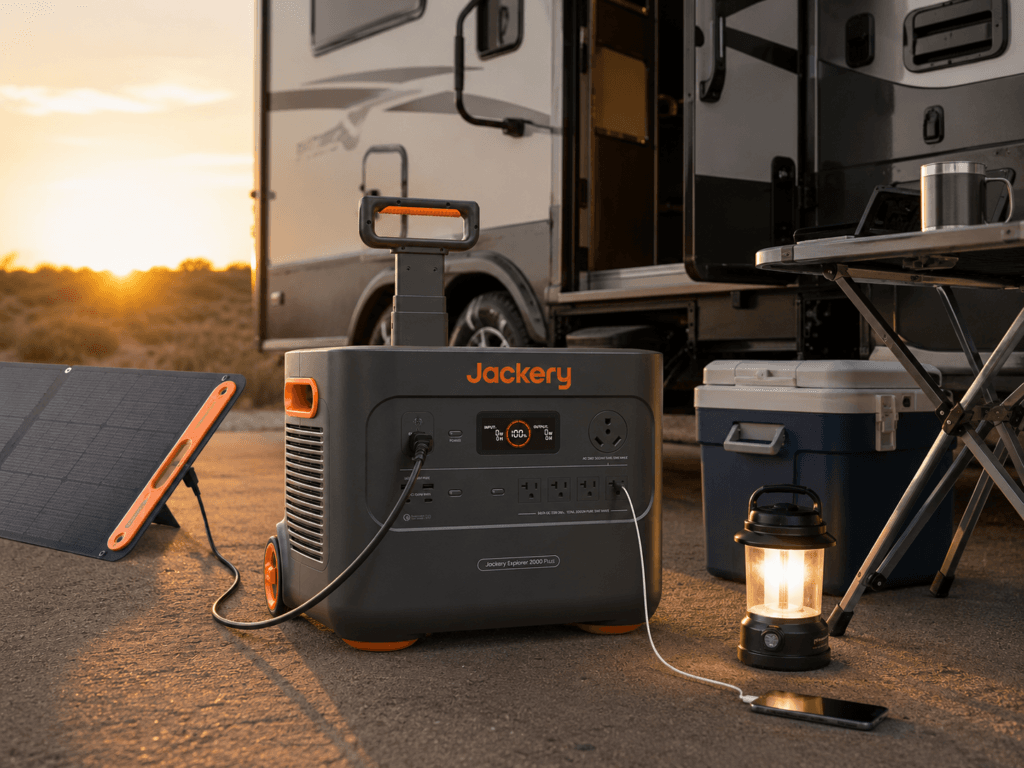
The Jackery Explorer 2000 Plus provides five AC outlets, two 100W USB-C ports, two 18W USB-A ports, and a 12V/10A car outlet. Direct USB-C can keep compatible laptops, cameras, tablets, and phone chargers off the AC outlets. This leaves more inverter capacity available for devices that truly need AC power.
At 61.5 lb and 18.6 × 14.1 × 14.7 in, the station should be kept in a dry, stable, ventilated location with a clear cable route. Plan the route from storage to use before an outage. A product that has to be lifted awkwardly or moved through stairs at the last moment is less useful than one that is placed deliberately and tested early.
Keep the power station away from moisture, blocking exits, and damaged extension cords. Use only compatible cables and accessories. A larger portable battery deserves the same discipline as any other high-capacity electrical device: stable placement, ventilation, cable inspection, and a plan for the devices that will be connected.
Practical Use Cases
Selected home essentials during an outage
For a home outage, the Jackery Explorer 2000 Plus is most useful as a selected-load reserve. A router, modem, phones, lighting, laptop work, and a tested refrigerator can form a reasonable priority plan. Start by connecting the low-draw essentials, then decide whether the remaining battery can support short use of a higher-watt device. This preserves more energy for food, communication, and work.
RV and road-trip power
For RV use, the Jackery Explorer 2000 Plus can support a controlled 120V appliance plan when the rig’s connection, cable, outlets, grounding, and total load have been confirmed. Solar recovery can be useful during longer travel, but the panel array must stay within the product’s published input conditions. Do not treat a portable station as proof that every RV appliance can run together.
Mobile work and controlled field equipment
The Jackery Explorer 2000 Plus can suit controlled mobile-work use for laptops, camera batteries, charging equipment, communications, lights, and selected corded devices. The key is to measure actual demand and avoid using a large battery as an excuse for an unplanned jobsite load. A full commercial tool or compressor plan may require a different platform and a specific safety assessment.
What to Verify Before Buying
| Verify | Why it matters |
|---|---|
| Priority-load watts and required hours | They determine whether 2,042.8Wh is sufficient before extra batteries are considered. |
| Combined AC demand | All five AC outlets share the 3,000W system limit. |
| Motor and compressor startup behavior | Running watts can differ from startup demand for refrigerators, pumps, and tools. |
| 120V versus 120/240V need | One base unit is 120V; the parallel system changes cost and setup requirements. |
| Solar array voltage, current, and connectors | Published DC input limits are a hard boundary for safe array design. |
| EPS behavior for exact equipment | 20ms EPS needs an equipment-specific test, especially for sensitive loads. |
| Weight, storage, and carrying route | 61.5 lb requires realistic placement and handling. |
| Current listing and bundle | Confirm ASIN B0C6DHK68Q, seller, accessories, and warranty eligibility before checkout. |
For broader preparation, read Ready.gov’s power-outage guidance. Never backfeed a home electrical panel through a wall outlet, use improvised high-current adapters, or treat a portable power station as a substitute for a code-compliant transfer system or approved medical-device backup plan.
Related Decision Paths
Read the connected Jackery Explorer 2000 Plus review for the deeper buyer analysis and alternatives. This Product page remains the central reference for verified model identity, structured specifications, Product Data, and the affiliate destination.
Buyers who need a larger base reserve should compare the Jackery Explorer 5000 Plus Product reference. Buyers who need a 2kWh class with different charging and expansion trade-offs can examine the EcoFlow DELTA 2 Max Product reference. The right choice depends on the actual load list, desired hours, recovery path, handling limits, and whether a 240V parallel system is truly needed.
Jackery Explorer 2000 Plus FAQ
Is the Jackery Explorer 2000 Plus good for home backup?
The Jackery Explorer 2000 Plus can be useful for a measured essential-load plan. It is not an automatic whole-home solution. Match its battery, inverter, outlet type, and charging path to actual devices and the time they must operate.
Can the Jackery Explorer 2000 Plus run a refrigerator?
The Jackery Explorer 2000 Plus may support a compatible refrigerator when the appliance is tested and stays within the system limits. Runtime varies with startup behavior, cycling, temperature, door openings, and other loads.
How fast does the Jackery Explorer 2000 Plus recharge?
Jackery lists a two-hour full AC charge under stated conditions and a two-hour solar charge with six SolarSaga 200W panels under stated conditions. Actual time depends on input source, battery state, array design, weather, and the operating environment.
Is the Jackery Explorer 2000 Plus expandable?
Yes. Jackery lists a 2–24kWh system range. Extra capacity can extend runtime, but it also adds cost, cables, storage needs, and setup complexity.
Does one Jackery Explorer 2000 Plus provide 240V?
No. A single Jackery Explorer 2000 Plus is a 120V unit. Jackery’s 120/240V and 6,000W capability requires the documented parallel configuration using a double 2000 Plus kit.
What Amazon ASIN should buyers verify?
The existing Product and connected Review use ASIN B0C6DHK68Q. Confirm the current standalone listing, seller, included accessories, and the exact bundle before purchase.
Final Product Decision
The Jackery Explorer 2000 Plus is a practical choice for a buyer who needs a 2,042.8Wh base reserve, 3,000W output, five 120V outlets, stronger device support, and a long-term path to added capacity. It is strongest for a carefully planned refrigerator-plus-essentials, RV, solar-recovery, or larger home-office and mobile-work setup.
Skip the Jackery Explorer 2000 Plus when the real need is electronics-only backup, easy frequent carrying, native single-unit 240V, or an unplanned whole-home promise. Start with the essential-load list, the time requirement, and the recovery path. Then choose the smallest verified system that solves the actual buyer problem.