
Review
DJI Power 1000 Review: High-Output 1kWh Power for Mobile Work
A standout compact choice for DJI-centered creator and mobile-work setups that benefit from 2200W continuous output, dual 140W USB-C, and SDC accessories. It is not the best fit where long runtime, conventional modular expansion, 240V, or broad home backup is the priority.
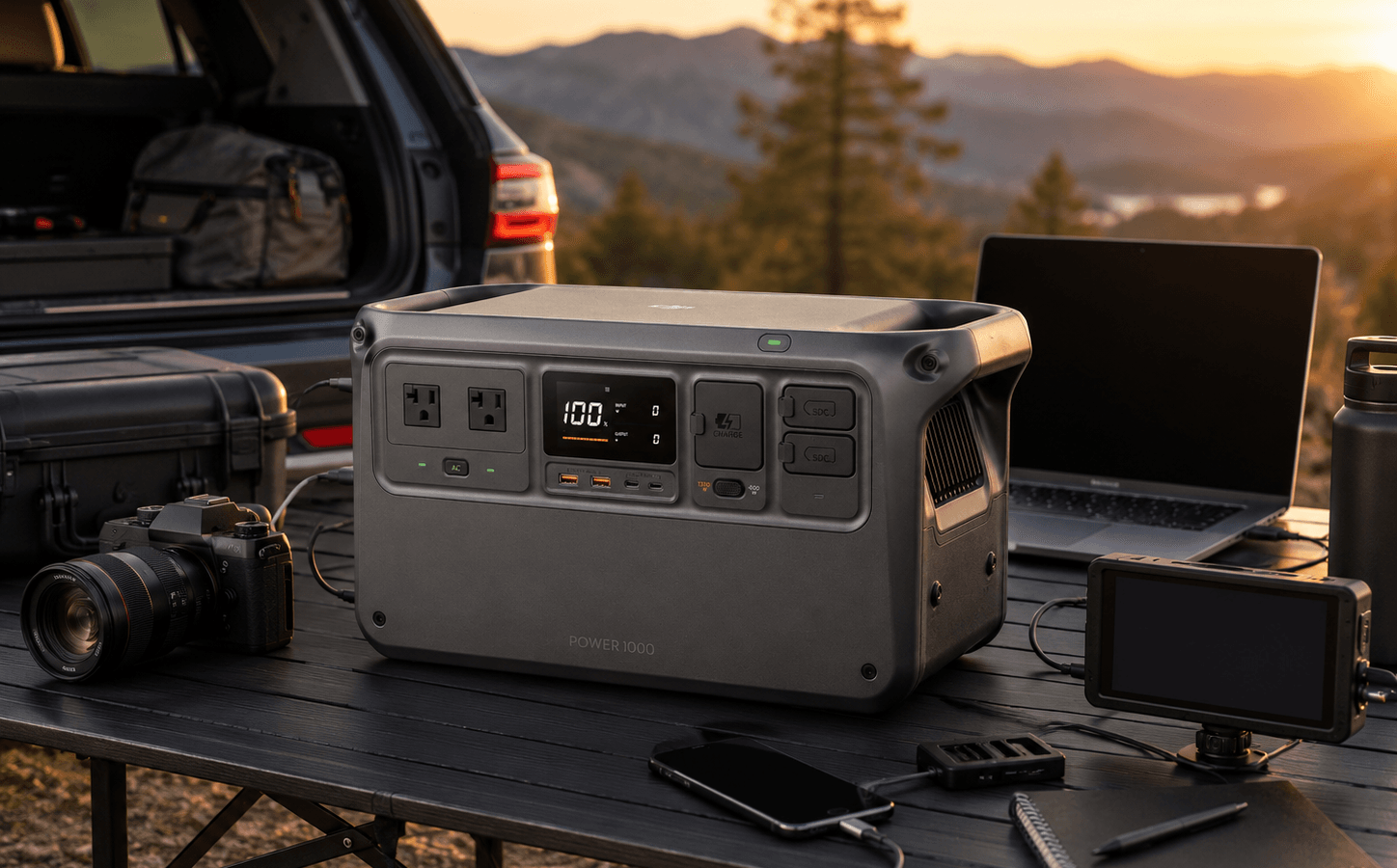
Linked Product Snapshot
Core specs
Buyer Fit
Pros and tradeoffs
Strengths
Pros
- 2200W continuous AC output for the DYM1000L configuration
- Dual 140W USB-C ports for compatible PD 3.1 devices
- DJI SDC and SDC Lite accessories can simplify creator and drone workflows
- Up to 800W solar input with required accessories
- Fast AC recharge, Bluetooth management, and listed 20ms UPS mode
Tradeoffs
Cons
- 1024Wh capacity is limited for long high-watt runtime
- Regional model and outlet configuration must be verified
- Solar, car, and drone functions require separately sold accessories
- No direct expansion-battery compatibility confirmed in the core product specification source
- UPS behavior must be tested with exact connected hardware
This article may contain affiliate links. If you buy through these links, PowerLabPro may earn a commission at no extra cost to you. As an Amazon Associate I earn from qualifying purchases.
This DJI Power 1000 review is for buyers who want high output and DJI-specific workflow options without carrying a larger 2kWh-class station. The DYM1000L version combines a 1,024Wh LiFePO4 battery with 2,200W continuous AC output, two 140W USB-C ports, two AC outlets, USB-A, SDC, and SDC Lite. That mix creates a different buyer decision from a basic camping battery: the product can make demanding devices compatible, but it still carries only about 1kWh of stored energy.
The main conclusion of this DJI Power 1000 review is that it is most persuasive for a measured creator, drone, remote-work, RV, or short-outage setup. The 2,200W inverter gives it significant device flexibility for the capacity class. The 1,024Wh battery means a user still needs to decide what must run, how long it needs to run, and which high-watt tasks are worth the energy cost. High output is not the same as long duration.
This is research-led editorial analysis based on current DJI documentation and product identity checks. PowerLabPro does not claim hands-on or laboratory testing. Confirm the DYM1000L code, outlet layout, bundle, accessory compatibility, warranty terms, and purchase destination before ordering.
DJI Power 1000 review quick verdict
The DJI Power 1000 is a strong choice when compact high output, dual 140W USB-C, or DJI SDC charging matters more than maximum stored energy. It can suit a demanding laptop, creator charger stack, camera gear, drone batteries, field monitor, router, lighting, portable refrigeration with verified behavior, and selected AC work loads. Its 28.7 lb carry weight is reasonable for the inverter class, making it easier to move than many larger-capacity stations.
This DJI Power 1000 review is not a recommendation for every buyer. A 1,024Wh battery can be depleted quickly by cooking, heating, motor loads, or long refrigeration duty. It is not a 240V platform, a fixed electrical system, or a whole-home backup answer. Buyers who need many hours of high-watt runtime should choose more stored energy first, even if a lower-output unit looks less impressive in a comparison table.
Best for, not ideal for, and the real buyer fit
Best for: DJI users, mobile creators, drone operators, remote workers, RV travelers, and controlled backup buyers who can use 2,200W continuous output, 140W USB-C, or SDC-based accessory paths.
Not ideal for: multi-day high-watt backup, whole-home plans, fixed transfer equipment, 240V service, or a buyer whose main goal is adding conventional expansion batteries later.
Main advantage: high DYM1000L continuous output and dual 140W USB-C in a compact 1kWh class.
Main drawback: capacity is finite, so the battery reserve drops quickly when the inverter is used for heavy appliance loads.
Better alternative if: you need longer runtime, a larger 2kWh reserve, a different application ecosystem, or a more conventional expansion path.
A worthwhile DJI Power 1000 review cannot treat all 1kWh products as interchangeable. A buyer who only needs phone charging, a router, a laptop, and a few lights may not need the extra inverter capability. A buyer with high-power USB-C needs, compatible DJI batteries, or a demanding mobile work kit may find the product meaningfully more useful than a simpler station with the same nominal capacity.
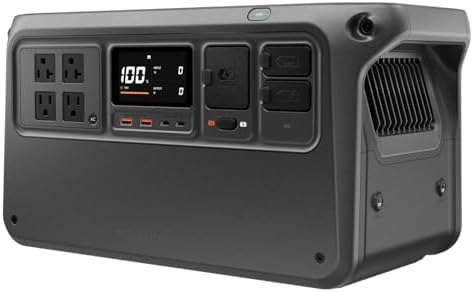
- Power More Than Ever – DJI Power 1000 V2 is a high-capacity solar generator that powers 99% [11] of appliances like kett…
- Charge Fast, Go Far – DJI Power 1000 V2 portable power station recharges to 80% in just 37 minutes [3], so you’re always…
- Uncompromising Safety, Anywhere – This power station features a 1024Wh LFP battery, intelligent BMS, sub-nano coating, a…
Table of Contents
DJI Power 1000 review: verified specifications
| Item | Current documented figure | Buyer interpretation |
|---|---|---|
| Capacity | 1,024Wh | A compact 1kWh reserve for a deliberately controlled load plan. |
| Cell chemistry | LiFePO4 | DJI lists over 70% remaining capacity after 4,000 cycles under stated laboratory conditions. |
| Continuous AC output | 2,200W | The normal planning rating for the DYM1000L configuration. |
| Temporary maximum output | 2,600W | DYM1000L is listed for about 30 seconds under stated conditions, not as continuous output. |
| Peak output | 4,400W | Short startup headroom, not normal appliance capacity. |
| USB-C | Two ports, 140W each maximum | High-power device charging requires PD 3.1 and an EPR-rated cable. |
| Solar | Up to 800W with accessories | Requires the right MPPT modules, panels, connector setup, and operating conditions. |
| AC charging | 0% to 80% about 50 min; 0% to 100% about 70 min | Useful readiness advantage, with conditions and battery state affecting results. |
| UPS mode | 0.02 sec listed | Can help compatible devices, but must be tested with the exact hardware. |
| Weight | About 28.7 lb | Portable for its output class, but still a planned carry rather than a small travel battery. |
This DJI Power 1000 review relies on DJI’s official specifications and FAQ for the 1,024Wh capacity, 2,200W DYM1000L continuous output, 2,600W temporary maximum-output condition, 4,400W peak, port count, USB-C capability, SDC functions, charging examples, solar accessory limits, and UPS mode. Review DJI Power 1000 official specifications and DJI Power 1000 official FAQ for changes. The connected U.S. retail identity is ASIN B0CZ5RYBWW, which should be checked again at the point of purchase.
DJI Power 1000 review: why regional identity matters
One of the most important details in this DJI Power 1000 review is the model code. DJI lists DYM1000L for a 100 to 120V configuration and DYM1000H for a 220 to 240V configuration. The current Amazon-linked record is DYM1000L, which is the appropriate version to verify for a U.S. buyer. A similar-looking unit from another market may have a different outlet layout, voltage context, accessory bundle, and commercial terms.
Regional accuracy matters because the product is often bought for demanding equipment. A creator might expect a high-power laptop, field monitor, and charging hub to share the inverter. An RV traveler might plan around an appliance or a car-powered accessory. A home-office buyer might expect UPS mode to bridge an interruption for a router and work device. The DJI Power 1000 can be useful in each situation only after the actual model, plug, device, and cable requirements have been confirmed.
Before buying, check the listing title, model number, product photographs, AC receptacles, included cords, and seller information. Do not use an adapter as a substitute for understanding regional electrical compatibility. The purpose of a portable power station is controlled reliable power, not a complicated workaround that introduces new uncertainty.
DJI Power 1000 review: 2200W output explained
The 2,200W continuous output is the core reason to shortlist the DJI Power 1000. It allows a controlled mix of devices that would overwhelm a 500W or 1,000W station. A user can plan around high-power USB-C laptops, chargers, lighting, a router, field equipment, a compatible portable refrigerator, or short-use appliances that genuinely fit the continuous limit. It is a meaningful flexibility advantage in the 1kWh class.
This DJI Power 1000 review treats 2,200W as the actual sustained planning boundary. DJI’s 2,600W figure is a temporary maximum-output condition. For DYM1000L, DJI lists roughly 30 seconds under stated battery and temperature conditions. Its 4,400W figure is a peak-output number. Neither should be used to decide that a 2,600W or 4,400W appliance can run continuously.
Motor loads deserve more caution than a simple wattage label suggests. A compressor, pump, refrigerator, portable cooler, or power tool may draw more during startup than while running. A high inverter rating can improve the chance of compatibility, but the appliance’s behavior and the remaining battery energy still matter. Test an important load at home before an outage or trip rather than discovering its limits when the device becomes essential.
The strongest use of the DJI Power 1000 is a structured load plan, not a maximum-watt experiment. Add the continuous draw of devices that need to run together, leave meaningful buffer, and decide which high-watt tasks should be brief. This helps a buyer use the product’s output headroom without wasting its finite energy reserve.
DJI Power 1000 review: capacity and realistic runtime
A 1,024Wh battery can be very useful when a buyer protects the right loads. It does not deliver a universal number of hours. Runtime depends on device watts, inverter losses, cable choices, battery temperature, battery state, and the way a device cycles on and off. A laptop compiling video, for example, may draw more than an idle laptop. A refrigerator may have a modest average draw but a higher compressor startup event.
For a short outage or mobile workday, the DJI Power 1000 can support a router, phone charging, laptop, selected monitor, lighting, camera batteries, tablet, and smaller accessories for a useful period. The owner should decide which of those loads are core and which are optional. A high-watt appliance can consume an outsized amount of the reserve, even when the inverter has enough headroom to run it.
A practical approach is to protect communications first, then work continuity, then comfort devices. Direct USB-C charging can reduce the number of conversions for compatible laptops and creator equipment. That does not change the battery’s capacity, but it can make a real workflow simpler. Use the PowerLabPro sizing guide to calculate the actual load list before assuming a 1kWh battery will cover a long evening or overnight event.
This DJI Power 1000 review therefore sees capacity as the product’s main limitation. Buyers who value 2,200W but repeatedly need high-watt loads for many hours should consider a larger-energy platform. A higher inverter cannot compensate for too little stored energy when the real requirement is duration.
DJI Power 1000 review: ports and creator workflows
The port arrangement is where the DJI Power 1000 earns a specialized role. Two AC outlets, two USB-A ports, and two 140W USB-C ports cover common digital and AC equipment. The USB-C specification is particularly relevant to buyers with PD 3.1 laptops or compatible high-power charging gear. To reach 140W, the device and cable must support the correct profile. A standard cable or device may deliver less power.
The SDC and SDC Lite ports add a DJI-oriented accessory path. DJI documents compatible solar, car-power, XT60, and selected drone-battery cables. For a drone operator, the ability to fast-charge supported DJI batteries can reduce downtime in a field kit. For a non-DJI buyer, the same ports may be less valuable than app features, conventional DC outputs, or an expansion ecosystem offered by another brand.
A good DJI Power 1000 review also recognizes that accessories are not bundled magic. Solar adapters, SDC charge cables, car-charger cables, and other parts are generally separate purchases. A buyer should map each key device to the correct connection before ordering. The product is strongest when it replaces cable clutter and charging friction, not when it creates a new list of adapters that are difficult to source.
DJI Power 1000 review: charging, solar, UPS, and app control
Fast AC recharging is a real everyday advantage. DJI lists about 50 minutes to 80% and 70 minutes to 100% in its stated setup. That makes the DJI Power 1000 easier to refresh before a travel day, after a work shift, or ahead of a forecast outage. The maximum 1,200W grid recharge condition depends on battery level and temperature, so actual timing can vary.
Solar input can reach up to 800W with compatible DJI MPPT modules and solar panels. This number should be interpreted as a supported system ceiling, not an expected all-day solar yield. Sun angle, weather, shade, cable loss, panel temperature, panel compatibility, and battery state all change field performance. The solar accessories are separate, so total system cost and transport space should be part of the decision.
DJI lists an UPS mode that can supply connected compatible devices within 0.02 seconds after a grid interruption. This DJI Power 1000 review sees it as useful context for a router, light, or personal work device, not as a blanket promise for servers, network storage, medical devices, security systems, or other critical equipment. Test the exact connected hardware before relying on the transfer function.
DJI Home supports Bluetooth device management and compatible settings. It can make routine use more convenient, but it is not a reason to skip basic load checks, cable checks, or safe placement. The station’s 23dB listed charging noise can be attractive for a desk, apartment, RV, or campsite, though actual acoustic behavior changes with charging mode, load, temperature, and placement.
DJI Power 1000 review: use-case analysis
Creator gear, drones, and field work
For a mobile creator, the DJI Power 1000 is a compelling fit when a laptop, camera batteries, drone batteries, lighting, monitor, phone, and accessories need a compact shared power hub. The high continuous output means a more demanding charger or AC tool may remain compatible. The dual 140W USB-C ports can reduce reliance on AC bricks. SDC accessories can be valuable for compatible DJI batteries. The underlying requirement is a specific equipment plan, not simply an interest in the DJI brand.
RV, camping, and road travel
For RVs and vehicle travel, the DJI Power 1000 suits electronics, lighting, device charging, a compatible portable refrigerator, laptops, and selected appliances that fit the plan. The solar pathway can help long stays, but it is accessory-dependent and must be installed with correct voltage and connectors. The station should be used on a dry stable surface with ventilation, not as a replacement for an entire RV electrical system.
Home office and controlled outage use
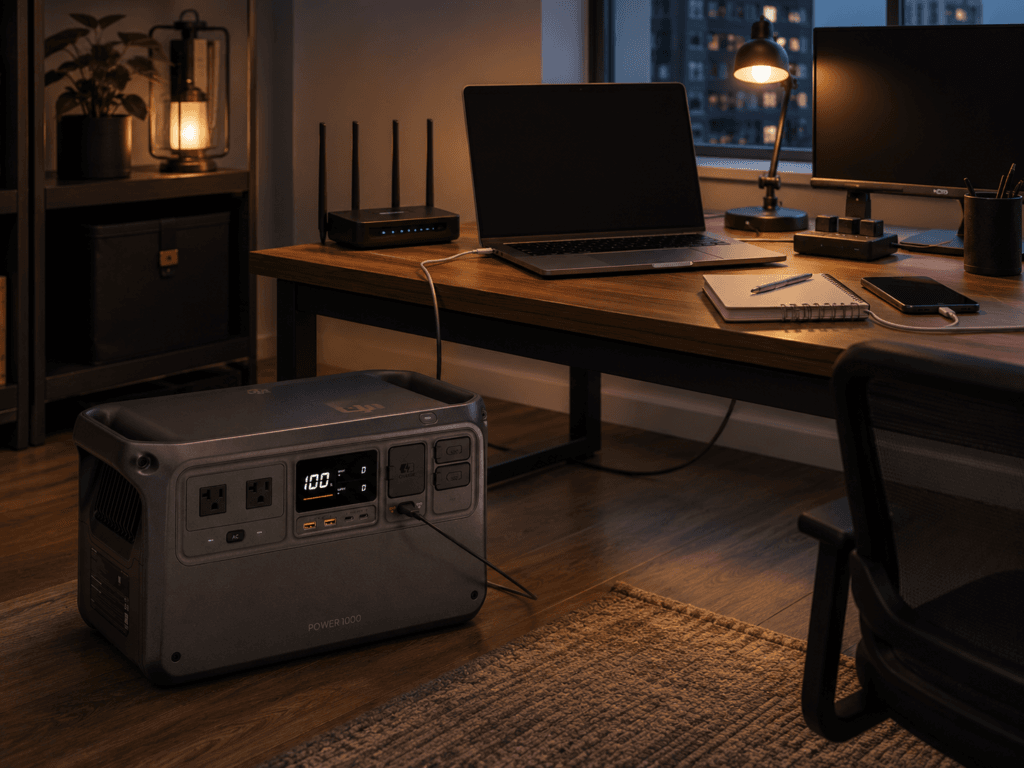
For a home office, the DJI Power 1000 can be valuable for keeping a router, laptop, monitor, phone charging, lighting, and selected camera or audio equipment available during an interruption. A priority plan is more realistic than trying to preserve normal household behavior. Decide which devices need continuity, calculate their draw, test transfer behavior, and avoid adding high-watt convenience loads until the core plan is secure.
DJI Power 1000 review: alternatives
DJI Power 2000 for longer runtime and a larger DJI system
The DJI Power 2000 is the logical alternative when stored energy is the true limit. It is heavier and less convenient to move, but its larger capacity is better suited to longer runtime, a more substantial backup plan, or a buyer who knows the 1kWh class is too restrictive. The DJI Power 1000 remains the better fit when compactness is central and the device list is controlled.
EcoFlow DELTA 3 Plus for a different 1kWh ecosystem
The EcoFlow DELTA 3 Plus is a relevant comparison for buyers who prioritize a different app, port, charging, and expansion ecosystem. The DJI model is more distinctive when high 140W USB-C and DJI SDC compatibility solve real workflow needs. The EcoFlow path may be more attractive when the buyer expects to build a broader home or travel energy ecosystem rather than focus on DJI accessories.
BLUETTI Elite 100 V2 for portable high-output backup
The BLUETTI Elite 100 V2 is worth comparing for a buyer who wants high 1kWh-class output, fast charging, solar potential, and app tools without a DJI-centered accessory plan. Its role is different. The DJI Power 1000 is most attractive to users who gain something specific from 140W USB-C and SDC workflows. Choose based on the equipment you already own and the workflow you intend to support.
DJI Power 1000 review: pros and cons
| Pros | Cons |
|---|---|
| 2,200W continuous output creates meaningful compatibility headroom in a 1kWh class. | 1,024Wh capacity is limited for lengthy high-watt use. |
| Two 140W USB-C ports can suit compatible laptops and creator equipment. | Full 140W charging requires a compatible device and EPR-rated cable. |
| SDC and SDC Lite support specialized DJI, solar, car, and DC accessory paths. | Many specialized functions require separately purchased accessories. |
| Up to 800W solar input with compatible MPPT modules and panels. | Solar setup has cost, space, compatibility, and weather constraints. |
| Fast AC charging, Bluetooth management, 20ms UPS mode, and low listed charging noise. | UPS behavior and app functions must be verified with the exact setup. |
DJI Power 1000 review FAQ
Can the DJI Power 1000 run a refrigerator?
It may run some refrigerators when the regional model, running watts, startup behavior, and other connected loads fit the 2,200W continuous plan. Do not treat the high inverter rating as a guarantee of long runtime. Test the exact refrigerator before an outage and choose more capacity when food preservation over many hours is the primary requirement.
What is needed to use the 140W USB-C ports?
The device must support the appropriate PD 3.1 charging profile and the cable must meet EPR specifications. A normal USB-C device or cable may charge at a lower rate. Confirm the laptop or device maker’s power-delivery requirements before treating 140W as a guaranteed result.
Can the DJI Power 1000 charge from solar panels?
Yes. DJI documents solar charging through its Power Solar Panel Adapter Module, MPPT, with compatible panels. The system can accept up to 800W under the documented accessory setup. Panels, adapters, voltage, connectors, weather, and placement determine the actual result.
Does the DJI Power 1000 have UPS mode?
DJI lists a 0.02-second transfer for connected compatible devices. That is useful context for personal electronics and networking equipment, but it is not a universal guarantee. Test the exact router, computer, monitor, or other hardware before relying on it during an important event.
Safety and backup limits
Operate the DJI Power 1000 on a stable dry surface with ventilation unobstructed. Keep it away from water, heat, damaged cables, vehicle footwells, and exits. It should not be used as a substitute for a fixed electrical system, critical medical backup, life-safety equipment, or a whole-home generator. Follow the manual’s storage guidance and use compatible accessories.
For general outage preparation, use Ready.gov’s power-outage guidance together with a written priority-load plan. Decide what must remain powered, test those devices before the event, and keep the cables and adapters in the same storage location as the station.
DJI Power 1000 review: final recommendation
The final conclusion of this DJI Power 1000 review is positive for a buyer with a real use for high 1kWh-class output, 140W USB-C, and DJI accessory connectivity. It is a particularly good match for creators, drone users, mobile professionals, RV travelers, and controlled home-office backup plans that need more device flexibility than a smaller station can provide.
Choose a larger platform when longer runtime and stored energy are the main problems. Choose a different 1kWh platform when you prefer a conventional app, port, or expansion ecosystem. Read the DJI Power 1000 product page for the verified central record, then use the PowerLabPro sizing guide to validate the equipment plan before purchase.
Testing Notes
- Research-led editorial analysis based on current DJI Power 1000 product specifications and FAQ, plus the matching U.S. DYM1000L retail identity, ASIN B0CZ5RYBWW.
- PowerLabPro did not conduct hands-on or laboratory testing of the DJI Power 1000.
- Actual runtime, UPS-style transfer behavior, device compatibility, and solar charging performance depend on the connected equipment and operating conditions.