
Review
Goal Zero Yeti PRO 4000 Review: 4kWh Backup
Research-led verdict: a strong 4kWh 120V backup platform for measured essential-load, RV, cabin, and solar-recovery plans, but too heavy and complex for modest electronics-first backup.
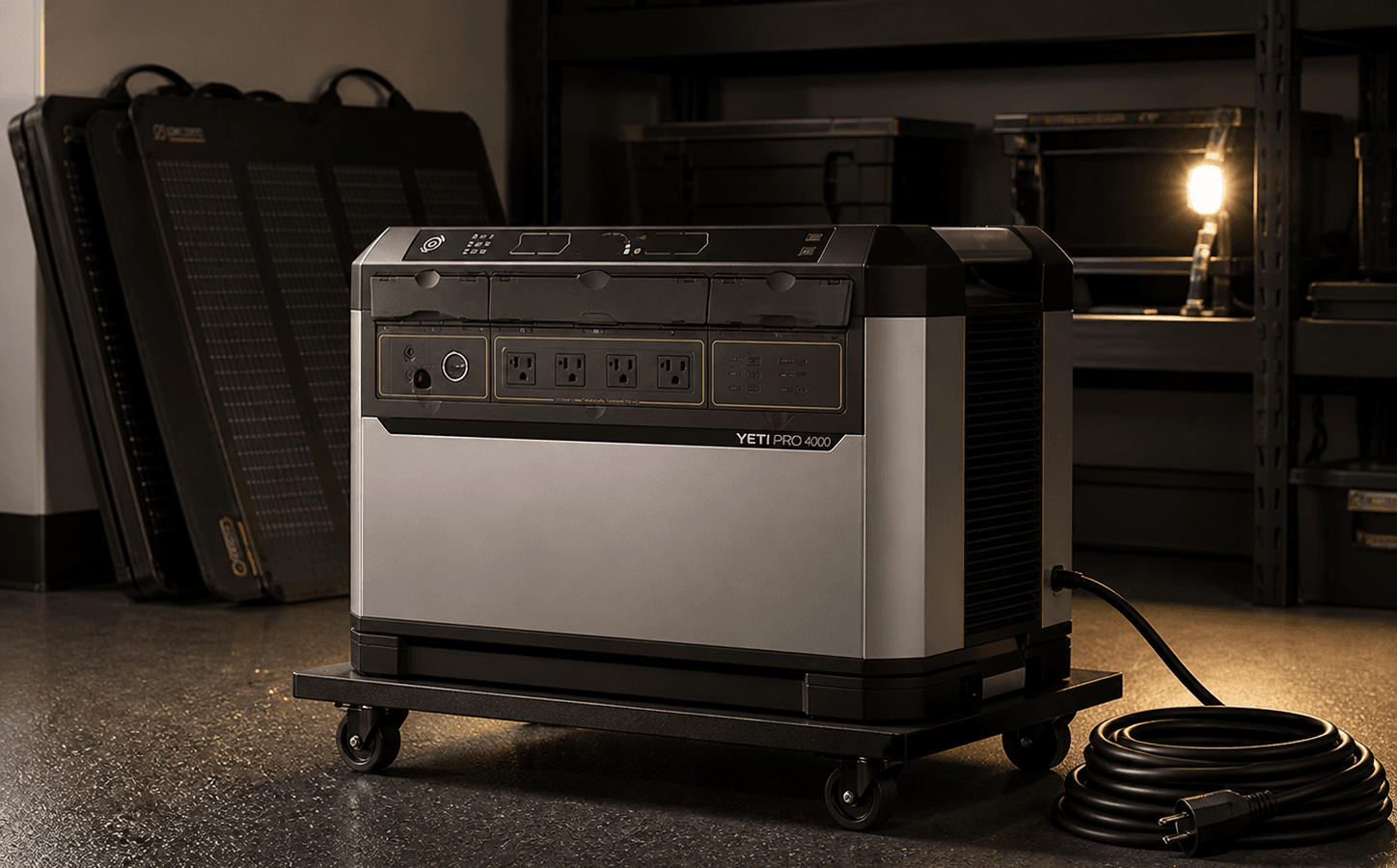
Linked Product Snapshot
Core specs
Buyer Fit
Pros and tradeoffs
Strengths
Pros
- 3,994Wh LiFePO4 base capacity
- 3,600W continuous 120V output
- 7,200W listed surge
- Up to 3,000W high-voltage solar input
- Up to four Tank PRO 4000 expansion batteries
- 120V 30A TT-30R RV outlet
- Wi-Fi and Bluetooth app control
- 5-year warranty
Tradeoffs
Cons
- 115.7 lb base unit requires planned placement
- 120V platform, not a single-unit 240V option
- Large system cost and expansion complexity
- High-watt loads can consume the battery quickly
- Solar recovery needs a correctly matched array
- Not a universal critical-device or whole-home solution
This article may contain affiliate links. If you buy through these links, PowerLabPro may earn a commission at no extra cost to you. As an Amazon Associate I earn from qualifying purchases.
Goal Zero Yeti PRO 4000 Review verdict: the Goal Zero Yeti PRO 4000 is a serious 4kWh-class battery platform for buyers who need a large, planned reserve for selected home essentials, RV or van power, solar recovery, and later capacity expansion. Goal Zero lists 3,994Wh of LiFePO4 storage, 3,600W continuous AC output, 7,200W surge, up to 3,000W high-voltage solar input, 1,800W AC fast charging, and up to four Tank PRO 4000 expansion batteries. The trade-off is equally clear: this is a 115.7 lb base unit that belongs in a deliberate location, not a casual carry kit.
This Goal Zero Yeti PRO 4000 Review is research-led. It uses current manufacturer documentation, the verified U.S. retail identity, and PowerLabPro buyer-fit analysis. It does not claim hands-on testing. The question is not whether the station has a large battery. The useful question is whether its capacity, output, charging options, physical size, and expansion ecosystem fit the loads you genuinely need to protect.
For a buyer whose outage plan is a router, phones, one laptop, a few lights, and a small fan, this system is usually excessive. For a buyer who has tested a refrigerator, needs a 120V 30A RV outlet, wants high solar recovery, or plans to build a larger reserve through Tank PRO batteries, the Goal Zero Yeti PRO 4000 Review points to a stronger match. It remains a 120V platform, not a single-unit 240V or automatic whole-home solution.
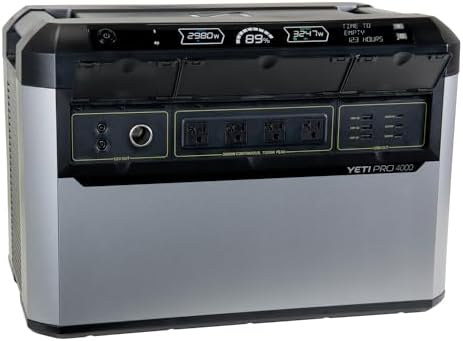
- The Yeti PRO 4000 features high-efficiency inverter technology designed for extended power delivery. With a 3600-watt co…
- Class-Leading Lifespan: Upgraded Lithium Iron Phosphate battery (LFP) technology provides an incredible 4000+ cycles, an…
- Exceptional Build Quality: The Yeti PRO 4000 is the largest portable power station on the market rated for outdoor use a…
Table of Contents
Goal Zero Yeti PRO 4000 Review: Quick Verdict
The Goal Zero Yeti PRO 4000 Review verdict is positive for a narrow buyer. This is a strong platform when you already have a measured high-capacity plan and want one large 120V battery that can be expanded, charged quickly, or integrated through the compatible Goal Zero ecosystem. It is not the automatic answer for every outage because its weight, physical footprint, and system cost can be unnecessary when the load list is modest. This Goal Zero Yeti PRO 4000 Review therefore starts with the load plan, not the product headline.
- Buy it for: a controlled refrigerator-plus-essentials plan, a 120V RV or travel-trailer setup, solar-supported recovery, a cabin or garage backup location, or a future Tank PRO expansion plan.
- Skip it for: small-device backup, frequent lifting, 240V loads, all-house expectations, or a plan that has not been tested against real appliance demand.
- Main strength: 3,994Wh of LiFePO4 storage, 3,600W continuous 120V output, a 30A TT-30 outlet, and a documented capacity path to 20kWh.
- Main limitation: the base unit weighs 115.7 lb, and larger home-circuit use requires compatible equipment, a defined plan, and appropriate installation.
This Goal Zero Yeti PRO 4000 Review treats the product as a planned-placement system. The included roll cart helps movement, but it does not make the station lightweight. It is more sensible in a protected utility area, garage, RV storage bay, or preplanned backup location than in a closet that requires last-minute lifting during bad weather.
Goal Zero Yeti PRO 4000 Review: Specifications That Matter
| Specification | Verified information | Buyer meaning |
|---|---|---|
| Battery capacity | 3,994Wh, 51.2V, 78Ah | Large stored energy for selected loads, not a universal runtime promise. |
| Battery chemistry | LiFePO4 | Goal Zero lists 4,000 or more lifecycles under stated test conditions. |
| Continuous AC output | 3,600W, 120V, 60Hz | Shared output budget for the total AC load. |
| Surge output | 7,200W | Short startup support, not a 7,200W continuous operating level. |
| Solar input | HPP high-voltage input up to 3,000W | Array voltage and current must remain within Goal Zero’s published limits. |
| AC fast charging | Up to 1,800W | Goal Zero lists 0% to 80% in two hours under stated conditions. |
| 120V RV output | TT-30R up to 3,600W | A defined RV connection path after verifying the rig and appliances. |
| USB and 12V | One 100W USB-C, two 30W USB-C, three USB-A, plus 12V ports | Lets compatible lower-draw devices avoid using AC outlets. |
| Expansion | Up to four Tank PRO 4000 batteries, up to 20kWh total | More runtime, with more equipment, cost, floor space, and charging needs. |
| Connectivity | Wi-Fi, Bluetooth, and Goal Zero Power App | Monitoring and charge-profile control, not a substitute for a load plan. |
| Weight and dimensions | 115.7 lb; 21.4 × 13.8 × 14.8 in | Plan location, ventilation, and handling before an outage. |
| Warranty | 5 years | Confirm current coverage and purchase-channel terms before checkout. |
Goal Zero’s official Yeti PRO 4000 documentation is the source for these core limits. The current U.S. retail listing confirms the matching Yeti PRO 4000 identity and ASIN B0CJCT1TC5. This Goal Zero Yeti PRO 4000 Review keeps the official page as the controlling source where retailer details differ. The Review uses those sources as planning evidence, not as a substitute for checking the current manual before building an array, connecting an RV, or purchasing expansion equipment.
Who the Goal Zero Yeti PRO 4000 Fits
The Goal Zero Yeti PRO 4000 Review finds the strongest buyer fit in a household or travel setup that has already outgrown compact power stations. The buyer should have an outage, RV, cabin, or mobile-work plan that needs a higher-output inverter and much more stored energy than a 1kWh class unit can provide. The Goal Zero Yeti PRO 4000 Review is most useful after that need has been written down.
- Selected home essentials: a tested refrigerator, router, lights, phones, laptops, fans, and carefully managed short-use appliances.
- RV and towable use: a compatible 120V plan where a 30A TT-30 outlet, 12V ports, and solar recovery can be genuinely useful.
- Cabin and off-grid users: buyers who can use a substantial solar array and need a staged expansion route rather than a one-time battery purchase.
- Preparedness planners: people who are willing to select priorities, test loads, and store the system in a ready location.
For these users, the Goal Zero Yeti PRO 4000 can be compelling because the battery, solar-input ceiling, and Tank PRO path all support a longer planning horizon. The product is not valuable merely because its specifications are large. It becomes valuable when the buyer will use its capacity, inverter headroom, recovery options, or ecosystem rather than simply own an oversized battery.
Use the PowerLabPro power-station sizing guide to list real loads, identify which devices run together, and estimate the number of hours that matter. The Goal Zero Yeti PRO 4000 Review is a better match when that exercise points beyond the compact or 2kWh category.
Who Should Skip the Goal Zero Yeti PRO 4000
The Goal Zero Yeti PRO 4000 Review does not recommend buying more system than the problem needs. A compact battery is easier to store, carry, recharge, and replace when the real task is communications and small-device power. A larger 120V/240V platform may make more sense when the actual requirement is split-voltage equipment or a more integrated high-output system. This Goal Zero Yeti PRO 4000 Review does not treat high wattage as a substitute for the right voltage.
- Small-load buyers: phones, Wi-Fi, lights, a laptop, and a small fan rarely justify 115.7 lb of stored power.
- Frequent-carry buyers: the removable cart helps, but the base unit needs a realistic movement plan and often a second person.
- Native 240V buyers: the Yeti PRO 4000 is a 120V platform. Do not treat its high output as a 240V capability.
- Whole-home expectation buyers: backup of selected circuits through compatible equipment is different from automatic, unrestricted whole-home power.
- Critical-equipment buyers: medical, life-safety, security, and server equipment need the backup method specified by their own manufacturers.
Output, Capacity, and Load Planning
One reason the Goal Zero Yeti PRO 4000 Review needs more than a specifications list is that output and energy solve different buyer problems. The 3,600W inverter describes how much compatible power can be delivered at one time. The 3,994Wh battery describes the reserve that must be shared over time. A device can fit the inverter limit yet still consume a meaningful portion of the battery during a short session.
The AC outlets share a system-level budget. They are not independent 3,600W sources. A router, lights, laptop charging, and a refrigerator after testing can form a sensible priority group. A kettle, microwave, space heater, air fryer, or portable air conditioner changes the plan quickly. High-watt loads may be possible for short use but can reduce the reserve that matters later.
Goal Zero lists 7,200W surge capability. Surge capacity may assist a short startup event, but it does not double continuous output, add battery energy, or prove a specific refrigerator, pump, compressor, tool, or RV air conditioner will work. Check device labels, understand starting demand, and test the exact appliance before relying on it during an outage.
The Goal Zero Yeti PRO 4000 Review therefore favors a priority order: communications, safety lighting, food protection after compatibility checks, work equipment, and selected short-use loads. That order helps preserve energy for the devices that matter most. It also makes the outcome more predictable than plugging in every available appliance because the station happens to have several outlets. That discipline is central to this Goal Zero Yeti PRO 4000 Review.
Charging, Solar Recovery, and Battery Care
Charging strategy is central to the Goal Zero Yeti PRO 4000 Review. Goal Zero lists up to 1,800W of AC fast charging and a 0% to 80% result in two hours under stated conditions. It also lists a 3,000W high-voltage input and an under-90-minute 0% to 80% solar claim under stated conditions. Those figures describe a correctly matched setup, not a promise for every household circuit, panel array, temperature, weather condition, or starting state of charge.
Solar recovery can be a major advantage for an extended outage, RV trip, or cabin use. It still needs a real electrical plan. Goal Zero publishes a 13.3 to 150V high-voltage input range and a 30A maximum for the HPP input. Panel nameplate watts alone are not enough. A safe array must respect voltage, current, connector, polarity, cable, and environmental limits in the current documentation.
Goal Zero also publishes low-voltage and vehicle charging paths. These can be useful supplemental options, but they are not equivalent to a 1,800W wall source or a large compatible solar array. Keep the correct cables with the station and test the chosen recovery path before a trip or expected outage. The Goal Zero Yeti PRO 4000 Review treats a tested recharge route as part of the purchase decision.
Battery care is part of ownership. Store the Goal Zero Yeti PRO 4000 dry, accessible, and within manufacturer temperature guidance. Check charge level periodically, inspect cables, and update firmware only through the official app process. Good storage and routine checks matter more for a large planned-placement system than for a small phone charger because the system is meant to be ready before a real event.
Expansion, Haven 10, and System Limits
The Goal Zero Yeti PRO 4000 Review sees expansion as a real advantage only when it solves a measured runtime problem. Goal Zero states that one Yeti PRO 4000 can pair with up to four Tank PRO 4000 expansion batteries for a system total up to 20kWh. More battery capacity can extend the same controlled loads. It does not make poor load management disappear, and it increases cost, floor space, charging time, and setup complexity.
Goal Zero also describes a Haven 10 home-backup ecosystem for up to ten selected circuits. That is not a do-it-yourself permission to connect portable power to a panel. It is a specific compatible system that requires proper equipment and professional installation. The Goal Zero Yeti PRO 4000 Review recommends treating circuit backup as a separate project with its own electrical assessment, load priorities, transfer method, and local code considerations.
Haven integration may be valuable for an owner who wants selected circuits to receive backup power without extension-cord routing. It is not the same as powering every circuit at once. Major electric heating, central cooling, water heating, ranges, and other heavy loads may exceed the practical plan even when a large portable battery is present. This Goal Zero Yeti PRO 4000 Review keeps that limit visible rather than implying normal whole-home operation.
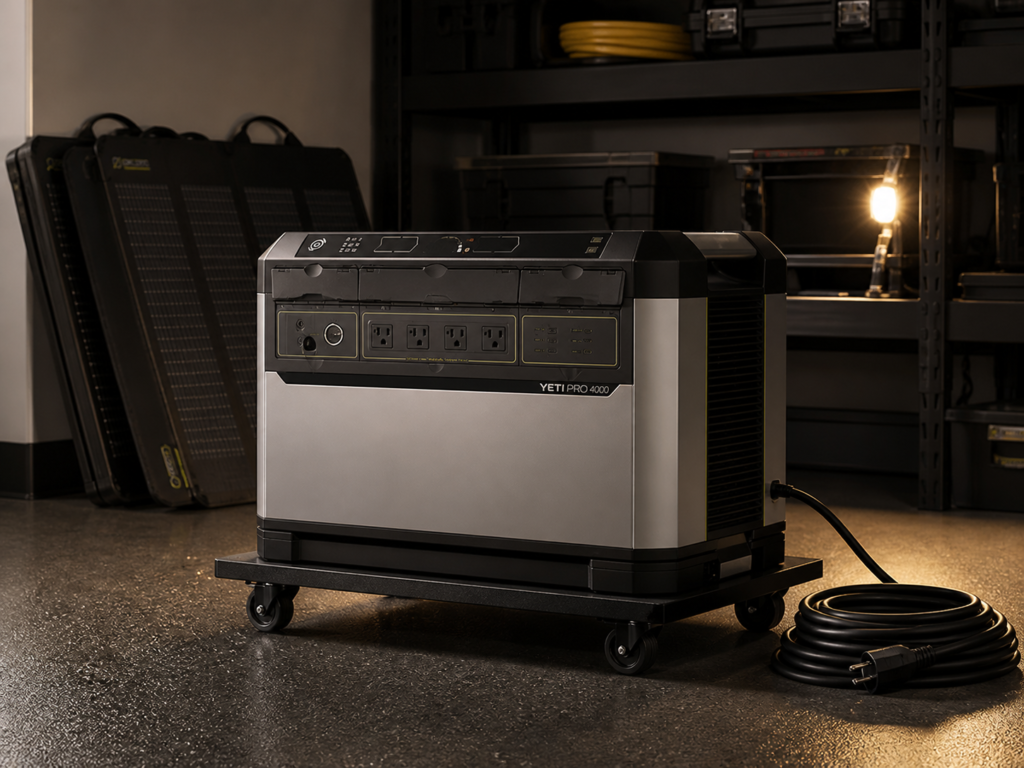
Ports, RV Use, App Control, and Placement
The Goal Zero Yeti PRO 4000 Review benefits from looking beyond the battery number. Goal Zero publishes a 120V 30A TT-30R outlet, a 100W USB-C port, two 30W USB-C ports, three USB-A ports, a 12V auxiliary port, a 12V high-power port, and two 12V 6mm outputs. This spread gives the owner a way to power lower-draw devices directly without using AC outlets unnecessarily.
The TT-30R connection is useful for a compatible 120V RV or travel trailer plan. It remains a connection point, not an automatic answer to every RV appliance. Confirm the RV inlet, cord, grounding approach, appliance demand, and the devices that will operate at the same time. A 120V 30A outlet does not create a 240V RV supply.
Goal Zero lists Wi-Fi, Bluetooth, and app support. The app can display battery level and power flow, turn ports on or off, and select charging profiles. That is useful for monitoring, but it does not replace safe cable routing, dry placement, proper ventilation, or a pretested load plan.
At 115.7 lb without the cart and 125.7 lb with it, location matters. Use a flat, dry, ventilated surface and keep a clear path to the selected devices. Avoid placing the station where a cable crosses an exit or where the unit must be carried up stairs at the last minute. Ask for help when moving it. The Goal Zero Yeti PRO 4000 Review rates placement and handling as practical ownership limits, not minor footnotes.
Practical Buyer Scenarios
Selected home essentials during a short or moderate outage
For home use, the Goal Zero Yeti PRO 4000 Review favors a selected-load approach. Begin with connectivity, phones, lighting, refrigeration after testing, laptop work, and a few carefully chosen comfort devices. Do not start by trying to duplicate normal household behavior. The difference between a useful outage reserve and a rapidly drained battery is usually the priority list.
Goal Zero publishes example runtimes for certain individual devices. Those examples can help explain the scale of the battery, but they should not be copied into a household promise. Refrigerator cycling, door openings, room temperature, outlet conversion, and the rest of the load mix create different results in each home.
RV, trailer, and road-based use
For an RV or trailer, the Goal Zero Yeti PRO 4000 can be relevant when a buyer needs more than device charging and small lighting. The 120V TT-30R outlet, higher inverter output, 12V options, and solar input can support a carefully planned travel setup. The smart approach is to list the appliances, measure normal draw, check start-up behavior, and decide what will not run at the same time.
A large portable station does not eliminate normal RV electrical limits. Air conditioning, heating, cooking, battery chargers, and entertainment equipment can create a demanding combined load. Controlled use and daylight recovery are more realistic than assuming every onboard device can operate like shore power.
Cabin, garage, and mobile-work planning
The Goal Zero Yeti PRO 4000 can also fit a cabin, garage, or controlled mobile-work plan where a large battery is stored in one location. It can support communication gear, laptops, lights, chargers, cameras, selected corded tools, and other loads that are verified in advance. A full commercial jobsite, high-draw compressor plan, or unmeasured workshop is a different power problem and may need a dedicated generator or professionally designed system.
Alternatives and Decision Paths
The Goal Zero Yeti PRO 4000 Review makes most sense next to alternatives with a different buyer role. The linked Goal Zero Yeti PRO 4000 Product reference is the central record for exact model identity, structured data, and affiliate destination. This Review is the decision layer that explains whether the platform fits your plan.
Choose the Anker SOLIX F3800 Plus Product reference when single-unit 120V/240V capability, a different expansion ecosystem, or a higher-output heavy backup platform is part of the comparison. Choose the Jackery Explorer 5000 Plus Product reference when 120V/240V output and a larger 5kWh-class base battery are more important than the Goal Zero ecosystem. Choose a smaller Product when your plan is electronics, communication, and compact storage rather than a high-capacity reserve.
The decision should not be reduced to a capacity number. Compare voltage needs, output limits, solar configuration, expansion architecture, app controls, physical placement, service access, and the exact loads that must run. The Goal Zero Yeti PRO 4000 Review is strongest where the buyer values a large 120V platform with Tank PRO expansion and compatible Haven or Escape ecosystem options.
What to Verify Before Buying
| Verify | Why it matters |
|---|---|
| Priority-load watts and required hours | They determine whether 3,994Wh is enough before expansion batteries are considered. |
| Combined AC demand | AC loads share the 3,600W continuous system rating. |
| Motor or compressor behavior | Refrigerators, pumps, tools, and RV appliances may have startup demand beyond running watts. |
| 120V versus 240V requirement | The Yeti PRO 4000 is a 120V platform and not a single-unit 240V solution. |
| Solar voltage, current, connectors, and polarity | The HPP input has published electrical boundaries that an array must respect. |
| Haven 10 or RV connection plan | Home circuits and RV connections need compatible hardware and safe installation. |
| Placement and carrying route | 115.7 lb requires a stable location and realistic movement plan. |
| Current retail listing | Confirm ASIN B0CJCT1TC5, seller, bundle, accessories, warranty, and return conditions at checkout. |
For general outage preparation, read Ready.gov’s power-outage guidance. Never backfeed a home panel through a wall outlet, improvise high-current adapters, or assume a portable station replaces a code-compliant transfer system or an approved medical-device backup plan. The Goal Zero Yeti PRO 4000 Review does not change those safety boundaries.
Goal Zero Yeti PRO 4000 FAQ
Is the Goal Zero Yeti PRO 4000 good for home backup?
The Goal Zero Yeti PRO 4000 can be a strong option for a selected-load home-backup plan. It is not a default whole-home solution. Match its 120V output, battery capacity, recovery plan, and compatible home-integration equipment to the circuits and devices you intend to protect.
Can the Goal Zero Yeti PRO 4000 run a refrigerator?
It may support many refrigerator plans within its output limits, but the exact result depends on compressor startup behavior, normal cycling, room temperature, door openings, and the other loads connected. Test the specific refrigerator before relying on it.
How fast does the Goal Zero Yeti PRO 4000 recharge?
Goal Zero lists 1,800W AC fast charging with a 0% to 80% result in two hours under stated conditions. It lists up to 3,000W solar input and a 0% to 80% solar result in under 90 minutes under stated conditions. Actual charging depends on the source, array design, battery state, temperature, and operating conditions.
Is the Goal Zero Yeti PRO 4000 expandable?
Yes. Goal Zero lists up to four Tank PRO 4000 expansion batteries for up to 20kWh total system capacity. Expansion adds runtime and adds cost, space needs, charging requirements, and system-management complexity.
Does the Goal Zero Yeti PRO 4000 provide 240V output?
No. The Yeti PRO 4000 is a 120V platform. Its 3,600W continuous output and 120V TT-30R outlet can be useful for compatible devices and RV plans, but they do not create a 240V source.
Final Goal Zero Yeti PRO 4000 Review Decision
This Goal Zero Yeti PRO 4000 Review concludes that the station is a thoughtful choice for a buyer with a defined high-capacity 120V backup, RV, cabin, or solar-recovery plan. The combination of 3,994Wh capacity, 3,600W continuous output, high-voltage solar input, app controls, 30A RV output, and Tank PRO expansion makes it substantially more capable than compact portable stations.
Skip the Goal Zero Yeti PRO 4000 when a smaller battery can cover the real load list, when frequent carrying is important, or when a native 240V system is required. The best purchase is the smallest verified platform that can run the priority loads for the needed hours and can be recharged safely through the plan you will actually use. That is the final buyer-first conclusion of this Goal Zero Yeti PRO 4000 Review.
Testing Notes
- Manufacturer documentation reviewed: Goal Zero Yeti PRO 4000 specifications and support materials.
- Retail identity verified: Amazon ASIN B0CJCT1TC5.
- PowerLabPro has not performed hands-on or lab testing.