
Product Intelligence
Best Expandable Home BackupJackery HomePower 3600 Plus: Practical 3.6kWh Backup
3.6kWh LFP portable power station built for essential home backup, RV use, and outage preparedness, with 3,600W AC output, expandable capacity, UPS support, app monitoring, and rolling portability.
Specifications
Key specs
Buyer Fit
Fit signals
Best for
Pros
- Large 3,584Wh capacity for essential home backup
- Strong 3,600W AC output for heavier emergency loads
- Expandable up to 21kWh per unit
- LFP battery chemistry for long-term backup use
- UPS support with less than 10ms transfer
- App monitoring for power level, charging status, and usage
- Rolling design with wheels and telescopic handle
- Includes RV-friendly NEMA TT-30 output
Cons
- Heavy at 77.2 lb despite the rolling design
- Overkill for basic phone and laptop charging
- Expansion batteries increase total system cost
- Not a fully automatic whole-home standby system by itself
- Real runtime depends heavily on connected appliances and load size
- Car socket output is not clearly listed
Spec table
| Capacity | 3584 Wh |
|---|---|
| AC Output | 3600 W |
| Surge Output | 7200 W |
| Solar Input | 1200 W |
| Weight | 77.2 lb |
| Battery | LiFePO4 |
| Warranty | 3+2 years / 5-year warranty |
| Expandability | Expandable up to 21kWh per unit; up to 43kWh with multiple units |
| UPS / EPS | UPS support, less than 10ms transfer |
| Recharge Time | Manufacturer markets a 4-hour Flash Charge configuration with SolarSaga 500 X; verify current manual for base-unit charge paths and conditions. |
This article may contain affiliate links. If you buy through these links, PowerLabPro may earn a commission at no extra cost to you. As an Amazon Associate I earn from qualifying purchases.
Jackery HomePower 3600 Plus bottom line: this is a 3,584Wh portable backup station for buyers who have moved beyond a phone-and-router kit but still need a deliberate selected-load plan. It provides 3,600W of listed output, ordinary 120V appliance support from one unit, a 120V TT-30 RV outlet, and a staged capacity path. It is not a portable promise to run every household circuit or high-draw appliance during an outage.
The Jackery HomePower 3600 Plus is most useful when the buyer has identified the priority devices, knows how long they need to run, and has a dry, stable operating location. Capacity, inverter output, outlet type, charging method, and expansion are separate decisions. Treating them as one vague idea of “more power” is how buyers overpay or build an unrealistic backup plan.
This Product page is a structured reference, not a hands-on test report. The connected Review provides deeper buyer-fit analysis. Before buying, confirm the exact current bundle, compatible accessories, manual, and safe connection path for your own loads.
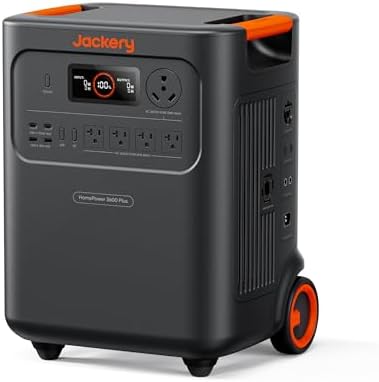
- Essential Home Backup: The Jackery HomePower 3600 Plus delivers 3600W output (7200W in parallel) to run pumps, heaters, …
- Safe Power That Lasts: Built with high-temp resistant ceramic membrane battery cells tested at 302 °F, the Jackery HomeP…
- Plug-and-Play: With its easy plug-and-play design, the Jackery HomePower 3600 Plus, paired with MTS, powers your home ef…
Table of Contents
Jackery HomePower 3600 Plus: Quick Product Reference
The Jackery HomePower 3600 Plus belongs in the larger portable-backup category rather than the compact emergency-battery category. Its base battery stores 3,584Wh, and Jackery lists 3,600W output. Those figures can support a measured plan involving refrigeration, internet equipment, lighting, laptop work, phones, selected kitchen tasks, and compatible RV loads. They do not create a fixed runtime because actual results vary with conversion losses, device duty cycles, temperature, battery reserve settings, and the loads used together.
Its strongest buyer advantage is not simply that it is larger. The platform lets a buyer start with a substantial base reserve, use normal 120V essentials, work with a defined 120V TT-30 RV outlet, and evaluate added capacity only after observing a real shortfall. That can be a more disciplined approach than buying the largest system available before measuring the actual outage plan.
- Best for: a measured essential-load plan that needs more stored energy and output headroom than a compact 1kWh-class station.
- Not ideal for: light communication backup, frequent lifting, or a buyer expecting automatic whole-home coverage.
- Main strength: 3,584Wh of base capacity, 3,600W listed output, a 120V TT-30 outlet, and expansion up to 21kWh.
- Main limitation: a single unit is for 120V appliances; Jackery says two connected units are needed for 240V use.
Jackery HomePower 3600 Plus Specifications and Buyer Meaning
| Specification | Current source-backed information | Buyer meaning |
|---|---|---|
| Base battery capacity | 3,584Wh | Stored energy for a defined priority-load plan, not a universal runtime claim. |
| Listed AC output | 3,600W | Sets the combined inverter ceiling for loads running at the same time. |
| Battery chemistry | LiFePO4 | Jackery presents the platform for repeated backup use and lists 6,000 cycles. |
| Base-unit voltage | 120V appliance support | One unit should be matched to normal 120V appliances and compatible outlets only. |
| 240V boundary | Two connected units required | Do not treat one base station as a 240V source. |
| Expansion | Up to 21kWh | More capacity can be added when measured runtime proves it is needed. |
| AC and RV outlets | Four 3-prong AC outlets plus one 120V NEMA TT-30 outlet | Supports ordinary appliance cords and a defined RV connection type, subject to load and compatibility checks. |
| USB outputs | Two 100W USB-C and two 18W USB-A outputs | Low-power electronics can stay on USB power without using AC outlets. |
| UPS claim | Less than 10ms listed transfer | Useful for selected tested devices, not a universal zero-transfer guarantee. |
| Weight | Amazon lists 77.16 lb | Confirm the current manual and exact bundle before making a lifting or vehicle-storage plan. |
| Solar and recharge | Jackery markets a 4-hour Flash Charge configuration with SolarSaga 500 X | The inspected manufacturer page does not provide a clear base-unit solar-input ceiling; confirm the current manual, bundle, and conditions. |
| Amazon ASIN | B0FM8653F1 | Check the selected listing to confirm it is the intended standalone product or bundle. |
Source note: Jackery’s current product page is the controlling reference for capacity, output, voltage behavior, expansion, ports, UPS description, and warranty conditions. Review the official Jackery HomePower 3600 Plus product page and the applicable manual before finalizing an accessory, solar, RV, or selected-circuit decision.
The Jackery HomePower 3600 Plus should not be judged by capacity alone. A 3,584Wh battery may be generous for a router, modem, phones, lighting, laptop work, and a refrigerator managed carefully. The same battery can be depleted quickly by electric heat, portable air conditioning, cooking appliances, or several high-draw devices operating together. Output tells you what can run at once. Capacity tells you how long a conservative version of the plan may last.
Who the Jackery HomePower 3600 Plus Fits
The best fit for the Jackery HomePower 3600 Plus is a buyer who has outgrown a compact power station but has not demonstrated a need for a much larger 120V/240V platform. That buyer may be planning a refrigerator, home internet, phones, LEDs, laptop work, a fan, selected small appliances, or an RV connection that specifically uses a 120V TT-30 outlet.
- Home-backup planners: households keeping food, communication, lighting, and work priorities available through a limited outage plan.
- RV users: owners who have verified a 120V TT-30 connection, cable condition, grounding approach, and the actual appliances they expect to run.
- Staged-expansion buyers: people who would rather measure a real runtime gap before buying extra compatible battery capacity.
- Preparedness users: buyers who can store the station charged, dry, accessible, and clear of hazards before severe weather or a planned trip.
The Jackery HomePower 3600 Plus is not an automatic recommendation just because it carries a large battery. A buyer who only needs a router, lights, phones, and a laptop may get a simpler, lighter, lower-cost result from a smaller station. The practical goal is to select the smallest verified system that can carry the priority loads for the required time, with a realistic way to recharge it.
Use the PowerLabPro power-station sizing guide before choosing capacity. It separates running watts, startup demand, stored watt-hours, and recovery planning. Those distinctions are more useful than selecting a model solely because its battery specification looks impressive.
What the Base Unit Can and Cannot Power
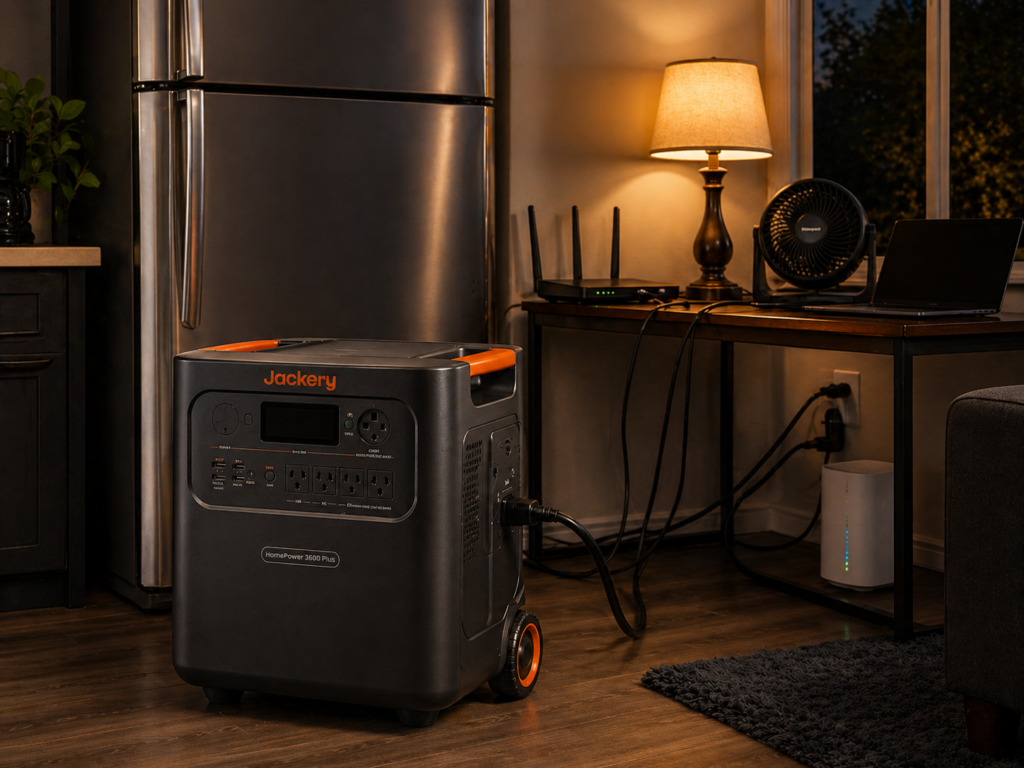
The Jackery HomePower 3600 Plus can make sense for an essential-load plan, not an everything-on plan. A conservative setup may prioritize refrigeration, a modem, a router, phone charging, LED lighting, laptop work, and devices that protect daily communication or food. Start by identifying what must remain available, then identify what can remain off until grid power returns.
Running watts and startup demand must both be checked. A refrigerator can have a moderate normal draw but a higher compressor-start demand. A router is modest but continuous. A kettle, toaster oven, microwave, induction appliance, space heater, or portable air conditioner can consume a large part of the stored energy in a short period. The unit may have enough inverter headroom for a device and still be a poor way to spend the available battery reserve.
The Jackery HomePower 3600 Plus is therefore strongest when the buyer makes a priority list in advance. List every device, its running watts, its likely startup behavior if relevant, and how many hours it must run. Then decide which loads cannot run together. This process produces a more useful backup plan than claiming that a large portable station will “run a house.”
For medical, life-safety, fire, or other critical equipment, check the equipment manufacturer’s specific backup requirements. A portable power station should not be represented as a substitute for code-governed or professionally designed backup systems. Test compatible devices in a controlled setting before relying on them during an outage.
120V, TT-30, and the 240V Boundary
A key buying boundary for the Jackery HomePower 3600 Plus is voltage. Jackery describes one unit as supporting 120V appliances. The platform can reach 240V only when two units are connected through the appropriate manufacturer-supported arrangement. That means the standard base unit should not be used as evidence that a buyer can run a 240V appliance, a 240V RV circuit, or a 240V home connection.
The 120V NEMA TT-30 outlet can be useful for an RV owner whose rig uses that connection type. It does not replace the need to verify the RV’s electrical requirements, load total, cable quality, grounding, and the product’s instructions. An outlet label identifies a possible connection path. It does not guarantee that every appliance combination is safe or appropriate.
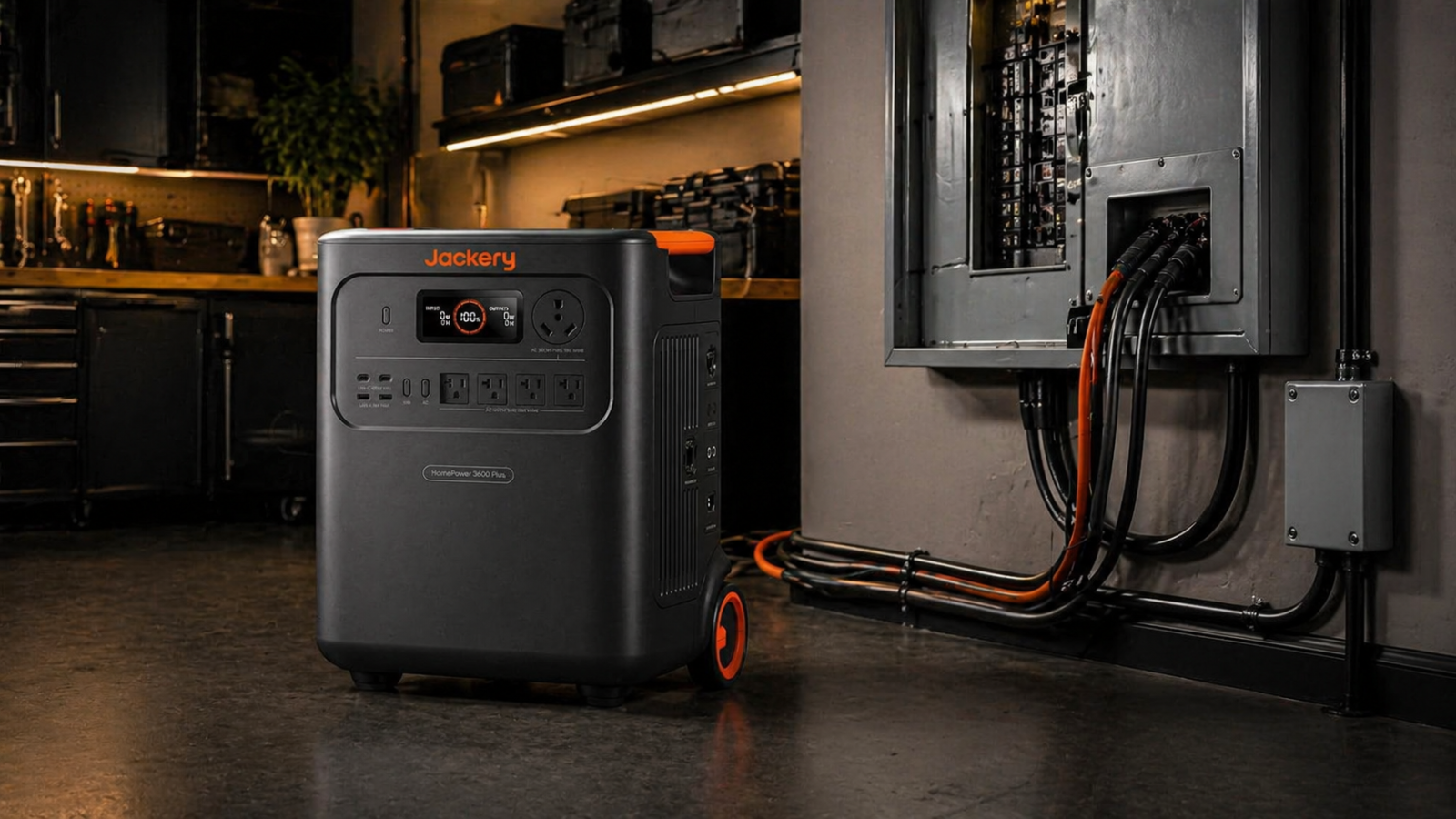
Jackery also describes a manual transfer-switch path for selected essential circuits. Treat that as an electrical project, not as a plug-in feature. A transfer switch, inlet, cable, panel, load limit, grounding method, and local requirements all need to be compatible. Use qualified electrical help when the plan goes beyond direct connection of appliances by properly rated cords.
Expansion, Charging, and UPS Planning
The expansion path is a central reason to consider the Jackery HomePower 3600 Plus. Jackery lists total expandable capacity up to 21kWh. That can be valuable during a longer outage, but extra capacity adds cost, floor space, cable management, charging time, and more equipment to inspect before severe weather. Expansion is strongest when it answers a measured runtime shortfall rather than a general desire to maximize specifications.
Begin with the base station, run a controlled test using the priority loads, and note the real battery use over several hours. A buyer who finds that the base reserve is adequate avoids unnecessary system cost. A buyer who finds a reliable shortfall has a reason to investigate the compatible expansion route. That staged approach is usually safer than assuming the largest capacity is automatically the better choice.
Charging deserves the same discipline. Jackery promotes a 4-hour Flash Charge configuration with SolarSaga 500 X, but real solar recovery changes with the exact panels, weather, shade, panel angle, temperature, wiring, input limits, and state of charge. The inspected manufacturer page does not clearly state a base-unit solar-input wattage. Verify the current manual and selected bundle before treating solar as a defined recharge-time promise.
The Jackery HomePower 3600 Plus also lists UPS protection under 10ms. That may be useful for selected tested networking, office, or monitoring equipment, but it is not a zero-millisecond transfer claim and should not be assumed compatible with every sensitive device. Test the exact device and its power adapter before relying on the behavior for a server, critical data equipment, medical device, security system, or other sensitive load.
Weight, Mobility, and Storage
Amazon lists the current B0FM8653F1 product at 77.16 lb. That makes the Jackery HomePower 3600 Plus a rolling or planned-location backup product rather than a casual carry battery. The retractable-handle and wheel design can help with relocation, but a buyer should still plan the path from storage to the intended operating location and avoid relying on solo lifting when it is not appropriate.
Store the system in a dry, stable, accessible area with clearance and according to the manufacturer’s safety instructions. A garage, protected utility area, or RV storage plan may work when it is dry and ventilated, but the buyer must still account for temperature, moisture, trip hazards, cable routes, and the need to reach the controls quickly. Do not create a home-backup setup that blocks exits or requires unsafe extension-cord routing.
The Jackery HomePower 3600 Plus has more value when it can be kept charged, inspected, and ready before an outage rather than moved hurriedly after one begins. A basic readiness routine should include checking its state of charge, reviewing the essential-load list, inspecting cables, and confirming that each priority device still works with the chosen connection method.
What to Verify Before Buying the Jackery HomePower 3600 Plus
| Verify | Why it matters |
|---|---|
| Your priority-load watts and runtime target | They determine whether 3,584Wh and 3,600W fit the actual backup objective. |
| Refrigerator or motor startup behavior | Startup demand can differ significantly from normal running watts. |
| 120V versus 240V requirement | One base unit supports 120V appliances; 240V requires two connected units. |
| TT-30 RV compatibility | The outlet must match the rig, cable, grounding method, appliance plan, and total load. |
| Expansion components and total cost | Capacity can grow to 21kWh, but additional equipment changes the system footprint and budget. |
| Solar panels and charging claims | Jackery’s shown 4-hour Flash Charge configuration is not a universal recharge promise. |
| Weight, storage, and moving path | Amazon lists 77.16 lb; confirm current manual data and plan handling conservatively. |
| Exact Amazon listing and bundle | Confirm B0FM8653F1 is the intended configuration before purchase. |
For outage-preparedness basics, see Ready.gov power-outage guidance. Never backfeed a home panel through an outlet. Do not improvise a transfer connection, use damaged cables, or assume a portable battery is interchangeable with a professionally installed backup system.
Related Decision Paths
Read the connected Jackery HomePower 3600 Plus review for the deeper buyer assessment, trade-offs, and alternatives. This Product page remains the central verified reference for the model identity, core specifications, outlet boundary, and Amazon configuration.
Buyers who need a smaller fixed-capacity option should compare the Jackery HomePower 3000 review. Buyers with a verified 240V requirement should examine whether a manufacturer-supported two-unit arrangement or a separate high-output platform is actually appropriate. Buyers who need more base reserve may compare the Jackery Explorer 5000 Plus Product reference after completing a load plan.
FAQ
Is the Jackery HomePower 3600 Plus good for home backup?
The Jackery HomePower 3600 Plus can be a strong fit for a measured essential-load plan that needs more reserve than a small station provides. It is not an automatic whole-home solution. Match its capacity, output, outlet type, and charging path to the actual devices and time required.
Can the Jackery HomePower 3600 Plus run a refrigerator?
It can support many refrigerator plans within its listed output limit, but no fixed runtime applies to every refrigerator. Compressor cycling, ambient temperature, door openings, battery reserve, and other connected loads all change the result. Measure or estimate the specific appliance before relying on the system.
Does one Jackery HomePower 3600 Plus provide 240V output?
No. Jackery describes one unit as supporting 120V appliances. Two connected units are required for 240V output, so a buyer should not select the base product for a 240V appliance or connection unless that supported configuration is planned and verified.
Is the Jackery HomePower 3600 Plus expandable?
Yes. Jackery lists expansion up to 21kWh. Expansion should follow a real load test and a clear runtime need, because added batteries also bring added cost, space, charging, and setup requirements.
What is the verified Amazon ASIN?
The current standalone Amazon ASIN used for the Product record is B0FM8653F1. Confirm the listing title, bundle, seller, and included accessories before purchase because retailer configurations can change.
Final Product Decision
The Jackery HomePower 3600 Plus is a practical match for a buyer whose essential-load plan genuinely needs a 3,584Wh starting reserve, 3,600W of listed output, 120V appliance support, a TT-30 RV connection path, and potential capacity growth. It is a serious portable backup platform when those features solve a defined problem.
Skip the Jackery HomePower 3600 Plus when the actual need is only a few small devices, frequent carrying, or unplanned whole-home coverage. Start with the priority loads, desired runtime, safe connection method, and recovery plan. Then choose the smallest verified system that can support that use case without overpromising what a portable battery can do.