
Review
Jackery Explorer 5000 Plus Review: 5kWh 240V Backup
Research-led verdict: a powerful 5kWh 120V/240V platform for measured home backup, RV, solar-recovery, and expansion plans, but far too large for modest electronics-first backup.
Linked Product Snapshot
Core specs
Buyer Fit
Pros and tradeoffs
Strengths
Pros
- 5,040Wh LiFePO4 base capacity
- 7,200W total AC output with 14,400W surge
- Direct 120V and 240V output options
- High-PV and dual low-PV solar input paths
- Up to 60kWh documented maximum system capacity
- Two 100W USB-C ports
- App-supported monitoring and operating modes
- Five-year warranty listed by Jackery
Tradeoffs
Cons
- About 134.5 lb base weight
- Large system cost and storage footprint
- Expansion adds batteries, cables, cost, and setup complexity
- High-watt loads can drain stored energy quickly
- Solar requires a correctly matched electrical array
- UPS behavior depends on the selected mode and configuration
- Not an automatic whole-home or universal critical-device solution
This article may contain affiliate links. If you buy through these links, PowerLabPro may earn a commission at no extra cost to you. As an Amazon Associate I earn from qualifying purchases.
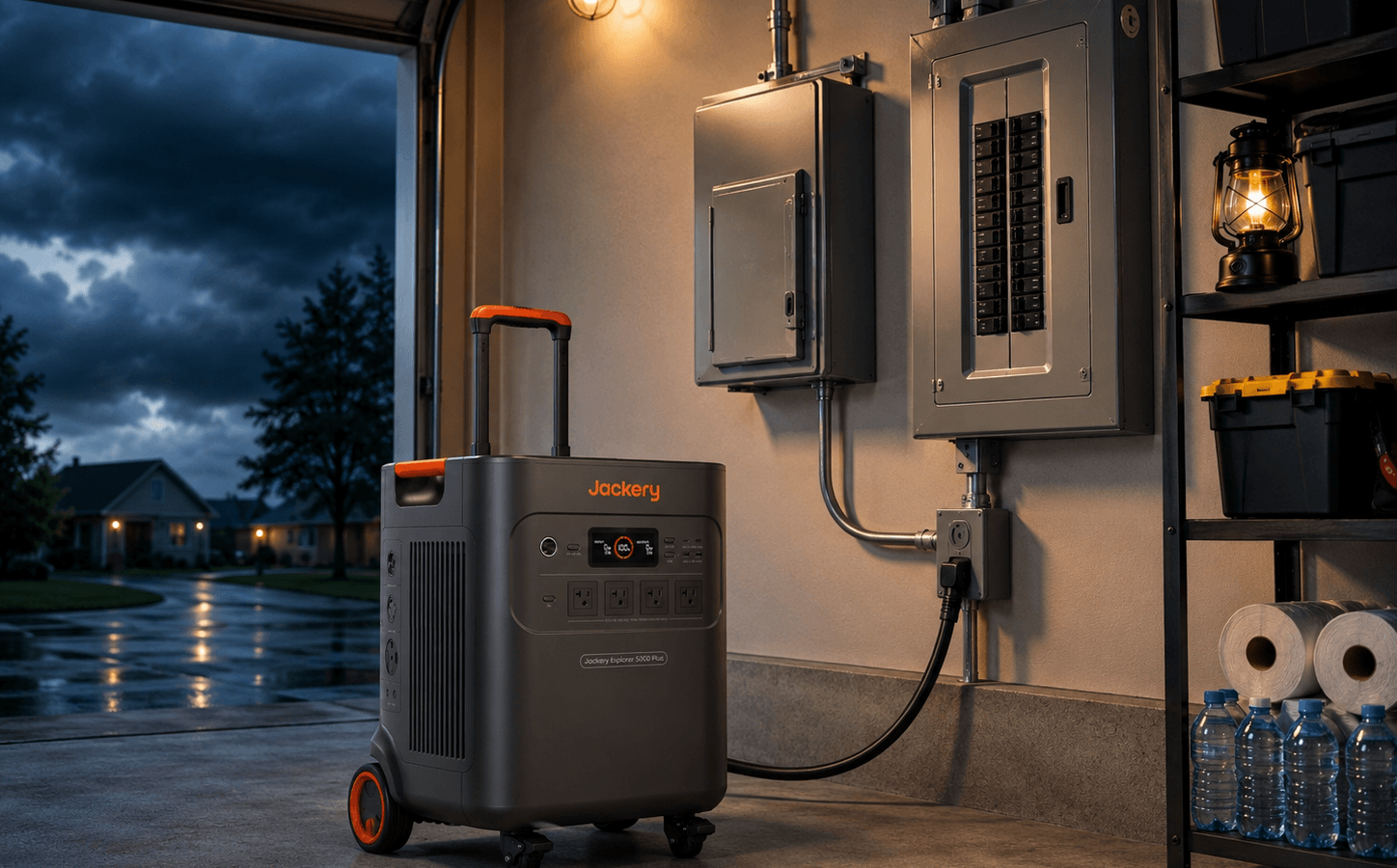
Jackery Explorer 5000 Plus Review verdict: this is a large 5,040Wh LiFePO4 portable power station for buyers who have a defined need for 120V and 240V output, selected-circuit planning, high-capacity home backup, or large RV and off-grid use. Jackery lists 7,200W maximum AC output, 14,400W surge, four 120V outlets, 120V/240V NEMA output support, and expansion up to 60kWh in its maximum two-unit, ten-battery system. The important trade-off is equally clear: the base unit weighs about 134.5 lb and needs a dedicated location, realistic cable plan, and deliberate load priorities.
This Jackery Explorer 5000 Plus Review is research-led. It uses current official Jackery product documentation, the verified U.S. retail identity, and PowerLabPro buyer-fit analysis. It does not claim hands-on or laboratory testing. The useful buying question is not whether the station has an impressive battery number. It is whether its voltage options, capacity, output, charging paths, expansion architecture, weight, and system requirements solve the actual problem you need to solve.
The Jackery Explorer 5000 Plus Review is most positive for a buyer who has already measured essential loads and knows why a compact 1kWh or 2kWh station is no longer enough. It is not a default recommendation for phones, Wi-Fi, lights, a laptop, and a small fan. A smaller product is normally easier to move, store, recharge, and use safely when those are the real needs.
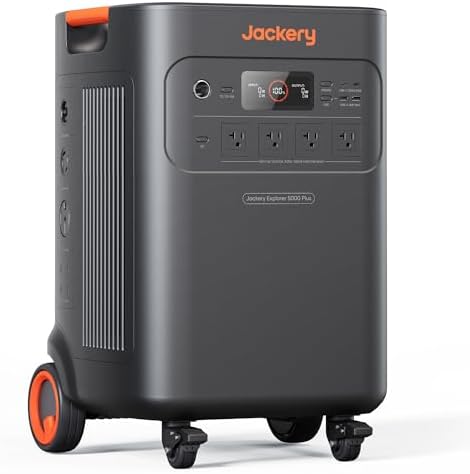
- Handles Even the Big Appliances: Run major home appliances with 7200W of rated power (14,400W surge). Supports both 120V…
- Backup That Lasts for 13 Days: A 5040Wh capacity, expandable up to 60kWh — enough to keep your home running through an e…
- More Power From the Sun: Compatible with both high-and low-voltage solar panels, recharge in about 2 hours with up to 40…
Table of Contents
Jackery Explorer 5000 Plus Review: Quick Verdict
The Jackery Explorer 5000 Plus Review verdict is conditional. It is a strong option for a buyer who wants a serious single-unit 120V/240V platform with a 5kWh base battery, a high continuous-output ceiling, documented selected-circuit options, and an expansion path that can grow after the buyer has tested real demand. It is a poor fit for someone who needs a grab-and-go outage kit or has never calculated which devices must run together.
- Best for: selected home essentials, compatible 120V and 240V loads, larger RV and off-grid planning, solar recovery, and staged high-capacity expansion.
- Not ideal for: basic electronics backup, frequent lifting, apartment storage, unchecked panel integration, or an unrestricted whole-home expectation.
- Main advantage: a 5,040Wh base battery with 7,200W total AC output and direct 120V/240V outlet options.
- Main limitation: 134.5 lb weight, a large physical footprint, and a system design that requires real planning to use responsibly.
This Jackery Explorer 5000 Plus Review treats the product as a rolling, planned-placement system. Its size can be justified in a garage, protected utility area, RV storage bay, cabin, or dedicated backup location. It is less suitable when a buyer has to carry it through stairs or clear a cluttered room during a storm. A well-placed system that is already charged and tested is more useful than a larger one that cannot be moved safely when needed.
Jackery Explorer 5000 Plus Review: Specifications That Matter
| Specification | Current official information | Buyer meaning |
|---|---|---|
| Battery capacity | 5,040Wh, 112V DC, 45Ah | Large stored energy for a selected-load plan, not a universal runtime promise. |
| Battery chemistry | LiFePO4 | Jackery lists 4,000 cycles to 70% or more capacity under stated conditions. |
| AC total output | 7,200W maximum | Shared system ceiling, not output available from every outlet independently. |
| Surge output | 14,400W | Short startup support, not a 14,400W continuous-load rating. |
| 120V outlets | Four 120V, 20A outlets, 3,600W maximum listed | Useful for familiar essential loads, within the total system budget. |
| 120V/240V outputs | NEMA L14-30R and NEMA 14-50 output support, 30A and 7,200W maximum listed | Useful only when the appliance, cable, and connection method match the documented setup. |
| USB and 12V | Two 100W USB-C, two 18W USB-A, and 12V/10A car outlet | Lets low-draw devices avoid taking an AC outlet. |
| AC charging | 3.5 hours via AC adapter listed | Actual time varies by battery state, temperature, and source conditions. |
| Solar inputs | High-PV 135 to 450V, 15A maximum; dual low-PV ports with 1,200W maximum listed | Solar needs a current manual, safe array design, and correct connectors. |
| UPS behavior | Backup UPS under 20ms; online UPS 0ms in stated applicable conditions | Do not assume identical transfer behavior for every device or wiring configuration. |
| Expansion | Up to 60kWh with two base units and ten Battery Pack 5000 Plus units | More runtime with more cost, equipment, floor space, and charging needs. |
| Weight and dimensions | About 134.5 lb; 16.5 × 15.5 × 25 in | Requires planned handling and a stable operating surface. |
| Warranty | Five years listed on the current official page | Verify direct-purchase and retailer eligibility before checkout. |
The official Jackery Explorer 5000 Plus product page is the controlling source for these electrical limits, ports, battery information, warranty context, and expansion architecture. This Jackery Explorer 5000 Plus Review uses that source rather than historic listing copy. Check the current manual before connecting solar, ordering a transfer accessory, building an expanded system, or relying on a particular UPS mode.
Who the Jackery Explorer 5000 Plus Fits
The Jackery Explorer 5000 Plus Review is most useful for a buyer whose priority list goes beyond communications and small lighting. That buyer may need a tested refrigerator, a pump or motor-driven device that has been checked for startup behavior, selected work equipment, a compatible RV plan, or 120V/240V capability that a standard portable station cannot provide. The system becomes valuable when those requirements are real and not merely hypothetical.
- Selected-circuit planners: homeowners who have identified the circuits and devices that matter, plus the approved connection method.
- Large RV owners: users who have verified the actual voltage, plug, appliance demand, and cable requirements of their rig.
- Solar-recovery buyers: people who have a realistic place and budget for a correctly matched high-PV or low-PV array.
- Staged-expansion buyers: households that want to begin with one 5kWh unit and expand only after testing runtime needs.
- Mobile-work planners: buyers with a measured power list for communications, battery chargers, lighting, tools, and compatible equipment.
For these buyers, the Jackery Explorer 5000 Plus can be more practical than a smaller station because it begins with more stored energy and has a higher system-output ceiling. It is not automatically the best choice just because it is larger. The buyer still needs to compare the system cost, physical placement, solar plan, expansion costs, and the duty cycle of the intended loads.
Use the PowerLabPro power-station sizing guide before moving into this category. The Jackery Explorer 5000 Plus Review recommends starting with the watts and hours that matter, then choosing the smallest verified system that has the correct voltage, recovery path, and margin for actual use.
Who Should Skip the Jackery Explorer 5000 Plus
The Jackery Explorer 5000 Plus Review does not recommend buying this system for a simple router, phone, laptop, and lighting plan. Those loads can often be covered by a smaller, less expensive, easier-to-store platform. Overbuying can create avoidable handling and setup problems without delivering a more useful outcome during an outage.
- Apartment and light-backup buyers: the weight and size are usually unnecessary for communications-first backup.
- Frequent-carry buyers: a 134.5 lb system is not a routine carry battery even when it can be rolled.
- Unplanned whole-home buyers: a large portable power station does not replace a designed electrical backup system.
- Heating and cooling buyers: high-draw loads can consume stored energy quickly even where output compatibility exists.
- Critical-device buyers: medical, life-safety, server, and security equipment require their own approved backup design.
The Jackery Explorer 5000 Plus Review also cautions against treating high output as a substitute for the correct voltage, transfer method, or installation. A product can be powerful enough on paper and still be wrong for the intended appliance, RV, panel, or circuit. Confirm the device, the electrical connection, and the permitted operating mode before spending money on a large system.
Capacity, Output, and Load Planning
The Jackery Explorer 5000 Plus Review separates capacity from output because buyers often combine them into one idea of “power.” Capacity is stored energy. Output is the maximum amount of power available at one time. A 5,040Wh battery can last a meaningful period with a conservative load plan, yet it can be depleted quickly by high-watt heating, cooking, or cooling devices.
The same principle applies to the 7,200W system rating. It means the system can support a broad group of compatible loads when their combined demand is within the published limits. It does not mean every outlet offers 7,200W, every appliance should run at once, or that the battery will provide that output for a long period. The 14,400W surge figure is a short startup capability, not a continuous-use number.
A refrigerator can be a sensible priority load when its startup behavior and running draw have been tested. A pump, compressor, large tool, RV appliance, microwave, electric kettle, or space heater needs equal care. The strongest use of the Jackery Explorer 5000 Plus is normally a tiered plan: communications and lighting first, food protection after compatibility checks, work equipment second, and convenience loads only when the remaining reserve supports them.
This Jackery Explorer 5000 Plus Review recommends writing the plan before buying. List each essential device, running watts, possible startup demand, desired hours, and whether it needs 120V, 240V, DC, or USB power. Then decide which devices cannot run together. This discipline provides a better result than selecting a large battery and hoping the electrical plan works later.
120V, 240V, and Selected-Circuit Boundaries
A major reason buyers consider the Jackery Explorer 5000 Plus is that it is not restricted to the ordinary 120V-only portable-station category. Jackery lists four 120V outlets plus 120V/240V NEMA L14-30R and NEMA 14-50 support. Those outlets can be useful for a compatible device or selected-circuit plan, but they do not remove the need for a correct inlet, cord, grounding approach, load assessment, and installation method.
The Jackery Explorer 5000 Plus Review treats 240V as a buyer-fit feature, not a general safety claim. Confirm that the appliance truly requires 240V, that its current draw fits the available output, that the connector and cable are correct, and that no other connected load pushes the system outside the published limits. Do not use an improvised adapter or treat a large outlet as permission to connect the station directly to a home panel.
For selected home circuits, Jackery offers a compatible Smart Transfer Switch. That is a system accessory, not a substitute for electrical planning. Use the current Jackery documentation, local-code requirements, and qualified electrical help when the project involves a transfer switch, inlet box, home panel, or hardwired circuits. Never backfeed a home electrical panel through a wall outlet.
Charging, Solar Recovery, and UPS Context
Charging and recovery deserve the same attention as capacity in this Jackery Explorer 5000 Plus Review. Jackery lists a 3.5-hour AC-adapter charge time. Its official page separately notes a 1.7-hour result through the Smart Transfer Switch configuration. Those are product-page conditions, not a guarantee for every circuit, starting charge level, temperature, or installation.
The solar system requires careful interpretation. Jackery lists a high-PV input from 135V to 450V at up to 15A and two low-PV DC 8mm ports, with up to 1,200W across the dual low-PV path. The low-PV and high-PV figures are electrical boundaries, not casual mix-and-match guidance. Use the current manual to verify panel open-circuit voltage, input current, connector type, polarity, configuration, and cable routing before connecting a solar array.
Jackery lists solar charging of 6.5 to 8.5 hours under its stated conditions. Treat that as planning context. Actual energy harvest changes with solar-array design, shade, weather, season, temperature, panel angle, cable losses, battery state, and the loads that remain connected while charging. A large battery can benefit from solar recovery, but solar is not a promise of unlimited power.
The Jackery Explorer 5000 Plus Review also needs precision on UPS claims. Jackery lists a backup UPS mode under 20ms and an online UPS result of 0ms in stated conditions. Jackery’s FAQ says the online mode applies when the unit is solely connected to home circuits and selected in the app, while a connection through the Smart Transfer Switch is described as 20ms because of the switch. Test the exact device before relying on continuity for computers, network storage, security systems, medical equipment, or other sensitive loads.
Expansion, Smart Transfer Switch, and System Limits
The Jackery Explorer 5000 Plus Review considers expansion a real benefit only when it resolves a measured runtime problem. Jackery states that one Explorer 5000 Plus with one Battery Pack 5000 Plus creates a 10kWh system, and that one base unit can use up to five packs for 30kWh. The 60kWh maximum needs two Explorer 5000 Plus base units and ten expansion batteries. That is a substantial multi-component system, not an add-on purchase for a casual backup kit.
Additional batteries can extend the duration of the same controlled load plan. They do not make heavy loads disappear, create unlimited runtime, or avoid the need for a charging strategy. Every added battery increases purchase cost, space, cable management, transport complexity, charging requirements, and the number of components that should be checked before an outage.
The Smart Transfer Switch can be useful for a buyer who wants a compatible selected-circuit path rather than extension cords across the home. It still needs proper equipment and professional installation where required. The Jackery Explorer 5000 Plus Review does not present it as an automatic whole-home solution or a reason to bypass normal electrical safety requirements.
Ports, App Control, Weight, and Placement
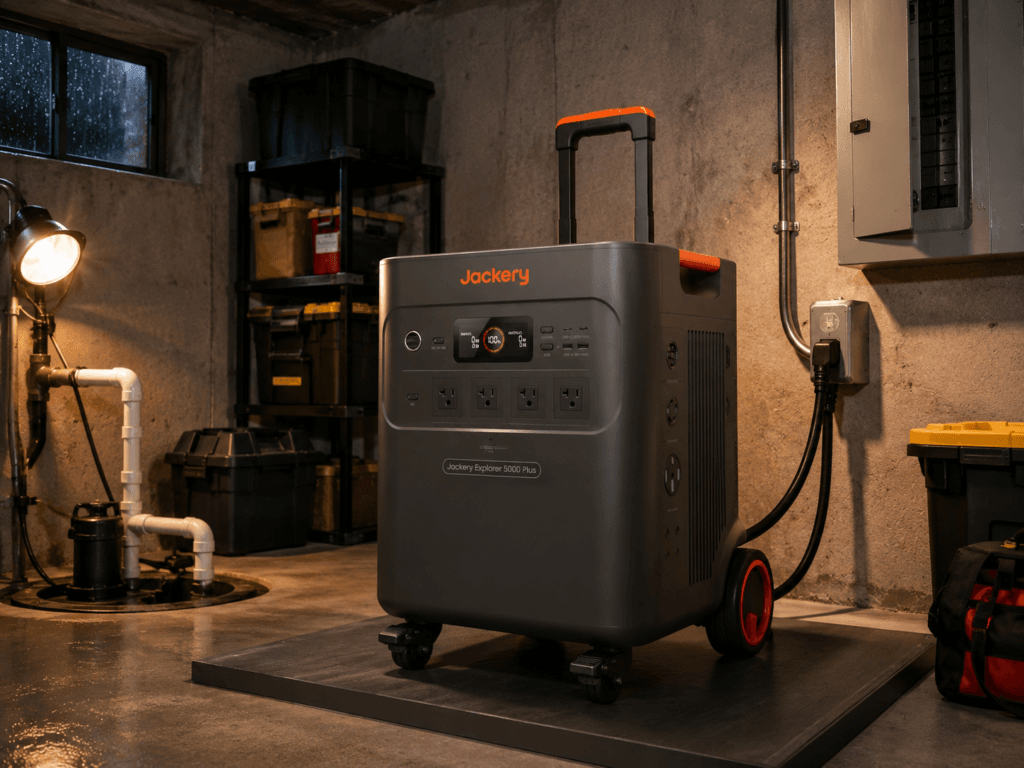
The Jackery Explorer 5000 Plus Review benefits from looking beyond the major AC specifications. Two 100W USB-C ports, two USB-A ports, and the 12V car outlet can keep compatible phones, tablets, laptops, cameras, lights, and accessories away from the AC side. That can make an essential-load setup cleaner and leave the AC outlets available for equipment that really needs them.
Jackery’s app can support monitoring and certain operating modes, but an app does not replace a safe setup. It cannot correct an overloaded circuit, a wrong solar array, damaged cables, poor ventilation, or an unplanned load mix. Keep the station dry, use a stable surface, allow airflow, keep cable paths clear of exits, and store the correct charging and connection accessories nearby.
At about 134.5 lb, moving the base unit should be planned. Measure the storage path, avoid last-minute stair carries, and ask for help where needed. The Jackery Explorer 5000 Plus Review considers physical handling part of the buying decision because a high-capacity product only helps when it can be placed, connected, and checked safely before the outage starts.
Practical Buyer Scenarios
Selected home essentials
For home backup, the Jackery Explorer 5000 Plus Review supports a selected-load plan rather than normal household behavior. A router, modem, phones, LED lights, laptop work, refrigerator after compatibility testing, and a few selected devices can form a sensible outage priority group. The key is deciding which loads remain on and which ones wait until power returns or solar recovery is available.
A high-watt convenience device can be compatible yet still be a poor use of stored energy. Cooking, heating, and cooling loads can change the runtime calculation quickly. The more disciplined plan protects food, communication, light, work, and safety needs first.
Large RV and off-grid planning
For a compatible RV or off-grid setup, the 120V and 240V options, 12V output, solar inputs, and high inverter ceiling can all be relevant. The Jackery Explorer 5000 Plus should not be treated as unlimited shore power. Confirm the rig’s inlet, expected loads, cable condition, grounding approach, and whether air conditioning, cooking, heating, or charging equipment can operate within the real battery and output budget.
Garage, cabin, and controlled mobile work
The Jackery Explorer 5000 Plus can be useful in a garage, cabin, or controlled mobile-work setting where a large battery remains in one place. It can support communication gear, charging equipment, lighting, cameras, and selected tools that have been tested in advance. An unmeasured commercial jobsite, compressor-heavy setup, or load that requires continual 240V output needs a more specific technical assessment.
Alternatives and Decision Paths
The Jackery Explorer 5000 Plus Review should be compared with alternatives that solve a different buyer problem. The connected Jackery Explorer 5000 Plus Product reference is the central record for the model identity, structured facts, ASIN, and affiliate destination. This Review explains the practical decision boundaries.
Compare the Anker SOLIX F3800 Plus Product reference when a different 120V/240V backup architecture, expansion ecosystem, or higher-output platform is the more relevant starting point. Compare the Goal Zero Yeti PRO 4000 Review when a 4kWh 120V platform with Tank PRO expansion is more aligned with the use case. Read the Jackery Explorer 5000 Plus versus Anker SOLIX F3800 Plus comparison after both product roles are clear.
The right alternative depends on voltage requirements, actual load list, recovery plan, desired expansion range, portability limits, service ecosystem, and total system cost. The Jackery Explorer 5000 Plus Review is strongest when 5kWh base storage and direct 120V/240V output solve a problem that the smaller categories do not.
What to Verify Before Buying
| Verify | Why it matters |
|---|---|
| Priority-load watts and required hours | They show whether 5,040Wh is appropriate before expansion batteries are considered. |
| Combined AC demand | All AC loads share the published total output limit. |
| Motor and compressor startup behavior | Refrigerators, pumps, tools, and RV equipment can draw more at startup than during normal running. |
| 120V or 240V need | Correct voltage, plug, cable, and outlet selection are required for safe operation. |
| Solar-array electrical limits | High-PV and low-PV paths have different voltage and current limits. |
| UPS mode for exact equipment | Backup UPS and online UPS behavior are mode- and configuration-dependent. |
| Transfer-switch plan | Selected-circuit backup needs compatible equipment and appropriate installation. |
| Weight and placement | 134.5 lb requires a clear moving route and a stable, ventilated operating surface. |
| Current retail identity | Confirm ASIN B0DFGLG35L, seller, included accessories, warranty eligibility, and return terms at checkout. |
For broader outage preparation, read Ready.gov’s power-outage guidance. Never backfeed a home electrical panel through a wall outlet, use improvised high-current adapters, or rely on a portable station as a substitute for a code-compliant transfer system or an approved medical-device backup plan. The Jackery Explorer 5000 Plus Review does not change those safety boundaries.
Jackery Explorer 5000 Plus FAQ
Is the Jackery Explorer 5000 Plus good for home backup?
The Jackery Explorer 5000 Plus can be a strong choice for a selected-load home-backup plan that needs a 5kWh base battery, high output, or 120V/240V capability. It is not an automatic whole-home solution. The value depends on the loads, circuits, recovery plan, and connection method being documented before purchase.
Can the Jackery Explorer 5000 Plus run a refrigerator?
It may support many refrigerator plans within the published output limits, but runtime is specific to the refrigerator and the rest of the load mix. Compressor startup, cycling, temperature, door openings, and connected devices all affect the result. Test the exact appliance before treating it as an outage priority.
Does the Jackery Explorer 5000 Plus provide 240V output?
Yes. Jackery lists 120V/240V NEMA L14-30R and NEMA 14-50 output support, with 7,200W maximum total output. The appliance, plug, cable, and wiring plan must still be compatible with the published conditions.
How fast does the Jackery Explorer 5000 Plus recharge?
Jackery lists a 3.5-hour AC-adapter charge time and a separate 1.7-hour Smart Transfer Switch result under stated conditions. Solar charging is listed at 6.5 to 8.5 hours under stated conditions. Actual performance varies with source, array design, battery state, and environment.
Is the Jackery Explorer 5000 Plus expandable?
Yes. One base unit can be paired with up to five Battery Pack 5000 Plus units for 30kWh. Jackery lists up to 60kWh only for a two-unit, ten-battery system. Expansion adds runtime and also adds cost, space needs, cables, charging requirements, and complexity.
Is this a hands-on Jackery Explorer 5000 Plus Review?
No. This Jackery Explorer 5000 Plus Review is research-led and uses official current documentation plus verified product identity. PowerLabPro does not claim hands-on or lab testing.
Final Jackery Explorer 5000 Plus Review Decision
The final Jackery Explorer 5000 Plus Review conclusion is that this is a serious high-capacity portable platform for a buyer who needs a 5,040Wh base reserve, 7,200W total output, real 120V/240V capability, a planned solar path, and an expansion system that can grow after measured testing. Its strongest role is controlled home backup, compatible RV or off-grid use, and selected-circuit preparation.
Skip the Jackery Explorer 5000 Plus when the actual need is small-device backup, frequent carrying, a vague whole-home expectation, or a system that can be purchased without planning. The best decision is still the smallest verified power platform that safely supports the priority loads for the required hours and can be recharged using the system you will actually maintain.
Testing Notes
- Manufacturer documentation reviewed: Jackery Explorer 5000 Plus current product page and published specifications.
- Retail identity verified: Amazon ASIN B0DFGLG35L.
- PowerLabPro has not performed hands-on or laboratory testing.