
Review
Jackery HomePower 3600 Plus Review: Who Should Buy It?
The HomePower 3600 Plus suits buyers who need expandable 120V home or RV backup with 3,584Wh capacity, 3,600W output, TT-30, and rolling mobility. Skip it for light loads, frequent lifting, or a plan that assumes one unit supplies ordinary 240V circuits.
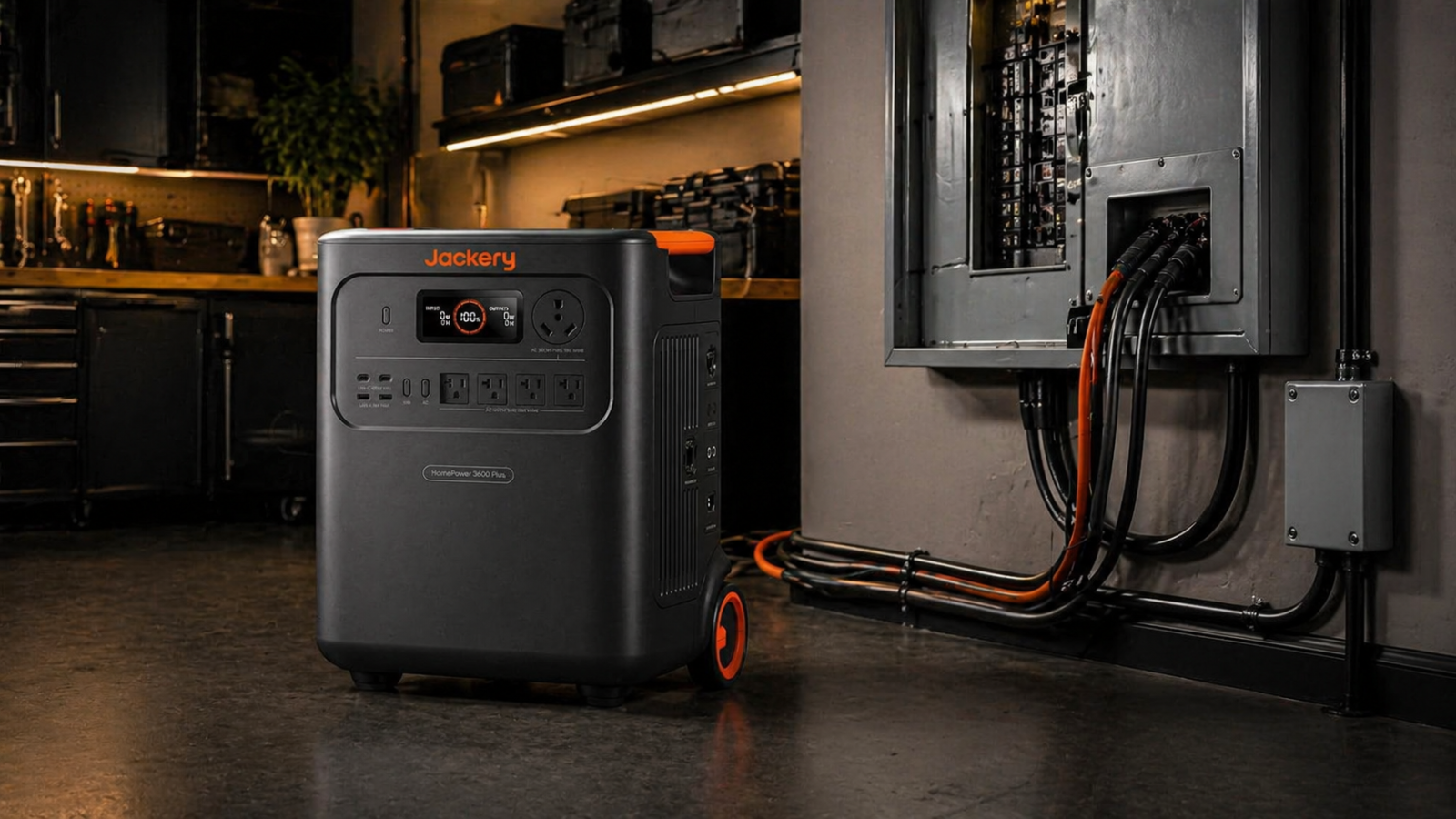
Linked Product Snapshot
Core specs
Buyer Fit
Pros and tradeoffs
Strengths
Pros
- Large 3,584Wh LiFePO4 battery
- 3,600W AC output
- 7,200W listed surge output
- Less than 10ms listed UPS transfer
- Expandable up to 21kWh per unit
- Up to 43kWh with multiple units
- Rolling design with telescopic handle
- 4 AC outlets including NEMA TT-30 RV output
- 2 × 100W USB-C output
- Jackery app support
- 5-year warranty structure
Tradeoffs
Cons
- Heavy at 77.2 lb
- Solar input is lower than some larger competitors
- Car socket is not listed by Jackery
- Expansion adds cost and storage space
- Not ideal for lightweight portable use
- Overkill for phones, Wi-Fi, laptops, and lights only
The Jackery HomePower 3600 Plus review decision is not simply whether 3,584Wh sounds large. The better question is whether a 120V, 3,600W rolling battery with a TT-30 outlet and an expansion path matches your actual outage or RV plan. For a measured group of essential loads, it can be a strong fit. For central air, electric heat, every household circuit, or frequent lifting, it can be the wrong tool.
This Jackery HomePower 3600 Plus review is research-led and based on current manufacturer documentation, the verified PowerLabPro Product record, and current public listing identity. PowerLabPro does not claim hands-on or laboratory testing. Verify the exact bundle, Smart Transfer Switch compatibility, expansion batteries, outlet requirements, and current warranty terms before purchase.
Jackery HomePower 3600 Plus Review: Quick Verdict
The short conclusion from this Jackery HomePower 3600 Plus review is clear: choose the HomePower 3600 Plus when you need a serious 120V essential-load platform that starts at 3,584Wh, supplies 3,600W of listed AC output, rolls instead of requiring routine lifting, and can expand after you measure a real runtime shortfall.
Best for: homeowners, preparedness buyers, and RV users who have a written priority-load list and want a large but still movable battery system with TT-30 output, app monitoring, less-than-10ms listed UPS transfer, and modular expansion.
Not ideal for: buyers who only need phones, Wi-Fi, lights, and laptops; anyone expecting one unit to power ordinary 240V household loads; or households that need automatic, code-compliant whole-home coverage without separately planned transfer equipment.
The main advantage in this Jackery HomePower 3600 Plus review is flexibility. The main drawback is that flexibility can encourage overbuying. A 3.6kWh-class battery still has finite stored energy, and high-draw heating, cooling, and cooking loads can consume that reserve quickly even when the inverter can operate them.
Who Should Buy the HomePower 3600 Plus?
The strongest buyer for this Jackery HomePower 3600 Plus review has already listed the loads that must remain available during an outage. That list may include a refrigerator or freezer, modem and router, phones, lights, laptop work, a television, medical-device support only where the device manufacturer permits it, and one or two carefully scheduled appliances.
- Measured home-backup planners: You know the running watts, startup behavior, and daily energy use of your priority devices.
- RV owners: Your rig uses a compatible 120V TT-30 connection, and you understand that air conditioning or electric heating can dominate battery use.
- Expansion-minded buyers: You want to begin with one unit and add compatible battery capacity only after a controlled runtime test shows a real need.
- Preparedness households: You can keep the unit charged, dry, ventilated, accessible, and connected through safe equipment.
This Jackery HomePower 3600 Plus review also favors buyers who value mobility more than compactness. The retractable handle and wheels make room-to-room or garage-to-driveway movement more practical, but the listed 77.2-pound weight means it is not a casual carry product.
Who Should Skip It?
A useful Jackery HomePower 3600 Plus review must say who should spend less, choose another architecture, or use a different backup method. The HomePower 3600 Plus is not automatically better because it is larger than a 1kWh station.
- Light-load users: A smaller LiFePO4 station may cover a router, phones, LED lights, and laptop work with less cost and storage burden.
- Frequent-carry users: Wheels help on smooth surfaces, but stairs, vehicles, and uneven terrain still require a realistic handling plan.
- Single-unit 240V buyers: One HomePower 3600 Plus is a 120V system. Ordinary 240V support requires the verified paired-system path and compatible transfer equipment.
- High-draw, long-runtime users: Space heaters, electric water heating, central air, electric ranges, and dryers can exceed the practical energy budget even when output is sufficient.
- Life-safety planners: Do not treat a consumer portable battery as a substitute for code-governed fire, medical, communications, or professionally designed standby systems.
The practical message from this Jackery HomePower 3600 Plus review is to buy the smallest verified system that covers the essential plan with reserve. Extra capacity is valuable only when it solves a measured duration problem.
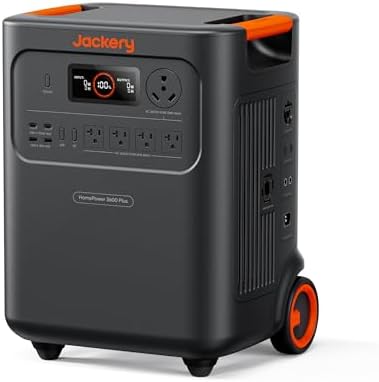
- Essential Home Backup: The Jackery HomePower 3600 Plus delivers 3600W output (7200W in parallel) to run pumps, heaters, …
- Safe Power That Lasts: Built with high-temp resistant ceramic membrane battery cells tested at 302 °F, the Jackery HomeP…
- Plug-and-Play: With its easy plug-and-play design, the Jackery HomePower 3600 Plus, paired with MTS, powers your home ef…
Table of Contents
Verified Specifications and Buyer Meaning
The figures in this Jackery HomePower 3600 Plus review are limited to current manufacturer-listed specifications that materially change the decision. Output, capacity, surge, solar input, and expansion describe different limits and should not be combined into one headline claim.
| Specification | Current manufacturer-listed value | What it means for the buyer |
|---|---|---|
| Battery capacity | 3,584Wh | The starting energy reserve before conversion losses, battery settings, temperature, and load behavior are considered. |
| AC output | 3,600W | The listed combined running-load ceiling for one unit. |
| Surge output | 7,200W | Temporary startup headroom, not continuous power. |
| Battery chemistry | LiFePO4 | A chemistry commonly selected for repeated backup cycling and longer service-life planning. |
| System voltage | 120V from one unit | A single station does not provide ordinary 240V output by itself. |
| Paired 240V path | Two units with compatible Smart Transfer Switch setup | A system-level option that adds cost, equipment, installation, and planning. |
| UPS transfer | Less than 10ms listed | Potentially useful for compatible devices, but not a universal 0ms guarantee. |
| Solar input | Up to 1,200W listed | A ceiling under compatible conditions, not guaranteed solar harvest. |
| Expansion | Up to 21kWh per unit; up to 43kWh in a dual-unit system | Capacity can grow substantially, with corresponding cost, space, and recharge implications. |
| RV connection | 120V NEMA TT-30 | Useful only after confirming the RV, adapter, cable, and load plan. |
| Weight | 77.2 lb listed | Rolling mobility, not lightweight portability. |
Jackery also lists four AC outlets, two 100W USB-C outputs, two 18W USB-A outputs, app support, a retractable handle, and wheels. In this Jackery HomePower 3600 Plus review, those features improve connection and ownership convenience, but they do not change the battery-energy calculation.
For current specifications and bundle details, use the official Jackery HomePower 3600 Plus page. A base station, solar bundle, expansion package, dual-unit package, and Smart Transfer Switch configuration are materially different purchases.
Is 3.6kWh Enough for Your Outage Plan?
The central planning question in this Jackery HomePower 3600 Plus review is not “How many appliances can it start?” It is “How much energy will the priority list consume before reliable recharging is available?” Capacity is measured in watt-hours, while appliance power is measured in watts. Runtime depends on both.
A simple planning estimate is: usable AC energy ÷ average combined load = approximate operating time. Use a conservative usable-energy allowance rather than dividing by the full 3,584Wh rating. Inverter losses, battery reserve settings, cold or hot conditions, appliance cycling, and battery age all reduce real-world energy delivered to AC loads.
| Planning step | What to record | Why it matters |
|---|---|---|
| 1. List essential loads | Device name, running watts, startup demand | Prevents optional devices from consuming the reserve. |
| 2. Record duty cycle | Continuous, intermittent, or scheduled | A refrigerator does not draw its running wattage every minute. |
| 3. Estimate daily energy | Watts × hours of operation | Converts a power rating into an energy requirement. |
| 4. Add simultaneous-load check | Which devices run together | Protects the 3,600W output ceiling and startup margin. |
| 5. Keep reserve | Energy held back for communications, lighting, and uncertainty | Avoids planning to zero percent battery. |
| 6. Define recharge path | Grid, solar, generator-assisted charging where safely supported, or vehicle-related option | Determines whether the plan lasts beyond the first battery cycle. |
This Jackery HomePower 3600 Plus review recommends writing three columns before buying: “must run,” “can cycle,” and “can wait.” A refrigerator may need regular cycles, while a coffee maker can be scheduled and electric heat may need a completely different plan.
Use the PowerLabPro power station sizing guide to separate running watts, startup demand, stored watt-hours, conversion losses, and outage duration.
120V, Paired 240V, and the Pro Max Difference
This section corrects a common oversimplification. One HomePower 3600 Plus is a 120V system. Current Jackery documentation also describes a paired two-unit system used with the compatible Smart Transfer Switch for 240V household support. Therefore, the right Jackery HomePower 3600 Plus review conclusion is not that the 3600 Plus can never support 240V. It is that 240V is a paired-system capability, not a single-unit capability.
| Decision path | HomePower 3600 Plus | HomePower 3600 Pro Max | Buyer implication |
|---|---|---|---|
| Single-unit output | 3,600W, 120V | 4,000W, 120V | The Pro Max offers higher listed single-unit output. |
| Single-unit capacity | 3,584Wh | 3,584Wh | Starting energy is similar; output and ecosystem details drive the choice. |
| 240V path | Paired units plus compatible Smart Transfer Switch | Paired units plus compatible Smart Transfer Switch | Neither should be described as a one-box 240V solution under current official documentation. |
| Expansion ceiling | Up to 21kWh per unit listed | Up to 14.3kWh per unit listed | The 3600 Plus has the larger listed per-unit expansion ceiling. |
| Weight | 77.2 lb listed | 88.2 lb listed | The 3600 Plus is lighter, though both are heavy rolling systems. |
The buyer takeaway from this Jackery HomePower 3600 Plus review is straightforward. Choose the 3600 Plus when 3,600W single-unit output is enough and its lighter weight, TT-30 RV fit, and expansion ceiling better match the plan. Compare the HomePower 3600 Pro Max Review when the additional single-unit output or its specific system architecture matters.
Any transfer-switch or household-circuit installation must match the manufacturer instructions, equipment listing, local electrical requirements, and the home’s actual loads. Use qualified electrical help when the setup extends beyond ordinary appliance cords.
Home Backup Fit and Realistic Load Priorities
For home backup, this Jackery HomePower 3600 Plus review is strongest when the goal is continuity, not normal-life duplication. Food preservation, communication, basic lighting, device charging, remote work, and selected comfort loads usually deserve priority over high-draw convenience appliances.
A refrigerator or freezer is a common target, but there is no responsible fixed runtime number without appliance data. Compressor cycling, room temperature, door openings, food load, appliance age, defrost cycles, and other connected devices all change energy use. Measure with an appropriate energy meter when practical, then build reserve around the result.
The 3,600W inverter gives this Jackery HomePower 3600 Plus review enough output headroom for many selected-load plans, but output headroom is not the same as long runtime. A 1,500W space heater can use roughly 1.5kWh in one hour of continuous operation before losses. That can consume a large share of the battery even though the station can run the heater.
Never backfeed a household panel through a wall outlet. Follow manufacturer instructions and use compatible transfer equipment installed and operated correctly. Review Ready.gov power-outage guidance for broader preparedness steps, including food, communications, lighting, and safe alternative plans.
This Jackery HomePower 3600 Plus review therefore treats the HomePower 3600 Plus as a selected-load system. It may become part of a larger household setup, but the battery alone does not prove whole-home capability, automatic transfer, or sufficient duration for every circuit.
RV Use and the TT-30 Outlet
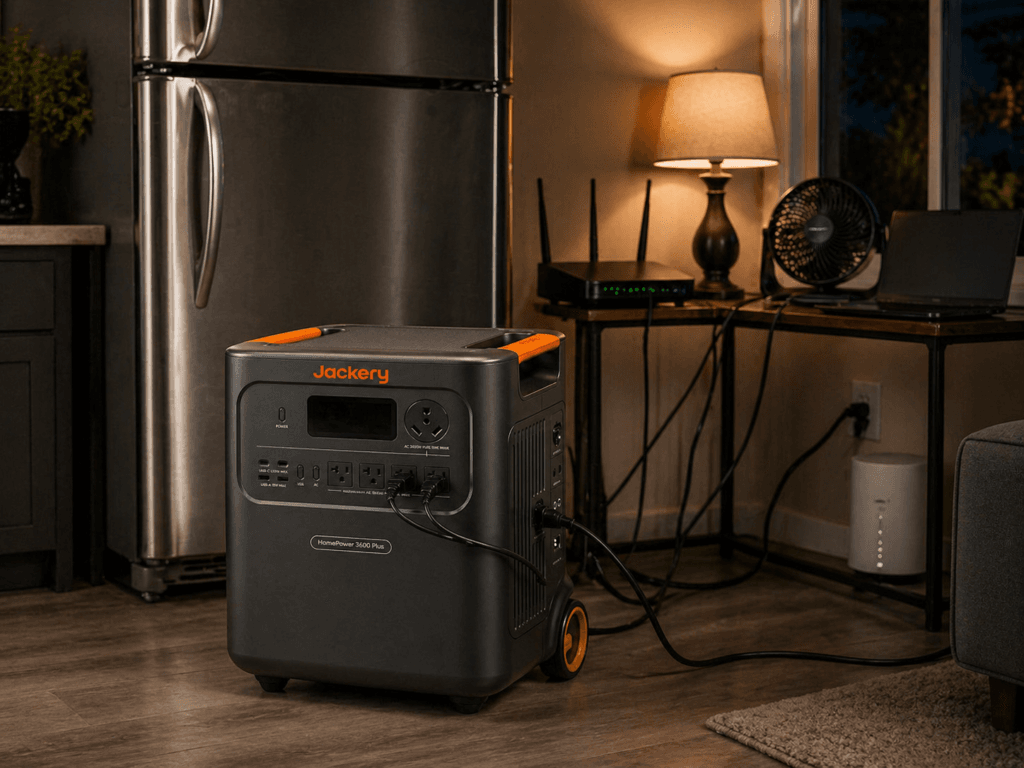
The TT-30 outlet gives this Jackery HomePower 3600 Plus review a clear RV angle. It provides a defined 120V connection path for compatible recreational vehicles, but the connector does not guarantee that every appliance can run together or that an air conditioner will operate for the desired duration.
Before connecting an RV, verify the rig’s inlet, cable rating, grounding arrangement, surge protection, converter behavior, battery charger, air-conditioner startup demand, and total simultaneous load. Do not confuse a 30-amp connector shape with unlimited 30-amp operation for an entire trip.
For boondocking, the better Jackery HomePower 3600 Plus review question is how the battery will be recovered. Solar input may reduce net daily consumption when weather and panel placement cooperate, but shade, season, temperature, cable losses, orientation, and the 1,200W listed input ceiling control the result.
Buyers who mainly need phones, cameras, lights, and occasional cooking may be better served by a smaller station. The 3600 Plus earns its RV space when the TT-30 connection, larger reserve, rolling design, and expansion path solve a real load-duration problem.
UPS, Charging, Solar, and Expansion
Jackery lists less than 10ms UPS transfer for the HomePower 3600 Plus. In this Jackery HomePower 3600 Plus review, that is treated as a useful compatibility feature, not a promise that every computer, server, medical device, networking system, or critical controller will ride through every transfer. Check the connected equipment requirements and test the actual setup before relying on it.
A dedicated UPS may still be preferable for sensitive electronics that require documented transfer characteristics, power conditioning, management software, or graceful shutdown. The HomePower 3600 Plus can support the broader battery reserve while a dedicated UPS handles the most sensitive device, where the equipment makers permit that arrangement.
Charging claims in this Jackery HomePower 3600 Plus review also need conditions. Jackery lists up to 1,200W solar input and describes rapid charging under compatible conditions. Those figures are ceilings or controlled-condition results, not promises for every panel array, extension cable, weather condition, or bundle.
Expansion is more important than headline charging speed for many buyers. The listed path to 21kWh per unit lets a household begin with 3,584Wh and add capacity after measuring actual use. However, each additional battery increases purchase cost, storage needs, cable management, recharge time, and the importance of a written operating plan.
The best expansion strategy from this Jackery HomePower 3600 Plus review is staged: test the base unit with the real priority list, record the lowest state of charge reached, identify the missing reserve, and expand only when the evidence supports it.
Portability, Noise, and Daily Ownership
At 77.2 pounds, the HomePower 3600 Plus belongs in the rolling-backup category. This Jackery HomePower 3600 Plus review does not describe it as lightweight. The handle and wheels are useful on level surfaces, but stairs, vehicle loading, gravel, snow, and emergency relocation can still require a second person or a safer handling method.
Plan where the unit will live before purchase. It should remain dry, ventilated, protected from impact, within safe cable reach of priority loads, and accessible for periodic charging and inspection. Do not block vents or place the station where water intrusion is possible.
Battery systems avoid the combustion, fuel-storage, exhaust, and carbon-monoxide hazards of gasoline generators, but they still require electrical and battery safety. The quieter indoor-use advantage in this Jackery HomePower 3600 Plus review does not remove the need to follow temperature, ventilation, cable, loading, and storage instructions.
App monitoring can make daily ownership easier by showing charge state and usage, but it is not a substitute for local controls or a written outage procedure. Everyone expected to use the system should know which loads are allowed, which are prohibited, and how much reserve must remain.
Pros and Cons
The pros and cons below summarize the buyer decision from this Jackery HomePower 3600 Plus review, not a laboratory score.
| Pros | Cons |
|---|---|
| 3,584Wh starting capacity for serious selected-load planning | Too large and costly for basic phone, Wi-Fi, light, and laptop backup |
| 3,600W listed single-unit AC output with 7,200W surge | One unit is 120V only |
| TT-30 RV outlet plus four AC outlets and high-output USB-C | RV air conditioning and electric heat can drain capacity quickly |
| Less-than-10ms listed UPS transfer for compatible equipment | Not a universal replacement for a dedicated UPS |
| Expansion to up to 21kWh per unit listed | Expansion adds cost, weight, storage, cables, and recharge demand |
| Rolling handle-and-wheel design | 77.2-pound listed weight still complicates stairs and vehicle loading |
| Dual-unit 240V system path with compatible transfer equipment | 240V requires another unit and system-level equipment, not a simple one-box setup |
The strongest reason to buy after reading this Jackery HomePower 3600 Plus review is that the base unit can grow with a measured plan. The strongest reason to skip it is that a smaller system may cover the same essentials more simply.
Better Alternatives for Different Buyers
Alternatives in this Jackery HomePower 3600 Plus review are matched to different buyer problems. They are not a ranking of universally better products.
| Alternative | Choose it when | Why the 3600 Plus may still fit better |
|---|---|---|
| Jackery HomePower 3000 | You want a simpler, smaller Jackery home-backup platform and do not need the same expansion ceiling or TT-30 role. | The 3600 Plus offers the larger base reserve, TT-30 connection, and a more extensive expansion path. |
| Anker SOLIX F3000 | You want to compare another rolling 3kWh-class platform and its ecosystem, connection options, and solar architecture. | The 3600 Plus may suit buyers who prioritize the Jackery ecosystem, TT-30 outlet, or its listed expansion ceiling. |
| Anker SOLIX F3800 Plus | You need a higher-output 120V/240V-oriented platform and are prepared for a larger system class. | The 3600 Plus is lighter and may be less excessive for a controlled 120V essential-load or RV plan. |
| Jackery Explorer 5000 Plus | Measured runtime needs justify a 5kWh-class starting battery and a more demanding home-backup architecture. | The 3600 Plus is easier to justify when 3,584Wh covers the priority list and expansion can wait. |
| Jackery HomePower 3600 Pro Max | You need its higher listed single-unit output and its specific ecosystem trade-offs. | The 3600 Plus is lighter and has a higher listed per-unit expansion ceiling under current manufacturer documentation. |
The connected Jackery HomePower 3600 Plus Product page stores the concise central product reference. Use it with this Jackery HomePower 3600 Plus review, the official manufacturer page, and the exact current listing before choosing a bundle.
Frequently Asked Questions
Can one HomePower 3600 Plus run a whole home?
One unit should not be treated as an automatic whole-home solution. This Jackery HomePower 3600 Plus review supports a selected-load approach based on 120V output, measured energy use, compatible equipment, and finite battery capacity. High-draw and 240V loads require separate verification and may require a paired system or another architecture.
Can the HomePower 3600 Plus provide 240V power?
A single HomePower 3600 Plus is a 120V system. Current Jackery documentation describes a 240V path using two compatible units with the Smart Transfer Switch. That is a system-level configuration with additional equipment, cost, installation, and load-planning requirements.
How long can it run a refrigerator?
There is no honest universal runtime number. This Jackery HomePower 3600 Plus review recommends measuring the refrigerator’s daily energy use and accounting for compressor cycling, defrost behavior, temperature, door openings, battery conversion losses, and all other connected loads.
How much solar input does it accept?
Jackery currently lists up to 1,200W solar input for the HomePower 3600 Plus. Treat that as an input ceiling under compatible conditions. Actual energy harvested depends on panel selection, weather, season, shade, orientation, temperature, and cable losses.
Can it replace a dedicated UPS?
Not automatically. Jackery lists less-than-10ms transfer, which may work for compatible equipment. This Jackery HomePower 3600 Plus review recommends checking device requirements and testing the actual setup. Sensitive or critical equipment may still need a dedicated UPS or professionally designed backup system.
Final Verdict
The final Jackery HomePower 3600 Plus review verdict is positive for a specific buyer: someone who needs a rolling 3,584Wh, 3,600W 120V backup platform, values the TT-30 RV outlet, wants modular expansion, and is willing to build the purchase around measured loads rather than headline numbers.
Choose the HomePower 3600 Plus when the base battery covers a meaningful essential-load plan and the expansion path protects against future runtime needs. Its strongest role is selected home backup, RV power, and preparedness where the owner has already separated must-run devices from optional high-draw loads.
Skip it when a compact battery would cover the real need, when frequent lifting is unavoidable, or when the plan depends on one unit supplying ordinary 240V household loads. The most important conclusion from this Jackery HomePower 3600 Plus review is that architecture matters as much as capacity. One unit is 120V; paired 240V support requires compatible system equipment; and every runtime claim depends on the actual energy budget.