
Review
EcoFlow DELTA Pro 3 Review: Single-Unit 240V Backup Done Right
The EcoFlow DELTA Pro 3 is the right buy when 240V loads and whole-home essential backup are in the plan: single-unit 240V, 4000W continuous, 2600W solar, and a 48kWh ceiling. It is the wrong buy for basic fridge-and-router backup, tight budgets, or buyers without 240V loads.
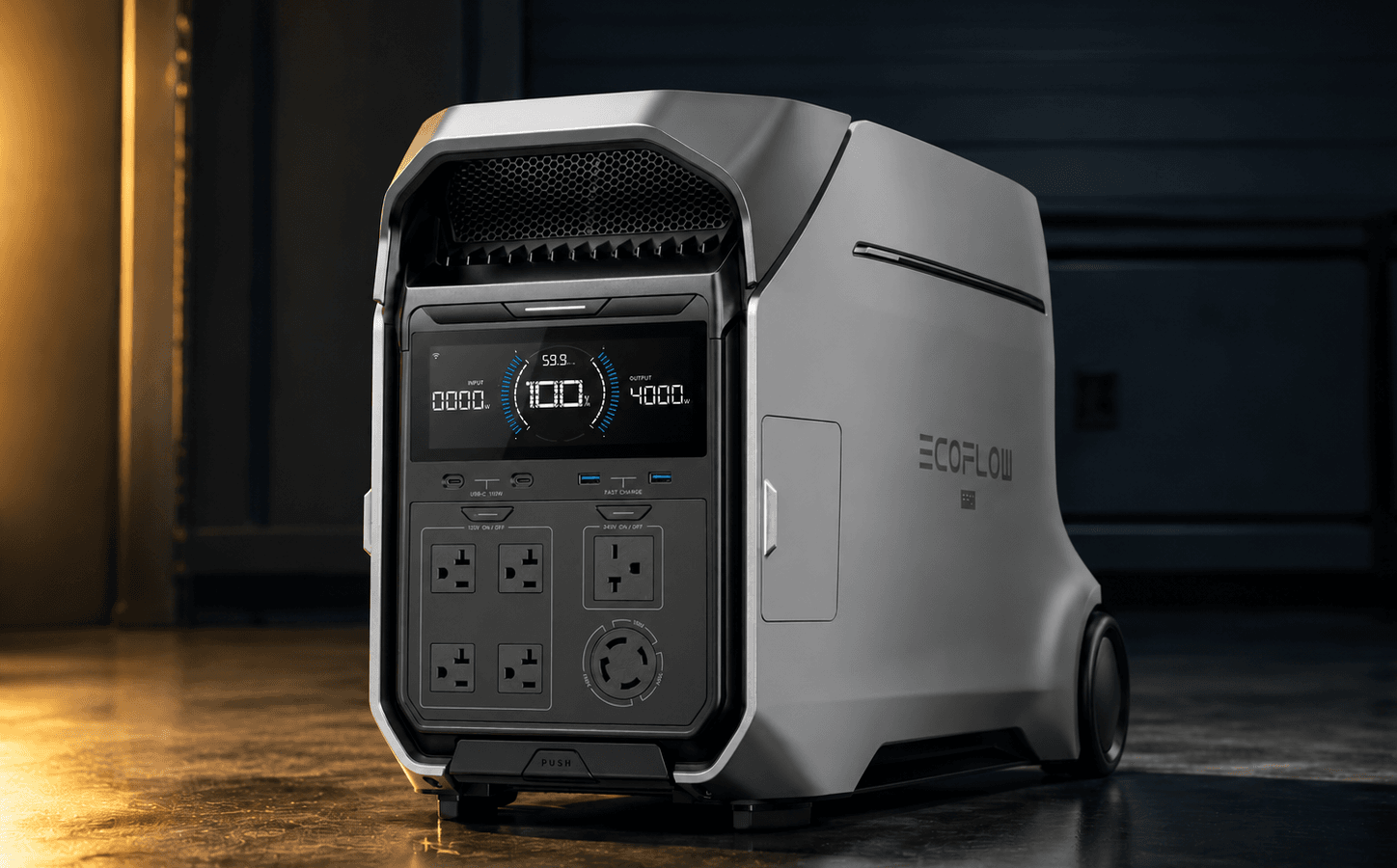
Linked Product Snapshot
Core specs
Buyer Fit
Pros and tradeoffs
Strengths
Pros
- 120V/240V output from a single unit
- 4000W continuous output for nearly all essential home appliances
- 4500-cycle LFP battery, more than 10 years of daily use
- Up to 2600W solar input, strongest in this catalog
- 10ms UPS for NAS, servers, and sensitive equipment
- Expandable to 12kWh per unit, 48kWh as a system
- 7 charging methods including gas generator and EV pile
- IP65 battery pack and 5-year warranty
Tradeoffs
Cons
- Heavy wheeled unit — stays where you put it
- Serious price, multiplied by the expansion path
- 120V and 240V do not output simultaneously
- X-Boost and 12000W figures are conditional, not continuous ratings
- Far more capability than a basic backup plan uses
This article may contain affiliate links. If you buy through these links, PowerLabPro may earn a commission at no extra cost to you. As an Amazon Associate I earn from qualifying purchases.
The EcoFlow DELTA Pro 3 review question is not whether this is a powerful battery. It is. The real question this EcoFlow DELTA Pro 3 review answers is whether single-unit 240V output, 4096Wh of LFP capacity, and a 48kWh expansion ceiling justify the price and weight over the 2kWh and 3kWh class, or over its closest rival, the Anker SOLIX F3800 Plus. Everything here is based on manufacturer-published specifications. No hands-on testing is claimed.
EcoFlow DELTA Pro 3 Review: Quick Verdict
The verdict of this EcoFlow DELTA Pro 3 review is direct: this is the most capable single-unit home backup platform on the site. One unit outputs 4000W at 120V or 240V, runs loads EcoFlow rates as heavy as a 3-ton central AC or 1 HP well pump, accepts up to 2600W of solar, and expands from 4kWh to 12kWh with two extra batteries, or 48kWh as a full system. The 4500-cycle LFP battery and 10ms UPS round out a genuinely complete spec sheet. The trade-offs are real: this is a heavy wheeled unit, a serious financial commitment, and far more machine than a fridge-and-router backup plan needs.

- Energize Almost Everything. The EcoFlow DELTA Pro 3 supports 120V/240V voltage and has a 4000W output (6000W with X-Boos…
- Forget Refueling. Featuring a 4096Wh LFP battery capacity, expandable to 48kWh with extra batteries or smart generators,…
- Plug and Play. Experience hassle-free power with the DELTA Pro 3, a versatile portable power station that’s easy to set …
In This Review
- Quick Verdict
- Who It Is Best For
- Who Should Skip It
- Key Specifications
- The 240V Case: Why Single-Unit Matters
- 4kWh to 48kWh: Capacity in Practice
- 2600W Solar Input
- X-Boost at 6000W Explained
- UPS and Smart Home Integration
- Pros and Cons
- How It Compares
- What to Verify Before Buying
- Frequently Asked Questions
- Final Verdict
Who It Is Best For
- Homeowners running essential circuits through a transfer switch or EcoFlow Smart Home Panel 2
- Buyers with 240V loads: well pumps, mini-splits, workshop equipment
- Solar-first users who want same-day recharges from a large panel array
- Anyone planning multi-day outage coverage with staged battery expansion
Who Should Skip It
- Buyers whose backup plan is electronics and a fridge — the 2kWh class does that for far less
- Anyone who needs to move the unit between rooms or vehicles regularly
- Buyers without any 240V loads who will not use the headline capability
- Budget-conscious buyers — the expansion path multiplies an already significant cost
EcoFlow DELTA Pro 3 Review: Key Specifications
| Spec | Value |
|---|---|
| Capacity | 4096Wh |
| Battery Chemistry | LiFePO4 / LFP (4500 cycles, 10+ years) |
| AC Output | 4000W continuous, 120V/240V (one voltage at a time) |
| X-Boost | Up to 6000W (load management) |
| System Scaling | Up to 12000W in expanded configurations |
| UPS Switchover | 10ms |
| Solar Input | Up to 2600W |
| Charging Methods | 7 unique, 18 combinations (AC, solar, car, gas generator, EV pile, Smart Home Panel 2) |
| Expandable | 2 extra batteries per unit (12kWh); 48kWh max system. Works with DELTA Pro and DELTA Max extra batteries |
| Battery Protection | IP65-rated CTC pack, automotive-grade LFP cells |
| Weight | [VERIFY at us.ecoflow.com — wheeled, 50+ kg class] |
| AC Outlets | [VERIFY count on current listing] |
| App | EcoFlow App (Bluetooth + Wi-Fi) |
| Warranty | 5 years |
The 240V Case: Why Single-Unit Matters
This is the core of the EcoFlow DELTA Pro 3 review. Every other path to 240V backup in this catalog requires pairing two units: two Jackery Explorer 2000 Plus stations, or comparable dual setups from other brands. That doubles the purchase, the floor space, and the failure points. The DELTA Pro 3 outputs 120V or 240V from one box, switchable but not simultaneous, which matters for buyers whose essential circuits include a well pump, a 240V mini-split, or workshop equipment.
One planning note this EcoFlow DELTA Pro 3 review flags seriously: EcoFlow’s rating for loads like a 3-ton central AC assumes soft-start behavior and realistic surge profiles. Compressor starting surge can exceed continuous draw by a wide margin. Anyone planning AC or pump backup should check the equipment’s locked-rotor amps or install a soft starter, and confirm the math with an electrician before relying on it. The portable power station sizing guide covers how to run these wattage calculations properly.
4kWh to 48kWh: Capacity in Practice
The base 4096Wh runs a realistic essentials load — fridge, freezer, router, lights, device charging, and a CPAP — for roughly a full day, with the usual caveat that real runtime depends on your actual loads and duty cycles. Adding two extra batteries takes a single unit to 12kWh, which EcoFlow positions as 2 to 4 days of essential-home coverage. The system ceiling of 48kWh involves multiple units and accessories and moves into permanently installed backup territory.
A practical detail this EcoFlow DELTA Pro 3 review highlights for upgraders: EcoFlow confirms the DELTA Pro 3 works with original DELTA Pro and DELTA Max extra batteries. Owners of older EcoFlow systems can carry batteries forward instead of starting over. Verify compatibility for your exact battery model before buying. Full structured specs are on the EcoFlow DELTA Pro 3 power station product page.
2600W Solar Input: The Off-Grid Differentiator
Up to 2600W of solar input is more than double any other unit in this catalog, and it is the spec that pushed the rating in this EcoFlow DELTA Pro 3 review upward. At full array capacity under good sun, a 4096Wh battery refills in well under 2 hours of peak production, which makes true solar-cycling realistic: discharge overnight, recover by midday. For off-grid cabins and serious RV setups, that input ceiling is the difference between solar as a supplement and solar as the primary charging method. Smaller arrays work fine too; charge time scales with panel wattage and conditions.
X-Boost at 6000W: Same Rule, Bigger Numbers
X-Boost on the DELTA Pro 3 follows the same principle as on every EcoFlow unit: the inverter delivers 4000W continuous, and X-Boost is load management software that lets certain resistive high-wattage devices run at reduced draw instead of tripping overload protection. The 12000W figure in EcoFlow’s marketing refers to expanded multi-unit configurations, not a single box. Plan around 4000W continuous; treat 6000W X-Boost as a convenience for tolerant loads, not rated capacity.
UPS and Smart Home Integration
Unsure whether you need this class at all? The portable power station sizing guide walks through load calculations so you can size to your real outage plan instead of the spec sheet.
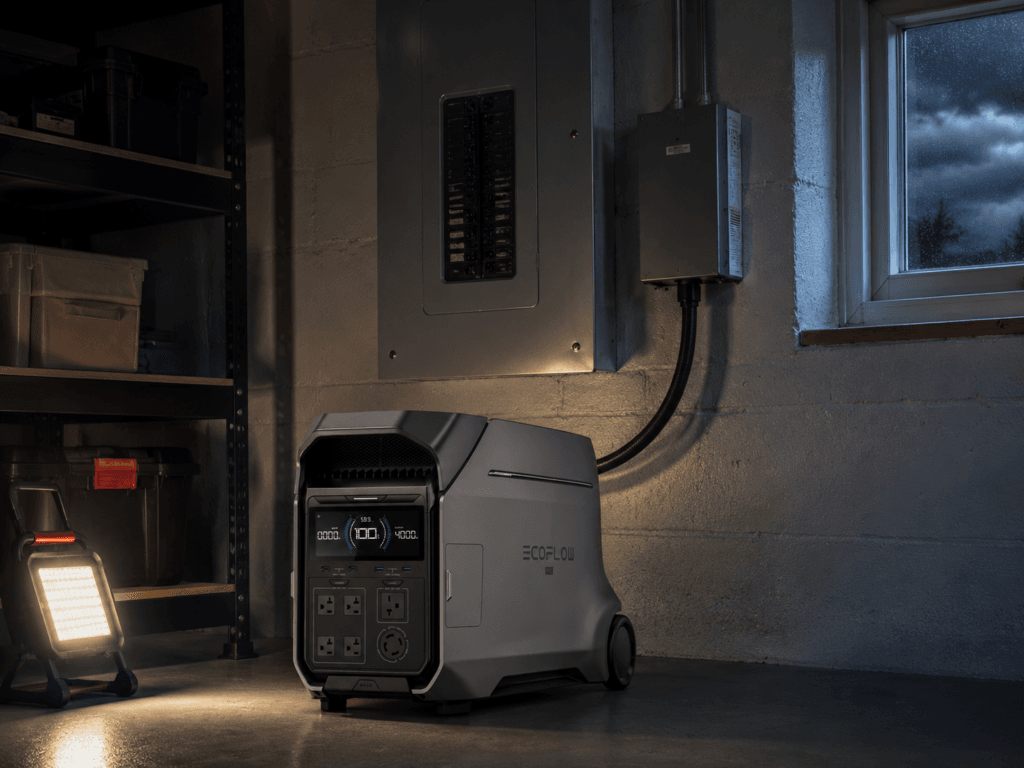
The 10ms switchover covers NAS systems, servers, desktops, and entertainment equipment — EcoFlow markets exactly this use. It is slower than the sub-10ms RIVER 3 Plus but well within tolerance for typical IT hardware. The more distinctive integration is the Smart Home Panel 2 path: wired into a home’s electrical panel by an electrician, the DELTA Pro 3 becomes automatic whole-circuit backup rather than an extension-cord solution. That installation is a separate cost and project, but it is the configuration where this unit makes the most sense.
EcoFlow DELTA Pro 3 Review: Pros and Cons
Pros
- 120V/240V output from a single unit
- 4000W continuous output for nearly all essential home appliances
- 4500-cycle LFP battery, more than 10 years of daily use
- Up to 2600W solar input — strongest in this catalog
- 10ms UPS for NAS, servers, and sensitive equipment
- Expandable to 12kWh per unit, 48kWh as a system, with backward battery compatibility
- 7 charging methods including gas generator and EV pile
- IP65 battery pack, 5-year warranty
Cons
- Heavy wheeled unit — stays where you put it
- Serious price, multiplied by the expansion path
- 120V and 240V do not output simultaneously
- X-Boost and 12000W figures are conditional, not continuous ratings
- Far more capability than a basic backup plan uses
How the EcoFlow DELTA Pro 3 Compares
EcoFlow DELTA Pro 3 vs Anker SOLIX F3800 Plus
These are the two single-unit 240V heavyweights, and no EcoFlow DELTA Pro 3 review is complete without this matchup. The F3800 Plus offers 3840Wh and 6000W continuous output with 120V/240V support; the DELTA Pro 3 offers 4096Wh and 4000W with a higher solar ceiling and backward battery compatibility with older EcoFlow packs. Choose the F3800 Plus for higher continuous output; choose the DELTA Pro 3 for more solar input and the EcoFlow ecosystem. Both reward checking current pricing, which moves frequently in this class.
EcoFlow DELTA Pro 3 vs Goal Zero Yeti PRO 4000
Both sit in the 4kWh class. The Yeti PRO 4000 is a strong 120V platform; the DELTA Pro 3’s single-unit 240V support and 2600W solar input are the separators. Buyers without 240V loads can weigh these as roughly equivalent capacity platforms and decide on ecosystem, pricing, and accessory needs.
What to Verify Before Buying
- Exact unit weight and dimensions at us.ecoflow.com for placement planning
- AC outlet count and port layout on the current Amazon listing
- Starting surge of any compressor or pump you plan to back up — consult an electrician for 240V circuits
- Smart Home Panel 2 installation requirements and cost if going the wired route
- Extra battery compatibility for your specific DELTA Pro or DELTA Max packs, and current pricing, at us.ecoflow.com
Frequently Asked Questions
Does the EcoFlow DELTA Pro 3 output 120V and 240V at the same time?
No. The EcoFlow DELTA Pro 3 outputs either 120V or 240V, switchable but one at a time. Buyers who need both simultaneously should plan circuits accordingly or discuss panel-level integration with an electrician.
How much can the EcoFlow DELTA Pro 3 expand?
A single unit accepts two extra batteries for 12kWh total. As a full system with additional units and accessories, capacity scales to 48kWh. It also works with original DELTA Pro and DELTA Max extra batteries, which helps existing EcoFlow owners upgrade without discarding packs.
Can the EcoFlow DELTA Pro 3 run a central air conditioner?
EcoFlow rates it for loads as heavy as a 3-ton central AC, but compressor starting surge varies widely by unit and installation. This EcoFlow DELTA Pro 3 review recommends verifying your AC’s starting requirements, considering a soft starter, and confirming with an electrician before relying on it.
How fast does the EcoFlow DELTA Pro 3 charge from solar?
With the maximum 2600W solar input under good conditions, the 4096Wh battery refills in well under 2 hours of peak production. Smaller arrays charge proportionally slower. AC, car, gas generator, and EV pile charging are also supported.
Does the EcoFlow DELTA Pro 3 have a UPS function?
Yes. EcoFlow lists a 10ms switchover aimed at NAS systems, servers, and entertainment devices. Total connected load must stay within the 4000W continuous rating, and medical device users should verify switchover tolerance with their equipment manufacturer.
EcoFlow DELTA Pro 3 Review: Final Verdict
This EcoFlow DELTA Pro 3 review lands on a clear conclusion: this is the unit to buy when 240V is in the plan and one box needs to carry whole-home essentials. Single-unit 240V, 4000W continuous, 2600W solar input, a 4500-cycle battery, and a 48kWh expansion ceiling make it the most complete platform in this catalog. It is not the right buy for basic backup plans, tight budgets, or anyone without 240V loads — the 2kWh class serves those buyers better for far less money. For the buyer it fits, the EcoFlow DELTA Pro 3 fits exactly.
Testing Notes
- No hands-on testing claimed by PowerLabPro
- Analysis based on verified manufacturer-listed specifications
- Amazon page used only for product identity ASIN and purchase path
- Weight and AC outlet count must be verified before publishing
- Central AC and pump claims depend on starting surge — flagged for buyer verification with an electrician
- Buyers should verify current warranty and availability before purchase