
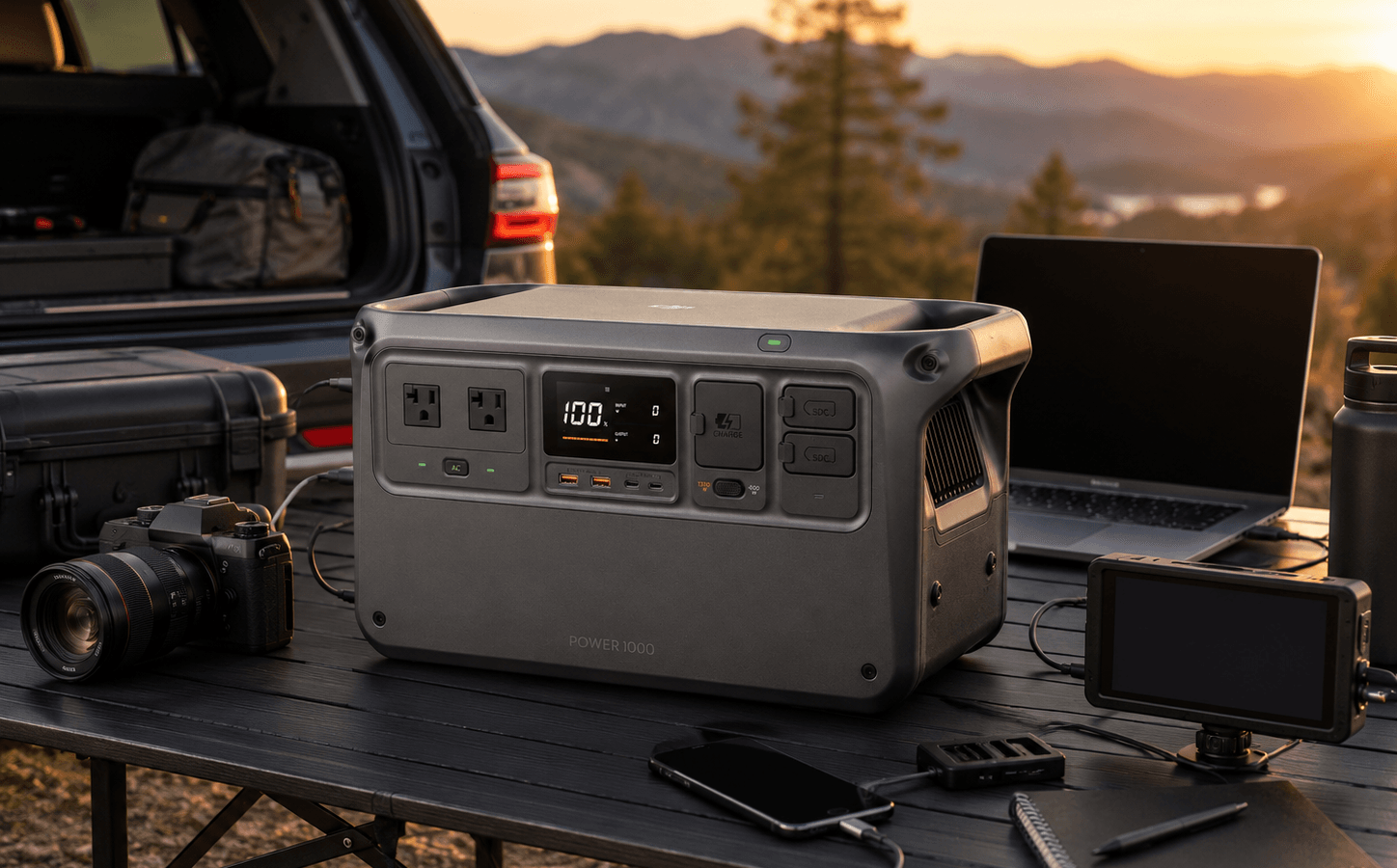
Product Intelligence
Best for DJI creator workflowsDJI Power 1000 Portable Power Station: 1024Wh, 2200W Guide
A compact 1,024Wh LiFePO4 station for DJI users, creators, mobile work, RV travel, and controlled backup plans. Its standout strengths are 2,200W continuous AC output for DYM1000L, dual 140W USB-C, DJI SDC accessory connectivity, and up to 800W solar input with the required accessories. Its trade-off is limited 1kWh runtime for high-draw loads.
Specifications
Key specs
Buyer Fit
Fit signals
Best for
Pros
- High 2,200W continuous AC output for DYM1000L
- Dual 140W USB-C ports for compatible PD 3.1 devices
- DJI SDC and SDC Lite accessory ecosystem
- Up to 800W solar input with compatible accessories
- Compact 28.7 lb form for this inverter class
Cons
- 1,024Wh capacity limits long high-watt runtime
- Exact regional model and outlet configuration must be confirmed
- Solar input requires separately sold adapters and panels
- No direct expansion-battery compatibility confirmed in the current product specification source
- UPS mode is not universal device compatibility
Spec table
| Capacity | 1024 Wh |
|---|---|
| AC Output | 2200 W |
| Surge Output | 4400 W |
| Solar Input | 800 W |
| Weight | 28.7 lb |
| Battery | LiFePO4 |
| Warranty | DJI’s official FAQ states a five-year standard warranty in the region shown. Confirm current U.S. coverage, purchase channel, and accessory terms before buying. |
| Expandability | Accessory expansion is documented through SDC and SDC Lite ports. Direct compatibility with DJI Power Expansion Battery 2000 was not confirmed in the current product specification source, so verify the exact battery and cable configuration before purchase. |
| UPS / EPS | UPS mode listed with 0.02-second, 20ms, transfer for connected compatible devices. Test the exact equipment before relying on it. |
| Recharge Time | AC input: 0% to 80% in about 50 minutes and 0% to 100% in about 70 minutes under DJI-listed conditions. Solar: up to 800W with compatible separately sold MPPT modules and panels; actual results vary. |
This article may contain affiliate links. If you buy through these links, PowerLabPro may earn a commission at no extra cost to you. As an Amazon Associate I earn from qualifying purchases.
The DJI Power 1000 is a 1,024Wh LiFePO4 portable power station for buyers who need unusual inverter headroom and high-power USB-C in a relatively compact form. The current North American DYM1000L configuration is listed with 2,200W of continuous AC output, two 140W USB-C ports, two AC outlets, USB-A, and DJI SDC accessory ports. That combination makes the DJI Power 1000 especially relevant for creator gear, mobile work, RV travel, drone operations, and controlled backup plans where the load list needs more flexibility than a small 500W or 1,000W station can offer.
The buying decision is still not simply about a large output number. The DJI Power 1000 stores 1,024Wh of energy, which is a defined 1kWh-class reserve. It can make a wider range of devices compatible, but it cannot power high-watt equipment indefinitely. Buyers should match the inverter to the loads that need to run, then match the battery capacity to the hours that matter. A large inverter solves a compatibility problem. It does not solve a duration problem.
Regional identity is a central check. DJI lists DYM1000L for a 100 to 120V configuration and DYM1000H for a 220 to 240V configuration. This Product record uses the DYM1000L output figures because the connected Amazon destination identifies that model. Verify the model code, outlet layout, accessories, and bundle at purchase. This is a research-led product guide, not a claim that PowerLabPro performed hands-on testing.
DJI Power 1000 quick verdict
The DJI Power 1000 is a strong compact option for a buyer who needs high continuous output, dual 140W USB-C charging, or the DJI SDC accessory ecosystem. It is most compelling for a measured mobile-work kit, creator setup, RV equipment plan, or short outage plan that prioritizes communication, charging, lighting, and selected AC loads. At about 28.7 lb, it is portable for its power class, although it is still a substantial item to carry between a vehicle, desk, or storage location.
Choose another class when long runtime is the first priority. A buyer trying to cover overnight refrigeration, broad household loads, cooking, heating, or several rooms should start with more watt-hours, not simply more inverter output. The DJI Power 1000 is not a 240V system, a transfer-switch solution, a whole-home battery, or a substitute for professionally designed backup power.
Best for: DJI users, field creators, mobile workers, RV travelers, and controlled backup buyers who can benefit from 2,200W continuous output, 140W USB-C, or SDC accessories.
Not ideal for: multi-day high-watt backup, fixed home integration, 240V loads, buyers who need a confirmed modular battery path, or anyone who does not need its high-output and DJI-specific advantages.
Main advantage: 2,200W continuous output in the DYM1000L configuration plus two 140W USB-C ports in a 1,024Wh package.
Main limitation: its 1kWh battery is finite, so high-output appliances can consume the stored energy quickly.
Better alternative if: more stored energy, conventional expansion, or broad home backup is more important than DJI-centered mobile workflow features.
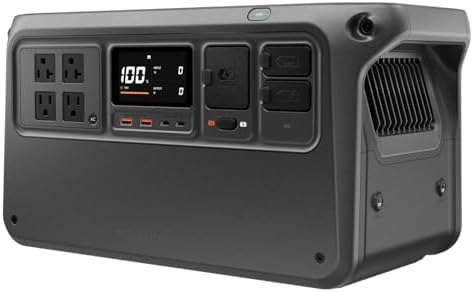
- Power More Than Ever – DJI Power 1000 V2 is a high-capacity solar generator that powers 99% [11] of appliances like kett…
- Charge Fast, Go Far – DJI Power 1000 V2 portable power station recharges to 80% in just 37 minutes [3], so you’re always…
- Uncompromising Safety, Anywhere – This power station features a 1024Wh LFP battery, intelligent BMS, sub-nano coating, a…
Table of Contents
DJI Power 1000 verified specifications
| Specification | Verified figure | Buyer meaning |
|---|---|---|
| Model family | DYM1000L / DYM1000H | Output and plug configuration vary by regional version. |
| Capacity | 1,024Wh | A compact 1kWh reserve for a planned load list. |
| Battery chemistry | LiFePO4 | DJI lists over 70% capacity after 4,000 cycles under stated laboratory conditions. |
| Continuous output | 2,200W | The primary planning number for DYM1000L and DYM1000H under DJI’s stated conditions. |
| Temporary maximum output | 2,600W | DYM1000L is listed for about 30 seconds under stated conditions. This is not normal continuous output. |
| Peak output | 4,400W | Brief startup headroom, not a sustained appliance rating. |
| AC outlets | 2 | Designed for selected priority loads rather than a large plug-in cluster. |
| USB-C | 2 × 140W maximum | Requires a compatible PD 3.1 device and EPR-rated cable to reach the highest rate. |
| USB-A | 2 × 24W maximum | Useful for phones, accessories, and smaller digital equipment. |
| DJI ports | 1 SDC and 1 SDC Lite | Supports compatible DJI charging, solar, car-power, and accessory workflows. |
| Solar input | Up to 800W with accessories | Requires compatible DJI Power Solar Panel Adapter Module, MPPT, accessories and panels. |
| Weight | About 28.7 lb | Portable for this output class, but not a casual ultralight station. |
DJI’s official specification page lists the DJI Power 1000 at 1,024Wh, approximately 13kg, with two AC outputs, two USB-C, two USB-A, SDC, SDC Lite, and 2,200W continuous output for DYM1000L and DYM1000H. Its official FAQ adds the 50-minute 0% to 80% and 70-minute 0% to 100% AC charging examples, 20ms UPS mode, solar accessory requirements, and the 800W solar-input figure. See DJI Power 1000 official specifications and DJI Power 1000 official FAQ before purchase.
Why the DJI Power 1000 DYM1000L model check matters
The DJI Power 1000 name is not enough by itself for an output decision. DJI lists DYM1000L for a 100 to 120V configuration and DYM1000H for a 220 to 240V configuration. The current Amazon-linked record uses the DYM1000L identity, which is the model to verify for a U.S. buyer. Outlet style, included cable, regional commercial terms, and AC behavior must match the unit in the cart.
This is not a minor labeling issue. A buyer may be choosing the DJI Power 1000 because a creator kit, work tool, laptop charger, portable refrigerator, or small appliance needs the headroom of a 2,200W continuous inverter. That plan only makes sense when the actual regional unit has the expected plug configuration and output specification. Do not assume a photo from another market, a second-hand listing, or a travel adaptor makes a different regional configuration equivalent.
Before ordering, confirm four details: DYM1000L model code, North American outlet layout, 100 to 120V input and output fit, and the exact accessories in the box. This product has a stronger regional-model dependency than a simple USB-first battery. A two-minute check can prevent a purchase that is technically capable on paper but wrong for the place where it will be used.
DJI Power 1000 2200W continuous output and temporary maximum output
The 2,200W continuous AC rating is the core electrical advantage of the DJI Power 1000. Continuous output tells you what the inverter can supply over time under the manufacturer’s stated conditions. It creates room for a more varied device list than a lower-output station, including a work desk, charging hub, router, lights, camera equipment, portable refrigeration with verified starting behavior, or a short-use appliance that fits the plan.
DJI separately lists a 2,600W maximum-output condition and a 4,400W peak figure. These are not substitute planning numbers. For DYM1000L, DJI says the temporary 2,600W condition can last about 30 seconds under stated battery and temperature conditions. Peak output is even shorter-duration headroom. Neither figure makes the DJI Power 1000 a 2,600W or 4,400W continuous power station.
Use the 2,200W continuous rating as the normal ceiling, then leave margin. A power station can technically start a device but still be a poor match when that device spends long periods near the limit. This is especially important for appliances with heating elements, compressors, pumps, or motors. Running watts, startup demand, temperature, cycle behavior, and other connected equipment all affect whether the setup is comfortable or fragile.
The right plan for the DJI Power 1000 is not “everything that fits into two outlets.” List your priority devices, add their simultaneous continuous watts, check any startup behavior, and leave headroom. A mobile work kit can be an excellent fit. A heater, air fryer, kettle, microwave, or several high-watt appliances can use the battery rapidly even when the inverter can carry the momentary load.
What 1024Wh means for DJI Power 1000 runtime planning
The DJI Power 1000 has 1,024Wh of stored energy before normal conversion losses and operating conditions. Runtime is influenced by the load, temperature, battery state, cable path, and whether the device uses AC, USB-C, USB-A, or an accessory port. A single runtime headline is not a responsible promise for every buyer.
A good use of this capacity is a tiered plan. Tier one is communication and work: router, phone charging, laptop, monitor, selected lighting, and camera batteries. Tier two is useful comfort or travel equipment such as a compact fan, small cooler, or extra charging. Tier three is a short high-watt task that is worth the energy trade-off. This sequence makes the DJI Power 1000 feel more useful because it preserves power for the equipment that actually matters.
Direct USB-C can help a compatible laptop or creator device avoid running through an AC inverter and an additional AC power brick. It does not increase the battery capacity, but it may reduce unnecessary conversion steps. The dual 140W USB-C ports are valuable only when the laptop, cable, and power-delivery profile support the rate. A normal cable or device may charge at a lower level.
Use the PowerLabPro sizing guide with the devices you own. Start with the output requirement, then calculate the hours required. The DJI Power 1000 can be a strong high-output compact station, but a buyer whose real problem is overnight or multi-day energy should choose more capacity before optimizing for ports or peak output.
DJI Power 1000 ports, SDC accessories, and 140W USB-C
The DJI Power 1000 is differentiated by its port strategy. The two AC outlets cover selected conventional loads. Two USB-A ports suit phones and lower-draw accessories. The two USB-C ports can reach 140W each when the connected device supports PD 3.1 and the cable meets EPR requirements. These ports are especially useful for some high-performance laptops, monitors, cameras, tablets, and charging hubs.
The SDC and SDC Lite ports are not generic decoration. DJI documents accessory workflows for solar charging, 12V car-power devices, compatible drone batteries, and selected DC equipment. With the correct separately sold SDC cable, the station can fast-charge selected DJI drone batteries, including certain Mavic 3, Air 3 or 3S, Inspire 3, and Matrice 30 batteries. Compatibility depends on the exact drone battery and matching cable.
The same accessory design has a limitation. A buyer outside the DJI ecosystem may not benefit enough from SDC to justify choosing this product over another compact 1kWh station. The DJI Power 1000 still offers high output and useful USB-C even without DJI gear, but the full value proposition is strongest when the SDC ports simplify a real workflow rather than sit unused.
Check accessory availability before you make the purchase decision. The unit itself does not include every solar, car, drone-battery, XT60, or car-charger cable. A practical kit starts with the devices you need to support, then identifies the exact cable and power-delivery profile for each one.
DJI Power 1000 charging, solar, and storage readiness
DJI lists 0% to 80% AC recharge in about 50 minutes and 0% to 100% in about 70 minutes under its stated conditions. The highest 1,200W grid charging figure depends on battery state and ambient temperature. This fast AC recovery can be a real ownership advantage for a buyer who recharges between workdays, prepares before travel, or wants a compact station ready before a forecast outage.
Solar charging is supported through DJI’s Power Solar Panel Adapter Module, MPPT, and compatible panels. DJI documents a maximum solar input of up to 800W for the DJI Power 1000 with the necessary accessories. Solar panels and the MPPT modules are separately sold. A panel nameplate does not guarantee production, and real solar input depends on panel direction, shade, temperature, cable loss, season, and battery state.
The 800W ceiling is useful for a compact station, but it should be treated as a system capability rather than an automatic recharge result. Build around a panel configuration that fits your vehicle, camp, worksite, storage, and setup time. A modest compatible solar arrangement that gets deployed reliably can be more useful than a theoretical maximum array that never leaves the garage.
For long-term readiness, DJI advises avoiding storage while fully depleted and recommends maintaining a mid-range charge when the station will sit unused. Check its charge every few months and follow the manual’s storage guidance. A portable power station is only useful during an outage or trip when it is charged, accessible, and paired with the cables you actually need.
DJI Power 1000 Bluetooth app, UPS mode, and noise
DJI lists DJI Home support through Bluetooth for device management and supported settings. App functionality can change, so confirm the current operating behavior before treating an app feature as central to the purchase. Bluetooth access can be useful when the DJI Power 1000 is kept in an RV compartment, on a home-office floor, or among a charging setup where reaching the front panel is inconvenient.
The product also lists an UPS mode with a 0.02-second transfer for connected compatible equipment. This can help certain routers, lights, and personal work devices remain on through a utility interruption. It is not a guarantee of zero interruption and it is not a universal replacement for a dedicated UPS. Test the exact router, monitor, computer power supply, or network device before relying on it during an important event.
DJI lists charging noise around 23dB under its stated test conditions. Quiet operation is useful for a desk, apartment, van, or campsite, but acoustic behavior can change with charging mode, output load, temperature, and physical placement. Keep vents clear, allow heat to dissipate, and do not place the unit in a sealed, hot, or wet location.
DJI Power 1000 real-world buyer fit
Creator gear and mobile work
The DJI Power 1000 is most differentiated for a creator, drone operator, photographer, video team, or mobile professional with a known charging workflow. A laptop, monitor, camera battery chargers, drone batteries, phone, router, LED light, and selected AC tool can be organized around its high continuous output, 140W USB-C ports, and SDC accessory options. The buyer benefit is not that the station runs every device indefinitely. It is that a practical kit can have fewer charging bottlenecks.
RV and road-trip use
For RVs and vehicle travel, the DJI Power 1000 can support lighting, laptops, cameras, phones, a compatible portable refrigerator, and selected appliances when all draw and runtime limits are known. Its 28.7 lb weight is manageable for vehicle loading, but it should be secured and operated on a stable, dry, ventilated surface. A solar plan can add recovery flexibility, but it requires the right accessories and enough daylight.
Home office and controlled outage backup
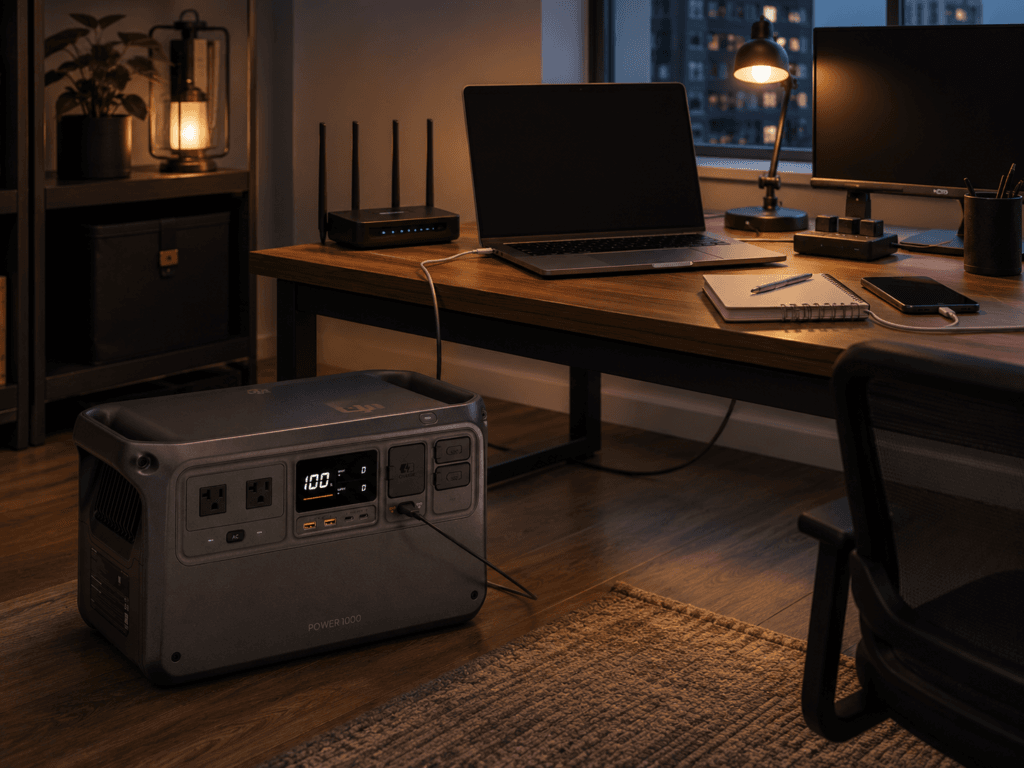
For a home office or apartment outage, the DJI Power 1000 is more useful as a priority-load station than as a whole-home promise. Start with a router, phones, laptop work, monitor, selected lighting, and essential charging. Add other equipment only after calculating the energy cost. For broader planning, see Ready.gov’s power-outage guidance and build a device list before the emergency.
What to verify before buying
| Check | Why it matters |
|---|---|
| Exact DYM1000L model code and outlets | Confirms regional voltage and configuration for a U.S. plan. |
| Connected device running watts | 2,200W is the sustained-output planning limit. |
| Startup demand of motor loads | Refrigerators, pumps, and tools can behave differently from their label wattage. |
| USB-C device and cable capability | 140W requires PD 3.1 and an EPR-rated cable. |
| Required SDC, solar, or car accessory | Many specialized functions require separately sold hardware. |
| Solar-panel compatibility | Input limits, connector, and MPPT modules must match the array. |
| UPS behavior with your exact hardware | 20ms transfer does not guarantee every device remains online. |
| Current warranty and return terms | Commercial coverage is regional and purchase-channel specific. |
DJI Power 1000 safety and storage
Use the DJI Power 1000 on a dry, stable surface with the vents clear. Keep it away from rain, sinks, standing water, direct heat, damaged cables, and walkways where cables create a trip hazard. Do not treat it as a substitute for a fixed electrical system, a medical backup plan, or life-safety power. Use compatible accessories, inspect them before use, and follow the product manual’s operating and storage guidance.
A compact power station works best when the setup is rehearsed. Charge the unit, label the essential cables, test the priority loads, and know which equipment should remain disconnected. Good planning prevents a high-output portable station from being used for the wrong job during the first minutes of an outage or on the first night of a trip.
DJI Power 1000 final product decision
The DJI Power 1000 is a compelling high-output 1kWh station when dual 140W USB-C, SDC accessory compatibility, fast AC recovery, and 2,200W continuous DYM1000L output solve a real buyer problem. It is especially relevant for DJI-centered creator work and mobile power plans that need more flexibility than a simple electronics battery.
Choose more capacity when you need long duration, not more peak wattage. Choose a different platform when conventional modular expansion, 240V capability, or broad home backup is the central need. For detailed buyer trade-offs and alternatives, read the DJI Power 1000 review. For runtime and appliance planning, use the PowerLabPro sizing guide.