
Review
BLUETTI AC70 Review: Compact 768Wh Backup With a Real 1,000W Limit
A well-balanced 768Wh power station for compact backup, travel, and solar use, provided the buyer respects the 1,000W output limit.
Linked Product Snapshot
Core specs
Buyer Fit
Pros and tradeoffs
Strengths
Pros
- 768Wh LiFePO4 capacity
- 1,000W rated output
- 500W solar input
- 950W Turbo Charging
- Bluetooth app control
- Power Bank Mode option
Tradeoffs
Cons
- 768Wh base capacity
- 1,000W output ceiling
- Power Lifting is not normal 2,000W output
- Exact Amazon ASIN pending verification
This article may contain affiliate links. If you buy through them, PowerLabPro may earn a commission at no extra cost to you. As an Amazon Associate I earn from qualifying purchases.
A compact station earns its place when it solves a practical problem without turning into a heavy box that never leaves the garage. This BLUETTI AC70 review looks at that middle ground. With 768Wh of LiFePO4 capacity, 1,000W rated AC output, fast wall charging, up to 500W solar input, Bluetooth control, and a carry weight of about 22.5 lb, it sits between a small device battery and a larger 1kWh backup system.
The useful question in a BLUETTI AC70 review is not whether it can power something. Almost any portable station can power a phone or lamp. The better question is whether it can support the exact devices you care about, at the same time, for long enough to matter. That could mean a router, phones, lights, laptop work, a fan, portable refrigeration, or a modest camping setup. It does not mean every appliance in an apartment suddenly becomes a sensible battery load.
This page focuses on that difference. The AC70 can be genuinely helpful in a short outage, on a road trip, or beside an RV. It can also disappoint buyers who expect it to act like a whole-home battery. A clear plan before buying is far more valuable than a long list of generic runtime claims.
Table of Contents
BLUETTI AC70 review: quick verdict
The short verdict in this BLUETTI AC70 review is positive, with one important boundary. It is a strong compact option for buyers who want useful backup power without stepping into the heavier and more expensive 1kWh or 2kWh categories. It can support communication gear, lights, phone charging, laptop work, a small fan, portable refrigeration, and selected low-to-moderate AC loads. It is also small enough to move between a closet, car trunk, cabin, or campsite without turning portability into an empty promise.
The limitation is equally clear. The 768Wh base battery is not built for long high-draw use, and the normal planning number is 1,000W, not the headline Power Lifting number. This BLUETTI AC70 review treats it as a well-equipped selected-load station. It is not a whole-home backup substitute, a transfer-switch solution, or a good answer for several high-watt appliances running together.
Who it suits and who should skip it
The right buyer in this BLUETTI AC70 review is someone who has already separated essential loads from convenience loads. Apartment renters may want the internet, phones, a laptop, lights, and a fan available during a short interruption. Campers may want a cooler, lantern, phone charging, camera batteries, and a laptop. RV users may want the same basic electronics plus a modest energy reserve while parked.
- Good fit: router and modem backup, lighting, phones, USB-C laptops, a fan, camera batteries, portable refrigeration, and controlled camping or RV loads.
- Needs checking: a refrigerator, freezer, pump, or power tool may work, but only after checking running watts, startup demand, and every other connected load.
- Skip it for: 240V service, transfer-switch integration, space heating, air conditioning, multi-day household coverage, or an appliance list that already exceeds 1,000W.
A sensible BLUETTI AC70 review should also say what this type of battery does well for renters. It provides quiet battery power indoors without the carbon monoxide risk of operating a fuel generator indoors. It does not replace permanent electrical infrastructure, but it can make a short outage calmer and more manageable when the device list stays realistic.

- [Smallest-Footprint 1kWh Power Station] – At just 23.59 lbs and 9.25×8.48×11.54″, Elite 100 Mini is 45% smaller and 36% …
- [Power 90% of Daily Essentials] – Featuring a 1004.8Wh capacity and ultra-low power consumption of less than 10W, the El…
- [17-Year Long-Lasting Lifespan] – Built with BLUETTI UltraCell LFP battery technology, The Elite 100 Mini delivers 6,000…
BLUETTI AC70 review: verified specifications
For this BLUETTI AC70 review, the useful specifications are the ones that change a purchase decision. Product bundles, retailer listings, and compatible accessories can change, so use the table as a planning reference and confirm the current listing before buying.
| Specification | Manufacturer-listed detail | Why it matters |
|---|---|---|
| Battery capacity | 768Wh | Enough for a focused backup plan, but not unlimited runtime. |
| Battery chemistry | LiFePO4, 3,000+ cycles listed | Designed for repeated use and regular readiness. |
| Rated AC output | 1,000W total through two 120V outlets | This is the normal planning ceiling for AC loads. |
| Power Lifting Mode | Up to 2,000W for compatible resistive loads | It does not make the product a standard 2,000W inverter. |
| Solar input | Up to 500W | Strong recovery potential for a compact capacity class. |
| Turbo charging | 0% to 80% in 45 minutes listed | Helpful when a storm or trip gives a short charging window. |
| USB-C output | Two ports up to 100W each | Useful for many laptops without using an AC power brick. |
| Connectivity | BLUETTI App via Bluetooth | Useful for monitoring and supported settings. |
| UPS switchover | 20ms listed | Confirm sensitive or medical equipment with its maker before relying on it. |
| Weight and size | About 22.5 lb; 12.4 × 8.2 × 10.1 in | Practical to move between rooms, vehicles, and camp setups. |
For current technical details, included accessories, and regional availability, read the official BLUETTI AC70 product page.
The specifications above are manufacturer-listed figures, not independent runtime testing. A detailed BLUETTI AC70 review should keep that distinction clear because battery temperature, connected loads, charging mode, battery state, cable losses, and outdoor conditions all affect real-world results.
What 768Wh means in practice
The capacity discussion in a BLUETTI AC70 review should start with an energy budget. A router sips from that budget. A laptop changes its draw depending on workload. A refrigerator cycles on and off. A coffee maker may consume a large part of the reserve in a few minutes. Capacity is not a guaranteed number of hours because the devices determine the answer.
In ordinary use, 768Wh can make a modest outage much easier. Keep a modem, router, phones, LED lighting, laptop work, and a fan running, and the battery can remain useful for a meaningful period. Add sustained cooking, heating, or other high-watt loads, and the same battery will drain much faster. This BLUETTI AC70 review recommends choosing the priority loads before the outage, not after the battery is already falling.
A practical approach is to use three groups. The first is communication and safety: phones, lighting, router, modem, weather alerts, and a power bank. The second is work and comfort: laptop, monitor, a small fan, controlled refrigeration, and any medical-support equipment only after you have checked its own requirements. The third is convenience: coffee, hair tools, cooking devices, and other short high-draw loads. A useful BLUETTI AC70 review should warn that the last group can quietly consume the reserve needed for the first two.
Use the PowerLabPro sizing guide with your actual device labels before making a final purchase decision. A written load list and charging plan are more useful than any generic runtime chart.
BLUETTI AC70 review: the real 1,000W limit
The most important warning in this BLUETTI AC70 review is that output and capacity are different. The inverter decides whether a device can run. The battery decides how long it can run. A station can still have plenty of charge left while refusing an appliance that needs too much power at startup or while operating.
For normal planning, use 1,000W as the ceiling. That gives the AC70 much more flexibility than a 300W or 500W travel battery, but it does not make every wall-plug appliance a match. Kettles, heaters, hair dryers, power tools, pumps, and compressors require the most care. This BLUETTI AC70 review treats Power Lifting as a special mode for compatible resistive loads, not a reason to call the unit a normal 2,000W power station.
Refrigerators deserve a separate check. Their average running watts may look manageable, but the compressor can need a higher burst at startup. Two similar refrigerators can behave differently. Check the appliance label, leave headroom, and test the setup before you depend on it during an important outage. The same rule applies to pumps, power tools, and portable coolers with motor-driven compressors.
Charging, solar, and app control
Fast charging is one of the strongest points in this BLUETTI AC70 review. BLUETTI lists up to 950W wall input, with Turbo mode taking the battery from zero to 80% in 45 minutes and a full recharge in roughly 1.3 to 1.6 hours. That does not increase capacity, but it makes the station easier to keep ready after travel, a test run, or a weather alert.
The 500W solar-input ceiling is also useful, but it needs realistic expectations. A 500W panel label does not mean the station receives 500W all day. Sun angle, shade, temperature, cable losses, panel orientation, and battery state all change real input. This BLUETTI AC70 review treats solar as a way to recover meaningful energy during the day, not a promise of unlimited off-grid electricity.
Bluetooth app control is a smaller feature, yet it is practical. You can check charge status or adjust supported settings without pulling the unit out from under a desk or out of a vehicle compartment. It should not be the main buying reason, but it makes everyday ownership easier. Verify the current app functions and firmware support before relying on a specific setting.
BLUETTI AC70 review: home backup use
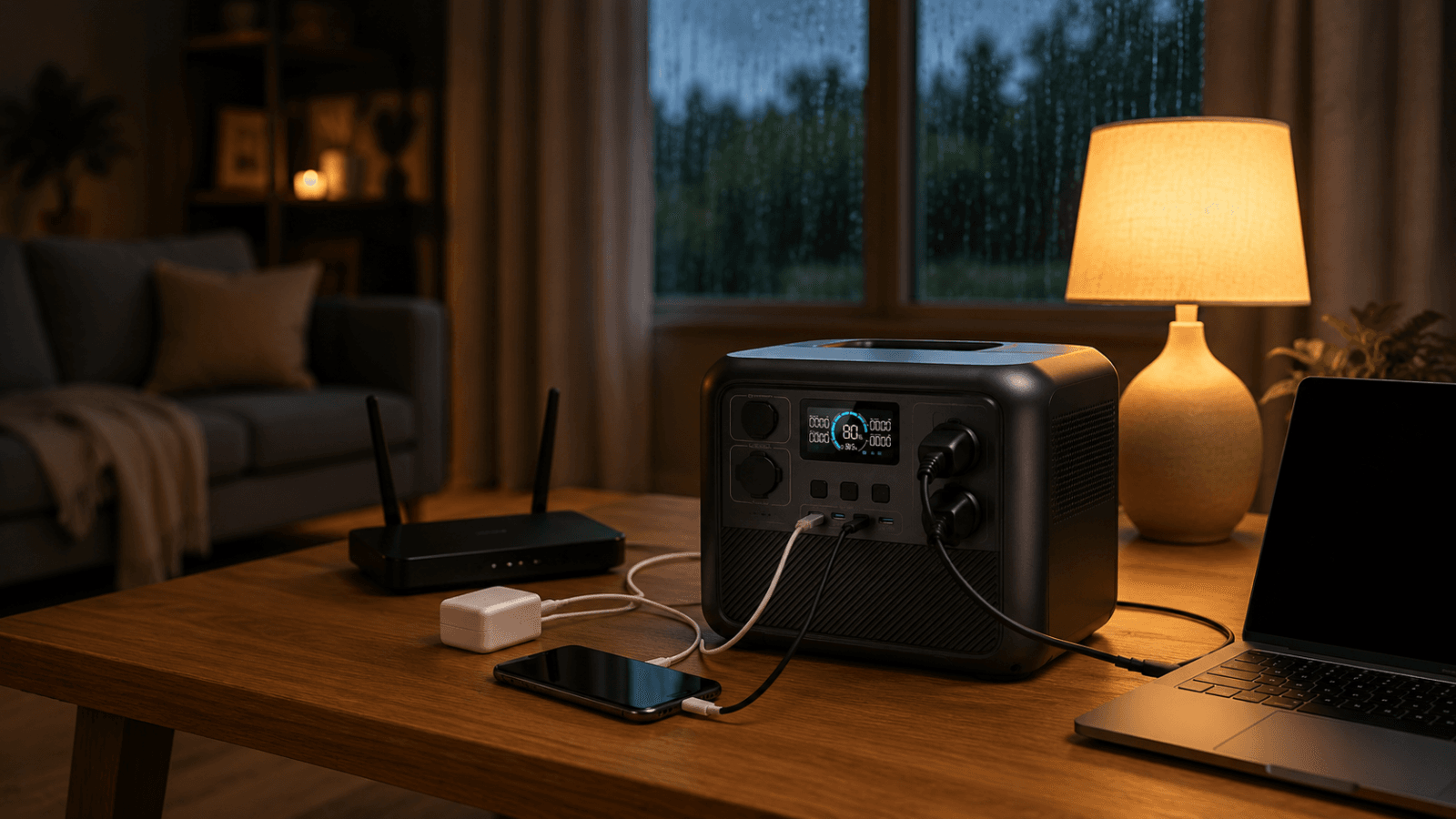
At home, this BLUETTI AC70 review recommends a calm selected-load plan. Start with the devices that keep the household informed and connected: router, modem, phones, laptop work, lighting, and a small fan. That is where a compact station gives the most value. It can reduce disruption without forcing you to buy a much larger system for an occasional short interruption.
Do not connect it to fixed household wiring without the right equipment and qualified guidance. Do not treat it as guaranteed support for medical, life-safety, or mission-critical equipment without confirmation from the equipment manufacturer. And do not assume a refrigerator will remain powered indefinitely because the capacity looks substantial on paper. This BLUETTI AC70 review is about practical backup, not fantasy runtime.
For food safety during an extended interruption, read the FDA guidance on keeping refrigerated and frozen food safe during power outages. A portable power station can help with a controlled refrigerator plan, but it does not remove the need to monitor food temperature and outage duration.
Buyers who need long refrigerator runtime, several workstations, high-watt cooking, or sustained appliance use are usually better served by moving up in capacity and inverter output. It is cheaper and less frustrating to buy the right size once than to force a compact station into a much larger job.
BLUETTI AC70 review: camping and RV use
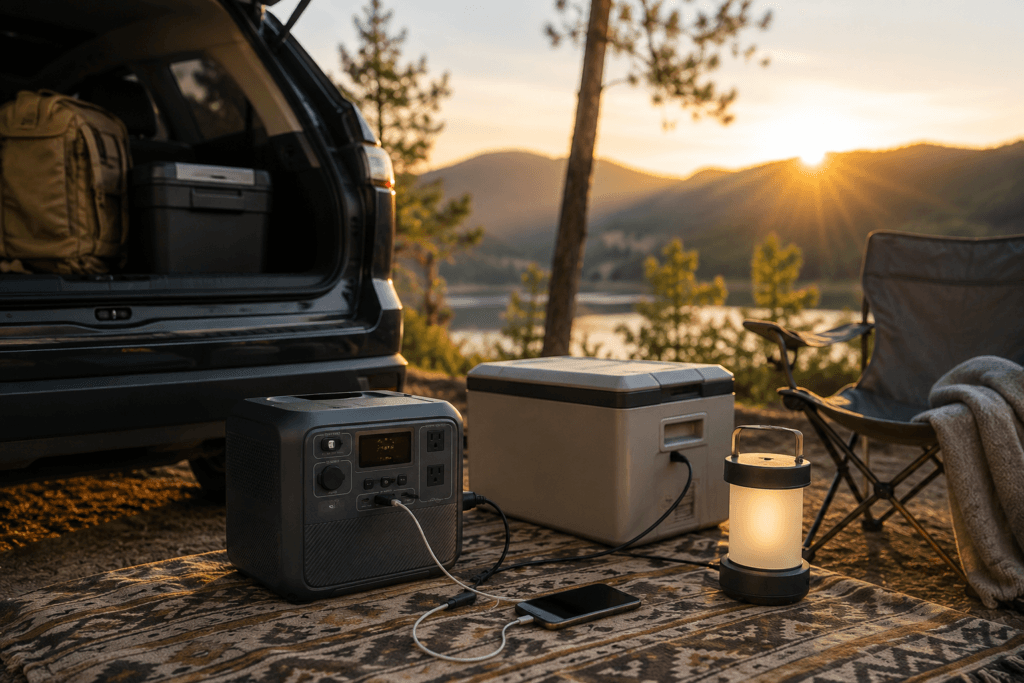
Outdoor use is where this BLUETTI AC70 review finds the most natural fit. At 22.5 lb, the unit is not a backpack battery, but it is realistic to carry from a car to a tent, cabin, picnic table, or RV compartment. That makes it suitable for phones, camera batteries, lights, a laptop, a small cooler, a fan, and modest AC loads that remain within the rated inverter limit.
The combination of manageable weight and a higher solar ceiling works well for a weekend trip. Start with a full battery, use the reserve for overnight essentials, and recover part of the energy budget during the day. This BLUETTI AC70 review still recommends keeping the plan simple: dry placement, short cable runs, no crushed wires under the hatch, and no expectation that a portable battery must power every convenience device.
Power Bank Mode and expansion
One detail that makes this BLUETTI AC70 review more interesting than a basic fixed-capacity comparison is Power Bank Mode. BLUETTI lists compatibility with B80, B230, and B300 expansion batteries when used with the correct supported configuration. That can give a buyer room to grow without replacing the base station immediately.
It is not a reason to assume every expansion path is simple or inexpensive. Additional capacity means another battery, compatible cabling, storage space, and a larger charging plan. This BLUETTI AC70 review sees it as flexibility for a buyer whose needs may grow, not as a substitute for buying a larger platform when long-term home backup is already the goal.
BLUETTI AC70 review: alternatives worth comparing
A useful BLUETTI AC70 review should not pretend this is the only sensible compact option. The right alternative depends on whether the limiting factor is battery size, inverter output, solar recovery, portability, or future expansion.
BLUETTI AC180
The BLUETTI AC180 is the logical step up when 1,000W feels too restrictive. Its larger 1,152Wh battery and 1,800W normal output provide more room for appliance planning and longer controlled outages. The trade-off is weight. This BLUETTI AC70 review favors the smaller unit when frequent movement and compact storage matter more than extra headroom.
EcoFlow DELTA 3 Plus
The EcoFlow DELTA 3 Plus is a better direction for buyers who want a serious 1kWh-class platform with a stronger inverter, faster charging ecosystem, and higher solar potential. The cost and weight increase, but so does the margin for home office and selected appliance planning. This BLUETTI AC70 review favors the lighter model only when modest loads and portability are the true priority.
Jackery Explorer 1000 v2
The Jackery Explorer 1000 v2 makes more sense for buyers who want around 1kWh of capacity and 1,500W output in a still-manageable package. The smaller BLUETTI is the cleaner choice when the extra inverter margin would mostly go unused. The Jackery is the stronger all-rounder when the device list already pushes past the smaller station’s comfort zone.
Pros and cons
| Pros | Cons |
|---|---|
| 768Wh LiFePO4 capacity in a manageable 22.5 lb design. | Limited reserve for long outages and heavy daily use. |
| 1,000W output offers more flexibility than many travel-first power stations. | 1,000W remains the normal ceiling for load planning. |
| Up to 500W solar input is strong for the size. | Real solar charging varies sharply with weather and setup. |
| Fast listed Turbo Charging and Bluetooth app control. | Manufacturer charging times are not guaranteed in every environment. |
| Compatible Power Bank Mode offers a growth path. | Expansion requires separate hardware and compatibility checks. |
| Two 100W USB-C ports reduce the need for AC adapters. | Not waterproof and not a substitute for fixed or critical backup systems. |
Frequently asked questions
Can it run a refrigerator?
This BLUETTI AC70 review cannot guarantee refrigerator compatibility because that depends on the specific appliance. Check running watts, compressor startup demand, cycling behavior, door-opening habits, and every other connected load. Test the combination before relying on it in an important outage.
Is it good for apartment backup?
For a focused plan, yes. This BLUETTI AC70 review sees it as practical for internet gear, phones, lights, laptop work, a fan, and selected small loads. It is not full-apartment coverage and should not be connected to fixed household wiring without the correct equipment and qualified advice.
Does it support solar charging?
Yes. The manufacturer lists up to 500W solar input. This BLUETTI AC70 review recommends checking voltage, connector compatibility, panel size, and realistic weather conditions before treating solar as the main recovery plan.
What does Power Lifting Mode mean?
Power Lifting Mode is for compatible resistive loads within the manufacturer’s stated limits. It does not make the product a standard 2,000W continuous inverter for every appliance. The safer interpretation in this BLUETTI AC70 review is to design normal loads around 1,000W.
Can the capacity be expanded later?
BLUETTI lists Power Bank Mode with compatible B80, B230, and B300 batteries. This BLUETTI AC70 review recommends checking the current battery, cable, and configuration requirements before purchasing an expansion accessory.
BLUETTI AC70 review: final decision
The final view from this BLUETTI AC70 review is straightforward. It is worth shortlisting when you want a compact, capable battery for light home backup, travel, camping, or a disciplined RV load plan. The attractive mix is its manageable weight, 768Wh capacity, 1,000W normal output, strong solar ceiling for the size, fast charging claim, and useful USB-C support.
This BLUETTI AC70 review is not a recommendation for buyers who already know they need long runtime, several high-watt appliances, or a permanent household backup strategy. Those buyers should usually step up to a larger battery and inverter class now. For the buyer who values portability and wants enough capability to matter, however, the AC70 occupies a useful middle ground.
For the matching product guide, read the BLUETTI AC70 portable power station page.
Testing Notes
- Research-based review using manufacturer-published specifications and current market context.
- No hands-on testing claimed by PowerLabPro.
- Verify appliance labels, accessory compatibility, and current configuration before purchase.