
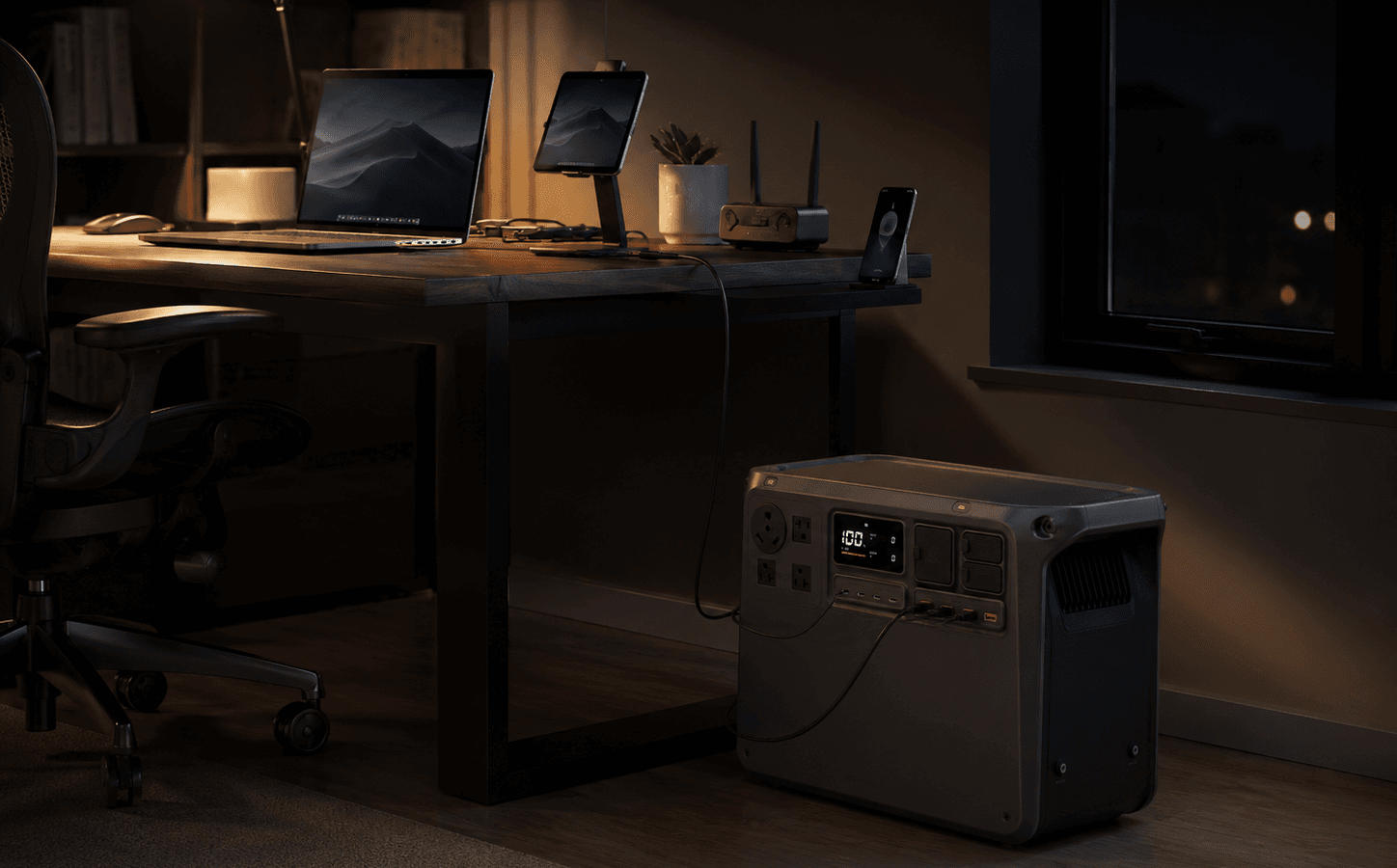
Product Intelligence
High-output 2kWh pickDJI Power 2000 Portable Power Station
A 2,048Wh LiFePO4 portable power station with 3,000W continuous AC output, four AC outlets, high-output USB-C ports, UPS capability, accessory-dependent solar and vehicle charging, and expansion up to 22,528Wh.
Specifications
Key specs
Buyer Fit
Fit signals
Best for
Pros
- 2048Wh LiFePO4 capacity
- 3000W continuous AC output
- Four AC, four USB-C, four USB-A, and two SDC ports
- Two USB-C ports up to 140W with compatible device and cable
- Expansion up to 22528Wh with compatible DJI batteries
- Grid, solar, car, and hybrid recharge paths with compatible accessories
- DJI-listed UPS transfer behavior within 0.01 seconds when configured
Cons
- Approximately 22 kg, which limits easy solo movement
- Maximum solar and vehicle charging paths require compatible DJI accessories
- No separate surge-output rating published by DJI in the specifications reviewed
- U.S. 0-80% grid recharge is approximately 55 minutes, not the 45-minute UK/EU/AU figure
- Not a substitute for whole-home, medical, life-safety, or code-governed backup
- Exact U.S. bundle, outlet configuration, and retailer availability must be confirmed before purchase
Spec table
| Capacity | 2048 Wh |
|---|---|
| AC Output | 3000 W |
| Solar Input | 1800 W |
| Weight | 48.5 lb |
| Battery | LiFePO4 |
| Warranty | Five-year DJI warranty coverage is listed, subject to DJI's current regional policy and any registration conditions. |
| Expandability | Up to 22,528Wh total capacity with up to ten compatible DJI Power Expansion Battery 2000 units. |
| UPS / EPS | UPS mode: DJI states connected devices can be powered within 0.01 seconds when configured. Confirm suitability with the device manufacturer before relying on it for sensitive or medical equipment. |
| Recharge Time | U.S. 120V: 0-80% in about 55 minutes under DJI laboratory conditions. UK/EU/AU: 0-80% in about 45 minutes. Full-charge time varies by region and method. |
This page may contain affiliate links. If you buy through them, PowerLabPro may earn a commission at no extra cost to you. As an Amazon Associate I earn from qualifying purchases.
The DJI Power 2000 portable power station is built for buyers who need more than a compact backup battery but do not need to pretend a portable unit can replace a professionally designed whole-home system. It combines a 2,048Wh LiFePO4 battery with 3,000W continuous AC output, four AC outlets, fast USB-C charging, expansion options, and two SDC ports for compatible DJI Power accessories.
The practical question is not whether the DJI Power 2000 portable power station has impressive headline specifications. It does. The better question is whether its capacity, output, physical size, and accessory ecosystem fit the devices you actually need to protect. That could mean a refrigerator and communication gear during a short outage, an RV load plan, a mobile-work setup, or DJI field charging. It does not mean every appliance in a house can run indefinitely.
Quick Verdict
The DJI Power 2000 portable power station is a strong fit for buyers who want a serious 2kWh-class platform with enough continuous output for selected high-draw loads, controlled home essentials, RV equipment, and creative or field gear. Its strongest buyer advantages are a 3,000W continuous inverter, a 2,048Wh LFP battery, high-output USB-C ports, an expansion path to 22,528Wh, and fast recharge options that depend on the selected charging method.
The trade-off is weight and planning. At approximately 48.5 lb, this is a planned backup platform rather than a lightweight device battery. Accessories matter too. Solar input, faster vehicle charging, battery expansion, and DJI drone charging require compatible equipment that is not automatically part of the base purchase.
Best For
- Buyers building a controlled home-essentials plan around communications, lighting, devices, and selected appliance loads.
- RV and road-trip users who want more battery reserve and inverter headroom than a compact 1kWh model provides.
- Mobile work, field production, and DJI users who can use compatible SDC accessories.
- Buyers who want the option to increase capacity later instead of replacing the base unit.
Not Ideal For
- Buyers who only need to keep phones, one laptop, a router, or lights running for a few hours.
- Anyone who needs permanent circuit coverage, transfer equipment, or code-governed automatic backup.
- Shoppers who do not want to verify accessory, bundle, or regional-variant compatibility before purchase.
Based on manufacturer-listed specifications and available documentation. This analysis does not claim hands-on testing. Check the current manual, retailer listing, regional variant, accessory compatibility, and warranty terms before purchase.

- Power More Than Ever – DJI Power 2000 Solar Generator runs 99% of appliances [1] like kettles, cookers, projectors, elec…
- Fast Charge Portable Power Station, Go Far – DJI Power 2000 recharges to 80% in just 55 minutes, so you’re always ready …
- Uncompromising Safety, Anywhere – DJI Outdoor Generator features a 2048Wh LFP battery, smart BMS, sub-nano coating, and …
Table of Contents
DJI Power 2000 Portable Power Station: Verified Specifications
| Specification | Verified detail | Why it matters |
|---|---|---|
| Battery capacity | 2,048Wh LiFePO4 | Capacity determines the energy reserve. It does not guarantee a fixed runtime because device draw, conversion losses, temperature, and battery age all change the result. |
| Continuous AC output | 3,000W | This is the sustained inverter limit. Add the running wattage of devices you may use together and leave practical headroom. |
| Surge output | DJI does not publish a separate surge rating in the specifications reviewed. | Do not treat the 3,000W continuous figure as a separate startup-surge claim. |
| AC outlets | Four | Confirm the exact outlet layout for the U.S. DYM2000L variant before purchase. |
| USB-C output | Two ports up to 140W and two ports up to 65W, subject to compatible devices and cables. | Useful for high-power laptops and USB-C equipment without occupying an AC outlet. |
| USB-A output | Four ports, up to 24W per port under DJI’s stated single-port conditions. | Useful for lower-power devices, but simultaneous sharing can reduce available output per port. |
| SDC ports | Two | They enable compatible solar, vehicle, expansion, and DJI fast-charge accessories. |
| Weight | Approximately 48.5 lb | Portable for planned movement, but not comfortable for frequent solo lifting in every situation. |
| Expansion | Up to 22,528Wh with up to ten compatible DJI Power Expansion Battery 2000 units. | Lets the system grow, but expansion batteries change total cost, space, and handling needs. |
| UPS mode | DJI states connected devices can be powered within 0.01 seconds when UPS mode is configured. | Check suitability with the manufacturer of sensitive or medical equipment before relying on it. |
DJI Power 2000 Portable Power Station Capacity and Runtime
A common mistake with the DJI Power 2000 portable power station is assuming that a 2,048Wh battery has a simple one-to-one runtime relationship with a device label. It does not. Battery capacity is an energy figure, while an appliance’s running draw is a power figure. A laptop, router, light, refrigerator compressor, fan, and coffee maker all use power differently. Some run steadily. Some cycle. Some need a higher startup draw than their normal operating draw.
That is why this DJI Power 2000 portable power station should be matched to a written device list. Start with equipment that matters most. During a short outage, that could be a modem, router, phones, laptop, LED lights, a small fan, and selected refrigerator operation after you confirm the appliance label. In an RV, it may be a compressor fridge, laptop, cameras, charging gear, a fan, and limited cooking loads. For mobile work, it may be a workstation, networking equipment, battery chargers, and lighting.
Higher-watt appliances can use a meaningful portion of the energy reserve quickly, even when their rated wattage falls below the inverter’s output limit. Heating appliances, cooking devices, electric kettles, hair tools, and resistive space heaters are the clearest examples. The DJI Power 2000 portable power station can provide useful inverter headroom, but it does not remove the need to protect battery capacity for the loads you value most.
Use the PowerLabPro sizing guide to calculate a realistic load plan before deciding whether a 2kWh-class unit is appropriate. The right question is not “What can it power?” in the abstract. It is “What can it power together, for how long, and what will you recharge it with?”
DJI Power 2000 Portable Power Station Output Analysis
The DJI Power 2000 portable power station has a meaningful advantage over many smaller portable batteries because its 3,000W continuous AC output gives it room for more demanding selected loads. That can reduce the chance that a buyer has to choose between a refrigerator, charging equipment, and another practical appliance simply because the inverter is too small.
Output and capacity still perform different jobs. A larger inverter determines whether a device can operate within the station’s continuous limit. Battery capacity determines how long the station can keep supplying energy. A power station with enough output for a 1,500W appliance may still be a poor choice for running that appliance continuously if the battery reserve needs to protect communications, refrigeration, or overnight essentials.
For home-backup planning, the DJI Power 2000 portable power station is better viewed as an essential-load system. It may suit a careful plan involving a refrigerator after startup verification, router, modem, phones, laptop, lights, and short controlled use of other loads. It should not be presented as a replacement for a code-compliant whole-home system, professional transfer equipment, life-safety backup, or a permanent generator installation.
For RV use, the 3,000W rating gives flexibility for occasional higher-power tools or appliances within a controlled setup. It does not turn every campground or vehicle electrical setup into an unlimited power source. Check plug compatibility, battery recharge options, and whether your use pattern needs a larger battery bank rather than more inverter capacity.
DJI Power 2000 Portable Power Station Charging Options
The DJI Power 2000 portable power station supports grid charging, vehicle charging, solar charging, and certain hybrid paths. The practical detail is that higher-input options depend on specific DJI accessories. Buyers should not assume that the base box includes the hardware needed for maximum solar or car charging.
DJI states that the U.S. 120V version can charge from 0 to 80% in approximately 55 minutes under laboratory conditions at 25°C. DJI’s 45-minute 0 to 80% claim applies to UK, EU, and AU outlets. Treat these as manufacturer-stated benchmarks rather than a guarantee for every home circuit, ambient temperature, or battery condition.
For solar input, the DJI Power 1.8kW Solar/Car Super Fast Charger can support up to 1,800W solar input, while DJI’s MPPT adapter module is listed for up to 400W solar input. These are accessory-dependent paths. Panel orientation, weather, shading, cable routing, and solar-panel specifications determine real-world solar harvest. A stated solar-input maximum is a ceiling, not a promise of daily energy production.
Vehicle charging also has important boundaries. DJI lists a 1kW Super Fast Car Charger and a 1.8kW Solar/Car Super Fast Charger for compatible setups. It also states that hybrid and fully electric vehicles are not compatible with those fast car chargers because of differences in generator operation. Verify the exact vehicle and accessory compatibility before building a travel or work plan around fast vehicle recharge.
DJI Power 2000 Portable Power Station Expansion Path
Expansion is one of the reasons the DJI Power 2000 portable power station can be more attractive than a fixed-capacity 2kWh model. DJI lists compatibility with up to ten Power Expansion Battery 2000 units, for up to 22,528Wh total capacity. That does not mean every buyer should plan for the maximum system immediately. The useful value is optionality.
Start with the base unit when it covers your current load plan and recharge capability. Add expansion only when a real need appears, such as longer outage coverage, a larger RV energy budget, repeated work-site use, or a more demanding off-grid schedule. Extra batteries increase stored energy, but they also increase the total cost, storage footprint, transport burden, and charging plan.
The DJI Power 2000 portable power station is therefore a good fit for buyers who want an expandable path but do not want to purchase maximum capacity before they understand their actual consumption. A buyer who needs repeated multi-day energy use may ultimately need a broader solar and battery strategy. A buyer who only needs one evening of router and phone coverage should probably look at a lighter, smaller product.
DJI Power 2000 Portable Power Station Ports and App Control
The DJI Power 2000 portable power station includes four AC outlets, four USB-C ports, four USB-A ports, and two SDC ports. The USB-C arrangement is particularly useful for a laptop-heavy setup. DJI lists two USB-C ports at up to 140W and two at up to 65W, provided the connected device and cable support the relevant power-delivery specifications.
The two SDC ports are the more specialized part of the platform. They can support compatible expansion batteries, solar and vehicle charging accessories, an SDC-to-car-charger cable for car-powered appliances, and certain DJI battery fast-charge cables. That makes the DJI Power 2000 portable power station especially interesting for users who already work with supported DJI drones or who want a structured accessory ecosystem instead of generic adapters.
The downside is ecosystem complexity. Buyers should verify which exact cable, charger, expansion battery, or solar adapter fits their model and use case. Do not assume an SDC port is the same as a universal consumer outlet. DJI lists Wi-Fi and Bluetooth support, and the DJI Home app can control AC output and auto-off settings. App functions, firmware, and regional availability can change, so verify them before relying on a feature for sensitive work equipment.
Source context: DJI Power 2000 official specifications and DJI Power 2000 official store and FAQ information.
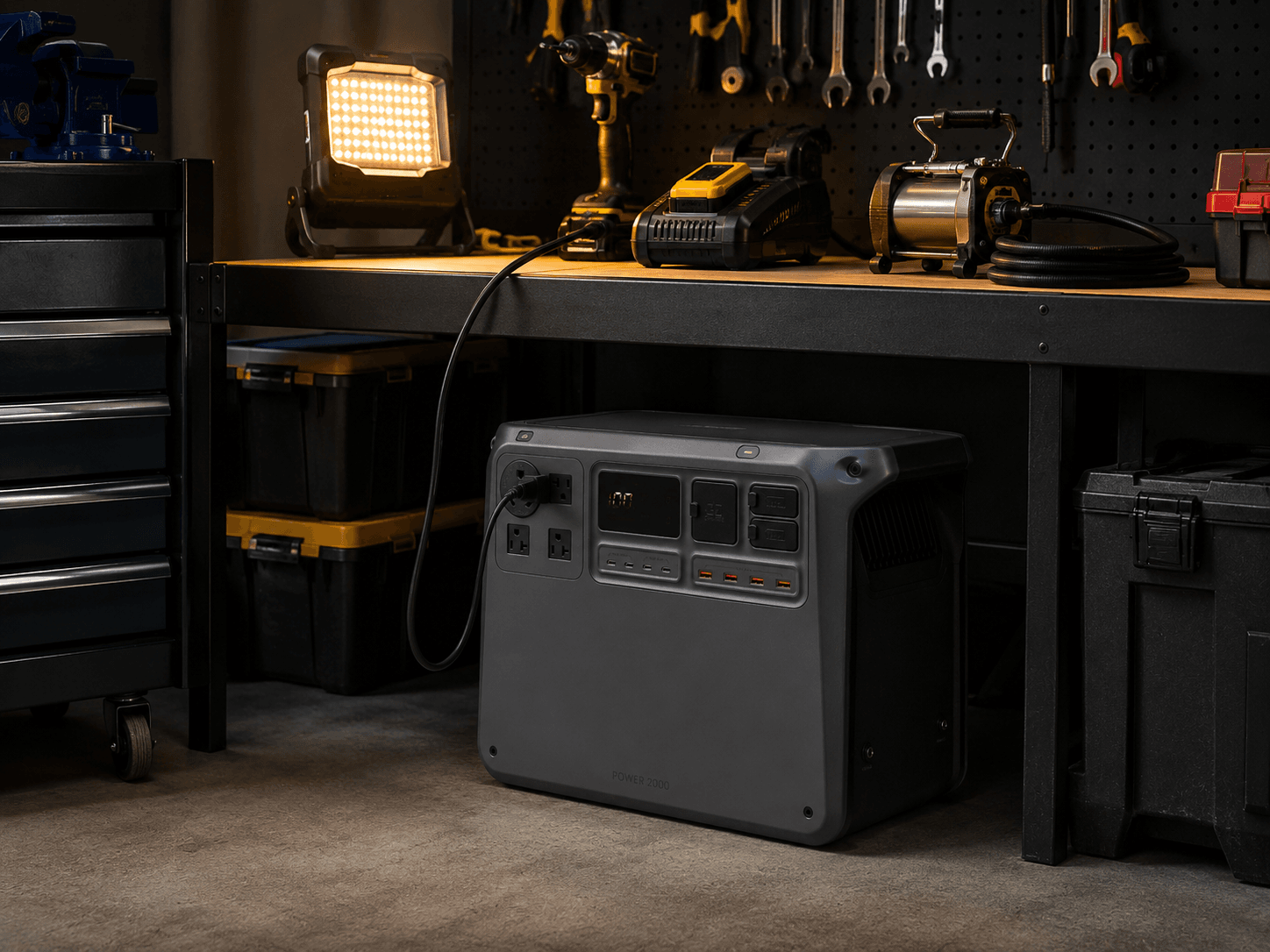
DJI Power 2000 Portable Power Station for Home Backup
For home backup, the DJI Power 2000 portable power station works best when it protects the devices that keep a household informed, connected, and reasonably comfortable. A careful load plan may include communication equipment, laptops, phones, LED lights, a small fan, selected refrigerator operation, and short-duration appliance use that stays within the station’s output and energy limits.
Start with the appliance label and manual. Refrigerators and freezers can have startup demand that differs from their normal running draw. Avoid treating portable power as a substitute for a permanent electrical installation. Do not connect a power station to home circuits without proper equipment and qualified professional advice. Do not use it as a substitute for medical, fire-safety, life-safety, or other critical backup systems.
Buyers planning short, controlled outage coverage may find the DJI Power 2000 portable power station useful because it offers meaningful output headroom and an expandable energy path. Buyers who need long-duration coverage for many appliances should compare it with larger power stations and professionally designed backup solutions instead of expecting one portable unit to cover every household need.
DJI Power 2000 Portable Power Station for RVs and Mobile Work
In an RV or road-trip setup, the DJI Power 2000 portable power station is best used as part of an energy plan rather than as an all-purpose answer. The base battery can support electronics, charging equipment, lighting, a compressor fridge, selected cooking use, and work devices when you control the load schedule. The 3,000W output creates flexibility, while the 2,048Wh battery sets the energy budget.
Mobile-work buyers may value the high-output USB-C ports, multiple AC outlets, and DJI-specific SDC options. A field-creation setup can include a laptop, displays, chargers, lights, camera batteries, and supported DJI equipment. The right fit depends on whether your gear needs the SDC ecosystem or whether a simpler power station with standard inputs would do the same work with fewer accessory decisions.
Before using the DJI Power 2000 portable power station in a vehicle environment, confirm ventilation, mounting, cable routing, battery protection, and any vehicle-specific accessory compatibility. Never run power cables where they can be crushed, exposed to water, or create a trip hazard.
DJI Power 2000 Portable Power Station Buyer Decision Table
| Buyer question | Direct answer |
|---|---|
| Who should choose it? | Buyers who need a 2kWh-class battery, 3,000W continuous output, and an expandable platform for planned essentials, RV use, mobile work, or compatible DJI accessories. |
| Who should skip it? | Buyers who only need compact backup, cannot comfortably manage a 48.5 lb unit, or need a professionally installed home-backup system. |
| Main advantage | It combines a large portable battery, high continuous output, multiple high-power USB-C ports, UPS capability, and a substantial compatible expansion path. |
| Main drawback | Accessory choices and physical weight add complexity, and the base unit alone is not unlimited backup capacity. |
| Better alternative if portability matters most | Choose a smaller 1kWh-class station such as the EcoFlow RIVER 3 Plus for lighter device and communications backup. |
| Better alternative if 240V or broader home coverage is required | Compare larger systems such as the EcoFlow DELTA Pro 3 and consult an electrician for code-governed backup integration. |
DJI Power 2000 Portable Power Station Pros
- 2,048Wh LiFePO4 battery with DJI’s stated 4,000-cycle benchmark.
- 3,000W continuous AC output for controlled higher-draw loads.
- Four AC outlets, four USB-C ports, four USB-A ports, and two SDC ports.
- Two USB-C ports listed up to 140W for compatible devices and cables.
- Compatible expansion path to 22,528Wh total capacity.
- Grid, solar, car, and hybrid charging routes with the correct accessories.
- DJI-listed UPS behavior with power transfer within 0.01 seconds when configured.
DJI Power 2000 Portable Power Station Cons
- Approximately 48.5 lb, which limits easy solo movement.
- Maximum solar and vehicle charging paths require separately selected DJI accessories.
- DJI does not publish a separate surge-output rating in the specifications reviewed.
- U.S. grid charging is listed at approximately 55 minutes from 0 to 80%, not the 45-minute figure used for UK, EU, and AU outlets.
- Not a substitute for permanent, code-compliant whole-home, medical, or life-safety backup.
- Exact U.S. bundle, outlet configuration, warranty details, and retailer availability should be confirmed before purchase.
DJI Power 2000 Portable Power Station: What to Verify Before Buying
- Confirm that the Amazon listing and configured Hostinger block identify the DJI Power 2000, not an accessory, expansion battery, or regional bundle.
- Check the current listing through the affiliate link for the exact U.S. product and package contents.
- Confirm the running and startup demand of every appliance in your intended outage or RV load plan.
- Verify current compatibility for DJI Power Expansion Battery 2000 units, solar adapters, car chargers, and supported DJI fast-charge cables.
- Confirm UPS suitability with the maker of sensitive, medical, networking, or storage equipment before relying on any switchover claim.
- Review DJI’s current U.S. warranty wording and support terms before purchase.
Related Buyer Resources
For the deeper trade-off analysis and alternatives, read the DJI Power 2000 review. For a wider shortlist, use the home backup buying guide and the best portable power station for RV guide. The PowerLabPro sizing guide remains the right next step when you need to translate a real device list into output and capacity requirements.