
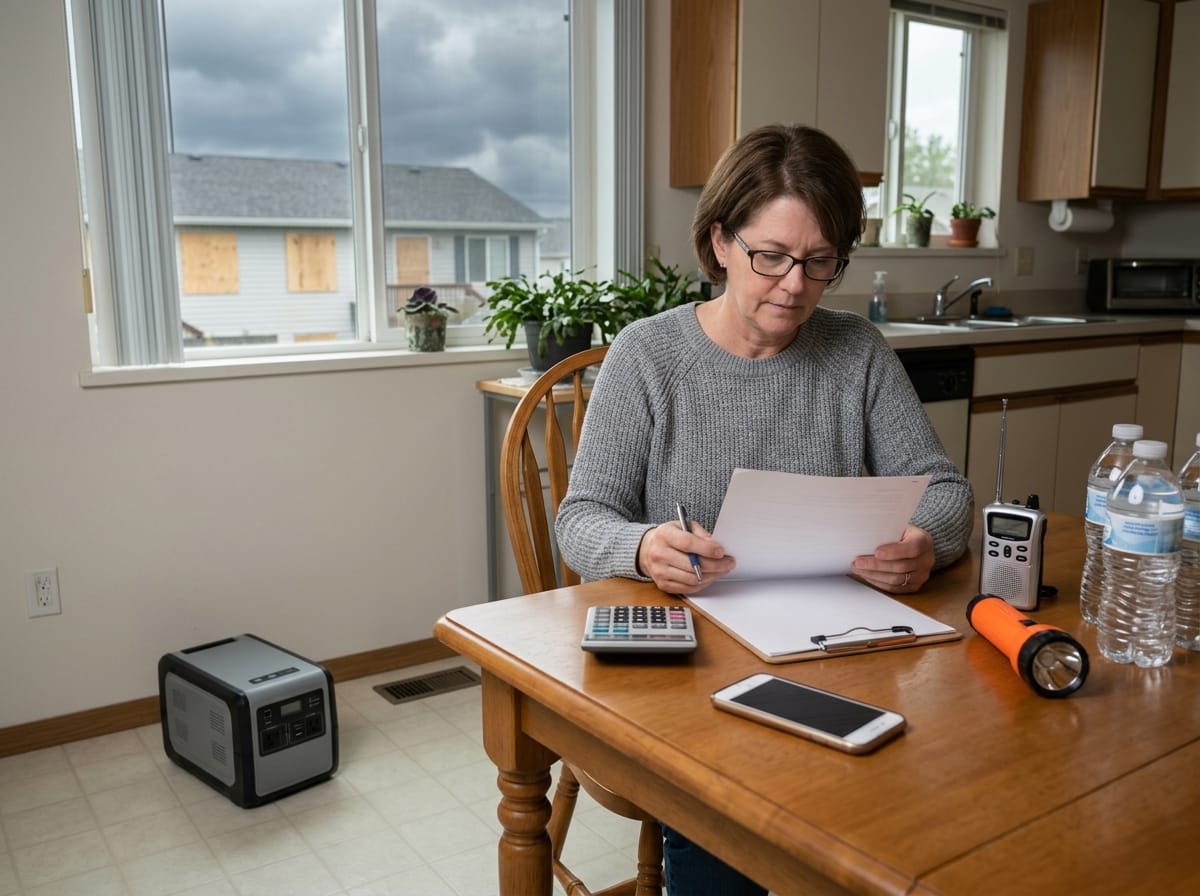
Research note: This hurricane battery backup guide is a research-led planning resource based on current public emergency guidance, basic electrical calculations, and PowerLabPro’s appliance-backup framework. PowerLabPro has not performed hands-on or laboratory testing for this article. Measure your own loads, follow local emergency instructions, and verify every connection method before relying on a battery system.
A practical hurricane battery backup plan starts with the loads that must stay available, not with the largest battery you can buy. For many households, the first priorities are phones, a weather radio, LED lighting, refrigeration, internet equipment, and limited fan use. Window air conditioners, sump pumps, well pumps, cooking appliances, and home circuits require separate output, startup, and connection checks.
The useful answer is therefore a range, not one universal battery size. A measured 24-hour essential-load plan may fit a modest system. Extending the same plan to 48 or 72 hours can require several times more stored energy unless you reduce loads or add a realistic recharge path. This guide shows how to build that plan without promising a runtime your equipment and weather may not deliver.
Hurricane Battery Backup: Start With the Loads, Not the Battery
A hurricane battery backup should support a written priority list. It should not be treated as an automatic whole-home substitute, an excuse to run every convenient appliance, or a replacement for evacuation and emergency instructions. Capacity tells you how much energy is stored. Output tells you which loads can operate at the same time. Recharge planning tells you whether the system can recover before the battery is empty.
Those three questions must be answered separately. A battery can have enough watt-hours for a day of small loads but still lack the inverter output or outlet type for a pump. Another system can start a high-draw appliance yet drain quickly because the appliance consumes energy faster than expected. A strong hurricane battery backup plan checks both the power ceiling and the energy budget.
The Direct Answer
For a 24-hour plan: total the energy used by essential loads for one day, divide by a conservative delivery fraction, and keep a reserve.
For a 48-hour plan: double the daily energy only when the same loads and operating schedule truly remain unchanged. Then check whether recharge can reduce the required stored capacity.
For a 72-hour plan: do not simply triple an unrestricted household load list. Reduce optional loads, schedule refrigeration and communications carefully, and separate any pump or cooling requirement that could dominate consumption.
The result is a household-specific number. The PowerLabPro power-station sizing guide explains the same watt, watt-hour, output, and startup concepts in more detail. Use the worksheet below to turn them into a hurricane plan.
Table of Contents
Why 24-, 48-, and 72-Hour Plans Are Different
The planning window changes both capacity and behavior. During the first 24 hours, the battery may mainly preserve communications, lighting, and food. By 48 hours, recharge access, hot-weather comfort, and freezer management become more important. By 72 hours, a plan that depends on high-draw appliances without dependable recovery can become unrealistic.
A hurricane battery backup plan must also recognize that the outage duration is unknown. The 24-, 48-, and 72-hour columns are decision checkpoints, not forecasts. They help you see which loads can remain on, which must be scheduled, and which require a different backup method.
| Planning window | Primary question | Best planning behavior | Common mistake |
|---|---|---|---|
| 24 hours | Can stored energy cover essentials for one day? | Protect communications, lighting, refrigeration, and a reserve. | Spending the first hours on cooking, heating, or aggressive cooling. |
| 48 hours | Can the same loads continue, or must the plan be reduced? | Measure daily use, schedule loads, and identify a recharge opportunity. | Assuming a sunny-day solar estimate will occur after a storm. |
| 72 hours | Is the battery system still the correct tool? | Reduce optional loads, protect a contingency reserve, and prepare alternatives. | Treating a portable battery as unlimited whole-home power. |
Build a Hurricane Battery Backup Planner
The Hurricane Battery Backup Planner is a four-step worksheet. Complete it before comparing products. The finished worksheet should show every load, its measured or documented consumption, the planned hours of use, startup demand where relevant, and whether the load is essential, useful, or conditional.
This process prevents a common failure: choosing a battery by headline capacity, then discovering that one overlooked appliance consumes most of the reserve. It also gives you a clean way to test the hurricane battery backup under controlled conditions before storm season.
Step 1: Separate Essential, Useful, and Conditional Loads
Begin with a room-by-room list, then remove everything that does not protect communication, food, water, basic visibility, or a clearly defined household need. Do not put a device in the essential column merely because it is convenient.
| Priority | Examples | Planning rule |
|---|---|---|
| Essential | Phones, weather radio, selected LED lights, required communication equipment | Fund these loads before comfort or convenience. |
| Useful | Router, laptop, small fan, limited television or monitor use | Schedule use and shut down when not needed. |
| Conditional | Refrigerator, window AC, sump pump, well pump, cooking appliance | Measure separately; verify output, startup, voltage, and connection requirements. |
| Do not assume | Central HVAC, electric water heating, range, dryer, every home circuit | These may require a different system, transfer equipment, or a non-battery solution. |
A hurricane battery backup plan becomes easier when every device has a reason to be included. A weather radio may need only brief charging. A router may not matter if the local internet network is down. A refrigerator may be high priority, but keeping its door closed and using food-safety timing can reduce unnecessary cycling and door openings.
Step 2: Calculate Daily Energy
For each device, calculate daily energy with this planning formula:
Daily watt-hours = running watts × hours used per day × duty cycle
Use a duty cycle only when a load turns on and off. A refrigerator or pump does not necessarily draw its running watts continuously. The strongest input is measured energy over a representative period. A plug-in energy monitor can help with ordinary cord-connected 120V appliances when used exactly as its manufacturer directs. For hardwired, high-voltage, or unfamiliar equipment, use qualified help instead of improvising.
Add all daily watt-hours to create the base energy budget. Keep the original measurements in the worksheet. That makes the hurricane battery backup plan auditable and easier to revise when a device, season, or household priority changes.
Step 3: Add Delivery Losses and a Reserve
The battery’s advertised capacity is not the same as guaranteed AC energy delivered to appliances. Inverter conversion, battery-management limits, standby draw, temperature, cable losses, and load behavior reduce usable energy. Use a planning assumption rather than pretending the full label capacity reaches every device.
A simple conservative equation is:
Required nominal battery watt-hours = total load watt-hours ÷ assumed delivery fraction
For a first-pass worksheet, an assumed delivery fraction such as 0.80 to 0.90 can be used only as a stated planning range. It is not a specification or test result. Then add a contingency reserve based on the consequence of running out. The more important the load, the less comfortable you should be planning to reach zero.
A responsible hurricane battery backup plan labels every assumption. When actual measured results become available, replace the assumption with the observed figure instead of preserving a convenient estimate.
Step 4: Check Output and Startup Demand
Energy capacity answers how long a plan may last. Inverter output answers whether the devices can run. Compare the total simultaneous running watts with the continuous AC output, then check startup demand for compressors and motors. Do not copy a surge number into the continuous-output column.
Voltage and outlet type matter as well. Many portable power stations provide only 120V AC. Some pumps, HVAC equipment, and household circuits use other voltages or hardwired connections. A large battery does not solve an incompatible electrical architecture. If the hurricane battery backup plan involves an inlet, transfer switch, panel, or hardwired load, the connection method must be designed and installed correctly. Never backfeed through a household receptacle.
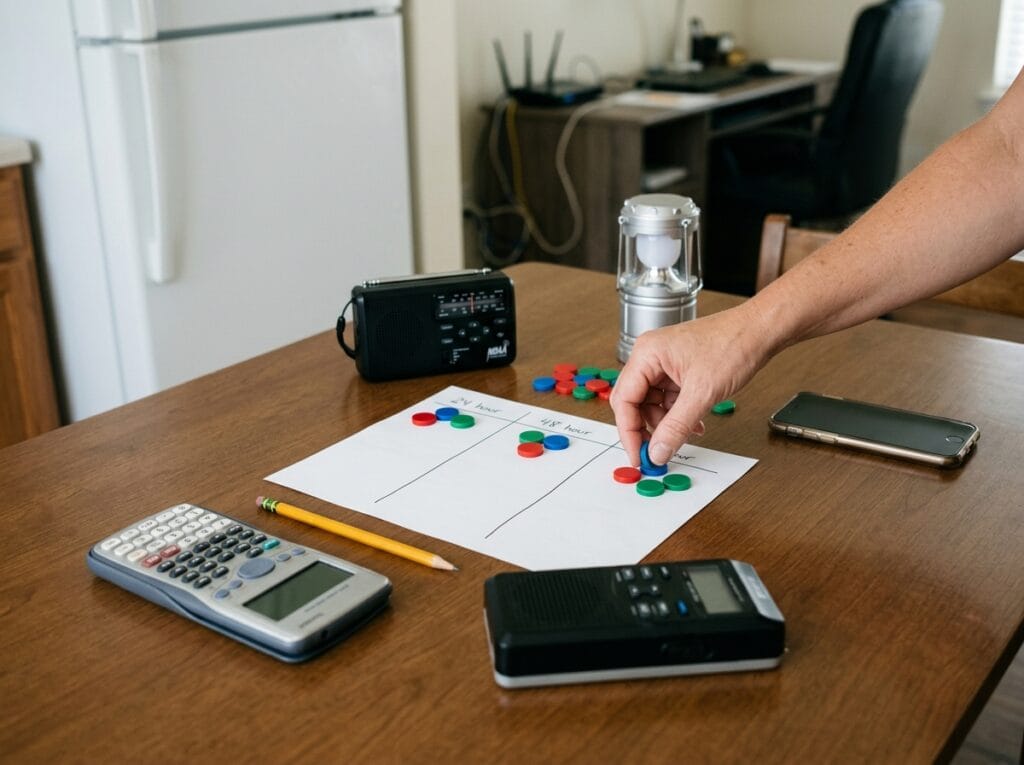
A Worked 24-, 48-, and 72-Hour Example
The following example is hypothetical. It demonstrates the arithmetic and must not be treated as a runtime promise. Assume a household measures or estimates these daily loads:
| Load group | Hypothetical daily energy | Assumption |
|---|---|---|
| Refrigeration | 1,200Wh | Measured or documented daily energy, not continuous nameplate watts. |
| Phones, radio, and LED lighting | 250Wh | Scheduled charging and limited lighting. |
| Router and laptop | 200Wh | Used only while the communication network is useful. |
| Small fan and contingency | 150Wh | Limited operation plus a small reserve line. |
| Total | 1,800Wh | Example only. |
At an assumed 85% delivery fraction, the nominal capacity calculation is 1,800Wh ÷ 0.85 = about 2,118Wh for one day before adding any additional contingency reserve. The same unchanged load plan would be about 4,235Wh for 48 hours and about 6,353Wh for 72 hours.
The correct lesson is not that every household needs those capacities. The lesson is that extending a hurricane battery backup plan multiplies energy quickly. Reducing a 150Wh optional load every day can matter more than buying capacity you have no practical way to recharge. A measured refrigerator could also use substantially more or less than the example.
24-Hour Hurricane Battery Backup Plan
A 24-hour hurricane battery backup plan can stay simple. Fund communication devices, the weather radio, essential lighting, and refrigeration if the measured budget supports it. Keep a reserve for a delayed restoration estimate or an unexpected device need.
- Charge phones and power banks before conditions deteriorate.
- Use one or two LED lights rather than lighting every room.
- Keep refrigerator and freezer doors closed as much as possible.
- Operate the router only while the local service is available and useful.
- Delay high-draw cooking, heating, or cooling unless the plan specifically budgets for it.
- Record the battery percentage at several checkpoints so the next plan uses observed consumption.
The 24-hour plan is also the easiest controlled test. Run the selected loads before hurricane season under safe, supervised conditions. If the battery reaches the reserve earlier than expected, revise the load schedule or capacity requirement before relying on it.
48-Hour Hurricane Battery Backup Plan
A 48-hour hurricane battery backup plan is not merely the 24-hour plan left unattended. By the second day, food management, indoor heat, communication availability, and recharge access may change. Recheck which loads still provide value.
Use a morning and evening energy budget. Schedule laptop work and device charging together. If the router has no upstream service, shut it down. If the refrigerator is the dominant load, stop opening the door to check it. If solar recovery is possible, compare actual energy received with the day’s consumption rather than assuming the panel rating equals daily harvest.
A two-day plan should also identify a non-battery fallback. That may be relocation, ice and coolers, a community charging site, a safely operated generator outdoors, or another option appropriate to local instructions. The battery is one component of resilience, not the entire emergency plan.
72-Hour Hurricane Battery Backup Plan
A 72-hour hurricane battery backup plan needs strict load discipline. If no dependable recharge path exists, preserve energy for information, communication, lighting, and the most consequential household loads. Comfort devices can consume the reserve that is needed later.
Separate the 72-hour plan into three daily envelopes. Do not spend day two’s energy during day one because the inverter can support a large load. A simple paper log should record battery state, energy added, energy consumed, weather conditions, and any change in priorities.
For longer outages, the correct decision may be to leave the battery system behind temporarily and follow evacuation or local shelter guidance. A 72-hour worksheet does not override storm surge, flooding, wind, heat, structural damage, or official instructions. The goal is to improve a safe shelter-in-place plan where appropriate, not to encourage remaining in an unsafe location.
Plan Refrigerator Backup Separately
Refrigeration often becomes the largest continuous energy category in a modest hurricane battery backup plan. Do not estimate it from the compressor nameplate alone. Measure daily energy when possible, account for hot-room conditions, and keep the doors closed.
The U.S. Food and Drug Administration advises that an unopened refrigerator keeps food cold for about four hours, while a full freezer can hold temperature for about 48 hours and a half-full freezer for about 24 hours when doors remain closed. Review the FDA’s food-safety guidance for emergencies and power outages before a storm. Battery runtime does not replace temperature and food-safety rules.
Use the refrigerator backup runtime guide to calculate this load separately. The goal is not to run the refrigerator without interruption at any cost. It is to preserve food safely while using the least energy compatible with the appliance, household conditions, and official guidance.
Treat Cooling as a Conditional Load
Hot-weather comfort matters, but cooling loads can dominate a hurricane battery backup budget. Start with shade, closed blinds, hydration, cross-ventilation when conditions are safe, and efficient fans. Then decide whether a room air conditioner belongs in the plan.
A window air conditioner requires enough continuous output, startup headroom, stored energy, and safe direct connection. Its energy use varies with size, thermostat setting, room heat gain, compressor cycling, and outdoor conditions. The window air-conditioner backup guide shows how to analyze that load without assuming one battery can cool a room for a fixed number of hours.
Do not use a generic cooling claim to make a medical or life-safety decision. People vulnerable to heat need a separate emergency plan based on local resources, health guidance, transportation, and reliable climate-controlled locations. A portable battery should not be the sole safeguard.
Pumps Can Change the Entire System
A sump pump or well pump can change the output, voltage, and capacity class of the entire hurricane battery backup plan. Pumps have motors, and motors may draw substantially more power at startup than during normal running. Cycling frequency also changes with rainfall, water demand, and system conditions.
For basement-water planning, use the sump-pump backup guide and verify the pump’s actual voltage, running draw, startup behavior, and discharge condition. A battery cannot protect a basement if the pump, float switch, discharge path, or connection method is incompatible.
For private wells, review the well-pump backup guide. Many well systems are not ordinary plug-in 120V loads. Do not improvise a panel, pressure-switch, or generator-inlet connection. Qualified electrical and well-system guidance may be required.
Internet, Phones, Lighting, and Information
Communication loads are usually easier to support than motors or cooling. That makes them a strong first layer in a hurricane battery backup plan. A phone, weather radio, LED lantern, and limited laptop use may consume a relatively small share of the total budget, but only your chargers and operating schedule determine the actual figure.
Keep information sources redundant. A router depends on the local network remaining operational. Cellular service can become congested or unavailable. A battery-powered or hand-crank weather radio can provide another route for alerts. Download essential documents and maps before the storm instead of assuming internet access will continue.
The National Weather Service recommends preparing before hurricane season, knowing evacuation zones, assembling an emergency kit, reviewing a family emergency plan, and understanding watches and warnings. Use the official NWS hurricane preparation checklist alongside the electrical worksheet.
Recharge Planning: Consumption Must Not Exceed Recovery
A battery plan lasts only when daily consumption does not repeatedly exceed stored energy plus verified recovery. For each day, record three figures: energy at the start, energy added, and energy used. This turns the hurricane battery backup from a vague promise into an operating budget.
| Daily result | What it means | Action |
|---|---|---|
| Recovery exceeds consumption | The battery can regain reserve under current conditions. | Keep monitoring; do not assume the next day will match. |
| Recovery roughly equals consumption | The system is maintaining, not building a large reserve. | Reduce optional loads before conditions worsen. |
| Consumption exceeds recovery | The battery will eventually empty. | Cut loads, find another safe recharge path, or change the plan. |
| No recharge available | Stored capacity is the complete budget. | Protect essential loads and use fixed daily envelopes. |
Solar Recovery During Hurricane Conditions
Solar panels can extend a hurricane battery backup plan, but the panel wattage is not a daily energy guarantee. Cloud cover, rain bands, shade, wind, panel angle, temperature, cable limits, and the power station’s input ceiling all affect recovery. Panels must be deployed only when conditions are safe.
Do not place panels in high wind, floodwater, traffic paths, or locations where setup requires exposure to storm hazards. Wait for safe conditions and follow manufacturer guidance. After deployment, use the battery display or a reliable measurement to record actual watt-hours recovered. Build the next day’s load budget from that result, not from the label on the panel.
AC, Vehicle, and Other Recharge Paths
Grid charging before the storm is the most predictable starting point. Complete charging early rather than during the final rush. Vehicle charging can be slow and may require the vehicle to operate, so follow vehicle and power-station instructions and never run a combustion engine in a garage or other enclosed area.
A public charging location may help after the storm, but access, travel safety, queues, and local restrictions can change. A larger battery is also harder to transport. Include weight, stairs, vehicle space, and lifting ability in the hurricane battery backup plan before assuming the system can be moved.
Apartment and House Plans Are Not the Same
Renters often need a different hurricane battery backup strategy from homeowners. Apartment plans usually favor silent indoor battery storage for phones, lighting, communications, a fan, and selected cord-connected appliances. They should not assume access to outdoor generator space, roof-mounted solar, or electrical modifications.
The portable power station for apartment outages guide covers renter-specific constraints. Keep equipment dry, ventilated, and clear of exits. Verify building rules, evacuation routes, and whether elevators may be unavailable.
A detached-house plan may include larger refrigeration loads, pumps, garage storage, outdoor solar after the storm, or a properly installed transfer solution. Those options add capability but also add connection, code, weather, and maintenance responsibilities. Do not copy a house plan into an apartment or an apartment plan into a pump-dependent property.
Hurricane Battery Backup Safety Limits
- Keep the power station and every connection dry. Do not operate or charge equipment in floodwater, rain, or a wet location unless the exact equipment is specifically rated and used as directed.
- Never backfeed a home through a wall outlet. Use only a correctly designed transfer method for circuits, with qualified installation where required.
- Do not exceed continuous output, input limits, outlet ratings, cable ratings, or manufacturer-specified environmental limits.
- Do not block cooling vents or cover the power station with storm supplies.
- Do not use damaged batteries, swollen packs, damaged cords, or equipment that has been exposed to water.
- Keep combustion generators outdoors and far from doors, windows, and vents. A battery and a fuel generator have different hazards and operating rules.
- Do not rely on a consumer portable battery as the sole backup for medical, fire, security, communications, or other life-safety equipment.
- Test ordinary loads before the storm, but do not create an unsafe panel, pump, HVAC, or hardwired test.
These limits are part of the hurricane battery backup calculation. A theoretically sufficient battery is not a suitable system when the location, connection, condition, or operating method is unsafe.
Connect the Battery Plan to the Hurricane Plan
The electrical worksheet should sit inside the larger family plan. Record who monitors alerts, who controls the load schedule, where the battery is stored, how equipment will be moved, which devices receive priority, and when the household will stop sheltering in place.
Prepare the hurricane battery backup before a watch or warning. Charge it, update firmware only when there is enough time to verify normal operation, inspect cables, label essential chargers, and place the worksheet with emergency documents. Do not depend on a phone-only copy.
Also plan for people who may not be present when the outage begins. The operating instructions should be simple enough for another household member to follow without guessing which outlets, loads, or settings are safe.
When a Portable Battery Is Not Enough
A portable battery may be the wrong tool when the required load is hardwired, 240V, extremely high draw, continuously life-sustaining, or expected to run for days without recovery. It may also be a poor fit when the household cannot safely move, store, charge, or monitor the equipment.
Use the PowerLabPro resources hub when the plan has moved beyond ordinary portable loads. After calculating the requirement, the portable power stations for home backup guide can help compare product categories. Planning should come before shopping.
The purpose of a hurricane battery backup worksheet is partly to identify a non-fit. Discovering that a pump, central cooling system, or multi-day energy budget requires a different solution is a successful planning result.
Hurricane Battery Backup FAQ
How much hurricane battery backup do I need for 24 hours?
Add the measured watt-hours for one day of essential loads, divide by a conservative delivery fraction, and add a reserve. A household using 1,000Wh per day has a different requirement from one using 3,000Wh. Output, startup, voltage, and outlet compatibility must still be checked.
Is 2,000Wh enough for hurricane battery backup?
It can be enough for a tightly controlled one-day plan, but it may be insufficient when refrigeration, cooling, pumps, or multiple days are included. Calculate the actual load budget. Do not assume that a 2,000Wh label provides 2,000Wh of guaranteed AC energy.
Can solar panels recharge a battery during a hurricane outage?
Yes, after conditions are safe and when the panels, cables, and battery input are compatible. Actual recovery can be much lower than panel ratings during cloud cover, rain, shade, or poor placement. Record delivered energy and adjust loads rather than relying on a sunny-day estimate.
Can a portable power station run a refrigerator and window AC together?
Possibly, but only when their combined running watts, startup behavior, and energy use fit the system. A window AC can consume the reserve quickly, while a refrigerator compressor may add startup demand. Analyze both separately and decide whether they should run at different times.
Should I connect a portable battery to my home electrical panel?
Only through a compatible, code-compliant transfer method designed for the equipment and installed or verified by qualified professionals where required. Never connect a portable battery to energize a home by backfeeding a receptacle.
Final Decision
A useful hurricane battery backup plan is a measured energy budget connected to a wider emergency plan. Start with phones, alerts, lighting, refrigeration, and any verified household-specific requirement. Separate pumps and cooling because they can change the voltage, output, and capacity class.
Build 24-, 48-, and 72-hour columns, state every loss and recharge assumption, preserve a reserve, and test ordinary cord-connected loads safely before storm season. If the worksheet shows that the required system is too large, incompatible, or unsafe, choose a better backup method rather than forcing the portable-battery category to fit.
The final decision is not “buy the biggest battery.” It is “use the smallest verified system and operating plan that can support the essential loads for the required time, with safe connections and a realistic path when the outage lasts longer.”