
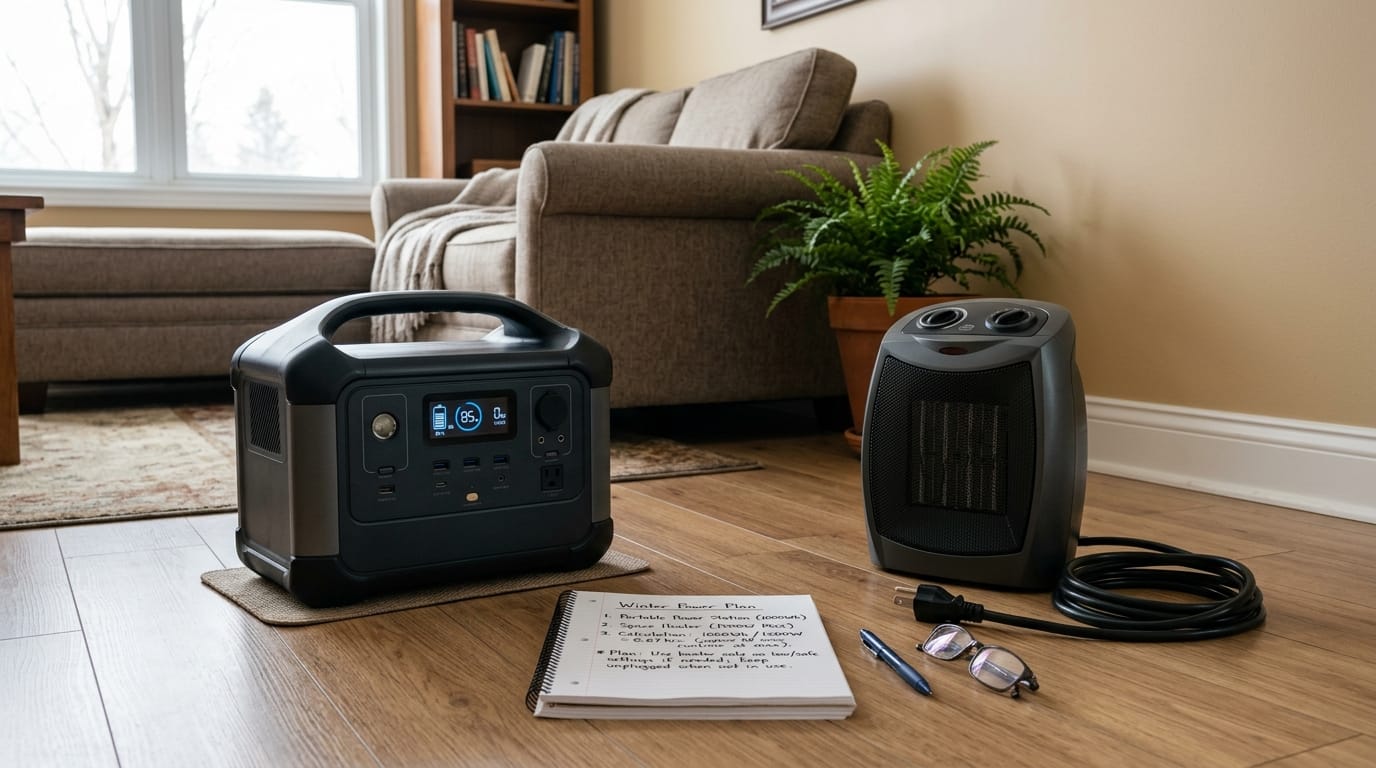
A portable power station can run some electric space heaters, but the electrical compatibility is usually the easy part. The harder question is whether the battery can provide useful heat for long enough without creating a poor emergency plan. A typical 1,500W heater can drain a 1,024Wh station in well under an hour after normal conversion losses.
This guide explains how to choose a portable power station for space heater use, calculate a planning runtime, verify inverter output, apply fire-safety rules, and recognize when insulation, layered clothing, a heated blanket, a gas-furnace blower backup, or relocation is the better answer. The examples are calculations, not test results or guaranteed runtimes.
Evidence boundary: PowerLabPro has not performed laboratory testing for this article. Use the exact heater label and manual, the power-station manual, current fire-safety guidance, room conditions, and a measured load where appropriate. Do not treat a consumer battery as a life-safety heating system.
Quick Answer: Can a Portable Power Station Run a Space Heater?
Yes, a portable power station for space heater use can work when the station has sufficient continuous AC output, the heater uses a compatible ordinary outlet, the cord and plug are undamaged, and the battery is large enough for the required time. The station must be placed according to its manual, and the heater must follow all clearance, outlet, supervision, and shutoff requirements.
For most buyers, the runtime is the limiting factor. A 500W low setting may provide roughly three times the runtime of a 1,500W high setting from the same battery. Even then, space heating is a sustained resistance load, so it consumes stored energy much faster than a router, phone charger, LED light, or laptop.
The practical conclusion is narrow: use a portable power station for space heater only for a verified, supervised, short-duration task when the battery calculation makes sense. Do not build an overnight or unattended heating plan around a runtime estimate.
Table of Contents
Why Space Heaters Drain Batteries So Quickly
A portable power station for space heater must support electric resistance heat, which converts a large, steady electrical load into heat. That makes a portable power station for space heater use fundamentally different from backing up electronics. A 1,500W heater uses 1,500 watt-hours for every hour it runs continuously. A router drawing 20W would need 75 hours to use the same 1,500Wh.
Battery capacity is normally published in watt-hours. A 1,024Wh station does not deliver all 1,024Wh through its AC outlets because the inverter and the station itself consume energy. Temperature, battery settings, age, state of charge, and protective cutoffs can reduce usable energy further.
The heater may cycle after the room warms, but a cold room, open floor plan, draft, or undersized heater can keep it running almost continuously. Do not assume thermostat cycling will rescue an inadequate battery plan. Calculate the continuous case first, then treat any cycling as possible extra margin rather than guaranteed runtime.
Portable Power Station for Space Heater Sizing Checklist
A safe portable power station for space heater decision needs more than the heater’s headline wattage. Complete each check before shopping or connecting the load.
- Read the heater label and manual. Record voltage, rated watts or amps, plug type, permitted outlet method, clearances, and any warning about generators or inverter power.
- Identify every heat setting. Many heaters have low and high modes, but the exact wattage varies by model.
- Check continuous AC output. The station must support the heater’s sustained draw with useful headroom.
- Confirm pure sine wave or other required output. Follow both manufacturers rather than assuming a marketing label proves compatibility.
- Calculate usable energy. Use documented measured performance when available or label a conservative planning factor.
- Choose the required minutes or hours. Short supervised warm-up and overnight heating are different risk and capacity problems.
- Keep other loads separate. A heater can consume most of a compact inverter’s output, leaving little headroom for a refrigerator or pump.
- Apply fire-safety rules. Clearance, a stable surface, direct outlet guidance, supervision, and shutoff behavior still control the setup.
- Maintain a cold-weather fallback. Know when occupants should move to a safer heated location.
If any input is unknown, the portable power station for space heater plan is not ready. A larger battery cannot fix a damaged plug, unclear outlet instruction, insufficient clearance, or an unsuitable operating location.
Calculate Space-Heater Runtime
For a first portable power station for space heater estimate, use this formula. The portable power station for space heater calculation should be completed before product selection:
Estimated runtime in hours ≈ battery capacity in Wh × usable-energy factor ÷ heater watts
The usable-energy factor is not a universal efficiency rating. It is a planning assumption that combines inverter losses, station overhead, reserve, and uncertainty. The examples below use 0.85 only to show the calculation. Replace it with current manufacturer documentation or measured evidence for the exact station when available.
Example: a 1,024Wh station, a 0.85 planning factor, and a 1,500W heater produce 1,024 × 0.85 ÷ 1,500 = 0.58 hours, or about 35 minutes. That does not guarantee 35 minutes. It shows why a 1kWh battery and a full-power heater are usually a short-duration combination.
A second example uses the same station with a verified 500W heater setting: 1,024 × 0.85 ÷ 500 = 1.74 hours. That is better, but it remains a supervised heating window, not an unattended overnight plan.
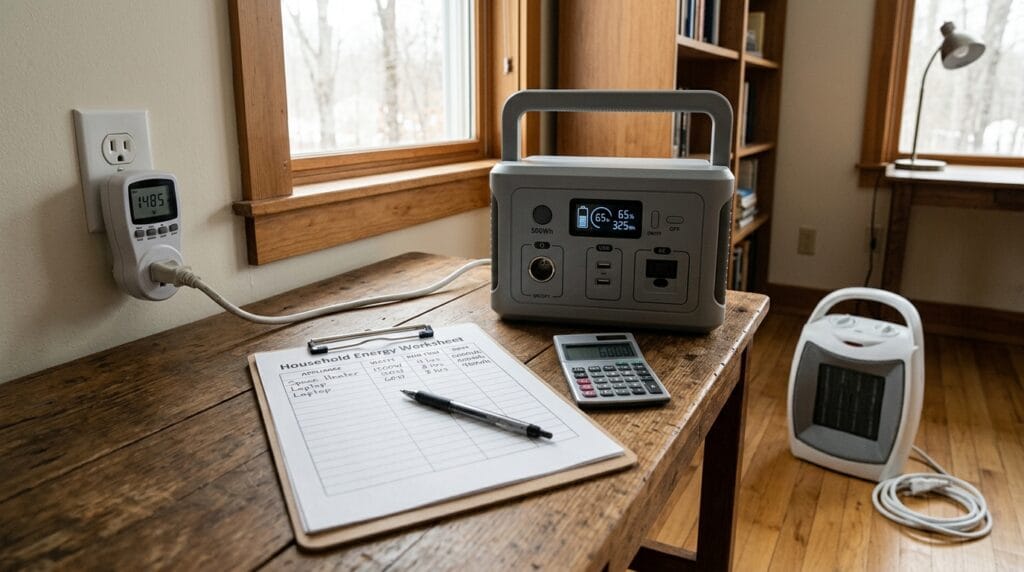
Runtime Table for 1kWh, 2kWh, and 3kWh Batteries
This portable power station for space heater table compares nominal battery capacity and heater wattage using the same 85% planning factor. It helps show the scale of a portable power station for space heater setup. It does not represent laboratory testing, a typical heater, or a guaranteed product result.
| Nominal battery | Heater draw | Planning runtime | Approximate minutes |
|---|---|---|---|
| 1,024Wh | 500W | 1.74 hours | 104 minutes |
| 1,024Wh | 750W | 1.16 hours | 70 minutes |
| 1,024Wh | 1,000W | 0.87 hours | 52 minutes |
| 1,024Wh | 1,500W | 0.58 hours | 35 minutes |
| 2,048Wh | 500W | 3.48 hours | 209 minutes |
| 2,048Wh | 750W | 2.32 hours | 139 minutes |
| 2,048Wh | 1,000W | 1.74 hours | 104 minutes |
| 2,048Wh | 1,500W | 1.16 hours | 70 minutes |
| 3,072Wh | 500W | 5.22 hours | 313 minutes |
| 3,072Wh | 750W | 3.48 hours | 209 minutes |
| 3,072Wh | 1,000W | 2.61 hours | 157 minutes |
| 3,072Wh | 1,500W | 1.74 hours | 104 minutes |
The table reveals two important limits. First, doubling battery capacity approximately doubles runtime when the load and assumptions remain the same. Second, lowering the heater draw has an equally direct effect. A 3,072Wh battery at 1,500W still provides only about 1.74 planning hours.
Do not use the last few minutes as a target. Preserve reserve for communication, lighting, orderly shutdown, and an outage that lasts longer than expected. Cold battery conditions may also reduce usable energy or charging performance.
Continuous Output, Surge, and Heater Settings
A space heater is usually a continuous load rather than a motor-start problem. For a portable power station for space heater, the continuous AC rating matters more than a large surge number. A station advertised with a high peak output can still be unsuitable when its normal output is below the heater’s sustained demand.
For a portable power station for space heater, check the exact settings. A heater may list 750W low and 1,500W high, 500W eco and 1,000W boost, or another combination. Thermostat or eco mode may cycle the element, but do not assume a lower average without measuring it under representative conditions.
Leave output headroom. A 1,500W heater on a 1,500W inverter leaves no useful margin for the station’s behavior, another connected device, or a heater that draws slightly more than the rounded label. Follow the station’s continuous-load limits, outlet limits, and duration restrictions.
Do not use a voltage-boost or appliance-lifting mode unless the heater and station manufacturers explicitly support that application. Reducing voltage or changing waveform to keep a resistance appliance running can alter heat output and may not match the heater’s design requirements.
Space-Heater Fire Safety Still Applies
A portable power station for space heater does not reduce a heater’s fire risk. The U.S. Fire Administration advises keeping anything that can burn at least three feet from heating equipment and turning portable heaters off when leaving the room or going to bed. Those rules remain essential in every portable power station for space heater setup.
- Maintain at least three feet of clearance from bedding, curtains, clothing, paper, furniture, and other combustible material.
- Use a stable, level surface where the heater cannot tip or block a walkway.
- Turn it off when leaving or sleeping. Do not make an estimated battery runtime the supervision plan.
- Keep children and pets away from the heater, cord, and power station.
- Stop after abnormal behavior. A hot plug, discoloration, odor, crackling, repeated shutdown, or damaged cord requires immediate disconnection and inspection.
- Maintain working smoke and carbon-monoxide alarms according to their manufacturers, even though an electric heater does not produce combustion gases.
The portable power station for space heater decision should be conservative because an outage already reduces normal safety margins. Darkness, crowded rooms, temporary cable routes, cold occupants, and distraction can make a marginal setup more dangerous.
Never Use an Extension Cord or Power Strip Unless the Heater Manufacturer Allows It
Portable-heater guidance commonly requires a direct wall-outlet connection and warns against extension cords or power strips because high current can overheat weak contacts. A portable power station for space heater changes the source, but it does not make an undersized cord, loose adapter, damaged receptacle, or overloaded power strip safe.
Use only the station’s built-in compatible AC outlet unless both manuals authorize another method. Do not stack adapters, use a household power strip as a high-current distribution point, or share an outlet bank with another large load. Keep the heater plug fully inserted and check for heat at the plug and outlet without touching exposed conductors.
Some power stations place several receptacles behind one shared inverter and one total current limit. Multiple visible outlets do not mean each outlet can simultaneously support a full-power appliance.
Where to Place the Power Station and Heater
A portable power station for space heater creates separate placement needs for the station and heater. A safe portable power station for space heater arrangement must satisfy both manuals at once. The heater needs combustible clearance and a stable floor. The battery needs a dry, ventilated location within its operating-temperature limits, with vents unobstructed.
- Keep the station away from the heater’s hot-air discharge and radiant heat.
- Do not place either device on bedding, upholstered furniture, or a soft surface.
- Route the heater cord so nobody trips, pulls the heater over, or damages the plug.
- Keep the station away from water, melting snow, wet footwear, and condensation.
- Do not cover the station to keep it warm, and do not place it inside a closed cabinet while operating.
- Keep exits, stairs, and doorways clear.
- Do not operate a fuel generator indoors or in an attached garage to recharge the station.
If the only available placement violates either manual, abandon the portable power station for space heater setup and use another heating plan.
When a Heated Blanket or Other Lower-Draw Option Makes More Sense
Before choosing a portable power station for space heater, remember that heating a person can require far less energy than heating an entire room. A heated blanket, heated throw, or heated clothing may use substantially less power than a 1,500W space heater, but the exact product must be verified and used according to its own safety instructions.
Passive measures also extend the value of stored energy: wear dry layers, use hats and insulated socks, close curtains, reduce drafts without blocking required ventilation, occupy a smaller safe room, and keep exterior doors closed. These measures do not replace a safe-heating plan for extreme cold or vulnerable occupants.
A lower-draw option can preserve battery capacity for the router, phones, lights, refrigerator, and alerts. A portable power station for space heater may be technically possible while a lower-energy comfort strategy is the better overall outage decision.
Gas Furnace Blower Backup Versus Electric Space Heating
A gas, propane, or oil furnace creates heat from fuel but still needs electricity for controls, ignition, inducer, blower, and possible condensate equipment. In some homes, supporting the complete furnace cycle can use less electrical energy than running electric resistance heat. The comparison must be measured and professionally connected because most furnaces are hardwired.
Read Can a Portable Power Station Run a Gas Furnace Blower? for the separate electrical, transfer, neutral, grounding, combustion, and carbon-monoxide checks. Do not improvise a furnace cord or backfeed a circuit.
The right choice is not automatically a portable power station for space heater. It may be a professionally prepared furnace backup, better insulation, an approved permanently installed system, a safely operated outdoor generator, or relocation to a heated location.
Apartment, RV, Garage, and Camping Considerations
Apartment: Battery power avoids engine exhaust, but the heater still needs clearance, direct-connection compliance, supervision, and sufficient runtime. Apartment rules, crowded layouts, and limited exits can make cable placement difficult.
RV: Confirm whether the heater’s current fits the station outlet, RV wiring, and campground or battery plan. Small spaces warm quickly but also place combustibles close to the heater. Never assume the TT-30 or RV connection changes the heater’s watt-hour demand.
Garage: Do not operate near gasoline, solvents, sawdust, paint, propane, or other flammable material. Temperature can affect battery performance, and a garage may expose equipment to moisture.
Camping or vehicle use: A standard household space heater is usually a poor battery load for a tent or vehicle. Fire clearance, unstable surfaces, condensation, ventilation, and limited exit space create additional hazards. Follow equipment makers and campground rules.
Each location changes the answer, so a portable power station for space heater should never be recommended from wattage alone.
When a Portable Power Station Is the Wrong Heating Plan
- The heater label, wattage, plug, or manual requirements cannot be verified.
- The station’s continuous output is below the heater’s sustained demand or leaves no required margin.
- The calculated runtime is shorter than the real heating need.
- The plan depends on unattended or overnight operation.
- The only connection uses an unapproved extension cord, power strip, or adapter.
- Three-foot combustible clearance and a stable placement cannot be maintained.
- The station would sit in the heater’s hot-air path, a wet area, or outside its temperature limits.
- Vulnerable occupants, freezing pipes, or extreme weather require a more dependable heating and relocation plan.
- The battery is also required for refrigeration, communication, medical guidance, or other higher-priority needs.
- The plan assumes solar or vehicle charging will replace energy without a realistic watt-hour calculation.
When these conditions apply, the portable power station for space heater is the wrong tool. Choose a safer heating location or a professionally designed backup method rather than increasing battery capacity blindly.
How to Choose a Power Station After the Calculation
Only shop for a portable power station for space heater after the runtime and safety checks are complete. For a portable power station for space heater, compare continuous AC output, usable battery energy, outlet rating, low-temperature limits, recharge options, weight, storage, and the other loads that must remain available.
A 1kWh station may support a short low-setting warm-up. A 2kWh or 3kWh station provides proportionally more time, but it also costs more, weighs more, and takes more energy to recharge. An expandable system can add duration later, but extra batteries do not reduce the heater’s demand.
Use the PowerLabPro sizing guide for the full load inventory, then compare broader selected-load options in the home-backup Buying Guide. Keep commercial product selection separate from the earlier safety decision.
Do not choose by a product card that says “runs a heater” without stating the heater wattage, setting, duration, and assumptions. Compatibility is not the same as useful runtime.
Common Mistakes
| Mistake | Why it fails | Better action |
|---|---|---|
| Using surge output as the heater rating | A heater is normally a sustained load | Compare with continuous AC output |
| Dividing nominal Wh by watts without losses | Overstates available AC energy | Use documented usable energy or a labeled planning factor |
| Assuming eco mode is always low draw | Thermostat behavior depends on the exact heater and room | Verify settings and measure when appropriate |
| Planning to use the battery to zero | Leaves no reserve and may shorten the practical window | Preserve capacity for communication and safe shutdown |
| Sharing the inverter with another large load | Can exceed output and rapidly deplete the battery | Create a load priority list |
| Using a power strip or improvised adapter | High current can overheat weak connections | Follow direct-connection instructions |
| Ignoring three-foot clearance | Battery power does not remove fire risk | Maintain the heater manufacturer and USFA clearance |
| Treating one test as an overnight guarantee | Conditions and battery behavior change | Supervise use and maintain a fallback |
The most expensive portable power station for space heater mistake is buying a larger battery before deciding whether resistance heat is the right emergency strategy. The most dangerous mistake is relaxing heater safety because the source is a battery rather than the grid.
Portable Power Station for Space Heater FAQ
What size power station do I need for a 1,500W heater?
The station needs continuous AC output above the heater’s verified sustained draw and enough usable watt-hours for the required supervised period. At a 1,500W continuous load, even a 3,072Wh battery provides only about 1.74 planning hours using the article’s 85% example factor. Choose from the exact calculation, not the inverter rating alone.
How long will a 1,000Wh power station run a space heater?
A nominal 1,024Wh battery at an 85% planning factor gives about 0.58 hours at 1,500W, 0.87 hours at 1,000W, 1.16 hours at 750W, or 1.74 hours at 500W. These are calculation examples, not guaranteed results.
Can I run a space heater overnight from a power station?
Do not use the setup as an unattended or sleeping heating plan. The U.S. Fire Administration advises turning portable heaters off when leaving the room or going to bed. Runtime estimates do not replace supervision or a safe cold-weather fallback.
Is a 500W heater better for battery backup?
A verified 500W setting uses energy more slowly than a 1,500W setting and can provide roughly three times the calculated runtime from the same battery. Whether it provides enough heat depends on the room, insulation, temperature, and heater. Safety rules still apply.
Final Answer
A portable power station for space heater can support a compatible electric heater for a limited supervised period, but space heating is one of the fastest ways to drain a portable battery. Start with the heater’s actual wattage and the station’s continuous output, then calculate runtime from usable energy rather than nominal capacity alone.
Keep combustible material at least three feet away, use the connection method required by the heater manufacturer, maintain a stable dry placement, and turn the heater off when leaving or sleeping. Preserve battery energy for communication and other essential loads, and maintain a relocation or alternative-heating plan for severe cold.
The best answer is often not a larger battery. It is a lower-draw personal-warming method, a professionally prepared gas-furnace backup, reduced heat loss, or a safer heated location. Choose a portable power station for space heater only when the verified numbers and the safety plan both support it.