
Review
OUPES Mega 1 Review: Expandable 1kWh Backup Trade-Offs
Expandable 1kWh backup with 2,000W output and verified 800W solar input, best for measured loads and staged B2 expansion rather than whole-home or 240V use.
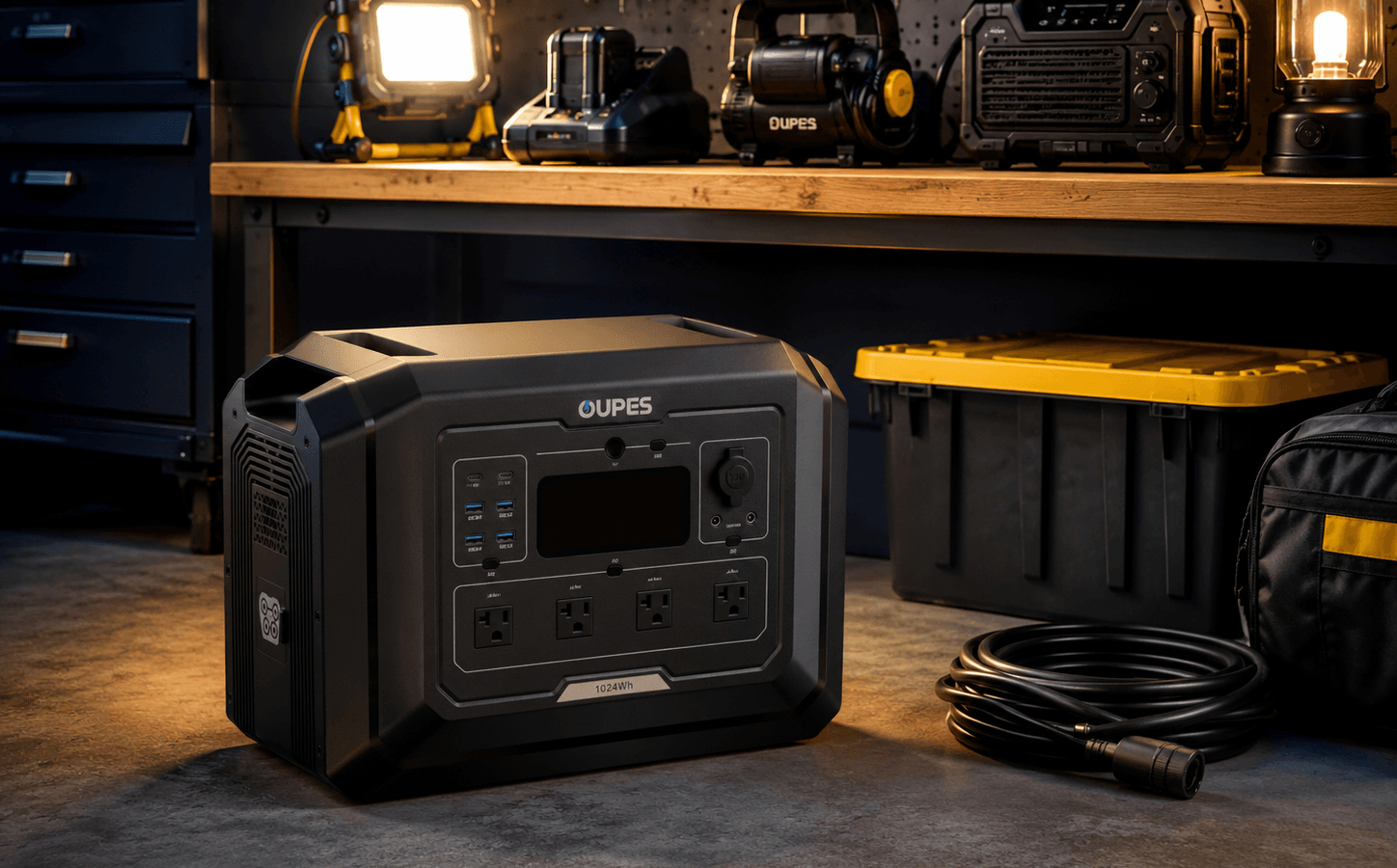
Linked Product Snapshot
Core specs
Buyer Fit
Pros and tradeoffs
Strengths
Pros
- 2,000W continuous output with 4,500W surge capability
- Expandable from 1,024Wh to 5,120Wh with two B2 batteries
- 800W solar-input ceiling with a documented voltage and current window
- Dual 100W USB-C ports plus Wi-Fi and Bluetooth app support
- Manageable 27.8 lb base-unit weight
Tradeoffs
Cons
- Base 1,024Wh capacity is limited for long high-draw backup
- No native 240V output or whole-home integration
- 20ms EPS transfer is not suitable for equipment that requires 0ms interruption
- B2 availability, seller support, and warranty process require current verification
- Smaller ownership ecosystem than the best-known portable-power brands
The OUPES Mega 1 is a sensible expandable 1kWh power station for buyers who value 2,000W continuous output, an 800W solar-input ceiling, and a path to 5,120Wh with two B2 batteries. It is not the automatic choice for everyone. Better-known brands may offer a broader accessory ecosystem, more familiar support channels, or a simpler ownership path. This OUPES Mega 1 review recommends it for a measured essential-load plan, not whole-home backup, 240V equipment, or safety-critical power.
This OUPES Mega 1 review is research-led analysis based on the current OUPES product page, the current Mega 1 user manual, the exact Amazon listing identity, and PowerLabPro buyer-fit analysis. It does not claim hands-on testing. See the OUPES Mega 1 Product reference for the concise central product record.
OUPES Mega 1 Review: Quick Verdict
The direct verdict in this OUPES Mega 1 review is positive for a buyer who wants a portable base unit now and a documented capacity-expansion route later. Its strongest combination is 1,024Wh of LiFePO4 storage, 2,000W continuous AC output, 4,500W surge capability, four AC outlets, dual 100W USB-C ports, and support for up to two OUPES B2 batteries.
The main advantage identified in this OUPES Mega 1 review is flexibility. The base unit is light enough at 27.8 lb for many owners to move between a home, garage, RV, and campsite, while the 2,000W inverter gives more output headroom than several familiar 1kWh alternatives. The main drawback is ownership confidence. Buyers should verify current B2 battery availability, seller support, warranty registration, app compatibility, and replacement-accessory access before committing to the ecosystem.
| Decision point | PowerLabPro conclusion |
|---|---|
| Best for | Expandable 1kWh home, RV, and outage backup with a disciplined load plan. |
| Not ideal for | Whole-home expectations, 240V loads, long high-draw runtime, or zero-interruption critical equipment. |
| Main advantage | 2,000W continuous output plus a documented B2 expansion path. |
| Main drawback | A smaller and less familiar ownership ecosystem than the best-known portable-power brands. |
| Better alternative if | Choose EcoFlow DELTA 2 for a more established 1kWh ecosystem, or Jackery Explorer 1000 v2 for a lighter, simpler fixed-capacity plan. |
| Final recommendation | Buy only after confirming the exact ASIN, seller, B2 availability, warranty terms, and the loads you actually need to support. |

- REVOLUTIONARY FAST-CHARGING TECHNOLOGY: Experience industry-leading recharge speeds with 0-80% capacity in just 36 minut…
- MODULAR EXPANSION CAPABILITY: Create a custom power ecosystem by connecting up to two B2 Extra Batteries, scaling your c…
- PROFESSIONAL-GRADE POWER DELIVERY: Delivering consistent 2000W continuous output (4500W surge) through premium AC outlet…
Table of Contents
Verified Specifications and Source Boundary
This OUPES Mega 1 review uses the official OUPES Mega 1 product page and the official OUPES manual-download page as the primary specification sources. The exact Amazon identity was rechecked as ASIN B0DG8JQNS4, matching the Mega 1 2,000W, 1,024Wh model represented by the current affiliate block.
| Verified detail | Buyer meaning |
|---|---|
| 1,024Wh LiFePO4 battery | A useful base reserve for selected essentials, not a guaranteed runtime for every appliance. |
| 2,000W continuous AC output | The combined sustained AC load must remain within this ceiling. |
| 4,500W surge rating | Temporary startup margin, not a second continuous-output rating. |
| 800W maximum solar input | A recovery ceiling that still depends on panel voltage, current, weather, orientation, and losses. |
| Solar input range: 12–78V, 14A maximum | Panel strings must stay inside the manual’s electrical window, not merely under a wattage label. |
| Up to 5,120Wh with two B2 batteries | A staged expansion route when the base 1,024Wh reserve proves too small. |
| 20ms EPS transfer | Potentially useful for compatible equipment, but not a zero-interruption or medical-power guarantee. |
| 27.8 lb | Portable for many adults, while still requiring stable placement and careful lifting. |
| Five-year warranty, with current registration terms to verify | Warranty length matters only when the seller, region, registration, exclusions, and service process are clear. |
The manual also lists 1,400W AC input and a maximum combined AC-plus-solar input of 2,200W under supported conditions. OUPES advertises a rapid recharge result under its test conditions, but real charging time changes with battery state, temperature, input quality, charging settings, and simultaneous loads. This OUPES Mega 1 review treats those charging figures as manufacturer-listed ceilings and examples, not promises.
Capacity, continuous output, surge output, and charging input answer different questions. Capacity affects energy reserve. Continuous output affects what can stay running at one time. Surge is brief startup margin. Charging input describes how quickly energy might be restored. A buyer who combines those numbers into one vague “power” score can choose the wrong battery even when every individual specification is accurate.
Why Choose It Over Better-Known 1kWh Models
The reason this OUPES Mega 1 review supports choosing the Mega 1 over a better-known 1kWh model is not simply a lower advertised price. Prices move, bundles change, and an unfamiliar platform can become poor value when the owner later struggles to find the correct expansion battery or replacement cable. The stronger case is the combination of a 2,000W continuous inverter, manageable base weight, 800W solar-input ceiling, and two-battery expansion path.
That combination matters in this OUPES Mega 1 review for an output-first buyer. A 1kWh station with a lower inverter rating may still have enough energy for low-draw loads, but it may reject a moderate appliance or startup event that the Mega 1 can handle within its documented limits. The Mega 1 also gives a staged-capacity buyer the option to begin at 1,024Wh, measure actual usage, and add B2 batteries only when the data supports the expense.
This OUPES Mega 1 review still recognizes that better-known brands can be the smarter ownership decision. A larger installed base may mean easier access to user guidance, accessories, service experience, app updates, and compatible expansion products. This article does not claim OUPES support is poor, and it does not claim another brand is automatically better. It identifies the trade-off: stronger on-paper output and expansion flexibility must be weighed against ecosystem familiarity and current accessory availability.
The practical question in this OUPES Mega 1 review is therefore not “Which badge is more popular?” It is “Which system still makes sense after I add the battery, required cables, solar hardware, possible expansion batteries, storage space, and service expectations?” The Mega 1 is compelling when its specific platform advantages solve your plan. It is less compelling when you prefer a simpler, fixed-capacity product from a brand with a broader local ownership trail.
Who Should Buy the OUPES Mega 1
Buy the Mega 1 when this OUPES Mega 1 review matches a measured, selective power plan. The station is most defensible for buyers who know their priority devices, understand that watt-hours control duration, and see value in expanding after real use rather than purchasing the largest possible system immediately.
- Short-outage planners: modem, router, phones, laptop work, LED lighting, a fan, and selected tested appliances take priority over broad household coverage.
- Output-first 1kWh shoppers: the 2,000W continuous rating matters more than maximizing the lowest possible carry weight.
- Staged-capacity buyers: the base unit is useful now, and one or two B2 batteries remain a realistic later step.
- RV and camping users: four AC outlets, dual 100W USB-C ports, DC outputs, and a portable base unit fit mixed charging needs.
- Garage and mobile-work users: lights, communications, chargers, small tools, and short-use equipment can be prioritized without running a combustion generator indoors.
A good buyer reading this OUPES Mega 1 review will also test important equipment before an outage. Refrigerators, pumps, compressors, power tools, and some electronics can behave differently from their nameplate running wattage. The Mega 1 is a flexible tool inside a prepared plan, not a substitute for measuring loads or checking equipment manuals.
Who Should Skip the OUPES Mega 1
Skip the Mega 1 when this OUPES Mega 1 review shows the base 1,024Wh reserve is clearly too small, when the load is 240V, or when the equipment cannot tolerate a transfer interruption. A portable 120V station is not a whole-home battery, an installed transfer system, or a code-compliant method for energizing household wiring.
- Whole-home expectation buyers: selected portable loads are realistic; unrestricted household circuits are not.
- 240V-load buyers: central air conditioning, many well pumps, electric ranges, dryers, and large shop equipment require another class of solution.
- Long high-draw users: space heaters, kettles, hot plates, microwaves, and portable air conditioners can consume a 1kWh reserve quickly.
- Zero-interruption or life-safety users: the manual lists 20ms EPS transfer and warns against equipment that requires 0ms interruption.
- Buyers who need a proven broad ecosystem: choose a more established platform when accessory availability, service history, and support familiarity matter more than the Mega 1 output advantage.
- Buyers unwilling to verify the seller and bundle: the exact ASIN, warranty registration, included cables, and B2 compatibility should be confirmed before payment.
The OUPES Mega 1 can still power a compatible high-watt device for a short task, but “can start” and “makes sense to run” are different judgments. This OUPES Mega 1 review recommends another system when the main plan is sustained heating, cooling, cooking, or multi-day appliance backup without a reliable recharge route.
Realistic Outage and Appliance Scenarios
This OUPES Mega 1 review cannot guarantee runtime from the 1,024Wh label. Inverter losses, standby draw, temperature, battery age, cycling, startup demand, and other connected devices all reduce the energy available to the load. The scenarios below are planning examples, not OUPES test results. They use an illustrative 85% usable AC-energy assumption, which equals about 870Wh, then divide that estimate by a measured average load.
| Illustrative measured load | Simple planning calculation | What the scenario means |
|---|---|---|
| 40W communications and lighting | 870Wh ÷ 40W = about 21.8 hours | A router, modem, LEDs, and periodic phone charging can stretch the base battery when the actual average stays low. |
| 120W home-office average | 870Wh ÷ 120W = about 7.3 hours | A laptop, monitor, networking gear, and task lighting may cover a work block, but the exact adapters and usage pattern matter. |
| 150W measured refrigerator average | 870Wh ÷ 150W = about 5.8 hours | This is useful only after measuring cycling behavior and confirming compressor startup; it is not a universal refrigerator runtime. |
| 350W mixed essentials | 870Wh ÷ 350W = about 2.5 hours | Several devices can fit the inverter but consume the base reserve quickly when they run together. |
| 900W short-use appliance | 870Wh ÷ 900W = under one hour | Output may be adequate, yet the energy cost can make sustained use a poor outage priority. |
A refrigerator plan in this OUPES Mega 1 review illustrates why average draw matters. A refrigerator may cycle rather than run continuously, and its compressor can demand more power at startup. Door openings, room temperature, food load, defrost cycles, and battery reserve targets also change the result. Measure the appliance with an energy meter over a representative period and test startup before relying on it.
A home-office plan in this OUPES Mega 1 review is usually easier to control. Direct 100W USB-C charging can power compatible laptops without using an AC adapter, leaving AC outlets for a monitor, router, or another device. A written shutdown order also helps: preserve communications first, reduce screen brightness, disconnect nonessential chargers, and keep enough reserve for the expected outage window.
For a broader plan after this OUPES Mega 1 review, use the PowerLabPro sizing guide and the canonical portable power stations for home backup guide. The sizing guide helps translate watts and hours into a battery class. The buying guide helps compare systems when one base 1kWh station is not enough.
Capacity, Output, and Runtime Limits
The 2,000W continuous rating is a meaningful strength, but it does not increase the 1,024Wh energy reserve. This distinction is central to the OUPES Mega 1 review. A 1,500W appliance can fit under the inverter ceiling and still drain the base battery rapidly. A 60W communications load may run far longer even though it uses only a small fraction of the available output.
The 4,500W surge rating in this OUPES Mega 1 review is temporary startup margin. Do not add 4,500W to the continuous rating or plan to run a 4,500W load. Motors and compressors can have fast, irregular startup behavior, and a published surge number does not guarantee that every refrigerator, pump, saw, or air conditioner will start. Test important equipment with the exact cords and other loads you expect to use.
The station in this OUPES Mega 1 review also cannot replace a professional home-circuit plan. Do not backfeed a wall outlet, use a double-male cord, or improvise a panel connection. Portable loads should be connected directly and kept within the station’s outlet, cable, and ventilation limits. For general outage preparation, review Ready.gov power-outage guidance.
This OUPES Mega 1 review treats reserve energy as part of safety and resilience. A battery at zero percent cannot cover a later communications need, safe shutdown, or changing weather. Build a stop-use threshold into the plan, especially when the same station must cover a refrigerator, router, lighting, and phone charging.
Expansion, AC Charging, and Solar Recovery
Expansion is the Mega 1’s most distinctive long-term feature in this OUPES Mega 1 review. OUPES states that the 1,024Wh base unit can expand to 5,120Wh with two B2 batteries. One extra battery can address a measured runtime gap without replacing the base station, while two batteries can move the system into a much larger energy class.
Expansion also adds obligations in this OUPES Mega 1 review. B2 batteries require purchase availability, compatible cables, storage space, extra handling weight, and a realistic method for recharging the larger total capacity. This article does not treat the maximum 5,120Wh figure as an automatic recommendation. Add capacity only when a measured load plan shows exactly why the base unit is insufficient.
For AC charging, the manual lists up to 1,400W input. OUPES also lists up to 2,200W combined AC and solar input under supported conditions. Rapid charging is useful before a forecast outage or between travel stops, but the owner should consider circuit capacity, extension-cord restrictions, ambient temperature, charging settings, and simultaneous output. Use a sound wall outlet and follow the current manual.
Solar planning is now verifiable. The manual lists an 800W maximum solar-input ceiling, a 12–78V input range, an MPPT working range of 18–75V, and a 14A current limit. It also describes up to three compatible 240W OUPES panels in series, with total open-circuit voltage kept below 78V. These are electrical boundaries, not a promise that an array will deliver 800W in ordinary weather.
Cloud cover, panel angle, shade, temperature, dirt, cable loss, and battery state all affect harvest. A nominal 800W array may produce far less during a short winter day. The recovery question in this OUPES Mega 1 review is therefore energy over time, not the maximum wattage printed on a panel. Confirm open-circuit voltage at expected cold conditions, current, connector polarity, and series configuration before connecting any third-party array.
EPS Transfer, Ports, App, and Connectivity
OUPES describes a 20ms EPS transfer. That may be suitable for a tested modem, router, desktop power supply, monitor, or other compatible electronics, but the manual warns not to use it with equipment that requires a 0ms interruption. The station’s input and output must also stay within the documented limits.
This OUPES Mega 1 review does not recommend the EPS function for medical, life-safety, security, server, or other critical equipment without the equipment maker’s approval and a tested dedicated plan. A device can reboot during a 20ms transfer even when another device stays online. Test the complete chain, including power strips, adapters, and network hardware, before an outage.
The port mix supports a practical device hierarchy. Four AC outlets handle compatible household and work equipment. Two 100W USB-C ports can charge many laptops and tablets directly. Four USB-A ports serve phones and accessories, while the car socket and DC5521 outputs support compatible 12V equipment. Using direct DC or USB charging where appropriate can reduce conversion steps and keep AC outlets free.
The current product information lists both Wi-Fi and Bluetooth connectivity. App control can be useful for checking status and changing settings, but it should not become a single point of failure in an outage plan. Confirm current app support for your phone, create the account before an emergency, install updates when appropriate, and learn the physical controls. The station must remain usable when internet service is unavailable.
For more UPS-oriented options, read the portable power stations with UPS guide. Treat every transfer-time claim as a compatibility starting point, not a guarantee for a particular computer, router, medical device, or security system.
Warranty, Support, and Long-Term Ownership
A power station in this OUPES Mega 1 review is not only a battery specification sheet. Long-term ownership includes seller legitimacy, warranty claim procedures, shipping support for a heavy lithium battery, app maintenance, firmware behavior, expansion-battery inventory, replacement cables, and access to accurate manuals. These factors can matter more than a small difference in output after the initial purchase.
OUPES currently lists a five-year warranty and promotes an additional year under its registration terms. Buyers should read the current warranty page and confirm whether registration, purchase channel, region, proof of purchase, battery cycle conditions, or shipping responsibilities affect coverage. This OUPES Mega 1 review does not treat a stated warranty length as proof of claim speed or service quality.
The B2 ecosystem is both an advantage and a dependency. The expansion path is valuable only if the correct battery and cable remain available when you need them. Check current inventory before assuming you can add capacity years later. Buyers who expect to expand soon may prefer to confirm the complete system cost and availability at the time of the base-unit purchase.
Support quality is difficult to verify from a product page. PowerLabPro did not perform a warranty claim, long-term app test, or repair interaction for this research-led article. The responsible approach is to save the invoice, register the product when required, download the current manual, record serial information, test all ports during the return window, and keep the support contact details with the outage plan.
This ownership boundary is why the Mega 1 does not win solely on price in this OUPES Mega 1 review. A modest initial saving can disappear if an owner later needs unavailable accessories or chooses to replace the entire platform. Conversely, a buyer who confirms B2 availability and values the 2,000W inverter may find the OUPES package more flexible than a familiar fixed-capacity alternative.
Home Backup, RV, Camping, and Garage Fit
For home outages, prioritize communications, lighting, phones, laptop work, and a measured refrigerator or freezer only when the energy budget supports it. Avoid treating the station as a household circuit source. The OUPES Mega 1 review supports direct, selected loads and a written priority order, especially when the outage duration is uncertain.
For garage preparedness, the Mega 1 can support LED work lights, a weather radio, phone charging, cordless-tool batteries, a small inflator, and selected short-use equipment. Keep the battery dry, stable, ventilated, and clear of doorways, walkways, and damaged cords. Because the station has no combustion engine, it can support appropriate indoor-rated loads, but every connected device must also be suitable for indoor use.
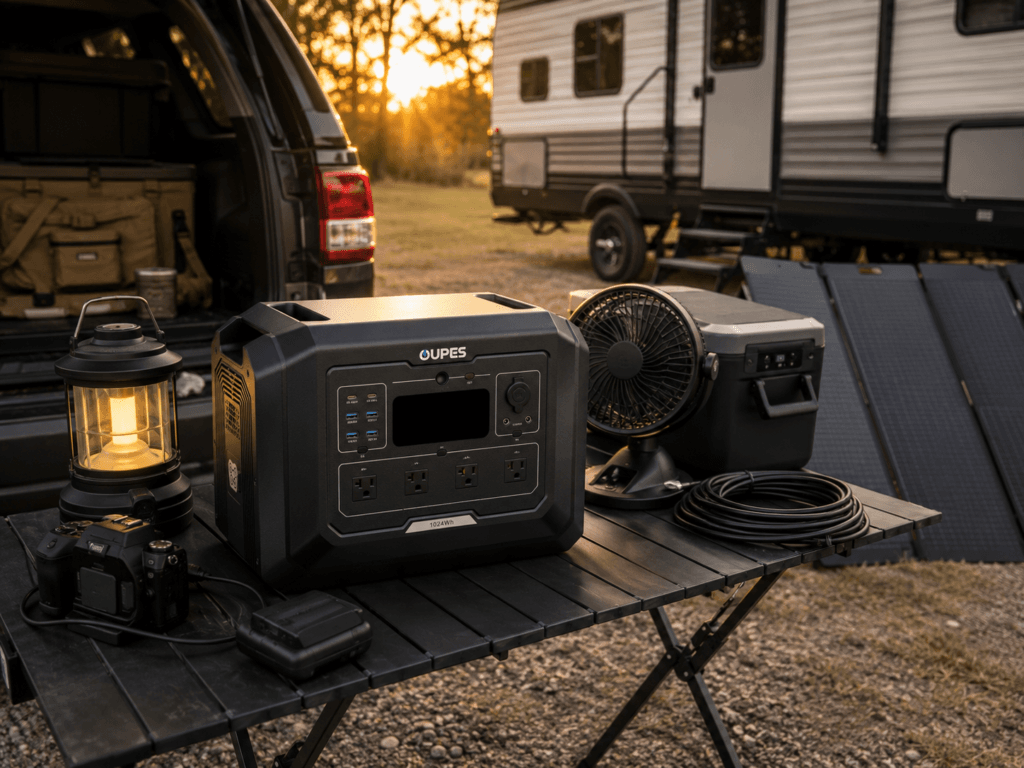
For RV and camping use, the second approved image shows a different editorial role from the garage-focused featured image. The outdoor scenario fits phones, cameras, laptops, lighting, fans, and selected RV accessories. It does not imply that every air conditioner, heater, induction cooker, or microwave is a sensible long-duration load.
Solar can extend a trip when the array stays within the manual’s 12–78V and 14A limits and receives useful sun. It cannot guarantee daily recovery. Before relying on solar, compare expected daily watt-hours from the array with the energy you plan to consume. This OUPES Mega 1 review recommends keeping a non-solar recovery option when weather or shade can interrupt charging.
For mobile work, the dual 100W USB-C ports are a practical advantage. Compatible laptops can charge directly while AC outlets remain available for a monitor, printer, router, camera charger, or test equipment. Confirm each device’s power demand, and avoid stacking adapters or extension cords that are not rated for the load.
OUPES Mega 1 Alternatives
The best alternative depends on what you want to reduce: ownership uncertainty, carry weight, ecosystem commitment, or expansion complexity. This OUPES Mega 1 review compares two relevant 1kWh-class directions rather than presenting unrelated 2kWh products merely because they are more powerful.
| Alternative | Choose it when | Why the Mega 1 may still fit better |
|---|---|---|
| EcoFlow DELTA 2 Product reference | You want a more established 1kWh ecosystem and broader ownership familiarity, even with a lower continuous AC-output rating than the Mega 1. | The Mega 1 offers 2,000W continuous output and a documented path to two B2 batteries. |
| Jackery Explorer 1000 v2 Product reference | You prioritize lower carry weight and a simpler fixed-capacity plan over the Mega 1 expansion path. | The Mega 1 provides more continuous output and a larger stated solar-input ceiling. |
EcoFlow DELTA 2 is the better direction for a buyer who values a familiar app and accessory ecosystem and does not need the Mega 1’s full 2,000W continuous rating. Jackery Explorer 1000 v2 is the better direction for portability-focused camping, apartment, or road-trip buyers who prefer a lighter base station and do not plan to add OUPES B2 batteries.
The Mega 1 remains the stronger fit when the exact buyer problem is “I want a portable 1kWh base station with 2,000W output and a credible expansion route.” It is not automatically better when the actual priority is the lightest carry, the largest established ecosystem, or a larger base battery from day one.
What to Verify Before Buying
- Confirm the current Amazon listing shows ASIN B0DG8JQNS4 and the exact OUPES Mega 1 2,000W, 1,024Wh model, not a different bundle or accessory.
- Confirm the seller, return terms, warranty registration, regional coverage, and who pays shipping for a battery service claim.
- List each must-run device, measure average watts where possible, check startup behavior, and set a minimum battery reserve.
- Confirm the current B2 battery model, expansion cable, stock status, total system cost, and storage space before relying on later expansion.
- Use the current manual to verify solar open-circuit voltage, working voltage, current, polarity, connector, series configuration, and the 800W ceiling.
- Test the 20ms EPS transfer with the exact router, computer, monitor, or other compatible device before depending on it.
- Inspect all outlets and charging ports during the return window, update the app when appropriate, and learn the physical controls.
- Use a dry, stable, ventilated location, route cables safely, and never backfeed household wiring.
A disciplined pre-purchase check is more valuable than another generic “best power station” claim. The OUPES Mega 1 review supports buying the Mega 1 only when the product identity, load plan, recovery plan, and ownership path all agree.
OUPES Mega 1 Review FAQ
Is the OUPES Mega 1 good for home backup?
Yes, for selected direct loads and a controlled short-outage plan. The Mega 1 can support communications, lighting, laptop work, charging, fans, and compatible tested appliances within its 2,000W continuous limit and available battery reserve. It is not a whole-home or 240V solution.
Can the OUPES Mega 1 run a refrigerator?
It may run a compatible refrigerator, but this OUPES Mega 1 review does not give a universal runtime. Measure average energy use, confirm compressor startup, account for defrost cycles and room temperature, and decide how much battery reserve must remain for other essentials.
How much solar input does the OUPES Mega 1 accept?
The current manual lists up to 800W solar input, a 12–78V input range, an 18–75V MPPT working range, and a 14A current limit. The connected array must satisfy every electrical limit. Actual solar harvest depends on weather, panel angle, temperature, shade, and system losses.
Is the OUPES Mega 1 expandable?
Yes. OUPES states that the 1,024Wh base system can expand to 5,120Wh with two B2 batteries. Confirm the exact battery model, cable requirements, availability, total charging plan, and warranty coverage before purchasing the expansion hardware.
Can the OUPES Mega 1 act as a UPS?
OUPES calls the function EPS and lists a 20ms transfer. Some compatible electronics may remain online, while equipment that requires 0ms transfer may not. Test the exact load and do not treat the station as guaranteed medical, life-safety, server, or security backup.
Final Verdict
This OUPES Mega 1 review recommends the Mega 1 for buyers who want an expandable 1kWh-class station with 2,000W continuous output, 800W solar-input capability, dual 100W USB-C charging, and a manageable 27.8 lb base unit. It fits controlled home essentials, RV weekends, camping, garage preparedness, and mobile work when the owner measures loads and plans recovery.
The main advantage is the combination of output and expansion. The main drawback is the need to verify the smaller OUPES ecosystem, current B2 availability, seller support, warranty process, and app ownership path. Choose EcoFlow DELTA 2 when ecosystem familiarity matters more, or Jackery Explorer 1000 v2 when lower carry weight and simpler fixed capacity matter more.
The final decision is conditional: buy the Mega 1 when the exact ASIN, seller, warranty, accessories, and load plan are verified, and when a future B2 battery remains a useful option. Choose another platform when you need 240V power, long high-draw runtime, whole-home integration, zero-interruption critical backup, or a broader established ownership ecosystem.