
Review
Jackery Explorer 2000 Plus Review: 3000W Platform Worth the Premium?
The Jackery Explorer 2000 Plus is best for buyers who need 3000W output and a scalable expansion platform. It is not the right fit for buyers who only need fixed 2kWh capacity, want the fastest solo charge, or will not use the expansion system.
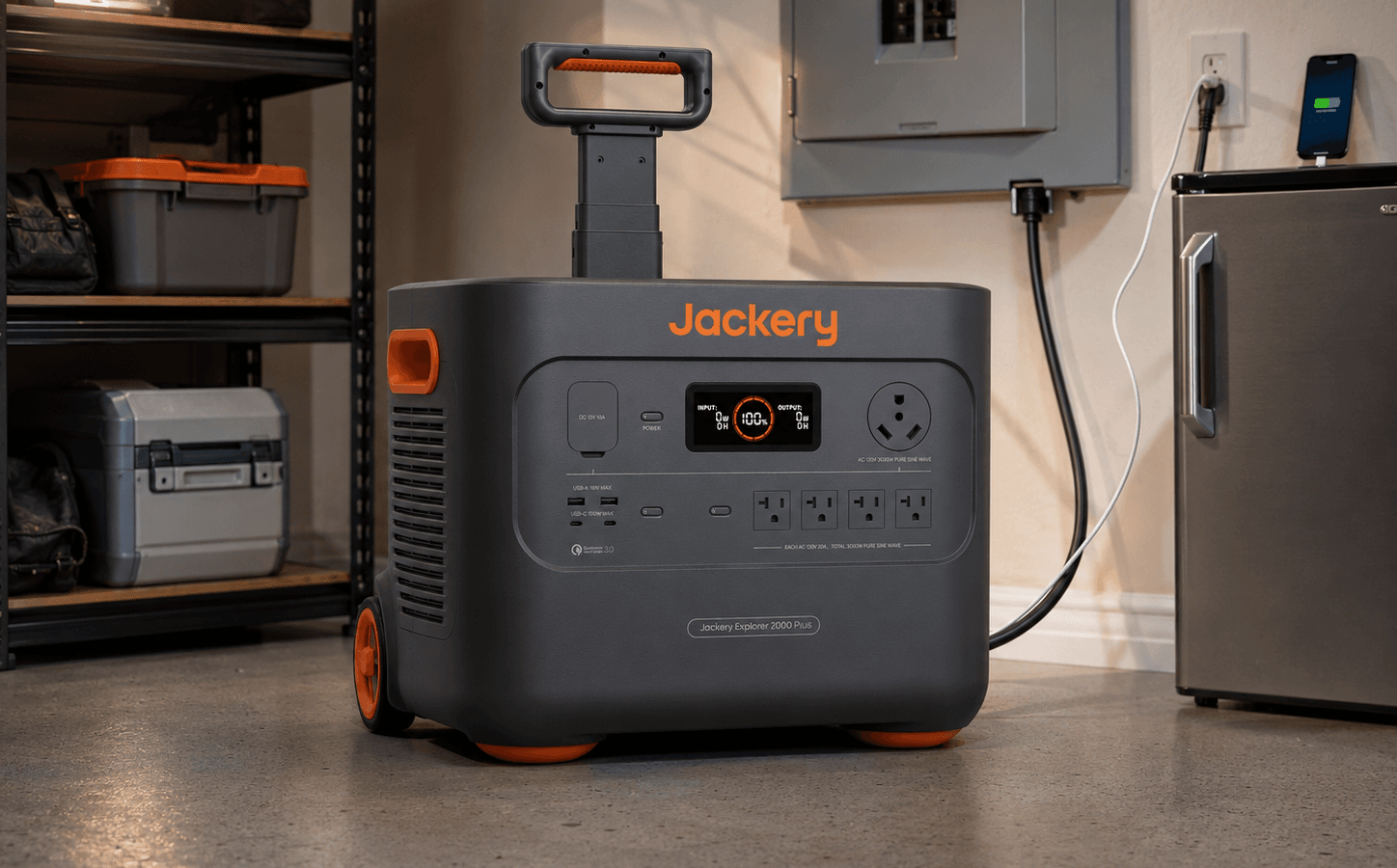
Linked Product Snapshot
Core specs
Buyer Fit
Pros and tradeoffs
Strengths
Pros
- 3000W continuous AC output — highest in the 2kWh class
- LiFePO4 battery rated for about 3000 cycles and 10 years of daily use
- Expandable to 12kWh standalone and 24kWh in parallel
- 240V output available via parallel connection with second unit
- 1000W solar input and 1800W AC for fast recharge
- Quiet operation at approximately 30 dB during charging
- 3-year warranty with 2-year extension on registration
Tradeoffs
Cons
- Full expansion requires significant additional investment in battery packs
- 240V output requires a second base unit not just an add-on battery
- Weight should be verified at jackery.com before purchase
- Platform premium for buyers who only need fixed 2kWh capacity
- Solo recharge is slower than EcoFlow DELTA 2 Max with combined AC and solar
This article may contain affiliate links. If you buy through these links, PowerLabPro may earn a commission at no extra cost to you. As an Amazon Associate I earn from qualifying purchases.
The Jackery Explorer 2000 Plus review question most serious buyers are asking is not whether 2kWh is enough. It is whether 3000W continuous output and a platform that scales to 24kWh justifies the price over a simpler fixed-capacity unit. This Jackery Explorer 2000 Plus review covers verified specs, real buyer scenarios, and the actual trade-offs based on manufacturer-published data. No hands-on testing is claimed.
In This Review
Jackery Explorer 2000 Plus Review: Quick Verdict
The Jackery Explorer 2000 Plus delivers the highest continuous AC output in the 2kWh class at 3000W, backed by a LiFePO4 battery rated for roughly 10 years of daily use. Its modular expansion system scales to 12kWh as a standalone unit and 24kWh in a dual-unit parallel setup at 240V. The trade-off is that the full expansion potential costs considerably more than the base unit, and buyers who only need 2kWh and 2400W may overpay for a platform they will not use.

- Magnificent Performance: Featuring up to 2,042.8 Wh gigantic capacity, the Jackery 2000 Plus Power Station can power a r…
- Ultra Fast Charging: Charge directly from the sun or via wall outlet, conveniently, quickly and additionally worry free….
- 2kWh – 24kWh Flexible Expansion: The Jackery Explorer 2000 Plus supports up to 5 expandable battery packs, featuring pow…
Who This Jackery Explorer 2000 Plus Review Is Best For
- Home backup buyers who need 3000W continuous output to run larger appliances without load concerns
- RV owners who want a 2kWh base unit that can grow to whole-home capacity with expansion packs
- Buyers planning a 240V backup setup who want to avoid a transfer panel initially
- Anyone building a modular power platform step by step over time
Who Should Skip It
- Buyers who only need 2kWh and will never expand (a fixed-capacity unit is a better value)
- Anyone prioritizing fastest possible solo-unit recharge (the EcoFlow DELTA 2 Max charges faster)
- Buyers who need a confirmed fast-switchover UPS (verify this before relying on it for medical equipment)
- Anyone on a tight budget who will not realistically invest in expansion packs later
Jackery Explorer 2000 Plus Review: Key Specifications
| Spec | Value |
|---|---|
| Capacity | 2042.8Wh |
| Battery Chemistry | LiFePO4 (~3000 cycles, ~10-year lifespan) |
| AC Output | 3000W continuous |
| Parallel Output | 6000W / 240V (two units) |
| Solar Input | Up to 1000W |
| AC Input | Up to 1800W |
| 0-80% Recharge | ~1.3 hr via AC |
| Expandable | Yes, up to 12kWh standalone (5 battery packs) |
| 240V Output | Yes, via parallel connection with second unit |
| Weight | [VERIFY at jackery.com before publishing] |
| App Support | Yes (Jackery App, iOS/Android) |
| Warranty | 3 years + 2-year extended (registration required) |
Why 3000W Matters in This Class
One reason this Jackery Explorer 2000 Plus review focuses heavily on output is simple: most 2kWh-class power stations max out at 2400W continuous output. The Jackery Explorer 2000 Plus runs 3000W, which opens up appliances that trip a 2400W unit’s overload protection. Window air conditioners, larger microwaves, electric kettles on full power, and some power tools fall into that 2400W to 3000W range. For buyers who want to run those appliances directly without worrying about load management features that throttle output, 3000W is a meaningful spec difference, not a marketing number.
That said, 3000W still will not run a central air conditioner, a large electric dryer, or a whole home. For understanding what your actual appliance load requires before buying, the portable power station sizing guide walks through wattage calculations without relying on vague estimates.
The Expansion Platform: What It Means in Practice
The Jackery Explorer 2000 Plus expansion system allows up to five Battery Pack 2000 Plus add-ons per base unit. Each battery pack adds approximately 2kWh, bringing total standalone capacity to roughly 12kWh. Two Explorer 2000 Plus units connected in parallel double that to 24kWh and unlock 240V output at 6000W.
The expansion path makes sense for buyers who want to start with a manageable 2kWh base cost and add capacity as budget allows. It does not make sense for buyers who want 6kWh or 12kWh immediately. At that point, the cost of the base unit plus several expansion packs may exceed the cost of purpose-built higher-capacity alternatives. Verify current prices for both the base unit and battery packs separately before treating the expansion path as the primary buying reason.
Jackery Explorer 2000 Plus Review: Home Backup Use
At 2042Wh and 3000W output, the Jackery Explorer 2000 Plus runs a standard home essentials load with headroom. A typical energy-efficient refrigerator, router, lights, phone and laptop charging, and a CPAP machine all fit comfortably within both the output and capacity. A fridge drawing 150 to 200W runs for roughly 7 to 10 hours on a full charge, depending on cycling and ambient temperature. Calculate your own load rather than relying on manufacturer runtime estimates.
For the full product specs and affiliate purchase link, see the Jackery Explorer 2000 Plus product page.
RV and Off-Grid Use
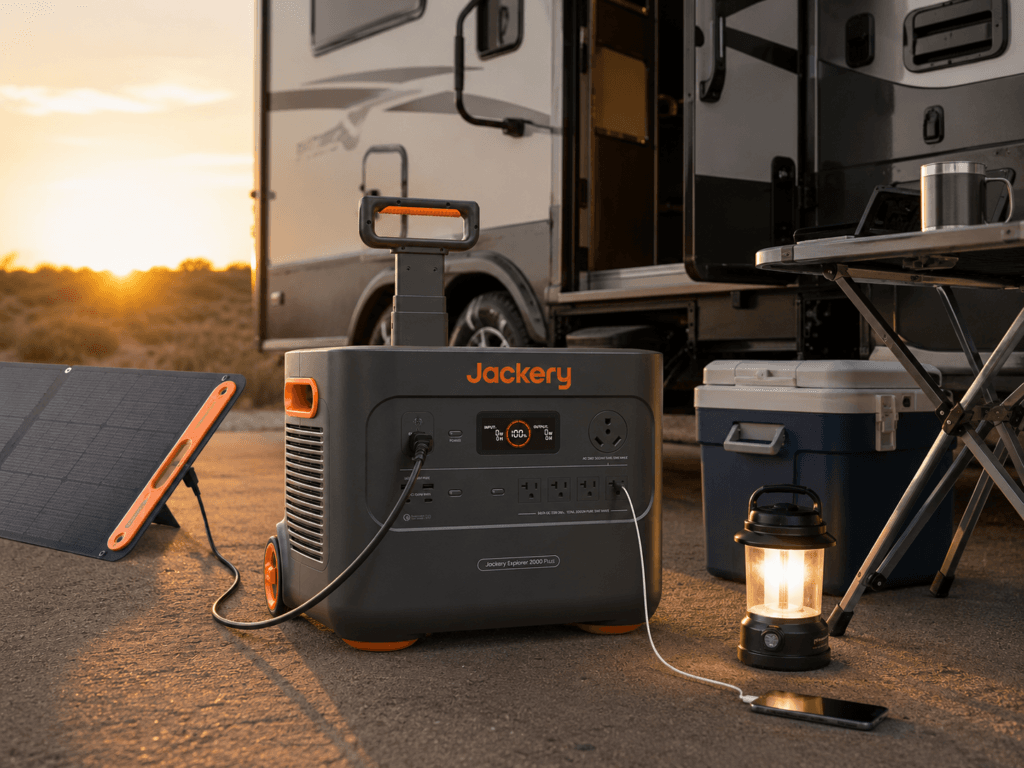
The 1000W solar input and 1800W AC input bring the unit to 80% charge in roughly 1.3 hours from AC and approximately 1.6 hours from six 200W solar panels. Both are competitive numbers for the class. The Jackery App provides state-of-charge monitoring and some charging controls, though it is worth confirming the full app feature set against current firmware before relying on specific scheduling features.
For RV use, the key verification before buying is weight. The base unit weight should be checked against the manufacturer spec page before finalizing purchase. At this capacity class, most units fall in the 45 to 55 lb range, which affects where you can store and how you move it inside a rig.
Charging Speed: Real Context
The 1.3-hour 0-to-80% claim is via maximum 1800W AC input. That is a standard wall outlet rate for this class, not a combined AC-plus-solar figure. The solar path to 80% at 1.6 hours requires six 200W panels (1200W combined) under good conditions. A realistic single-panel or two-panel setup would take considerably longer. Buyers planning solar-primary use should calculate actual panel wattage and expected hours of good sun per day rather than using the headline solar time.
Pros and Cons
Pros
- 3000W continuous AC output — highest in the 2kWh class
- LiFePO4 battery rated for approximately 3000 cycles and 10 years of daily use
- Expandable to 12kWh standalone and 24kWh in parallel
- 240V output available via parallel connection with second unit
- 1000W solar input and 1800W AC input for fast recharge
- Quiet operation at approximately 30dB during charging
- Jackery App monitoring
Cons
- Full expansion to high capacity requires significant additional investment
- 240V requires a second base unit, not just a battery pack add-on
- Weight should be verified before purchase
- Solo-unit fast charge is slower than the EcoFlow DELTA 2 Max with combined AC and solar
- Platform premium for buyers who realistically only need 2kWh fixed capacity
How the Jackery Explorer 2000 Plus Compares
This part of the Jackery Explorer 2000 Plus review matters because the unit is not automatically the best choice for every 2kWh buyer. Its biggest advantage is the combination of 3000W output, expansion potential, and 240V parallel capability. Buyers who care more about fastest recharge speed, lower weight, or fixed-capacity value may be better served by a different model.
Jackery Explorer 2000 Plus vs EcoFlow DELTA 2 Max
Both are 2kWh LiFePO4 units with expansion options. The Jackery Explorer 2000 Plus wins on continuous AC output (3000W vs 2400W) and maximum expansion ceiling (12kWh vs 6kWh standalone). The EcoFlow DELTA 2 Max wins on faster solo-unit recharge and higher solar input. Choose the Jackery Explorer 2000 Plus when output and expansion ceiling matter most.
Jackery Explorer 2000 Plus vs Jackery HomePower 3000
The HomePower 3000 offers roughly 3kWh of base capacity without expansion. If you know you need 3kWh today and do not need to grow the system, the HomePower 3000 may offer better value per watt-hour. If expansion potential matters, the Jackery Explorer 2000 Plus is the better platform.
What to Verify Before Buying
- Confirm current unit weight on the Jackery product page before purchase
- Verify Battery Pack 2000 Plus compatibility and current pricing before committing to the expansion plan
- Confirm solar panel connector type (DC8MM/DC8020) for third-party panel compatibility
- Check current AC outlet count and USB-C output specs on the Jackery product page
- Confirm extended warranty registration window and current terms at jackery.com before purchase
Not sure whether 2kWh is enough or whether you should start bigger? The portable power station sizing guide covers how to calculate your actual load, estimate runtime, and choose the right capacity without overbuying.
Frequently Asked Questions
Does the Jackery Explorer 2000 Plus support 240V output?
Yes, but only via a parallel connection with a second Explorer 2000 Plus unit. In that configuration, combined output reaches 6000W at 240V. A single unit operates at 120V only.
How many battery packs can be added to the Jackery Explorer 2000 Plus?
Up to five Battery Pack 2000 Plus units per base station, bringing total standalone capacity to approximately 12kWh. Two base units in parallel with ten total battery packs can reach 24kWh.
What does this Jackery Explorer 2000 Plus review say about charging speed?
Via AC input at maximum 1800W, the Jackery Explorer 2000 Plus reaches 80% charge in approximately 1.3 hours. Via six 200W solar panels, the same 80% takes roughly 1.6 hours under good conditions. Single-panel setups will take considerably longer.
Can the Jackery Explorer 2000 Plus run a window air conditioner?
Possibly, depending on the unit. A small window AC drawing under 1000W starting watts should run on the Jackery Explorer 2000 Plus’s 3000W output with margin. Larger units with high starting surge may still trip overload protection. Verify your specific AC unit’s rated and starting wattage before relying on this.
What is the warranty on the Jackery Explorer 2000 Plus?
Jackery provides a 3-year standard warranty. An additional 2-year extension is available but requires completing a registration form within a specified window after purchase. Verify current terms at jackery.com before purchase.
Jackery Explorer 2000 Plus Review: Final Verdict
This Jackery Explorer 2000 Plus review finds the unit strongest for buyers who need 3000W continuous output in the 2kWh class and want a platform that can scale significantly over time. The expansion ceiling, 240V parallel capability, and solid LiFePO4 battery make it a serious long-term option. It is not the right buy for buyers who only need fixed 2kWh capacity, want the fastest possible solo-unit recharge, or are on a tight budget. Verify weight, AC outlet count, and current battery pack pricing before committing to the Jackery Explorer 2000 Plus.
Testing Notes
- No hands-on testing claimed by PowerLabPro
- Analysis based on verified manufacturer-listed specifications
- Amazon page used only for product identity ASIN and purchase path
- Weight and AC outlet count must be verified at jackery.com before publishing
- Buyers should verify current warranty and availability before purchase