
Review
EcoFlow RIVER 3 Plus Review: Compact UPS Power With Honest Limits
The EcoFlow RIVER 3 Plus is best for buyers who want a long-life desk-side UPS that doubles as light portable power. It is not suitable for appliance backup: 286Wh and 600W cover electronics, routers, laptops, and CPAP machines, not refrigerators or heaters.
Linked Product Snapshot
Core specs
Buyer Fit
Pros and tradeoffs
Strengths
Pros
- Sub-10ms UPS switchover for desktops, NAS, routers, and consoles
- LiFePO4 battery rated for 3000 cycles, roughly 10 years of daily use
- Full AC recharge in about 1 hour
- Under 30dB, quiet enough for bedrooms and offices
- 10.4 lbs and compact enough for closet storage and travel
- Expandable to 858Wh with a stacking extra battery
- 5-year warranty, IP54 protection, drop-rated shell
Tradeoffs
Cons
- 286Wh covers electronics only, no meaningful appliance backup
- 600W output rules out fridges, heaters, and full-power kitchen devices
- X-Boost 1200W is load management, not real extra power
- 220W solar ceiling makes solar-primary use slow
- USB port configuration varies by listing — verify before purchase
This article may contain affiliate links. If you buy through these links, PowerLabPro may earn a commission at no extra cost to you. As an Amazon Associate I earn from qualifying purchases.
This EcoFlow RIVER 3 Plus review is for buyers who want a small power station, not a full-size home backup unit. It looks at whether this 286Wh model makes sense for desk-side UPS protection, router backup, weekend camping, and small-device charging.
The main takeaway from this EcoFlow RIVER 3 Plus review is simple: it works best as a compact electronics backup. It is useful for laptops, phones, routers, lights, cameras, and small campsite gear, but it is not the right choice for refrigerators, microwaves, heaters, or long outage runtime.
EcoFlow RIVER 3 Plus Review: Quick Verdict
The EcoFlow RIVER 3 Plus does one thing better than almost anything at its size: it replaces a traditional lead-acid desktop UPS with a battery that lasts roughly 10 years instead of 3 to 5, while also working as a portable power station for camping and outages. The sub-10ms switchover, under-30dB noise, and 10.4 lb weight make it practical to live next to a desk or bed. The hard limits are 286Wh of capacity and 600W of output: this is an electronics unit, not an appliance unit. Buyers who need fridge backup should start one or two classes up.

- [<10 MS UPS]-The RIVER 3 Plus power station ensures <10 ms switchover for premium UPS protection, securing your home off...
- [Power up to 1200W]-RIVER 3 Plus portable power station delivers a steady 600W and surges to 1200W with X-Boost. It feat…
- [2× Runtime & Ultra-Quiet]-The RIVER 3 Plus battery generator, powered by X-GaNPower, boosts energy efficiency, giving y…
In This Review
- Quick Verdict
- Who It Is Best For
- Who Should Skip It
- Key Specifications
- The UPS Case: Why This Beats a Desktop UPS
- What 286Wh Actually Runs
- Charging: 1 Hour AC, 1.5 Hours Solar
- X-Boost at 1200W Explained
- Expansion to 858Wh
- Pros and Cons
- How It Compares
- What to Verify Before Buying
- Frequently Asked Questions
- Final Verdict
In this EcoFlow RIVER 3 Plus review, the most important question is not whether the unit has impressive specs on paper. The real question is whether its compact capacity, fast recharge time, UPS-style behavior, and expansion option fit the way you actually plan to use it.
Who It Is Best For
The best fit in this EcoFlow RIVER 3 Plus review is a buyer who needs backup power for electronics instead of appliances. It makes sense for home-office users, apartment renters, weekend campers, and anyone who wants a quiet portable unit for small essentials.
- Work-from-home users who need true UPS protection for a desktop, monitors, router, or NAS
- Apartment renters who want compact, quiet outage backup that stores in a closet
- CPAP users who need a light overnight backup with a switchover fast enough to avoid restarts
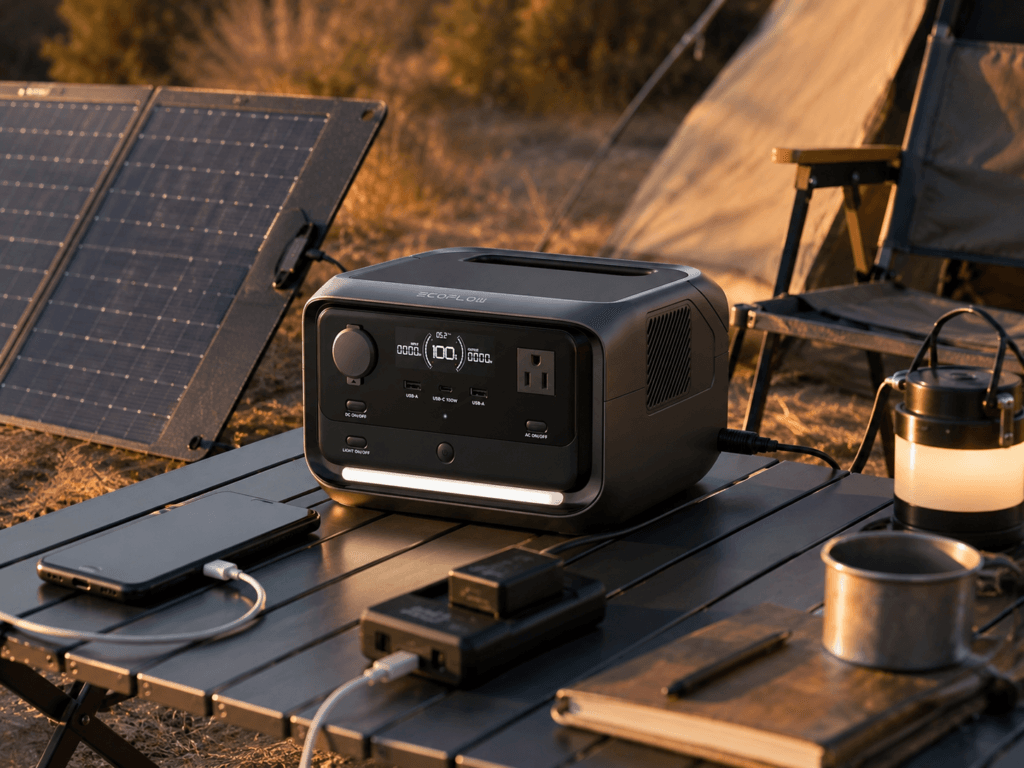
- Campers and travelers who want real AC output under 11 lbs
Who Should Skip It
- Anyone who needs to run a refrigerator, space heater, or microwave during an outage
- Buyers who need more than a few hours of backup for anything beyond small electronics
- Off-grid users who need fast solar recharge (220W input is modest)
- Anyone whose backup plan will grow beyond 858Wh — start in the 1kWh or 2kWh class instead
EcoFlow RIVER 3 Plus Review: Key Specifications
The specs below are the core numbers behind this EcoFlow RIVER 3 Plus review. Capacity, output, recharge speed, UPS switchover, solar input, and expansion support matter more here than marketing claims.
| Spec | Value |
|---|---|
| Capacity | 286Wh |
| Battery Chemistry | LiFePO4 (3000 cycles, ~10 years to 80%) |
| AC Output | 600W continuous, pure sine wave |
| X-Boost Mode | Up to 1200W (load management) |
| UPS Switchover | <10ms |
| Solar Input | Up to 220W |
| AC Recharge | ~1 hour (X-Stream) |
| Solar Recharge | ~1.5 hours at 220W |
| AC Outlets | 3 (two rear-facing) |
| Noise | <30dB |
| Weight | 10.4 lbs / ~4.7 kg |
| Dimensions | 9.2 x 9.1 x 5.8 in |
| Expandable | Yes — EB300 or EB600, up to 858Wh total |
| Protection | IP54, fire-retardant shell, 1.5m drop rated |
| App | EcoFlow App (Bluetooth + Wi-Fi) |
| Warranty | 5 years |
For this EcoFlow RIVER 3 Plus review, the key limitation is capacity. The 286Wh battery is useful for short electronics backup, but buyers should not confuse it with a larger power station made for refrigerators, cooking appliances, or extended outages.
The UPS Case: Why This Beats a Desktop UPS
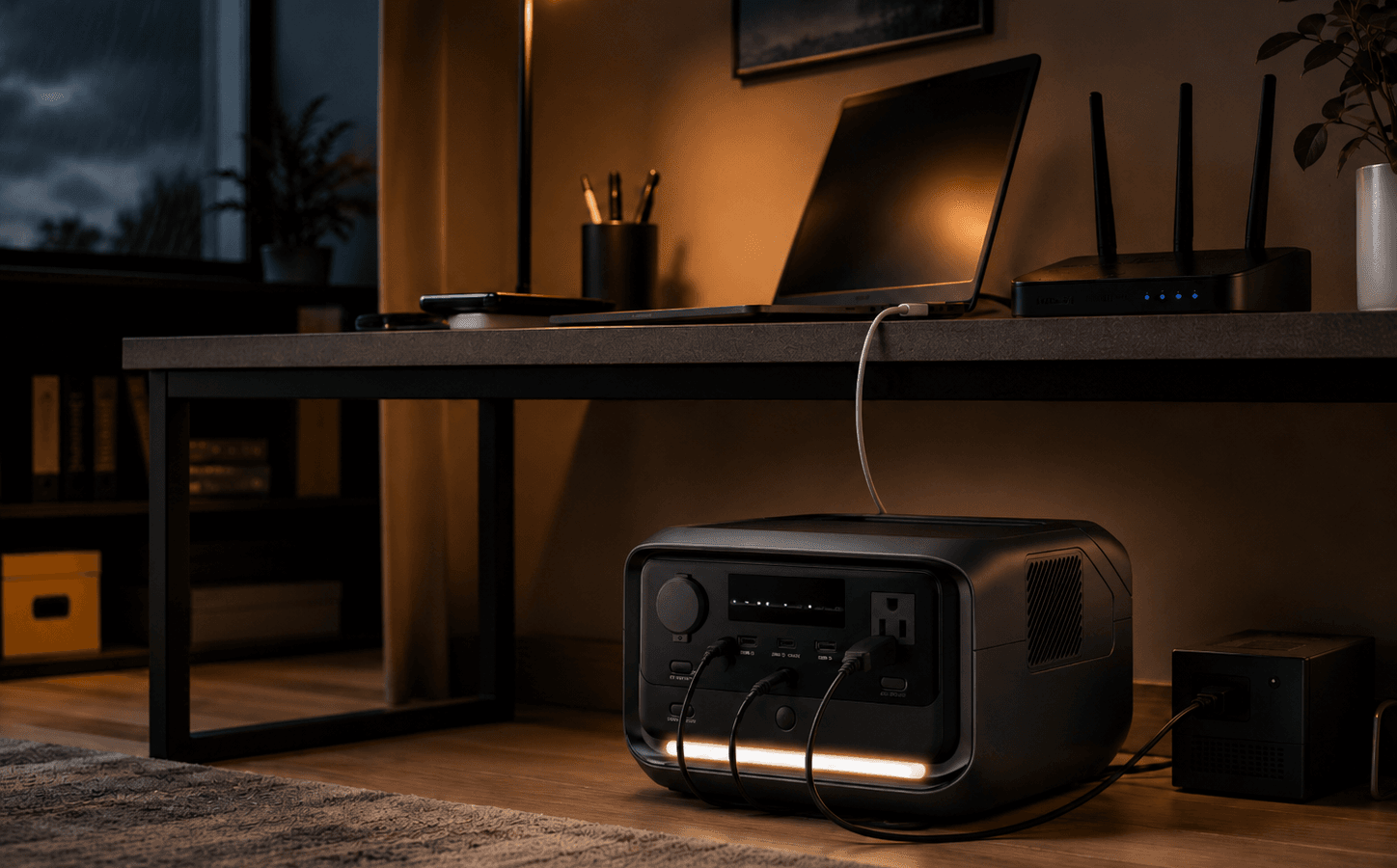
This is the strongest argument in the entire EcoFlow RIVER 3 Plus review. A traditional desktop UPS uses a lead-acid battery that typically needs replacement every 3 to 5 years, sits permanently under a desk, and does nothing else. The RIVER 3 Plus uses a LiFePO4 battery rated for 3000 cycles, performs the same sub-10ms switchover job, and doubles as a portable power station for camping and outages. EcoFlow lists a PC and NAS-compatible data interface that can notify you and trigger automatic data saving when the battery runs low.
The sub-10ms switchover is fast enough for desktop computers, NAS drives, gaming consoles, modems, and routers, which typically tolerate that gap without restarting. As with any UPS, buyers running medical equipment should verify the device manufacturer’s switchover tolerance before relying on it. Total connected load must stay under the 600W continuous output for UPS mode to hold.
What 286Wh Actually Runs
EcoFlow’s own numbers set the right expectations: a 3W Wi-Fi router runs up to 35 hours, and a 600W desktop runs for at least 21 minutes, enough for a safe shutdown. In practical apartment-outage terms, 286Wh covers a router and modem for a full day, a phone roughly 15 to 20 charges, a laptop 4 to 6 charges, LED lights for many hours, and a 30 to 60W CPAP without a humidifier for roughly 4 to 8 hours. Actual runtime depends on your specific devices and efficiency losses, so calculate from your own appliance wattage.
What it does not do is appliance backup. A 150 to 200W refrigerator would drain the battery in under 2 hours, and the 600W ceiling rules out heaters, kettles, and microwaves at full power. If your outage plan includes a fridge, the portable power station sizing guide walks through the wattage math, and the EcoFlow RIVER 3 Plus product page lists the full structured specs for this unit.
Charging: 1 Hour AC, 1.5 Hours Solar
The X-Stream AC fast charge takes the unit from empty to full in about 1 hour from a wall outlet, which is the fastest practical turnaround in this size class. EcoFlow pairs this with trickle-charge technology designed to limit battery stress during fast charging. Solar charging tops out at 220W input, which fills the battery in roughly 1.5 hours under ideal conditions with a properly sized panel; a smaller 100W panel in real conditions takes considerably longer. Car charging while driving is also supported, which suits road trip and camping use.
X-Boost at 1200W: Same Rule as the Bigger Units
X-Boost on the RIVER 3 Plus follows the same principle as on the larger EcoFlow units: the inverter is still 600W continuous, and X-Boost is software that limits what a connected high-wattage device draws so it keeps running at reduced output instead of triggering an overload shutoff. A 1000W kettle in X-Boost mode heats slower, not at full power. Use 600W as your planning ceiling for anything that needs full rated performance.
Expansion to 858Wh: Useful, With Limits
The RIVER 3 Plus accepts one stacking extra battery: the EB300 adds 286Wh and the EB600 adds 572Wh, for a maximum of 858Wh total. That turns a router-and-laptop unit into something that can carry a small outage load for a weekend. The limits are that output stays at 600W regardless of added capacity, and the combined cost of base unit plus EB600 approaches 1kWh-class pricing. Buyers who already know they need 800Wh or more should compare total system cost against a fixed 1kWh unit before committing to the stacking path.
At this point in the EcoFlow RIVER 3 Plus review, the buying decision is clear: choose it for compact backup, UPS-style protection, light solar charging, and portable electronics. Skip it if your main goal is appliance backup or multi-day runtime.
Pros and Cons
Pros
- Sub-10ms UPS switchover for desktops, NAS, routers, and consoles
- LiFePO4 battery rated for 3000 cycles, roughly 10 years of daily use
- Full AC recharge in about 1 hour
- Under 30dB — quiet enough for bedrooms and offices
- 10.4 lbs and compact enough for closet storage and travel
- Expandable to 858Wh with a stacking extra battery
- 5-year warranty, IP54 protection, drop-rated shell
Cons
- 286Wh covers electronics only — no meaningful appliance backup
- 600W output rules out fridges, heaters, and full-power kitchen devices
- X-Boost 1200W is load management, not real extra power
- 220W solar ceiling makes solar-primary use slow
- USB port configuration varies by listing and should be verified
How the EcoFlow RIVER 3 Plus Compares
EcoFlow RIVER 3 Plus vs EcoFlow DELTA 3 Plus
The DELTA 3 Plus is the step up: 1kWh capacity, 1800W output, and confirmed UPS, at roughly three times the weight. If your outage plan includes a refrigerator or you want one unit that covers everything, the DELTA 3 Plus is the better buy. If your real need is desk-side UPS protection and light portable power, the RIVER 3 Plus does that job for less money and a third of the weight.
EcoFlow RIVER 3 Plus vs BLUETTI AC180
The BLUETTI AC180 has four times the capacity (1152Wh), triple the output (1800W), and a 20ms UPS, at 37.4 lbs and a higher price. The AC180 can carry a fridge through a short outage; the RIVER 3 Plus cannot. The RIVER 3 Plus wins on switchover speed (sub-10ms vs 20ms), weight, noise, and price. Choose based on whether appliances are in your backup plan.
What to Verify Before Buying
- Confirm USB-C and USB-A port count and wattage on the current Amazon listing
- Verify your total desk load stays under 600W for UPS use
- Check EB300/EB600 extra battery pricing before planning expansion
- Confirm CPAP or medical device switchover tolerance with the device manufacturer
- Review current specs and warranty terms at us.ecoflow.com before purchase
Not sure whether this size class fits your situation? The portable power station sizing guide covers appliance wattage, runtime estimates, and capacity selection step by step.
Frequently Asked Questions
Does the EcoFlow RIVER 3 Plus work as a real UPS?
Yes. The EcoFlow RIVER 3 Plus lists a sub-10ms switchover with pure sine wave output, which is fast enough for desktops, NAS drives, routers, and gaming consoles. Total connected load must stay under 600W, and medical device users should verify switchover tolerance with the device manufacturer.
How fast does the EcoFlow RIVER 3 Plus charge?
About 1 hour from empty to full via AC using X-Stream fast charging, and roughly 1.5 hours via solar at the maximum 220W input under ideal conditions. Car charging while driving is also supported.
Can the EcoFlow RIVER 3 Plus run a refrigerator?
Not practically. A typical fridge drawing 150 to 200W would drain the 286Wh battery in under 2 hours. For refrigerator backup, start with a 1kWh-class unit such as the BLUETTI AC180 or larger.
Can the EcoFlow RIVER 3 Plus capacity be expanded?
Yes. It accepts one stacking extra battery: the EB300 adds 286Wh and the EB600 adds 572Wh, for a maximum of 858Wh. AC output stays at 600W regardless of added capacity.
How long can the EcoFlow RIVER 3 Plus run a CPAP machine?
A CPAP without a humidifier typically draws 30 to 60W. At 50W average, 286Wh supports roughly 4 to 5 hours of use after efficiency losses, enough for partial-night backup. CPAP users who need full-night coverage should consider the expansion battery or a 1kWh-class unit, and should verify their machine’s actual draw.
Final Verdict
This EcoFlow RIVER 3 Plus review finds the unit strongest as a long-life replacement for a desktop UPS that also earns its keep outdoors. The sub-10ms switchover, 1-hour recharge, under-30dB noise, and 10.4 lb weight make it unusually practical for desk setups, bedrooms, apartments, and weekend camping.
The 286Wh capacity and 600W output are honest limits: this is an electronics protection and light portable power unit, not an appliance backup. Buy the EcoFlow RIVER 3 Plus for the desk, the bedside, and the campsite. Buy bigger for the fridge.
Testing Notes
- No hands-on testing claimed by PowerLabPro
- Analysis based on verified manufacturer-listed specifications
- Amazon page used only for product identity ASIN and purchase path
- USB port configuration varies by listing and must be verified before publishing
- Buyers should verify current warranty and availability before purchase