
Review
Jackery HomePower 3600 Pro Max Review: Practical 4,000W Backup Fit
A practical choice for a defined serious backup plan that needs a 3,584Wh base battery, 4,000W rated 120/240V output, and a staged expansion path. It is not the right fit for light backup, frequent lifting, or equipment that requires 0 ms switching.
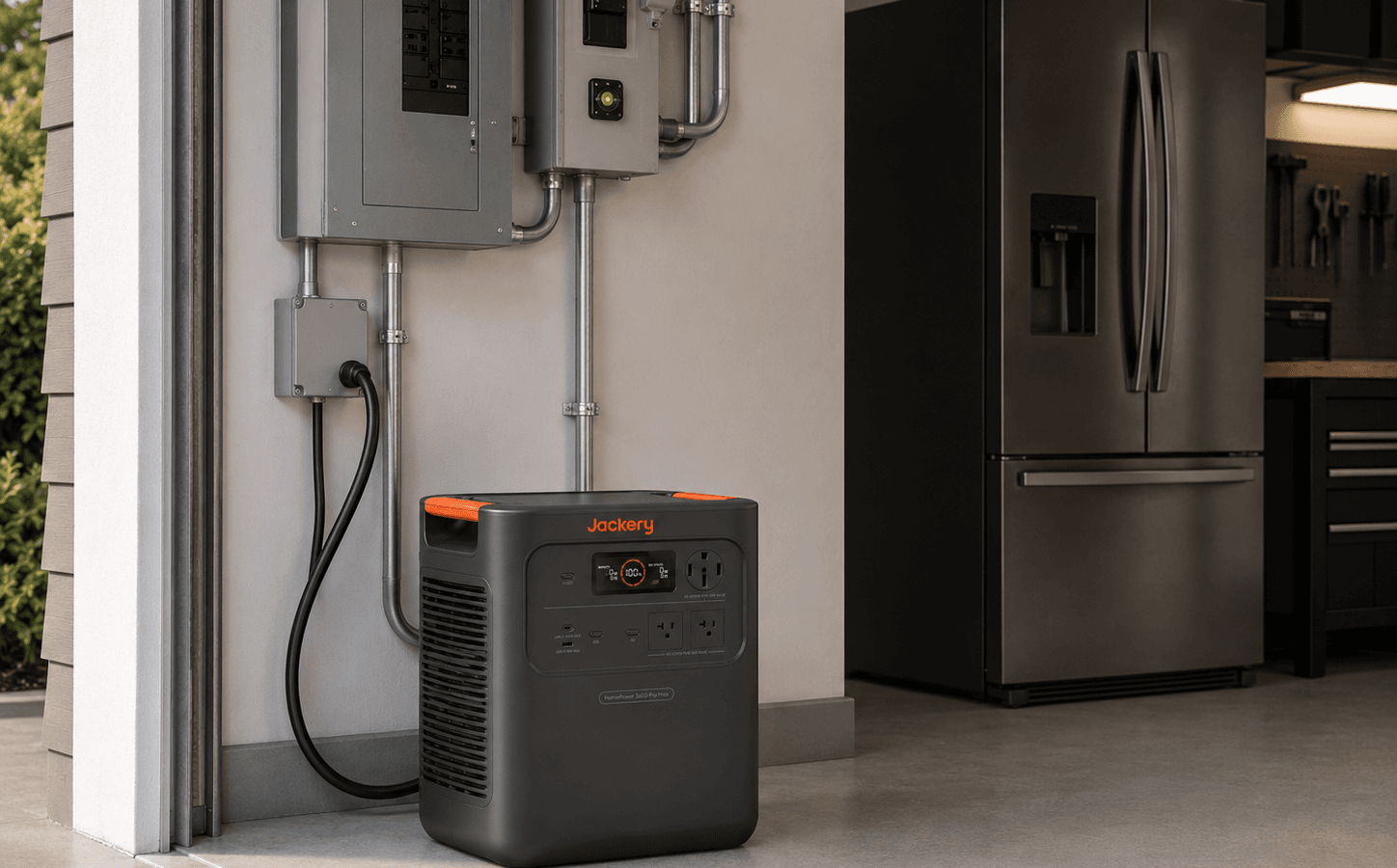
Linked Product Snapshot
Core specs
Buyer Fit
Pros and tradeoffs
Strengths
Pros
- 4,000W rated 120/240V AC output
- 3,584Wh LiFePO4 base capacity
- Up to 1,200W solar input
- Less-than-10-ms listed UPS transfer
- Supports up to five compatible expansion batteries
- Wi-Fi and Bluetooth app support
Tradeoffs
Cons
- 73.85 lb before add-on batteries
- Not a 0 ms UPS
- No separately listed 12V vehicle output
- Solar performance varies by compatible panels and conditions
- Circuit-level use needs compatible equipment and planning
- Expansion increases total cost and floor-space needs
This Jackery HomePower 3600 Pro Max review helps buyers decide whether a 3,584Wh portable power station with 4,000W rated 120/240V output fits a real outage plan better than a smaller station or a larger backup platform.
The JHP-3600C is a serious system for controlled refrigeration, communications, lighting, remote work, selected appliances, compatible RV use, and staged expansion. It is not a promise that every appliance or circuit will remain active during an outage.
Its verified base profile is 3,584Wh of LiFePO4 capacity, 4,000W rated output, 8,000W peak surge, two 120V NEMA 5-20R outlets, one 240V NEMA 14-50R outlet, up to 1,200W solar input, and support for up to five Battery Pack 3600 units.
This is a research-led buyer assessment based on the official Jackery product page and JHP-3600C documentation. PowerLabPro does not claim hands-on or laboratory testing.
Jackery HomePower 3600 Pro Max Review: Practical Verdict
Best for: buyers with a written essential-load plan who need 4,000W rated output, a 3,584Wh base battery, 120V and 240V capability, or a staged expansion route.
Not ideal for: basic router-and-laptop backup, casual camping, frequent lifting, or any workload that specifically requires 0-ms transfer behavior.
Main advantage: Jackery HomePower 3600 Pro Max combines high inverter output, a verified 240V outlet, solar recovery headroom, and expansion support in one portable platform.
Main drawback: the 73.85 lb base unit needs a stable location and deliberate load, accessory, and installation planning.
Better alternative if: choose Jackery HomePower 3000 for simpler fixed-capacity backup, Jackery HomePower 3600 Plus for a different current 3.6kWh path, or Jackery Explorer 5000 Plus when the plan requires a larger base battery.
Final recommendation: shortlist Jackery HomePower 3600 Pro Max when the measured loads genuinely require its voltage options, output, and expansion path. Skip it when a smaller, lighter station already covers the priority list.
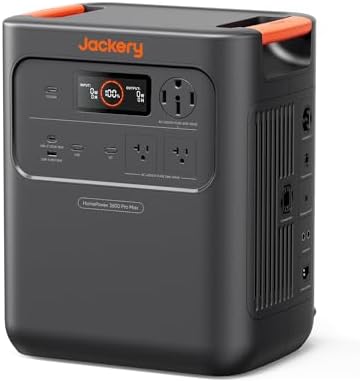
- 4kW–8kW Auto Backup, Ready in Half the Time: Turn your 3600 Pro Max into a home energy hub using a manual transfer switc…
- Experience True Seamlessness: With a <10ms UPS switch—faster than a blink—your computers and appliances keep running wit…
- True 240V Performance from a Single Unit: Get 4000W of 120V/240V power from one unit. Starting at 3.6kWh and expandable …
Table of Contents
Verified Specifications That Drive the Decision
| Specification | Verified value | Review meaning |
|---|---|---|
| Model | JHP-3600C | This review covers this exact Pro Max model, not the separately positioned HomePower 3600 Plus. |
| Capacity | 3,584Wh | Useful reserve for a deliberate essential-load plan. |
| Battery chemistry | LiFePO4 | Jackery lists 6,000 cycles with at least 70% state of health retained. |
| Rated output | 4,000W | Defines simultaneous inverter headroom. |
| Surge output | 8,000W peak | Helps address short motor-start demand, not long-duration load use. |
| AC outlets | 2 × 120V NEMA 5-20R, 1 × 240V NEMA 14-50R | Supports defined 120V and 240V use cases with compatible equipment. |
| Solar input | Up to 1,200W | Creates recovery potential, not a fixed all-day charge rate. |
| 120V AC input | Up to 1,800W | Charge time depends on actual setup and battery state. |
| UPS transfer | Less than 10 ms listed | Not 0-ms switching. |
| Weight | 73.85 lb | Best treated as a planned backup unit, not a frequent carry item. |
| Expansion | Up to 5 Battery Pack 3600 units | Adds stored energy after real runtime needs are measured. |
This Jackery HomePower 3600 Pro Max review separates those figures because buyers often combine them into one idea of “power.” They are not interchangeable. Capacity controls how much energy is stored. Inverter output controls what can run at the same time. Solar input controls potential recovery. Expansion controls how far the capacity side can grow. Good buying decisions come from understanding the limit that actually matters for the outage plan.
Who Should Consider It
The best buyer for Jackery HomePower 3600 Pro Max review guidance is someone who has written down the devices that matter. A refrigerator, modem, router, phones, LED lights, laptop work, a monitor, and selected small appliances are a controlled backup plan. A house where every heater, cooker, dryer, air conditioner, and convenience load stays on is a different electrical problem.
- Measured home-backup buyers: households prioritizing food preservation, communications, lighting, and productive work.
- Selected-load planners: buyers who will verify compatible transfer equipment, load limits, and installation support.
- RV owners with verified needs: users who know the connector, voltage, grounding, and appliance requirements of their setup.
- Staged-expansion buyers: people who prefer to start with a base station and add batteries after testing real runtime.
- Preparedness buyers: users who can keep the system dry, ventilated, charged, and accessible before a storm.
Use the PowerLabPro sizing guide before buying. This Jackery HomePower 3600 Pro Max review is most useful after the buyer distinguishes running watts, startup surge, battery capacity, expected outage time, and recharge potential.
Who Should Skip It
This Jackery HomePower 3600 Pro Max review does not recommend the Pro Max by default. Buyers whose essentials are a modem, router, laptop, phone charging, LED lights, and a small fan will often get a cleaner result from a smaller product. Less capacity can mean less cost, less floor space, easier carrying, and fewer decisions during an outage.
It is also a poor fit for someone who needs to move a station constantly. At 73.85 lb, Jackery HomePower 3600 Pro Max should be planned into a garage, utility area, RV bay, or other dry, accessible location. Moving it safely is possible for some users, but repeated lifting should not be treated as the default ownership experience.
Finally, avoid this product when the stated goal is automatic whole-home coverage without a designed electrical plan. Jackery HomePower 3600 Pro Max can play a meaningful role in selected-load backup, but it does not eliminate the need for compatible equipment, qualified installation where needed, or a priority list that keeps high-draw loads under control.
Capacity and Runtime Reality
The 3,584Wh capacity is a serious starting reserve, but this Jackery HomePower 3600 Pro Max review avoids a universal runtime claim. Runtime changes with conversion losses, appliance duty cycles, battery reserve settings, temperature, load timing, and what else is connected. A refrigerator can cycle on and off. A router is modest but continuous. A kettle or space heater can consume energy quickly.
A practical outage plan begins with the loads that protect food, communication, lighting, and work. Add the running watts of items that must operate at the same time. Check brief startup demand for motors and compressors. Then decide which devices can wait. Jackery HomePower 3600 Pro Max is most valuable when the buyer uses its capacity for high-priority time, not for unnecessary simultaneous loads.
The 8,000W surge figure should be understood carefully. It may help some motor-driven devices start, but it does not change the 4,000W rated output and does not create extra stored energy. This Jackery HomePower 3600 Pro Max review therefore treats surge as a compatibility check, not as a reason to assume continuous support for a heavy appliance.
120V and 240V: Where the Outlet Mix Helps
The two 120V NEMA 5-20R outlets cover familiar extension-cord backup tasks. The 240V NEMA 14-50R outlet is the feature that moves Jackery HomePower 3600 Pro Max into a more specialized decision category. It can matter for a compatible selected-circuit or RV plan where a normal 120V-only station is not enough.
A Jackery HomePower 3600 Pro Max review should not turn that outlet into an automatic compatibility claim. The appliance, connector, cable, total load, transfer equipment, and installation must all be appropriate. Jackery documents compatible manual and automatic transfer-switch paths, but buyers need to verify the exact accessories and seek qualified electrical help when the plan moves beyond ordinary extension-cord use.
For many households, the 120V outlets may handle all practical essentials. The 240V capability is valuable when it solves a defined buyer problem, not when it only adds complexity. The right decision is to identify the actual voltage need before paying for the larger platform.
Solar, AC Charging, and Recovery Planning
Jackery lists two DC8020 inputs and up to 1,200W maximum solar input. For this Jackery HomePower 3600 Pro Max review, solar should be treated as recovery capacity. It can extend a reduced-load plan, but it does not guarantee a fixed rate or unlimited daily energy. Panel compatibility, sun exposure, shade, season, angle, temperature, cable setup, and input limits all matter.
The manual describes direct 500W panel connections per port or compatible series configurations. Buyers should stay within the documented voltage and wiring limits, and they should not assume unrelated panels or arbitrary wiring are interchangeable. A correctly matched panel system matters more than a headline solar-input number.
For wall charging, Jackery lists up to 1,800W on 120V AC input. The manual also describes a 240V input path through the AC Expansion Port with a separately sold Jackery 40A Charging Cable. Because the charging route changes the requirements, this Jackery HomePower 3600 Pro Max review does not state one universal full-charge time.
When solar and AC charging are both present, the manual says the system prioritizes solar while charging at the maximum permissible power. The practical lesson is still simple: charge before the outage, reduce nonessential loads, and use solar to recover priority capacity rather than treating it as an unrestricted power source.
UPS, Ports, App Control, and Low-Power Limits
Jackery lists a UPS transfer time below 10 ms. The manual also states that Jackery HomePower 3600 Pro Max does not support 0 ms switching. That matters for sensitive equipment. This Jackery HomePower 3600 Pro Max review recommends testing the actual connected device before relying on the UPS function for something that cannot tolerate a transfer.
The unit includes one 100W USB-C output and one 18W USB-A output. It does not separately list a 12V vehicle output port. A car charger sold by Jackery is an input accessory, not a vehicle-style output for external loads. That difference can affect RV, vehicle, and mobile-work buyers who expected a 12V output option.
The Jackery app connects through Wi-Fi and Bluetooth, with a 2.4 GHz Wi-Fi network required for setup. Documented tools include monitoring, charging plans, quiet charging, battery-saving settings, and time-of-use behavior. Jackery HomePower 3600 Pro Max owners can use those controls to manage the system, but app functions do not change the battery capacity or make a poor load plan work.
Low-power devices need a separate test because Energy Saving Mode can affect output behavior at low load. A buyer using a very small continuous device should verify the relevant mode before an outage. This is another reason that hands-on compatibility checking by the owner matters after purchase.
Image Section
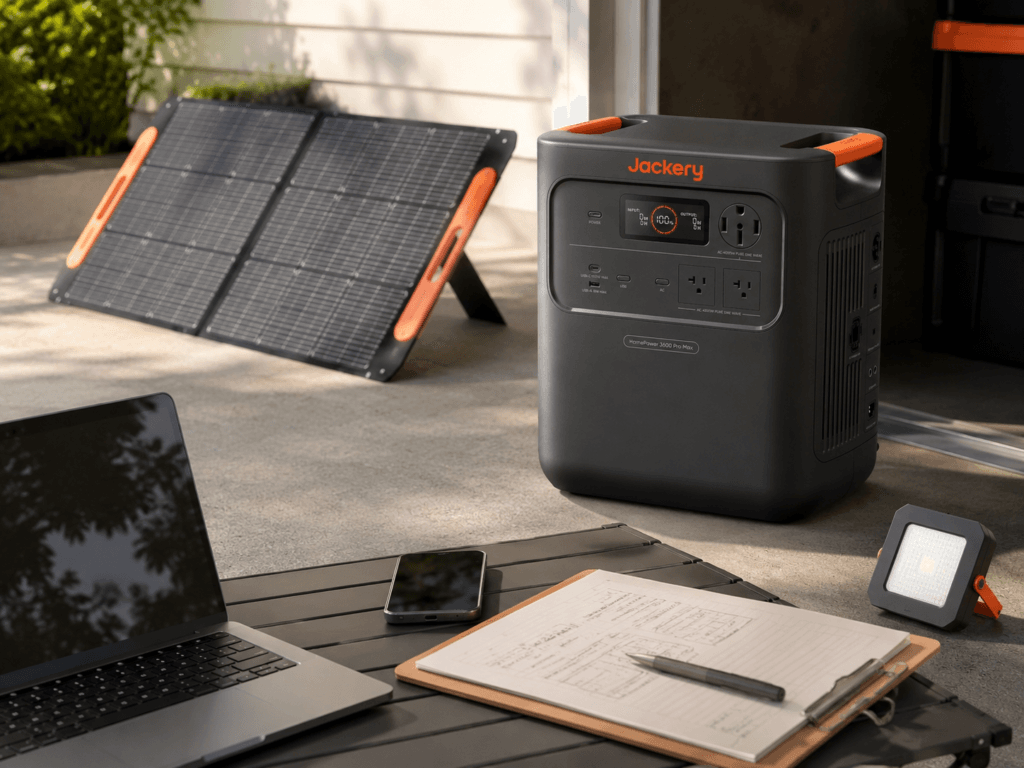
Expansion and Two-Unit Planning
Expansion is the strongest long-term reason to choose Jackery HomePower 3600 Pro Max. Jackery lists support for up to five Battery Pack 3600 units. A sensible buyer starts with the base system, runs a realistic essential-load test, and then decides whether the measured runtime shows a true need for added capacity.
More batteries mean more than more watt-hours. They add purchase cost, floor space, cables, storage decisions, and a larger system to inspect before an outage. This Jackery HomePower 3600 Pro Max review favors staged growth because it prevents a buyer from paying for an oversized stack before understanding the actual backup gap.
Jackery also documents a two-unit cascade-parallel configuration that can provide up to 8,000W total output with specified communication and 40A cables. Treat this as a defined Jackery system configuration. It is not a universal method for combining unrelated portable power stations.
Alternatives Chosen for Different Buyers
| Alternative product | Choose it when | Why the Pro Max may still be better |
|---|---|---|
| Jackery HomePower 3000 | You want simpler fixed-capacity 3kWh-class backup and do not need a larger expansion plan. | Jackery HomePower 3600 Pro Max adds 4,000W rated output, a 240V outlet, and a staged capacity route. |
| Jackery HomePower 3600 Plus | You are assessing another current 3.6kWh Jackery path and its model-specific feature set. | The Pro Max is more appropriate when its verified 4,000W 120/240V configuration and expansion support are needed. |
| Jackery Explorer 5000 Plus | Your measured plan needs a larger 5kWh-class base battery and you accept a heavier category. | The Pro Max can be more practical when 3,584Wh is enough but 240V and 4,000W still matter. |
These alternatives are selected as actual Product records in the Review field, not just generic names. This Jackery HomePower 3600 Pro Max review uses them because each serves a different buyer profile. The goal is not to call one system universally best. It is to match the product category to the actual outage plan.
Pros and Cons
| Pros | Cons |
|---|---|
| 4,000W rated 120V and 240V output | 73.85 lb base weight |
| 3,584Wh LiFePO4 starting capacity | Not a 0-ms UPS |
| Up to 1,200W solar input | No separately listed 12V vehicle output |
| Up to five compatible expansion batteries | Solar recovery varies by conditions |
| Wi-Fi and Bluetooth app support | Expansion adds cost, space, and cable management |
| Documented two-unit configuration | Selected-circuit use requires compatible equipment and planning |
FAQ
Is the Jackery HomePower 3600 Pro Max good for home backup?
This Jackery HomePower 3600 Pro Max review finds it a strong fit for a measured essential-load plan, compatible selected-circuit planning, and staged capacity growth. It is not a one-box guarantee for every home load or every outage duration.
Can the Jackery HomePower 3600 Pro Max run a refrigerator?
Jackery HomePower 3600 Pro Max can support many refrigerator plans within its rated output limits. Actual runtime changes with compressor cycling, ambient temperature, door openings, battery reserve, and the other connected loads.
Does the Jackery HomePower 3600 Pro Max have 240V output?
Yes. Jackery lists one NEMA 14-50R 240V outlet with 4,000W rated output and 8,000W peak surge. Buyers should confirm the intended appliance, connectors, cable, and connection method.
Can the Jackery HomePower 3600 Pro Max be expanded?
Yes. Jackery lists support for up to five Battery Pack 3600 units. Add capacity after a real load plan reveals a meaningful runtime gap.
Is this a hands-on Jackery HomePower 3600 Pro Max review?
No. This Jackery HomePower 3600 Pro Max review is research-led and uses official product documentation and product-identity verification. PowerLabPro does not claim hands-on or laboratory testing.
Final recommendation: Jackery HomePower 3600 Pro Max is worth shortlisting when your measured backup plan needs a 3,584Wh starting reserve, 4,000W rated 120/240V output, solar recovery potential, and room to add capacity later.
Skip it when: lighter weight, lower complexity, and basic communications backup are the real goal. The best system is the smallest verified product that can safely carry the priority loads for the needed duration.
Final Recommendation
The final Jackery HomePower 3600 Pro Max review conclusion is conditional but clear. It is a serious portable backup platform for buyers who understand why they need 4,000W rated output, a 240V outlet, 3,584Wh of base capacity, and a potential expansion path. Those capabilities are meaningful only when they fit a real priority list.
Choose Jackery HomePower 3600 Pro Max when the backup plan has moved beyond light communications coverage and the buyer has a safe path to use the product’s output and voltage options. Choose a smaller station when the priority loads are modest. Choose a larger base-capacity platform only when measured runtime and power needs prove that the smaller category is insufficient.
For structured product facts, see the connected Jackery HomePower 3600 Pro Max product page. For current official materials, consult the Jackery HomePower 3600 Pro Max product page and the applicable manual before making a purchase or accessory decision.
Testing Notes
- Research source: Official Jackery HomePower 3600 Pro Max product page.
- Technical source: Official Jackery JHP-3600C user manual.
- Product identity: Amazon ASIN B0H33PBCHP verified against the supplied current listing.
- Testing scope: Research-led buyer assessment only. PowerLabPro did not conduct hands-on or laboratory testing.