
Review
EcoFlow DELTA 3 Classic Review: Fast 1kWh Backup With Fixed Capacity
A strong fast-charging 1kWh choice for short home outages, refrigerator planning, home-office continuity, camping, and mobile work. Skip it for 240V loads, whole-home wiring, multi-day heavy use, or buyers who need battery expansion.
Linked Product Snapshot
Core specs
Buyer Fit
Pros and tradeoffs
Strengths
Pros
- 1,024Wh LiFePO4 capacity with 1,800W continuous output
- 0–80% AC recharge in 45 minutes under stated conditions
- 500W solar input with AC, solar, vehicle, and generator recovery paths
- 10ms UPS claim with Wi-Fi, Bluetooth, and OASIS 3.0 app control
- About 26.7 lb with direct 100W USB-C charging
Tradeoffs
Cons
- Fixed 1,024Wh capacity with no current published extra-battery path
- Three AC outlets provide less connection flexibility than some competitors
- 500W solar ceiling is lower than the DELTA 3 Plus
- X-Boost up to 2,600W is not the 1,800W continuous rating
- Not a 240V, whole-home, or long-duration heavy-load backup system
This article may contain affiliate links. If you buy through these links, PowerLabPro may earn a commission at no extra cost to you. As an Amazon Associate I earn from qualifying purchases.
This EcoFlow DELTA 3 Classic review is for buyers who want a modern 1kWh portable power station with fast AC charging and useful 1,800W output, but who do not need an expandable battery platform. The current US model combines a 1,024Wh LiFePO4 battery, 1,800W continuous AC output, 3,600W surge capability, 500W maximum solar input, a manufacturer-listed 10ms UPS transition, Wi-Fi and Bluetooth app control, and a body weighing about 26.7 lb.
The central decision in this EcoFlow DELTA 3 Classic review is whether simple fixed capacity is an advantage or a limitation for your plan. The station is a strong conceptual fit for short home outages, refrigerator-first planning, home-office continuity, camping, and mobile work. It is a weaker fit for buyers who expect multi-day heavy use, 240V output, central air conditioning, or a future extra-battery upgrade.
This is research-led editorial analysis based on EcoFlow’s current US product page, the verified PowerLabPro Product record, and the matching Amazon identity saved for ASIN B0FQVC4RF5. PowerLabPro has not performed hands-on or laboratory testing of the unit. Confirm the current listing, exact variant, included accessories, current manual, warranty registration requirements, and device compatibility before purchase.
EcoFlow DELTA 3 Classic review: quick verdict
The conclusion of this EcoFlow DELTA 3 Classic review is positive for a buyer who needs a defined group of 120V essentials and values quick recovery more than expansion. The 1,800W inverter can support many refrigerators, networking devices, computers, lights, televisions, fans, and short-use kitchen appliances when their combined running draw and startup behavior fit. The 1,024Wh battery is large enough to matter during a short interruption, but small enough that high-draw heating, cooking, and cooling loads require strict sequencing.
The strongest reasons to choose the DELTA 3 Classic are its 45-minute 0–80% AC charging claim, 500W solar ceiling, direct 100W USB-C output, compact footprint, and app-based preparation tools. The strongest reason to skip it is fixed capacity. If your written load plan already shows that one kilowatt-hour will be consumed too quickly, another platform is a better starting point.
This EcoFlow DELTA 3 Classic review does not treat X-Boost or surge output as extra continuous power. Plan around the standard 1,800W continuous rating, use the 3,600W figure only as temporary startup headroom, and treat X-Boost support up to 2,600W as device-specific behavior that may not suit motors, compressors, sensitive electronics, or precision equipment.
Best for, not ideal for, and the buyer decision
Best for: short home outages, refrigerator-first planning, home-office continuity, camping, and mobile work with controlled loads.
Not ideal for: 240V equipment, whole-home wiring, central HVAC, multi-day heavy use, or buyers who need expansion.
Main advantage: fast AC charging and 1,800W output in a manageable fixed-capacity package.
Main drawback: one fixed 1,024Wh battery can become the limiting factor during long outages.
Better alternative if: you need more ports and expansion, easier carrying, or a larger energy reserve.
The best buyer for the DELTA 3 Classic has already separated essential loads from convenience loads. In that situation, this EcoFlow DELTA 3 Classic review finds a clear role for refrigeration, communications, laptop work, LED lighting, fans, phone charging, and brief use of selected appliances. It also fits vehicle-based camping and mobile work when the owner can keep the station dry, ventilated, and securely transported.
It is not ideal for whole-home expectations, hardwired circuits without approved transfer equipment, 240V appliances, large well pumps, electric water heating, ranges, dryers, central air conditioning, or several days of heavy use without dependable recharging. Buyers who need expansion should not assume an extra battery will appear later because EcoFlow does not currently list an expansion-battery path for this model.
Read the connected EcoFlow DELTA 3 Classic Product reference for the exact product identity, saved ASIN, core specifications, and purchase checks. This EcoFlow DELTA 3 Classic review owns the deeper buyer decision, practical scenarios, alternatives, trade-offs, and final recommendation.

- Power for Every Scenario: EcoFlow DELTA 3 Classic delivers 1800W output (3600W surge) with X-Boost technology—enough for…
- Ultra-Fast Charging: Go from 0–80% in just 45 minutes with X-Stream AC charging. Keep your devices and appliances powere…
- <10ms UPS: Protect sensitive electronics like PCs, servers, and medical devices. DELTA 3 Classic automatically switches ...
Table of Contents
EcoFlow DELTA 3 Classic review: verified specifications
The specification table below uses the current US Product record and EcoFlow’s official page. In this EcoFlow DELTA 3 Classic review, every figure is treated as a boundary for planning rather than a guaranteed runtime or universal compatibility promise.
| Specification | Verified current detail | Buyer meaning |
|---|---|---|
| Battery | 1,024Wh LiFePO4 | Useful for a defined essentials plan, not a fixed runtime promise. |
| Continuous AC output | 1,800W total | The normal sustained inverter ceiling across connected AC loads. |
| Surge output | 3,600W listed | Temporary startup headroom, not continuous output. |
| X-Boost | Selected devices up to 2,600W | Compatibility feature; verify device behavior and voltage tolerance. |
| AC outlets | Three US AC outlets | Enough for a focused setup, with less flexibility than six-outlet rivals. |
| USB output | 100W USB-C, 30W USB-C, 18W USB-A | Direct charging for compatible laptops, phones, and electronics. |
| AC charging | Up to 1,400W | EcoFlow lists 0–80% in 45 minutes and full in 60 minutes. |
| Solar input | 500W maximum | Useful recovery ceiling under compatible electrical and weather conditions. |
| UPS | 10ms listed transfer | Potential fit for compatible electronics; test the exact device chain. |
| Weight | About 26.7 lb | Portable for many adults, but still a deliberate two-hand lift. |
| Dimensions | About 15.7 × 7.9 × 11.1 in | Compact for protected shelf, floor, vehicle, or under-desk placement. |
| Warranty | Up to 5 years | Three-year standard coverage plus a two-year app-registration extension. |
| Expansion | No current extra-battery path listed | Treat the model as a fixed 1,024Wh platform. |
The controlling manufacturer source for this EcoFlow DELTA 3 Classic review is the official EcoFlow US DELTA 3 Classic page. It lists the current capacity, output, charging, solar, UPS, noise, communication, dimensions, weight, and warranty information. Manufacturer examples remain conditional, and current support documents should be checked before use.
EcoFlow DELTA 3 Classic review: 1,024Wh capacity and realistic runtime
A 1,024Wh battery is an energy budget, not a runtime promise. This EcoFlow DELTA 3 Classic review recommends starting with measured watt-hours rather than dividing capacity by an appliance label and assuming the result is exact. Inverter losses, standby consumption, temperature, battery condition, device cycling, and reserve reduce the energy available to connected AC loads.
A 100W average load uses roughly 600Wh over six hours before losses and reserve. A 500W continuous load consumes the same energy in little more than an hour. A refrigerator may draw several hundred watts while its compressor runs, then use much less while cycling off. That is why a plug-in energy meter and a conservative reserve are more useful than one headline refrigerator runtime.
The practical value described in this EcoFlow DELTA 3 Classic review comes from prioritization. Keep food cold, maintain communications, charge phones, and preserve work capability before spending energy on entertainment or heat-producing appliances. A microwave, kettle, coffee maker, toaster, or induction device may fit the inverter, but short scheduled use is very different from continuous operation.
Use the PowerLabPro sizing guide to total running watts, startup demand, desired hours, conversion losses, and reserve. If the calculation shows that your essentials consume most of 1,024Wh quickly, this EcoFlow DELTA 3 Classic review points toward a larger-capacity platform rather than optimistic load management.
EcoFlow DELTA 3 Classic review: 1,800W output, surge, and X-Boost
The 1,800W continuous AC rating is the main compatibility number. In this EcoFlow DELTA 3 Classic review, the combined running demand of all connected AC devices must remain within that ceiling. Three AC outlets provide enough connections for a focused setup, but fewer than some competitors, and outlet count never increases total inverter capacity.
EcoFlow lists 3,600W surge output. Surge is temporary startup headroom, not a second sustained rating. Refrigerators, freezers, pumps, air conditioners, and tools can demand substantially more power during startup than during normal operation. Surge capability may help, but it does not guarantee that every motor or compressor will start successfully.
EcoFlow also lists X-Boost support for selected devices up to 2,600W. This EcoFlow DELTA 3 Classic review treats that as a compatibility feature, not a 2,600W continuous-output upgrade. X-Boost can alter voltage behavior, which may be unsuitable for electronic controls, motors, compressors, medical devices, or precision equipment. The safer decision is to choose a station whose standard output covers the planned load with margin.
Load sequencing improves both reliability and runtime. Let the refrigerator cycle normally, then use one short high-draw appliance instead of stacking several heavy loads. Test the complete setup before an outage, and keep a non-battery alternative for any load whose failure could create food loss, water damage, safety risk, or business interruption.
Home-outage and refrigerator fit
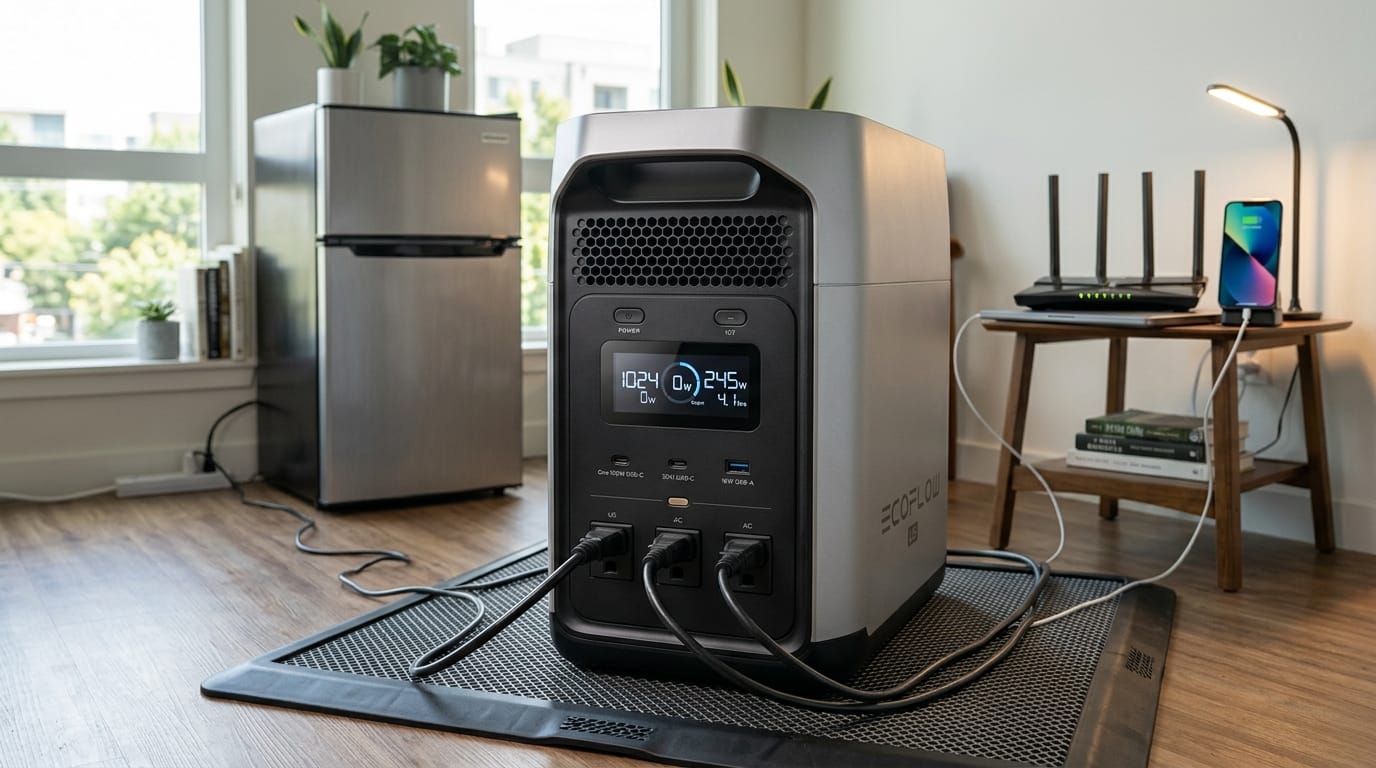
For a short residential outage, this EcoFlow DELTA 3 Classic review finds the strongest role in a refrigerator-plus-essentials plan. A realistic setup may reserve the AC outlets for one refrigerator and another priority load while phones, a compatible laptop, and smaller electronics use USB connections. The actual combination must remain within the 1,800W continuous limit and the available energy reserve.
Refrigerator runtime varies with compressor cycling, room temperature, door openings, food temperature, defrost behavior, age, and other connected devices. The appliance nameplate usually describes electrical limits rather than a full-day energy profile. Read how long a portable power station can run a refrigerator and measure the specific appliance where practical.
The DELTA 3 Classic is more useful when the household protects the battery. Cool food before severe weather, minimize door openings, disconnect optional loads, and choose a shutdown reserve. This EcoFlow DELTA 3 Classic review does not recommend draining the station for entertainment while refrigeration, communications, lighting, or evacuation information may still be needed.
Never backfeed a household receptacle. Plug compatible appliances directly into the station or use only code-compliant transfer equipment designed and installed for the purpose. The DELTA 3 Classic is a portable 120V station, not a whole-home battery, standby generator, or source for split-phase 240V equipment.
EcoFlow DELTA 3 Classic review: home-office backup and UPS limits
A home office is one of the clearest use cases because routers, modems, laptops, monitors, network switches, and phones usually draw far less than 1,800W. This EcoFlow DELTA 3 Classic review views the 100W USB-C port as especially useful because many compatible laptops can charge directly without occupying an AC outlet or adding another conversion step.
EcoFlow lists a 10ms UPS transfer time. That may be acceptable for many consumer electronics, but a transfer specification is not a universal certificate. Test the exact computer, monitor, router, network storage device, and power adapters by safely interrupting utility power after the complete setup is configured.
Sensitive servers, medical equipment, laboratory devices, or systems with strict power-quality requirements may need a dedicated certified UPS. This EcoFlow DELTA 3 Classic review does not present the DELTA 3 Classic as medical or life-safety backup. Follow the connected equipment manufacturer’s requirements and maintain another continuity plan for critical systems.
For a measured office setup, disable unnecessary monitors, use efficient power modes, keep networking equipment on the lowest stable load, and separate essential devices from optional peripherals. The home-office backup guide explains how to size a system around actual work needs.
AC charging, solar recovery, and vehicle options
Fast AC charging is one of the strongest advantages in this EcoFlow DELTA 3 Classic review. EcoFlow states that the unit can reach 80% in 45 minutes and full charge in about 60 minutes with up to 1,400W AC input under stated conditions. That can restore a large share of the battery during a short grid window, but the wall circuit, receptacle, and supplied cable must be suitable.
A high charging rate can share a household circuit poorly with another major appliance. Avoid damaged receptacles, undersized extension cords, and circuits already carrying substantial loads. A slower charging mode may be more appropriate when circuit headroom, noise, battery temperature, or battery-care preferences matter more than maximum speed.
The 500W solar ceiling can make daytime recovery meaningful, but this EcoFlow DELTA 3 Classic review treats 500W as an electrical maximum rather than guaranteed harvest. Panel angle, sun hours, cloud cover, shade, temperature, wiring, connector losses, dirt, and the station’s input range determine actual production. EcoFlow’s approximate 2.5-hour solar claim assumes favorable conditions.
Solar planning should compare daily consumption with realistic daily harvest. If priority loads consume 800Wh and the panels replace only 350Wh, the battery still loses energy each cycle. Preserve reserve for overnight loads and maintain another charging route for poor weather.
EcoFlow also markets car, generator, and compatible alternator-charging paths. Accessories, vehicle wiring, installation, current limits, and operating conditions must be verified. This EcoFlow DELTA 3 Classic review does not assume an alternator charger is included with the base ASIN or that a standard vehicle socket can match a dedicated charger.
EcoFlow DELTA 3 Classic review: the fixed-capacity trade-off
EcoFlow does not currently list expansion-battery compatibility for the US DELTA 3 Classic. This EcoFlow DELTA 3 Classic review treats the station as a fixed 1,024Wh platform. That simplifies ownership and avoids a complicated battery ecosystem, but it also means a buyer cannot solve a later runtime shortage by adding a supported extra battery.
Fast charging does not remove the capacity limit. During normal conditions, a one-hour recharge is convenient. During a long outage, utility power may not return, solar may underperform, and vehicle charging may be unavailable. Stored energy determines how long the station can bridge those gaps.
Fixed capacity is reasonable for renters, apartment users, campers, remote workers, and homeowners with a narrow essentials list. It is a weaker fit for multi-day refrigeration, electric heating, sustained cooking, or several large appliances. This EcoFlow DELTA 3 Classic review recommends estimating the longest realistic period between dependable recharge opportunities before buying.
If the buyer already expects growth, the EcoFlow DELTA 3 Plus review provides a useful internal comparison, while larger 2kWh platforms may reduce load management. The correct choice depends on energy needs, carrying limits, charging conditions, ports, expansion expectations, and budget.
EcoFlow DELTA 3 Classic review: ports, portability, app control, and noise
The DELTA 3 Classic has three US AC outlets, one 100W USB-C port, one 30W USB-C port, and one 18W USB-A port. This EcoFlow DELTA 3 Classic review considers the port selection adequate for a focused backup kit but less flexible than competitors with six AC outlets or more DC connections. Direct USB charging can reduce clutter and preserve AC outlets for devices that require them.
Do not solve an outlet shortage with overloaded splitters, questionable adapters, or tangled extension cords. Use properly rated accessories, keep the total load within 1,800W, and route cables where they cannot be pinched, damaged, tripped over, or exposed to water. The cleanest setup is often one refrigerator cord, one priority AC device, and direct USB charging.
EcoFlow lists Wi-Fi and Bluetooth communications plus OASIS 3.0 app functions for monitoring, scheduled tasks, energy tracking, and Storm Guard. These features can improve preparation, but they do not increase capacity or guarantee connectivity during an outage. This EcoFlow DELTA 3 Classic review recommends keeping a written offline load and shutdown plan.
At about 26.7 lb, the station is manageable for many adults but still requires a stable two-hand lift. EcoFlow lists noise of no more than 30dB at a 600W load under stated conditions. Fan behavior can change with charging rate, load, battery temperature, and room temperature, so the unit should not be described as silent in every situation.
EcoFlow DELTA 3 Classic review: alternatives to consider
The best alternative depends on the problem the DELTA 3 Classic does not solve. This EcoFlow DELTA 3 Classic review compares alternatives by portability, stored energy, charging, expansion, ports, and ecosystem rather than declaring one universal winner.
EcoFlow DELTA 3 Plus for more ports, solar, and expansion flexibility
The EcoFlow DELTA 3 Plus is the closest ecosystem alternative. It keeps the 1,024Wh and 1,800W class but adds more AC outlets, stronger solar input, higher-power USB-C options, and a more flexible expansion path. This EcoFlow DELTA 3 Classic review favors the Classic when simplicity and fixed capacity are acceptable; it favors the Plus when connectivity and future flexibility matter more.
Anker SOLIX C1000 Gen 2 for a competing fast-charge 1kWh platform
The Anker SOLIX C1000 Gen 2 is a strong comparison for buyers who want another compact LiFePO4 1kWh station with fast charging. Compare normal output, charging behavior, app controls, outlets, warranty process, and ecosystem preferences. This EcoFlow DELTA 3 Classic review does not declare a winner without considering the exact current bundle and buyer priorities.
Jackery Explorer 1000 v2 for a lighter and simpler ownership path
The Jackery Explorer 1000 v2 is relevant when carrying ease, familiar controls, and a simple fixed-capacity product matter. Its feature mix differs, so the choice should be based on output, recharge options, solar compatibility, ports, app expectations, and warranty. This EcoFlow DELTA 3 Classic review favors the EcoFlow when its faster recovery and app tools solve the real problem.
BLUETTI Elite 100 V2 for another 1,800W 1kWh-class option
The BLUETTI Elite 100 V2 is another direct 1kWh-class alternative with 1,800W output. Compare its port layout, charging, solar ceiling, app behavior, carrying design, warranty, and current listing. The conclusion of this EcoFlow DELTA 3 Classic review remains buyer-specific: choose the model whose verified limits match the load plan, not the one with the longest feature list.
EcoFlow DELTA 3 Classic review: pros and cons
| Pros | Cons |
|---|---|
| 1,024Wh LiFePO4 capacity with useful 1,800W continuous output. | Fixed 1,024Wh capacity with no current published extra-battery path. |
| 0–80% AC recharge in 45 minutes under stated conditions. | Three AC outlets provide less connection flexibility than some competitors. |
| 500W solar input and several compatible recovery methods. | 500W solar ceiling is lower than the DELTA 3 Plus. |
| 10ms UPS claim with Wi-Fi, Bluetooth, and OASIS 3.0 app control. | X-Boost up to 2,600W is not the 1,800W continuous rating. |
| About 26.7 lb with direct 100W USB-C charging. | Not a 240V, whole-home, or long-duration heavy-load system. |
The advantages in this EcoFlow DELTA 3 Classic review address real buyer problems: fast recovery, useful inverter output, manageable weight, direct laptop charging, and a straightforward fixed-capacity system. The disadvantages are equally important because they prevent the unit from becoming an assumed multi-day, whole-home, or modular backup solution.
EcoFlow DELTA 3 Classic review FAQ
Can the EcoFlow DELTA 3 Classic run a refrigerator?
It can run many household refrigerators when running watts and compressor startup fit the inverter. Runtime varies with cycling, room temperature, door openings, defrost behavior, food load, conversion losses, and other connected devices. This EcoFlow DELTA 3 Classic review recommends measuring actual energy use and preserving reserve rather than relying on one guaranteed-hour claim.
How fast does the EcoFlow DELTA 3 Classic recharge?
EcoFlow lists 0–80% in 45 minutes and full charge in about 60 minutes with up to 1,400W AC input under stated conditions. Real charging time changes with battery temperature, starting state, charging settings, circuit voltage, and simultaneous loads. This EcoFlow DELTA 3 Classic review recommends using a suitable wall circuit and the current manufacturer instructions.
Is the EcoFlow DELTA 3 Classic expandable?
EcoFlow does not currently list an expansion-battery path for the US model. Treat it as a fixed 1,024Wh platform unless current official documentation says otherwise. Buyers who expect substantially larger future storage should compare an expandable system before purchase. That fixed-capacity limit is one of the most important findings in this EcoFlow DELTA 3 Classic review.
Is the 10ms UPS claim enough for sensitive equipment?
It may be acceptable for compatible electronics, but it is not a universal guarantee. Test the exact router, computer, monitor, network storage, or other load. Use a dedicated certified UPS when the equipment manufacturer or operating requirement demands one. This EcoFlow DELTA 3 Classic review does not recommend assumption-based medical, server, or life-safety use.
Is the EcoFlow DELTA 3 Classic good for camping?
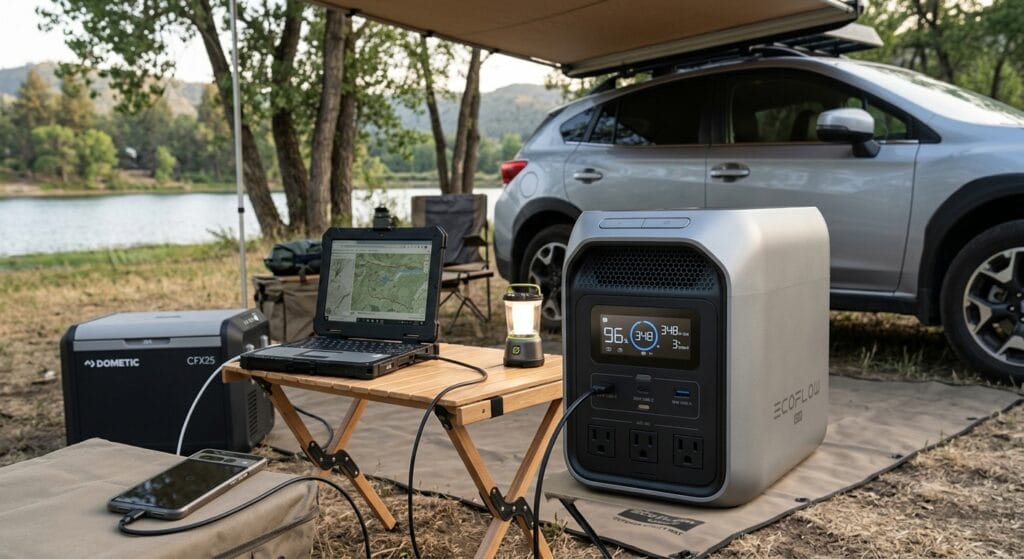
It can suit vehicle camping, electronics, lighting, a compatible cooler, laptop work, and moderate appliance use. Its 26.7 lb weight is manageable for many vehicle-based trips, and 500W solar can support recovery in favorable conditions. This EcoFlow DELTA 3 Classic review recommends dry covered placement, secure transport, and a daily energy plan.
Safety and purchase checks
Before ordering, confirm the exact DELTA 3 Classic selection, ASIN B0FQVC4RF5, seller, bundle contents, included cable, outlet layout, current warranty terms, and return policy. Amazon and manufacturer selectors can move between a base station, solar bundles, bags, chargers, multi-unit packages, and nearby models. This EcoFlow DELTA 3 Classic review does not rely on a saved price, stock message, discount, or star rating.
Keep the station dry, stable, and ventilated. Inspect cables, avoid trip hazards, and do not cover the unit while charging or supplying a load. Stop using damaged, swollen, leaking, unusually hot, or abnormal equipment. Never backfeed household wiring or improvise a connection to a breaker panel.
Test important setups before storm season, travel, or a critical workday. Label cables, store the current manual with the station, document the load sequence, and choose a reserve threshold. For general preparedness, combine this EcoFlow DELTA 3 Classic review with Ready.gov power-outage guidance.
EcoFlow DELTA 3 Classic review: final recommendation
The final recommendation in this EcoFlow DELTA 3 Classic review is positive for buyers who want a fast-charging, fixed 1kWh station for short outages, home-office continuity, refrigerator planning, camping, and mobile work. Its 1,800W inverter, 500W solar input, direct USB-C charging, app control, and manageable body create a useful balance without the weight and complexity of a large rolling platform.
Skip it when the real requirement is 240V output, whole-home wiring, central air conditioning, electric resistance heating, several days of heavy loads, or a future extra-battery upgrade. One fixed 1,024Wh battery can be depleted quickly when high-draw appliances are used without sequencing, and fast charging cannot help when no charging source is available.
Choose the DELTA 3 Classic for a measured essentials plan and a credible recovery route. Choose the DELTA 3 Plus when more ports, stronger solar, or expansion flexibility matter. Choose another 1kWh competitor when its carrying design, ecosystem, or current bundle better fits. The strongest reason to follow this EcoFlow DELTA 3 Classic review is not one headline specification; it is the clear match between capacity, output, charging, portability, and the buyer’s actual backup problem.
Testing Notes
- Manufacturer documentation reviewed: EcoFlow DELTA 3 Classic current US product page and published specifications.
- Retail identity verified: Amazon US ASIN B0FQVC4RF5 from the connected verified Product record.
- PowerLabPro has not performed hands-on or laboratory testing.